Guanyin fortune stick

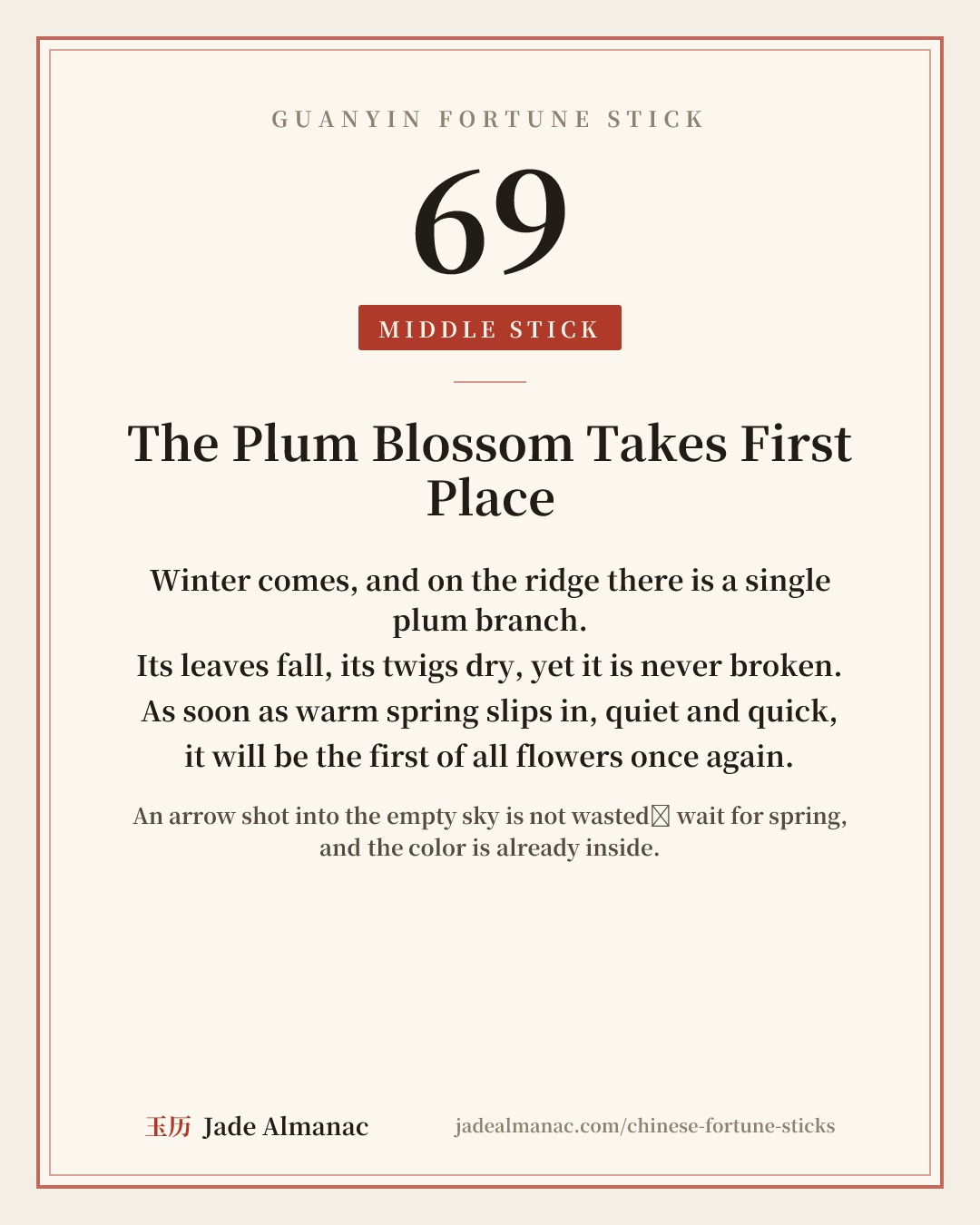
69

Middle stick

Guanyin fortune stick 69: The Plum Blossom Takes First Place

Winter comes, and on the ridge there is a single plum branch.
Its leaves fall, its twigs dry, yet it is never broken.
As soon as warm spring slips in, quiet and quick,
it will be the first of all flowers once again.

jadealmanac.com

Save image

The verdict
An arrow shot into the empty sky is not wasted; wait for spring, and the color is already inside.
What it says to you
A plum branch on a winter ridge looks dead: bare twigs, no leaves, nothing to show. The poem insists it isn't. Plum blossom opens before every other flower, and the stick reads your situation the same way. What looks like a shot into empty air is aimed after all. The advice is about timing: things go well if they go later. So don't judge your effort by how it looks in the cold months. Keep the roots alive, do the dull maintenance, and let the season turn. If you are tempted to quit or to force a result this week, give it until spring.

Matter by matter

Love
Success, but later.
Money
Be cautious; wait for the right time to trade.
Work and study
Steady, careful steps; make good use of study time.
Health
A scare, but no real harm.
Home
Not entirely smooth.
Travel
You'll arrive later than planned.
Lost things
Look to the east.

The story behind the stick

Plum blossom taking first place among flowers is the image line, and most editions attach the story of the plum blooming twice, from the Qing novel of that name; one edition adds the orphan of Zhao, hidden and raised by the doctor Cheng Ying. In the novel, the official Mei Kui is killed by a treacherous minister. His son Mei Liangyu escapes and lives under a false name in the house of his father's friend Chen Risheng. One day the household's plum tree blooms and Chen honors his dead friend before it, but that night a storm strips every flower. Chen, his daughter Xingyuan and the young man pray, and the tree blooms a second time. Mei Liangyu later tops the imperial exams, clears his father's name and marries Xingyuan. Blossom after a ruined first flowering is the promise of a middle lot that says later is better.
Line by line

  1. Winter comes, and a single plum branch stands on the ridge. The plum is one of the friends of winter in Chinese art, the flower that blooms in the cold.

  2. Its leaves fall and its twigs dry, yet it is never broken. Readers take this as a lean season that looks like failure from outside while the life inside holds.

  3. Warm spring arrives suddenly and quietly. Traditionally the line says the change will come without warning, so the waiting is not endless even when it feels so.

  4. Then I am first among flowers again. Temple readers apply this to exams, rankings and comebacks, and the word again marks it as a return to a place once held.

The original verse

冬来岭上一枝梅
叶落枝枯终不摧
但得阳春悄急至
依然还我作花魁

Seven characters a line, as printed in the BW Monastery edition.

Sources for the story: https://www.51chouqian.com/guanyinlingqian/69.html (The Plum Blooms Twice); masterseanchan.com/guanyin-oracle/lot-69 (edition A: also Cheng Ying Hides the Orphan).

Optional: the temple way

At a temple the stick is not yours until two moon blocks agree: one flat side up and one round side up, a holy cup.

About stick 69

Is Guanyin stick 69 good or bad?

Stick 69, "The Plum Blossom Takes First Place", is a middle stick, a mixed stick, good with conditions. An arrow shot into the empty sky is not wasted; wait for spring, and the color is already inside.

What does Guanyin stick 69 say about love?

Success, but later.

What does Guanyin stick 69 say about money?

Be cautious; wait for the right time to trade.

What does Guanyin stick 69 say about work?

Steady, careful steps; make good use of study time.

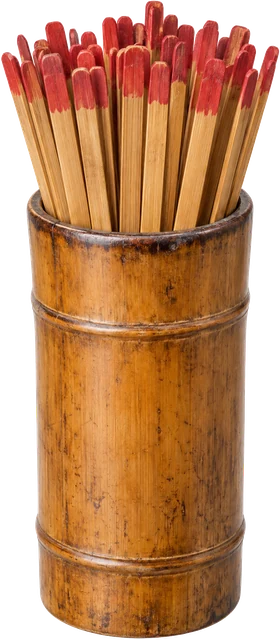
A bamboo fortune-stick cup

Draw another stick , or for a straight yes or no, throw the moon blocks

The verse follows the BW Monastery edition of the Guanyin set; the English rendering and reading are Jade Almanac's own. A drawn stick is a tradition and a prompt for reflection, not advice about health, money or the law.

Stay in the loop.

Chinese mythology, the zodiac, and the meaning behind names and symbols, rooted in the classics and read back to you. No spam. Unsubscribe anytime.