Guanyin fortune stick

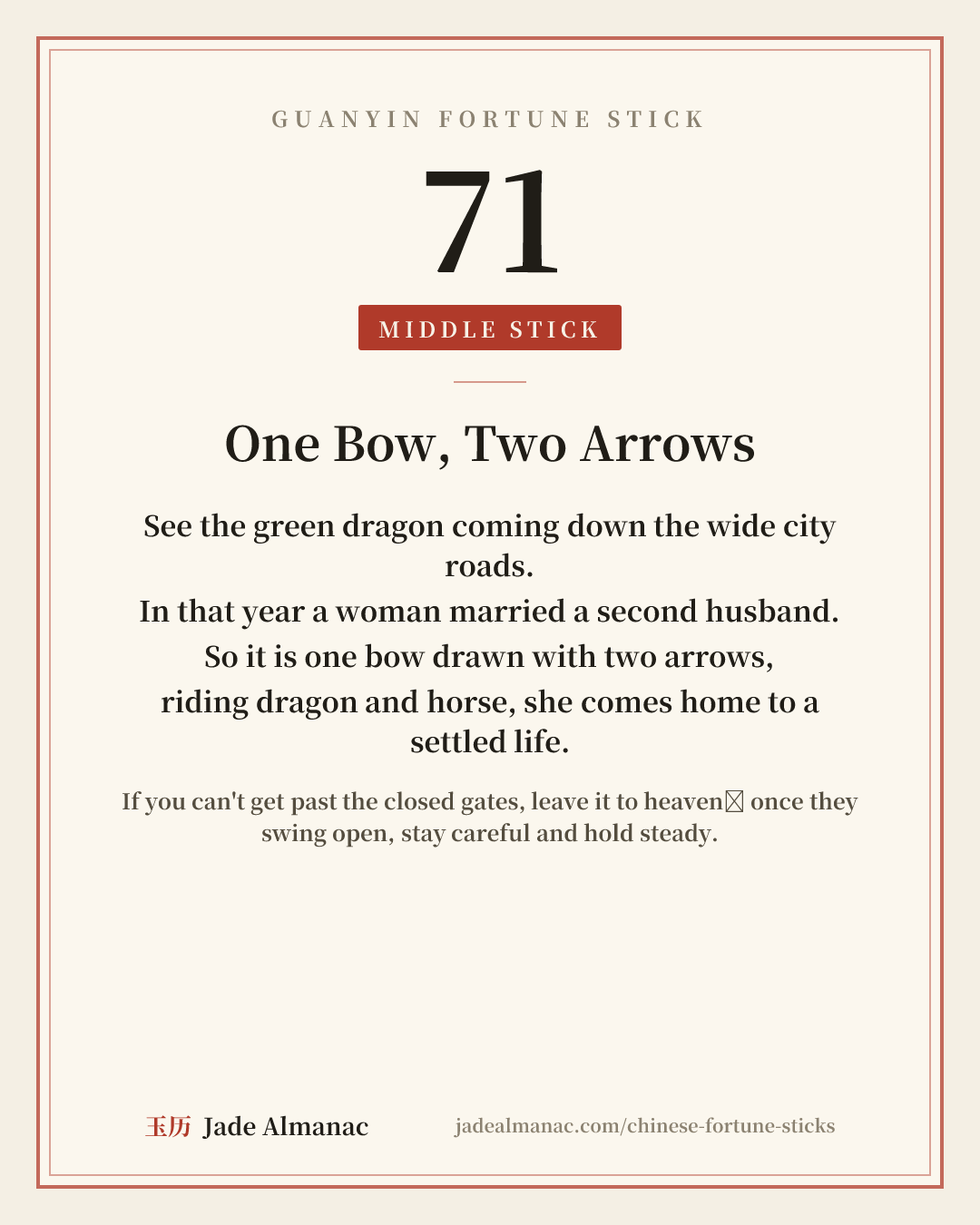
71

Middle stick

Guanyin fortune stick 71: One Bow, Two Arrows

See the green dragon coming down the wide city roads.
In that year a woman married a second husband.
So it is one bow drawn with two arrows,
riding dragon and horse, she comes home to a settled life.

jadealmanac.com

Save image

The verdict
If you can't get past the closed gates, leave it to heaven; once they swing open, stay careful and hold steady.
What it says to you
Two arrows on one bow is an awkward way to shoot, and the poem pairs it with a woman who married twice and still came home to a settled life. The image says your matter takes a second attempt. The first round may come apart, and the rejoining is where the good lies. Love, in the stick's own words, parts first and then comes together. If something has failed once, don't read that as the final answer. Until the gates open, leave the outcome to heaven and keep working; effort is not wasted here. When they do open, move carefully. Write down what went wrong the first time before you try again.

Matter by matter

Love
Parted first, together later.
Money
Hard work; be careful in trade.
Work and study
Effort pays off; diligence makes up for weakness.
Health
The stick calls for prayers and merit; keep up your care.
Home
Some losses at home.
Travel
Obstacles on the road.
Lost things
Likely to turn up.

The story behind the stick

Zhuo Wenjun and Sima Xiangru are the couple most editions name, while one adds Diaochan and the minister Wang Yun as an alternate. In the Western Han, Zhuo Wenjun was the young widowed daughter of Zhuo Wangsun, an iron magnate of Linqiong. At a banquet she heard the poet Sima Xiangru play the zither, fell for him, and slipped out at night to run away with him to Chengdu. He was poor, so they came back and opened a wine shop, Wenjun serving at the counter, until her embarrassed father gave them a share of his fortune. Sima Xiangru later won the favor of Emperor Wu. A woman who married a second time and found a settled life is the poem's second line, and a match that comes right on the second try is the image of one bow with two arrows. That suits a middle lot.
Line by line

  1. A green dragon comes down the broad city avenues. The green dragon is the guardian of the east, and readers take its arrival in the streets as a powerful turn reaching ordinary life.

  2. In that year a woman married a second husband. Temple readers stress that this is not a judgment on her; it marks a second union as the setting of the lot's good outcome.

  3. One bow drawn with two arrows is an awkward double aim. Traditionally it means a second attempt or a joined effort, and the image line ties success to things coming together again.

  4. Riding dragon and horse, she reaches a settled home. Readers take the dragon and horse as rank and good fortune, and the settled home as the stability that follows.

The original verse

认知苍龙下九衢
女子当年嫁二夫
自是一弓施两箭
骑龙跨马上安居

Seven characters a line, as printed in the BW Monastery edition.

Sources for the story: https://www.51chouqian.com/guanyinlingqian/71.html (Wenjun Seeks Out Xiangru); masterseanchan.com/guanyin-oracle/lot-71 (edition A: also Diaochan and Wang Yun).

Optional: the temple way

At a temple the stick is not yours until two moon blocks agree: one flat side up and one round side up, a holy cup.

About stick 71

Is Guanyin stick 71 good or bad?

Stick 71, "One Bow, Two Arrows", is a middle stick, a mixed stick, good with conditions. If you can't get past the closed gates, leave it to heaven; once they swing open, stay careful and hold steady.

What does Guanyin stick 71 say about love?

Parted first, together later.

What does Guanyin stick 71 say about money?

Hard work; be careful in trade.

What does Guanyin stick 71 say about work?

Effort pays off; diligence makes up for weakness.

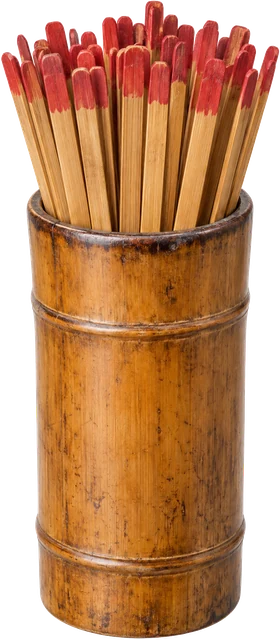
A bamboo fortune-stick cup

Draw another stick , or for a straight yes or no, throw the moon blocks

The verse follows the BW Monastery edition of the Guanyin set; the English rendering and reading are Jade Almanac's own. A drawn stick is a tradition and a prompt for reflection, not advice about health, money or the law.

Stay in the loop.

Chinese mythology, the zodiac, and the meaning behind names and symbols, rooted in the classics and read back to you. No spam. Unsubscribe anytime.