Guanyin fortune stick

3

Lower stick

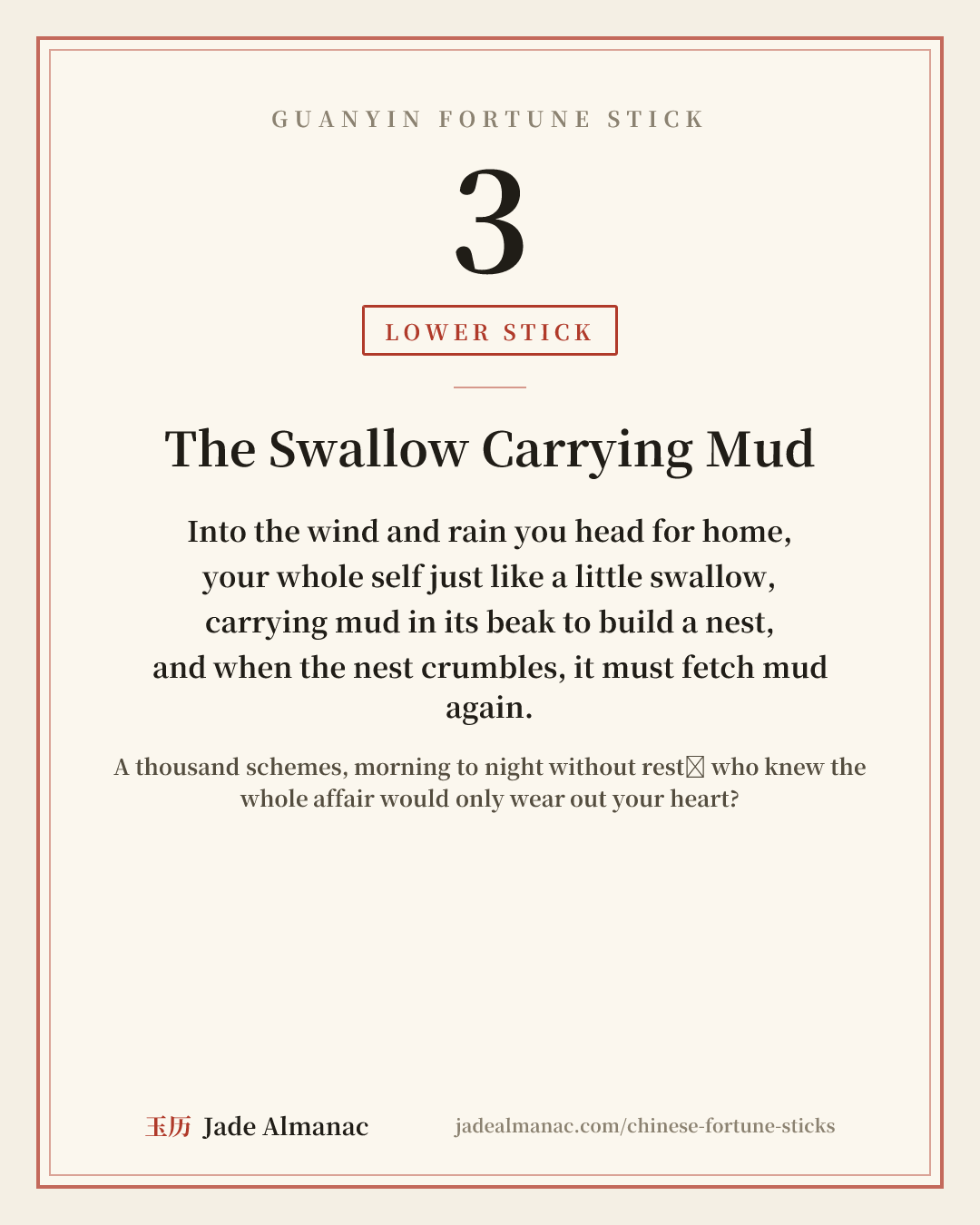
Guanyin fortune stick 3: The Swallow Carrying Mud

Into the wind and rain you head for home,
your whole self just like a little swallow,
carrying mud in its beak to build a nest,
and when the nest crumbles, it must fetch mud again.

jadealmanac.com

Save image

The verdict
A thousand schemes, morning to night without rest; who knew the whole affair would only wear out your heart?
What it says to you
You may recognize yourself in that swallow, flying out in the wind and rain, beak full of mud, building something that keeps falling down. The poem is frank: a great deal of effort here goes into repairs, and plotting harder from dawn to dusk will not change that. Yet swallows do finish nests, and the matters under this stick are kinder than the poem, with business and investments coming through. So stop adding new schemes. Look at where the nest keeps breaking, fix that one weak spot properly, and rest your wings before the next trip.

Matter by matter

Love
The two of you don't fit well.
Money
Gains come; business can succeed.
Work and study
Busy, tiring running around; study twice as hard.
Health
Traditionally, give thanks for answered vows; keep up your care.
Home
Trouble first, good later.
Travel
Auspicious.
Lost things
It will be found.

The story behind the stick

A swallow carrying mud is the image, and most mainland and Hong Kong temple books pair it with Dong Yong, the Han-dynasty model of filial devotion. Too poor to bury his father, he sold himself as a bonded laborer to raise the money. Moved by his devotion, a weaver maiden from heaven came down, married him, and wove silk through the nights until his debt was paid; then she went back to the sky, and the household she had helped him build came apart. That arc of hard labor, a home made and a home lost, matches the nest that crumbles and must be built again, and it explains the lower grade. Master Sean Chan's edition names a different story here, the warlord Dong Zhuo taking in Diaochan, another tale of effort that ends undone.
Line by line

  1. Heading home through wind and rain sets the scene: a trip made in bad weather toward a place of rest. Temple readers see effort spent under conditions you did not choose.

  2. The swallow is the bird of eaves and returning spring in Chinese verse, small and endlessly busy. The line names you as that bird, so the toil described is personal, not someone else's.

  3. Swallows build cup nests from pellets of wet mud carried one beakful at a time. The line shows the slow, honest work of building a home, a business or a plan.

  4. Mud nests crack and fall, and the bird simply starts over. Interpreters see repeated rework in this line, effort that keeps returning to the first step until the method itself changes.

The original verse

临风冒雨去还乡
正是其身似燕儿
衔得泥来欲作垒
到头垒坏复须泥

Seven characters a line, as printed in the BW Monastery edition.

Sources for the story: https://www.k366.com/guanyin/28772.htm; https://services.shen88.cn/chouqian/guanyin-3.html; https://www.masterseanchan.com/guanyin-oracle/lot-3/; https://mstn.org/168/?p=515; https://www.fatekeep.com/blog/3640.

Optional: the temple way

At a temple the stick is not yours until two moon blocks agree: one flat side up and one round side up, a holy cup.

About stick 3

Is Guanyin stick 3 good or bad?

Stick 3, "The Swallow Carrying Mud", is a lower stick, a cautionary stick. A thousand schemes, morning to night without rest; who knew the whole affair would only wear out your heart?

What does Guanyin stick 3 say about love?

The two of you don't fit well.

What does Guanyin stick 3 say about money?

Gains come; business can succeed.

What does Guanyin stick 3 say about work?

Busy, tiring running around; study twice as hard.

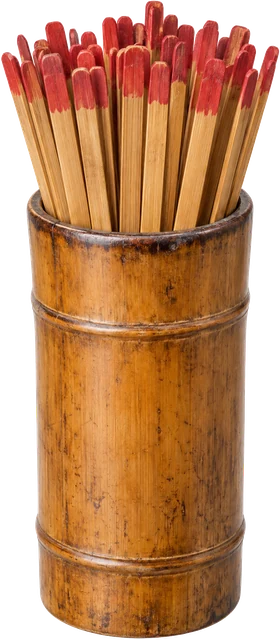
A bamboo fortune-stick cup

Draw another stick , or for a straight yes or no, throw the moon blocks

The verse follows the BW Monastery edition of the Guanyin set; the English rendering and reading are Jade Almanac's own. A drawn stick is a tradition and a prompt for reflection, not advice about health, money or the law.

Stay in the loop.

Chinese mythology, the zodiac, and the meaning behind names and symbols, rooted in the classics and read back to you. No spam. Unsubscribe anytime.