Guanyin fortune stick

7

Lower stick

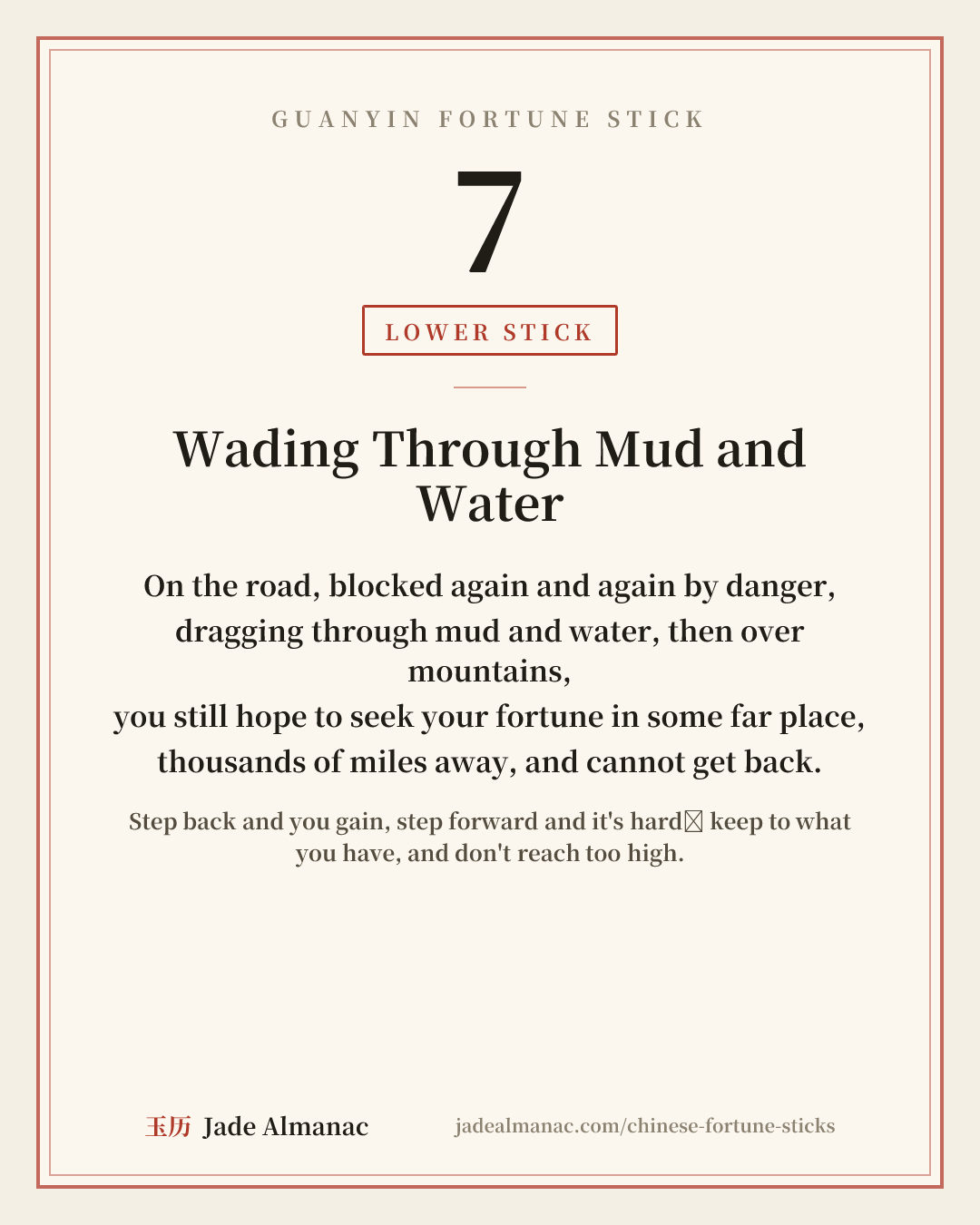
Guanyin fortune stick 7: Wading Through Mud and Water

On the road, blocked again and again by danger,
dragging through mud and water, then over mountains,
you still hope to seek your fortune in some far place,
thousands of miles away, and cannot get back.

jadealmanac.com

Save image

The verdict
Step back and you gain, step forward and it's hard; keep to what you have, and don't reach too high.
What it says to you
Mud to the knees, water to the waist, and a mountain still ahead: the poem is a picture of a trip that keeps getting harder, and of someone who goes looking for better luck far away and then cannot get home. If you are weighing a bold move, a new job in another city, or a big climb, this stick says stay. Its verdict is unusually direct about it: stepping back gets you things, stepping forward costs you. Tend what you already have. Fix one unfinished problem close to home before you think about the mountain.

Matter by matter

Love
Do good works and pray for the bond.
Money
Very good in the second half; business average.
Work and study
Keep your feet on the ground and guard what you've built.
Health
Traditionally, do good works for long life; keep up your care.
Home
Not very favorable.
Travel
Tiring, with obstacles all the way.
Lost things
Not likely to be found.

The story behind the stick

Wading through mud and water belongs to Su Ying, a queen of folk ballad set in the reign of King Jing of Zhou. When a western kingdom sent a talking parrot as tribute, only she could coax it to speak, and the king's praise turned a rival consort, Mei Yuchun, against her. Framed on a capital charge, she was saved only because a loyal minister, Pan Ge, let his own wife die in her place. Su Ying fled by night and, on the road, gave birth to the crown prince at the White Horse Temple. The story is ballad tradition rather than history. Exile, danger behind, no road back: that is the lower grade of this stick, and the reason its verdict prefers holding your ground to setting out.
Line by line

  1. Rushing about, blocked at every turn, danger on danger: the line piles up obstacles the way a hard road piles up stages. Readers take it as a plan meeting resistance from several sides.

  2. Dragging through mud and water is a common phrase for messy, unfinished business that clings. Crossing mountains after it adds distance and labor, so interpreters expect slow, dirty progress.

  3. Hoping to find work in a far place echoes the old gamble of leaving home for better prospects. Here the line treats that hope itself as the mistake.

  4. A thousand villages and ten thousand miles is the stock measure of hopeless distance. The real cost, temple readers say, is that the move cannot easily be undone once made.

The original verse

奔波阻隔重重险
带水拖泥又渡山
更望他乡求用事
千乡万里未能还

Seven characters a line, as printed in the BW Monastery edition.

Sources for the story: https://www.k366.com/guanyin/28784.htm; https://services.shen88.cn/chouqian/guanyin-7.html; https://www.masterseanchan.com/guanyin-oracle/lot-7/; https://www.fatekeep.com/blog/3640.

Optional: the temple way

At a temple the stick is not yours until two moon blocks agree: one flat side up and one round side up, a holy cup.

About stick 7

Is Guanyin stick 7 good or bad?

Stick 7, "Wading Through Mud and Water", is a lower stick, a cautionary stick. Step back and you gain, step forward and it's hard; keep to what you have, and don't reach too high.

What does Guanyin stick 7 say about love?

Do good works and pray for the bond.

What does Guanyin stick 7 say about money?

Very good in the second half; business average.

What does Guanyin stick 7 say about work?

Keep your feet on the ground and guard what you've built.

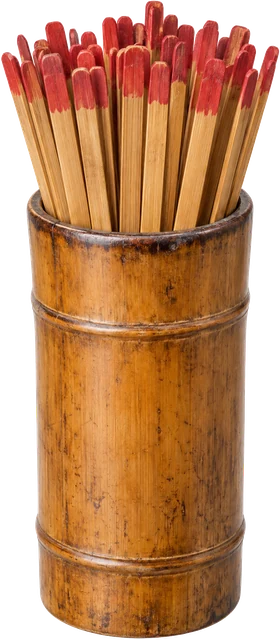
A bamboo fortune-stick cup

Draw another stick , or for a straight yes or no, throw the moon blocks

The verse follows the BW Monastery edition of the Guanyin set; the English rendering and reading are Jade Almanac's own. A drawn stick is a tradition and a prompt for reflection, not advice about health, money or the law.

Stay in the loop.

Chinese mythology, the zodiac, and the meaning behind names and symbols, rooted in the classics and read back to you. No spam. Unsubscribe anytime.