Guanyin fortune stick

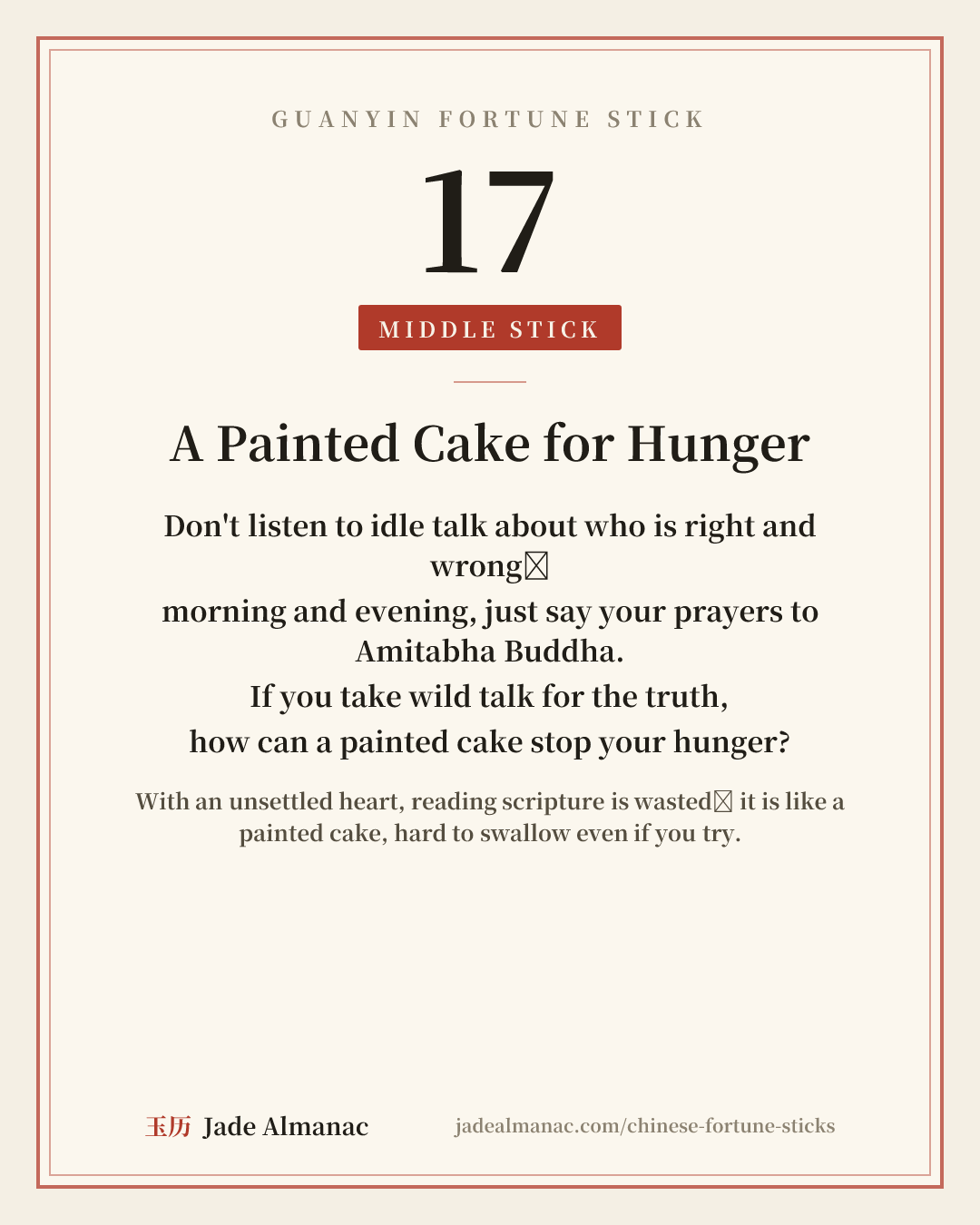
17

Middle stick

Guanyin fortune stick 17: A Painted Cake for Hunger

Don't listen to idle talk about who is right and wrong;
morning and evening, just say your prayers to Amitabha Buddha.
If you take wild talk for the truth,
how can a painted cake stop your hunger?

jadealmanac.com

Save image

The verdict
With an unsettled heart, reading scripture is wasted; it is like a painted cake, hard to swallow even if you try.
What it says to you
A cake drawn on paper looks fine and feeds nobody. The poem points it at gossip and big talk: promises, rumors, the friend who swears this deal is certain. Much of what is reaching you right now is more picture than cake. The second warning is about you. A restless mind can read wise words all day and take nothing in. So do two plain things. Stop repeating or acting on what you heard secondhand, and keep a short quiet practice morning and evening, as the poem prescribes prayer. Then check the facts for yourself.

Matter by matter

Love
Progress is slow and bumpy.
Money
Investments smooth; don't rush business deals.
Work and study
Watch out for gossip and talk of right and wrong.
Health
Traditionally, give thanks for answered vows; keep up your care.
Home
Do good deeds and pray for blessing.
Travel
Arrival will be late.
Lost things
Not coming back.

The story behind the stick

A painted cake that cannot feed you finds its partner in a famous Cao Cao anecdote. Leading his army on a hot march with no water anywhere, and his soldiers too parched to go on, the Three Kingdoms warlord called out that a grove of plum trees lay just ahead, heavy with sour fruit. At the thought of plums their mouths watered, and they pushed on until they found water. The tale, recorded in the fifth-century collection A New Account of the Tales of the World, gave Chinese the idiom of quenching thirst by thinking of plums. Both images are comfort without substance. A trick may get you to the next well, but it does not feed you, which is why the stick stays middle and warns against taking talk for truth.
Line by line

  1. Idle talk about right and wrong is gossip, the village habit of judging others. The line asks you to stop listening, and temple readers apply it to rumors at work and family quarrels.

  2. Reciting the name of Amitabha, the Buddha of the Pure Land, morning and evening was the simplest lay devotion. Readers take it as a call to steady the mind with a routine.

  3. Wild talk taken for truth names boasts, promises and tall tales. The warning covers deals and offers that sound certain but rest on nothing that can be checked.

  4. The painted cake comes from a saying of a third-century Wei emperor: a reputation is like a cake drawn on the ground, which no one can eat. Readers apply it to anything that looks real and feeds nobody.

The original verse

莫听闲言说是非
晨昏只好念弥陀
若将狂话为真实
画饼如何止得饥

Seven characters a line, as printed in the BW Monastery edition.

Sources for the story: https://www.k366.com/guanyin/28875.htm; https://services.shen88.cn/chouqian/guanyin-17.html; https://www.masterseanchan.com/guanyin-oracle/lot-17/; https://www.fatekeep.com/blog/3640.

Optional: the temple way

At a temple the stick is not yours until two moon blocks agree: one flat side up and one round side up, a holy cup.

About stick 17

Is Guanyin stick 17 good or bad?

Stick 17, "A Painted Cake for Hunger", is a middle stick, a mixed stick, good with conditions. With an unsettled heart, reading scripture is wasted; it is like a painted cake, hard to swallow even if you try.

What does Guanyin stick 17 say about love?

Progress is slow and bumpy.

What does Guanyin stick 17 say about money?

Investments smooth; don't rush business deals.

What does Guanyin stick 17 say about work?

Watch out for gossip and talk of right and wrong.

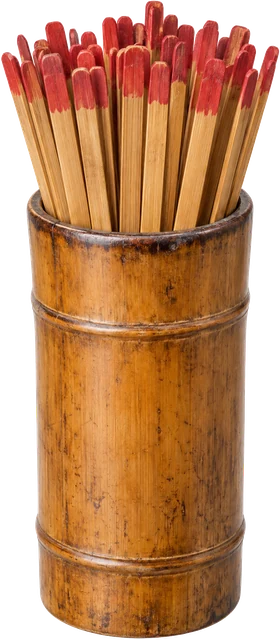
A bamboo fortune-stick cup

Draw another stick , or for a straight yes or no, throw the moon blocks

The verse follows the BW Monastery edition of the Guanyin set; the English rendering and reading are Jade Almanac's own. A drawn stick is a tradition and a prompt for reflection, not advice about health, money or the law.

Stay in the loop.

Chinese mythology, the zodiac, and the meaning behind names and symbols, rooted in the classics and read back to you. No spam. Unsubscribe anytime.