Guanyin fortune stick

15

Middle stick

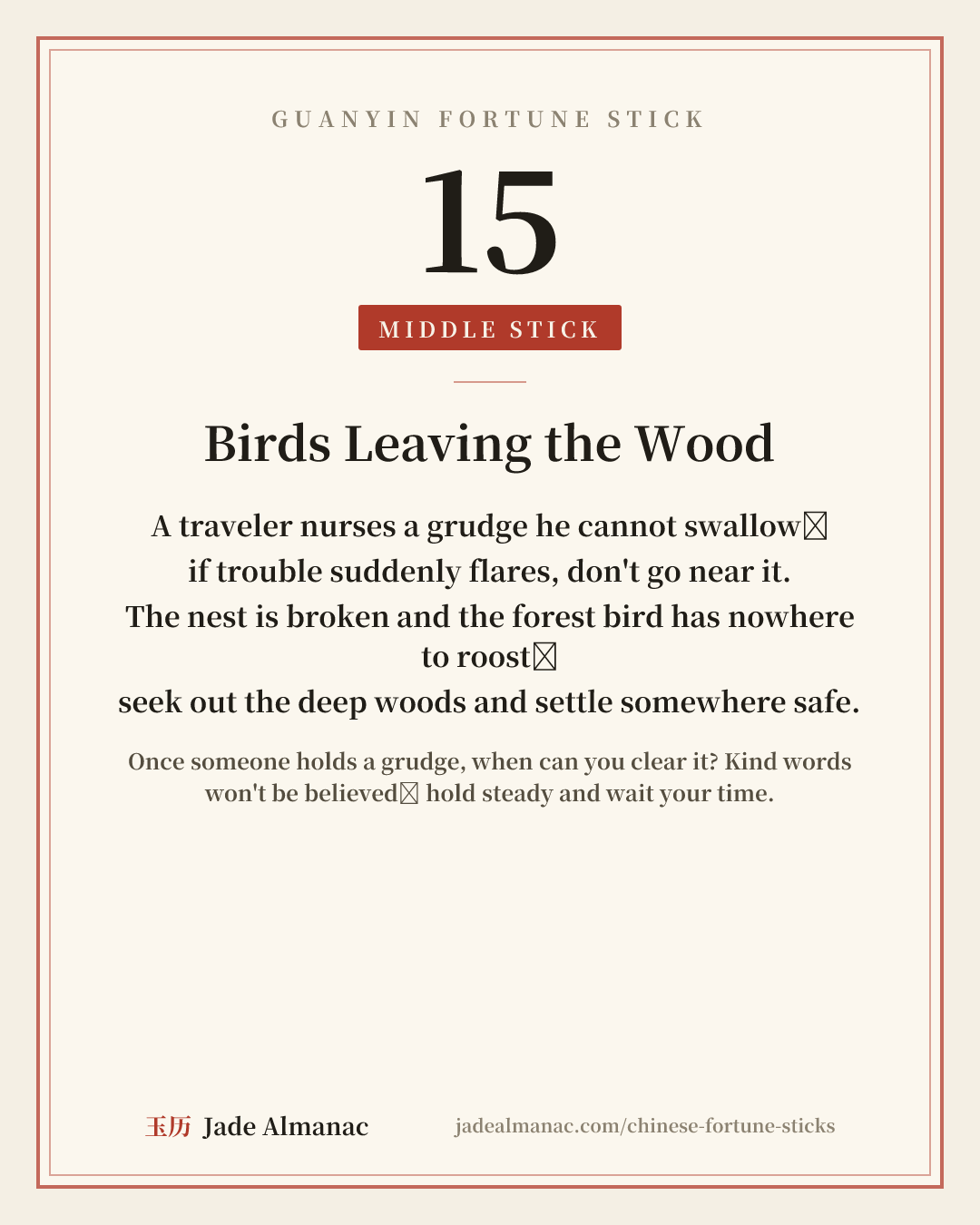
Guanyin fortune stick 15: Birds Leaving the Wood

A traveler nurses a grudge he cannot swallow;
if trouble suddenly flares, don't go near it.
The nest is broken and the forest bird has nowhere to roost;
seek out the deep woods and settle somewhere safe.

jadealmanac.com

Save image

The verdict
Once someone holds a grudge, when can you clear it? Kind words won't be believed; hold steady and wait your time.
What it says to you
Someone near you is angry, and it is the kind of anger a good explanation will not fix. The poem's advice is unglamorous and sound: don't go poking at it. If the trouble has already reached you, act like a bird whose nest has fallen. Fly deeper into the trees, find a quiet branch, and stay there a while. Pleading your case now will be read as more provocation. The image line ends hopefully: in the end it goes the way you want. For the next stretch, keep your head down and your door politely shut.

Matter by matter

Love
Blocked for now; slow progress.
Money
Favorable; business succeeds.
Work and study
Keep the peace and think of the bigger picture.
Health
Traditionally, give thanks for answered vows; keep up your care.
Home
Trouble first, then good.
Travel
Smooth.
Lost things
Hard to recover.

The story behind the stick

Mainland temple lists give this stick a second chapter of Su Qin's life, Su Qin Achieves His Aim: the failed persuader of stick two, back on the road after his hard study, wins over the rulers of Yan and Zhao and ends up holding the seals of six states. That success sits oddly with a poem about a broken nest and a grudge that will not go down. Master Sean Chan's edition, which grades the lot lower, attaches a darker story that matches the image more closely: the Three Kingdoms general Zhang Fei, who flogged his own officers in his rages and was murdered in his sleep by two of them. Read together, the two stories frame the middle grade: anger kept close ends in ruin, while patience can still bring an aim home.
Line by line

  1. A traveler cursing the day, unable to swallow his anger, is a picture of resentment with no outlet. Temple readers apply it to grudges between partners, coworkers or neighbors.

  2. Sudden disaster arriving, and the order not to step toward it, is advice to keep your distance. For disputes and lawsuits the reading is literal: do not intervene, do not take sides.

  3. A forest bird with a broken nest has nowhere to spend the night. The line pictures losing a home base, a job or a household arrangement without warning.

  4. The deep part of the forest is where birds shelter from hawks and wind. Interpreters take it as advice to withdraw to a quiet, protected place and wait there.

The original verse

行人怨日气难吞
忽有灾事勿近前
巢破林鸟无所宿
可寻深处稳安身

Seven characters a line, as printed in the BW Monastery edition.

Sources for the story: https://www.k366.com/guanyin/28873.htm; https://services.shen88.cn/chouqian/guanyin-15.html; https://www.masterseanchan.com/guanyin-oracle/lot-15/; https://www.fatekeep.com/blog/3640.

Optional: the temple way

At a temple the stick is not yours until two moon blocks agree: one flat side up and one round side up, a holy cup.

About stick 15

Is Guanyin stick 15 good or bad?

Stick 15, "Birds Leaving the Wood", is a middle stick, a mixed stick, good with conditions. Once someone holds a grudge, when can you clear it? Kind words won't be believed; hold steady and wait your time.

What does Guanyin stick 15 say about love?

Blocked for now; slow progress.

What does Guanyin stick 15 say about money?

Favorable; business succeeds.

What does Guanyin stick 15 say about work?

Keep the peace and think of the bigger picture.

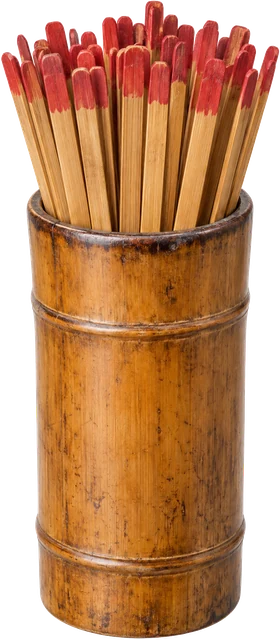
A bamboo fortune-stick cup

Draw another stick , or for a straight yes or no, throw the moon blocks

The verse follows the BW Monastery edition of the Guanyin set; the English rendering and reading are Jade Almanac's own. A drawn stick is a tradition and a prompt for reflection, not advice about health, money or the law.

Stay in the loop.

Chinese mythology, the zodiac, and the meaning behind names and symbols, rooted in the classics and read back to you. No spam. Unsubscribe anytime.