Guanyin fortune stick

14

Middle stick

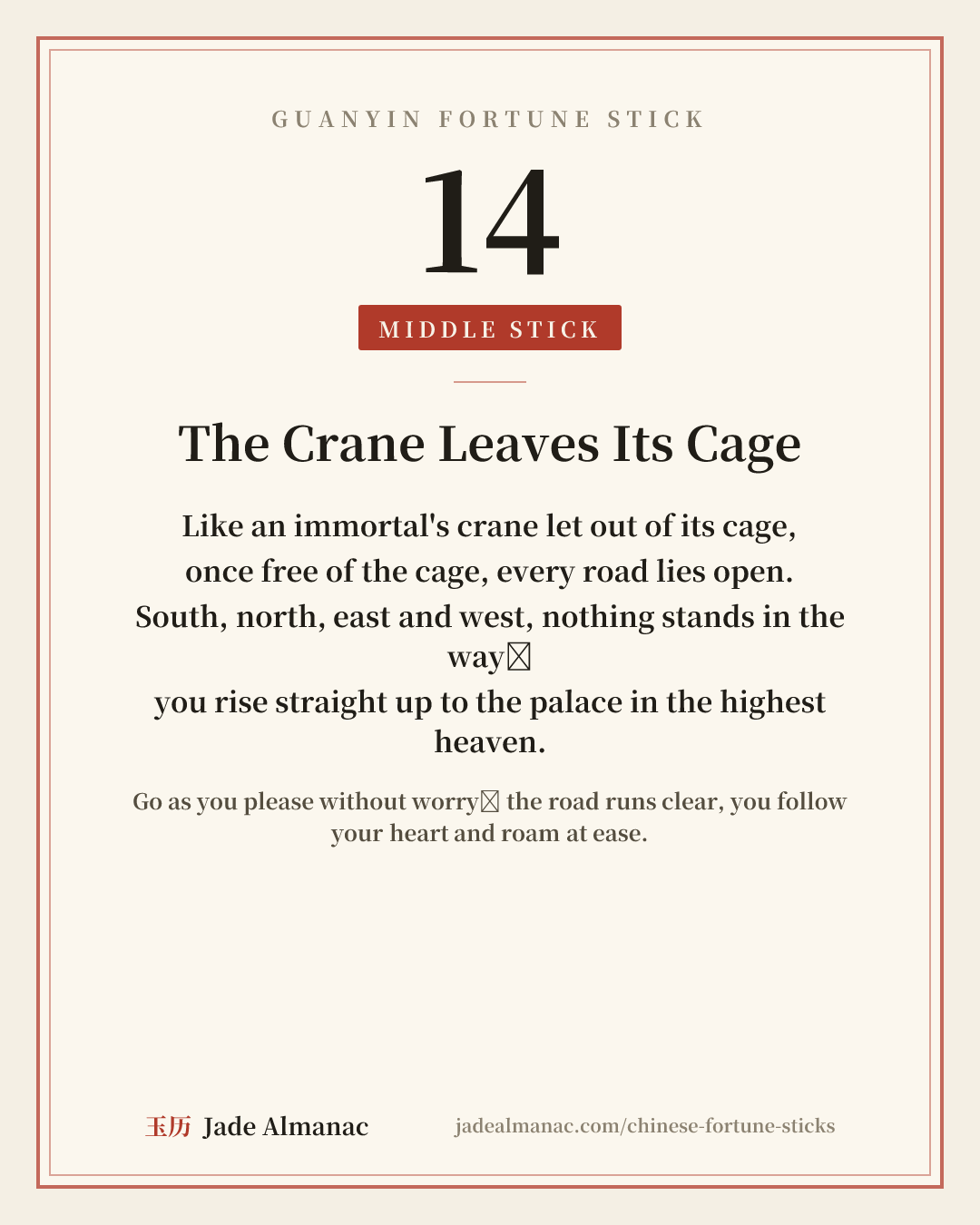
Guanyin fortune stick 14: The Crane Leaves Its Cage

Like an immortal's crane let out of its cage,
once free of the cage, every road lies open.
South, north, east and west, nothing stands in the way;
you rise straight up to the palace in the highest heaven.

jadealmanac.com

Save image

The verdict
Go as you please without worry; the road runs clear, you follow your heart and roam at ease.
What it says to you
The cage door is open, and the crane still has to decide to fly. That is the moment this poem catches. Something that has held you, a role, a worry, a set of rules you no longer need, is losing its grip, and the stick says to stop second-guessing. The image line warns that trouble comes before the good part, so the first wingbeats may feel shaky. Fine. Choose one direction, any of the four, and start moving. The verdict is clear that worrying less is itself the advice here.

Matter by matter

Love
The two of you are well matched.
Money
Wishes come true; business succeeds.
Work and study
Hold firm to your aim and you will gain.
Health
Traditionally, make a large prayer offering; keep up your care.
Home
Not very settled at present.
Travel
The traveler will be seen.
Lost things
Look to the southeast.

The story behind the stick

Jiang Ziya is the figure behind the crane leaving its cage, in the version told by the novel Investiture of the Gods. Sent down from his Daoist master's mountain, he failed at every trade he tried, and at seventy-two took a minor post at the court of the tyrant King Zhou of Shang. When the king ordered him to build the lavish Deer Terrace, Jiang protested, then escaped by plunging into the river and walked away from office for good. He went to fish on the Wei River and wait for the right ruler. Throwing off a post that held him was his release, and the trouble that came first fits the image line's warning of hardship before good, which keeps this freeing stick at middle.
Line by line

  1. The crane is the mount of Daoist immortals and a symbol of long life. A cage holding one is a striking mismatch, and temple readers take the release as overdue.

  2. Once free of the cage, every road opens. Repeating the cage across two lines stresses that the limit itself, more than the road ahead, was the problem.

  3. The four directions named one by one cover every option. Readers take the line as clearing travel, moving house and new ventures in any direction at all.

  4. The palace of the ninth heaven is the highest celestial court, where immortals live. Rising straight to it is the old picture of sudden elevation in rank or in spirit.

The original verse

宛如仙鹤出樊笼
脱得樊笼路路通
南北东西无阻碍
任君直上九霄宫

Seven characters a line, as printed in the BW Monastery edition.

Sources for the story: https://www.k366.com/guanyin/28855.htm; https://services.shen88.cn/chouqian/guanyin-14.html; https://www.masterseanchan.com/guanyin-oracle/lot-14/; https://www.fatekeep.com/blog/3640.

Optional: the temple way

At a temple the stick is not yours until two moon blocks agree: one flat side up and one round side up, a holy cup.

About stick 14

Is Guanyin stick 14 good or bad?

Stick 14, "The Crane Leaves Its Cage", is a middle stick, a mixed stick, good with conditions. Go as you please without worry; the road runs clear, you follow your heart and roam at ease.

What does Guanyin stick 14 say about love?

The two of you are well matched.

What does Guanyin stick 14 say about money?

Wishes come true; business succeeds.

What does Guanyin stick 14 say about work?

Hold firm to your aim and you will gain.

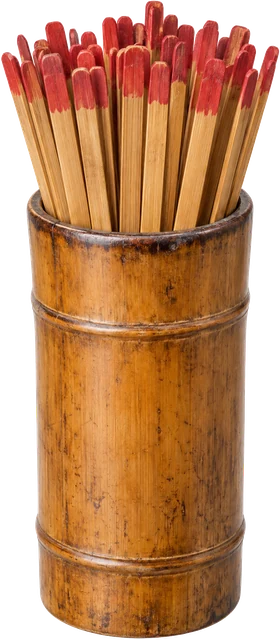
A bamboo fortune-stick cup

Draw another stick , or for a straight yes or no, throw the moon blocks

The verse follows the BW Monastery edition of the Guanyin set; the English rendering and reading are Jade Almanac's own. A drawn stick is a tradition and a prompt for reflection, not advice about health, money or the law.

Stay in the loop.

Chinese mythology, the zodiac, and the meaning behind names and symbols, rooted in the classics and read back to you. No spam. Unsubscribe anytime.