Calligraphy
Chinese Calligraphy Generator
Type a character and watch it take on the classic hands, from Qin seal script to a loose, flying cursive, then save the one you like as a print-ready image. No Chinese keyboard? Type a word in any language and turn it into Chinese in one click. Good for picking a look before a tattoo, a card, or a piece of art.
Any language, up to ten characters, type English and hit "See it in Chinese", or enter a character like 爱 directly.
Looking for a name? A real Chinese name is chosen for sound and meaning, not spelled out letter by letter. Get your Chinese name first
Your piece
Brush · 福
Twice screen resolution, with a small Jade Almanac seal in the corner. The inscription sits where a signature would; a seal you carve below goes under it. These are digital typefaces drawn after calligraphic hands, a fast way to compare looks before you settle on one; they are not brushwork.
Seal script: Chong Xi Small Seal, Academia Sinica, CC BY-ND 3.0 TW. Other faces: Google Fonts, SIL Open Font License.
Seal maker
Carve a seal of your own
A piece of calligraphy is not signed with a pen. It is stamped, with a small stone seal: one to four characters, red on white or white on red. Carve one here and watch it land on the paper, then stamp it under the inscription on your piece above, or save it on its own.
Your seal
Right column first, top to bottom. Seal script uses the Chong Xi Small Seal face after the Shuowen forms; a simplified character is then cut as the form it came from. A digital design for signing your own work, not an official seal.
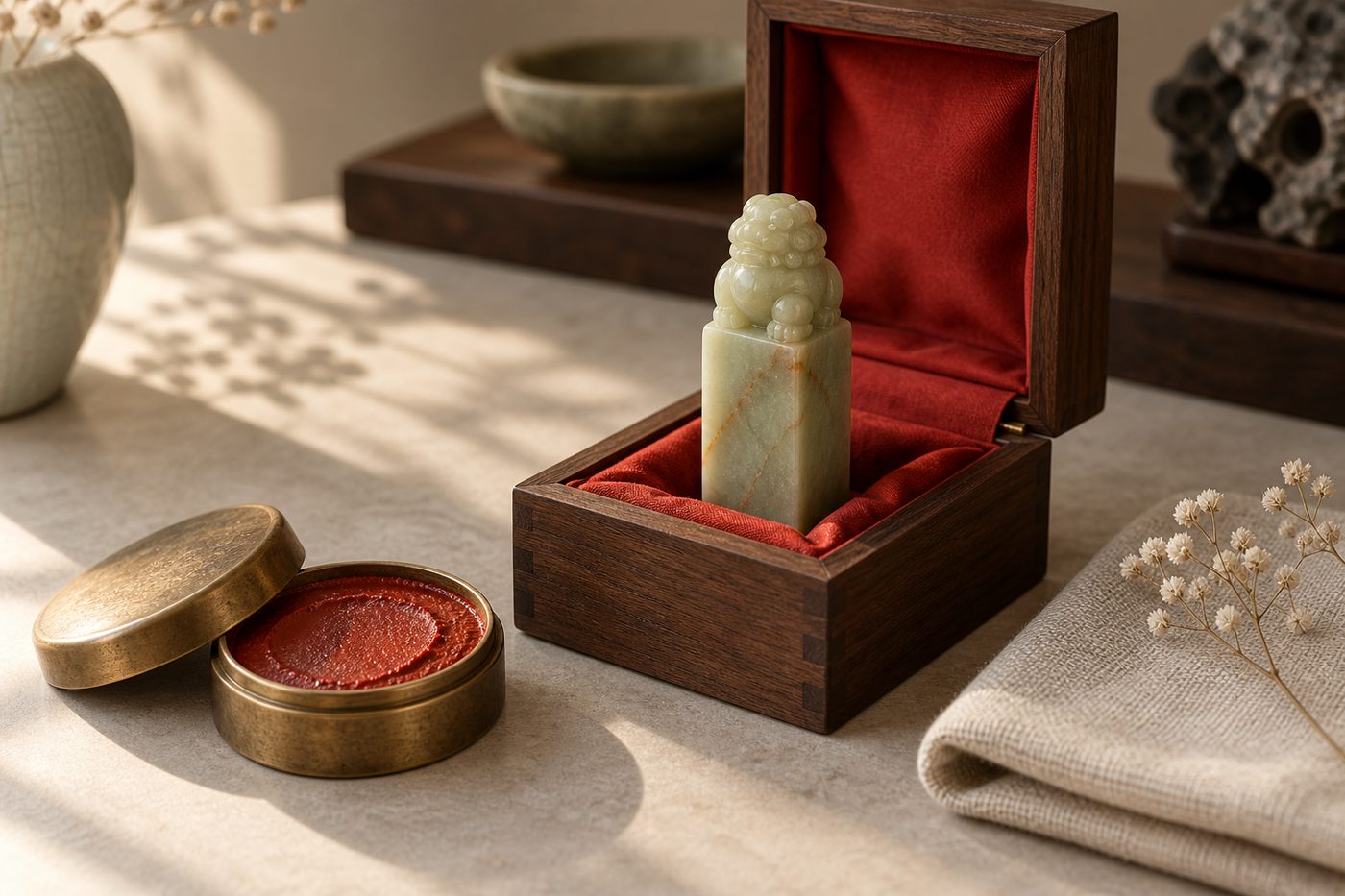
In stone
Have yours carved in stone
The seal you just designed, cut by hand into jade-toned soapstone and boxed with its own tin of cinnabar paste. Press it into the corner of a letter, a painting, a book you are giving away, and it is signed the way Chinese art has been signed for two thousand years.
We are lining up a small first run. Leave an email and you are first to hear when it opens.
One email when it opens. Nothing else.
The red stamp on a painting, and what is on it
Chinese art is signed twice: once with the brush, and once with a seal pressed in cinnabar paste under the signature. The seal carries the artist's name, or a studio name, or a phrase they liked; collectors then added their own as a work passed through their hands, which is why an old scroll can carry a crowd of red squares and the Qianlong Emperor's favorites carry dozens of his alone. Red characters on a white ground are , cut in relief; white characters in a red field are , cut into the stone. Read a seal right column first, top to bottom.
Made to order
Your word, as a finished piece
The composer above is a typeface on paper. This is the other thing: your character, or your English word, worked up as a finished artwork, as a cinnabar seal or in black ink, and delivered as a print you can frame. Four words are done. Tell us yours, and you are first in line when orders open.


The five hands, and which one you are looking at
Chinese calligraphy is taught as five scripts, and they are usually listed in the order each became standard. That order contains a surprise: the wild, barely legible cursive hand is roughly two centuries older than the neat regular one that every schoolchild starts with. Speed did not arrive as a later corruption of tidiness. Scribes were already writing fast, and the tidy hand was the thing that had to be invented.
| Script | Pinyin | Became standard | How to recognize it |
|---|---|---|---|
| Seal script | Standardized under the Qin, c. 220 BCE | Tall, symmetrical, every line the same thickness and mostly curved. It looks carved because it largely was. | |
| Clerical script | c. 200 BCE, the Han clerk's hand | Wide and flat rather than tall, with one dominant horizontal stroke that flares out into a heavy tail. | |
| Cursive script | c. 50 BCE | Whole characters collapse into two or three continuous strokes. Frequently unreadable without training, and meant to be. | |
| Running script | Han dynasty, matured in the fourth century | Regular script written at speed. Strokes lean into each other and occasionally join, but you can still read it. | |
| Regular script | c. 150 CE, dominant by the Tang | Every stroke separate, upright and deliberate. This is the hand schoolchildren learn and the one printing still imitates. |
What this generator covers, and what it does not
The eight tiles above run from the oldest hand to the fastest. Seal is the Chong Xi Small Seal face, drawn at Academia Sinica after the small-seal forms recorded in the Shuowen Jiezi; eleven thousand seal glyphs make a 22 MB file, so it fetches in the background once you start typing rather than with the page. Regular is a true kai face, the hand schoolchildren learn. Print is the Song face of modern books, a printer's cut of the same script, and Elegant is fangsong, the compromise between the two. Brush, Running hand and Bold brush move through running script, progressively looser. Cursive is the real thing, and on many characters it will be genuinely hard to read.
- Seal script · Seal
- Cursive script · Cursive
- Running script · Running hand, Bold brush, Brush
- Regular script · Regular, Print, Elegant
Clerical script is still missing, and that is a limitation worth stating rather than hiding. It needs a glyph set drawn character by character from Han stelae, and no free web font covers it at the quality this page would want. Seal script had the same problem until 2022, when Academia Sinica released its face; this page said the same thing about seal until then.
One more thing seal script cannot do: simplified characters. It predates every one of them by two thousand years, so a simplified character is shown as the form it was simplified from, 爱 as 愛, 龙 as 龍, and the tile says so. A few characters have no seal form at all, 囍 among them, because they were invented long after anyone wrote seal script.
The most famous piece of writing in China is a rough draft
In 353, an official named Wang Xizhi sat with forty-one friends, relatives and students beside a stream, floating cups of wine down the water and composing poems as a game. The preface he wrote for the resulting collection, the Preface to the Poems Composed at the Orchid Pavilion, is the most admired piece of writing in the history of the art, and it was produced as an occasional piece at a party.
Emperor Taizong of the Tang wanted it so badly that he had it buried with him. Nothing in Wang Xizhi's own hand survives anywhere: every version you have ever seen is a tracing or a rubbing of a tracing. He is still called the Sage of Calligraphy, on the strength of copies of copies of an afternoon's improvisation.
That is worth holding onto while you compare fonts here. What Chinese calligraphy prizes is the record of a hand moving once, at speed, and never repeating itself. A digital face is the exact opposite: perfectly consistent, infinitely repeatable. It is a useful way to choose a look, and it is not the thing itself.
Questions people actually ask
What are the five main types of Chinese calligraphy?
Tradition counts five: seal script (zhuanshu), clerical (lishu), regular (kaishu), running (xingshu), and cursive (caoshu). They are ordered by when each became standard, not by how fast they are written. Regular script came last, around the Han-to-Tang transition, and is the one modern print still follows. This generator covers four of the five: seal, regular, running and cursive. Clerical is the one still missing.
Is this real calligraphy?
No, and it is worth being clear about it. These are digital typefaces drawn after calligraphic hands, so every instance of a character comes out identical. Real calligraphy is brush, ink, pressure and timing, and no two characters by the same hand are ever the same. Use this to compare a look before you commit to one; it will not replace a calligrapher.
Can I use this to pick a style for a tattoo?
For choosing the look, yes. But style is the smaller half of the problem: most Chinese tattoo mistakes are the wrong character, not the wrong script. Settle the meaning first, reading the entry for the character you have in mind, and only then decide whether you want it in a clean regular hand or a loose cursive one.
Why does my English name look wrong when converted?
Because a Chinese name is not a spelling of an English one. Names are chosen for sound and meaning together, usually a one-character surname plus a one- or two-character given name, and transliterating letter by letter produces something that reads as a foreign noise rather than a name. The name generator builds a real one instead.
Why does a character render in some styles but not others?
Glyph coverage varies by font. The brush and cursive faces were drawn for the common modern character set, so rare characters and most traditional forms fall outside them and drop back to the standard print face. If a character looks unchanged across several styles, that is what happened. The seal face is the exception in the other direction: it covers eleven thousand characters, but only in the forms that existed when seal script was written, so a simplified character is shown as the form it was simplified from, and the tile says so when that happens.
Do these styles work with simplified characters?
Yes, and the relationship runs deeper than compatibility. When the simplified set was standardized in 1956, a number of its forms were taken directly from cursive shorthand that scribes had used for centuries: shu, wei, dong and che among them. In those cases the cursive rendering is not a stylization of the simplified character; the simplified character is a tidied-up copy of the cursive one.
How can I convert text to Chinese calligraphy font?
Type the character, or the word, into the box at the top. It renders at once in eight hands, from seal script to cursive. Click the one you want, choose a paper and a mounting, add an inscription and a seal if you like, and save the result as a PNG at twice screen resolution. There is nothing to install and no account; the faces are web fonts, so the file is drawn in your own browser.
Can I copy and paste Chinese calligraphy?
Not as text. A calligraphy font only shows as calligraphy where that font is installed, so pasting the characters into a chat or a document hands over plain characters in whatever face the other side has. What travels is the picture. Save the PNG and paste that, or share it straight from the page. The characters themselves you can of course copy: they are ordinary Chinese, not a special alphabet.
Can I make Chinese calligraphy from an English word or name?
Yes, in three ways. Type an English word and press "See it in Chinese": if it is one of the characters we have written up, you get our sourced character with a link to its entry; otherwise you get a machine translation, labeled as such, worth checking before you commit to it. For a name, do not translate it: use the name generator, which builds a real Chinese name for sound and meaning, then bring it here. And the English word itself can be the piece: the Brush, Running hand, Bold brush and Cursive faces all write Latin letters with a brush.
What font looks like Chinese writing?
If you mean English letters drawn to look Chinese, the "wonton" or "chop suey" lettering of old takeaway signs, no serious face does that and this page does not either; it reads as a costume. If you mean an English word written with a Chinese brush, that is a different thing, and the brush faces here do it: type your word and pick Brush, Running hand, Bold brush or Cursive. The strokes come from the same hands that write the Chinese characters.
Does this generator use AI?
Not for the characters. Every character is drawn from a typeface, which is why it cannot come out wrong: an image model asked for a Chinese character will sometimes invent a stroke, and a stroke is the difference between one word and another. The things around the character, the paper textures, the silk mountings and the stone seal still-life, were made with an image model and checked by hand, and none of them contain writing.
Can I write vertically, or use traditional characters?
Both. Two or more characters can be stacked top to bottom, the way a scroll reads. Traditional characters render in every face: type them directly, or type the simplified form and pick the seal tile, which shows the form the character had before simplification, since seal script predates every simplified form.
What is the red stamp on Chinese paintings?
A seal, pressed in cinnabar paste. The artist stamps one under the signature, usually a name seal, and sometimes a second with a studio name or a motto. Later owners added their own, which is why an old scroll can carry a crowd of them: the Qianlong Emperor covered his favorite pieces with dozens. Read one right column first, top to bottom. Red characters on a white ground are zhuwen, carved in relief; white characters on a red ground are baiwen, carved into the stone.
What is a Chinese signature stamp called?
A seal, yinzhang in Mandarin, or a chop, the English word that came through India from the Hindi for a stamp. On a painting it is the artist's signature and the owner's mark at once. A personal one carries a name; a leisure seal carries a phrase. The seal maker on this page cuts either, in a brush hand or in seal script, red on white or white on red.
How do you read a Chinese seal?
Column by column, starting at the top right and reading down, then the next column to the left. A four-character seal therefore reads top right, bottom right, top left, bottom left. A single character stands alone; two stack; three usually get a tall seal rather than a square one. Seal script is the hard part: it is a form of the characters from before the Han dynasty, so even fluent readers often need to work a seal out character by character.
Not sure which character you want yet? Browse the symbols and their meanings
Expecting? The most-asked question we answer has nothing to do with handwriting: try the Chinese gender predictor
There is one set of characters nobody chooses: the eight the calendar assigns you at birth, two for the year, two each for month, day and hour. That reading is named after them, 八字, eight characters. See the eight for your birthday