Guanyin fortune stick

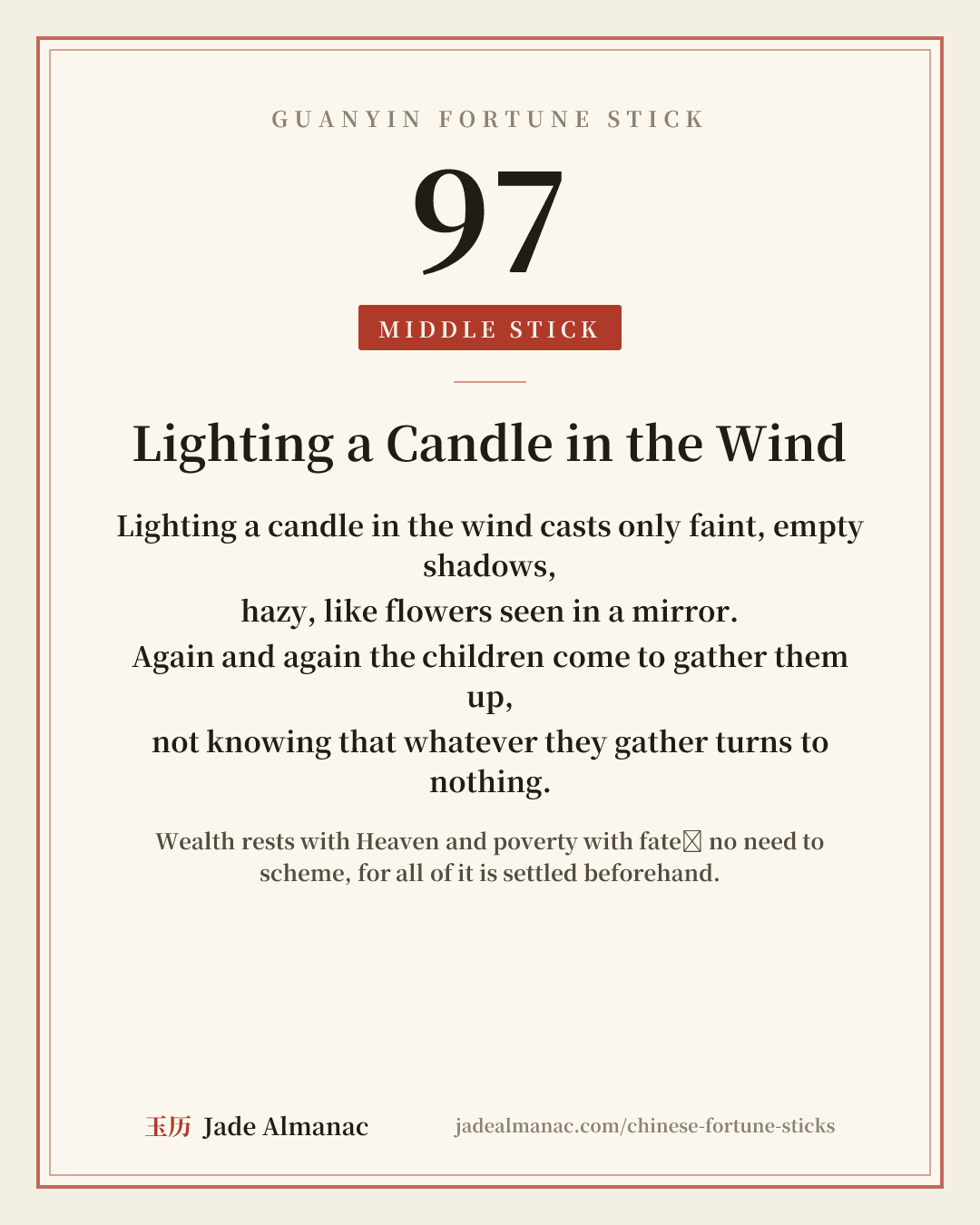
97

Middle stick

Guanyin fortune stick 97: Lighting a Candle in the Wind

Lighting a candle in the wind casts only faint, empty shadows,
hazy, like flowers seen in a mirror.
Again and again the children come to gather them up,
not knowing that whatever they gather turns to nothing.

jadealmanac.com

Save image

The verdict
Wealth rests with Heaven and poverty with fate; no need to scheme, for all of it is settled beforehand.
What it says to you
Try lighting a candle in a stiff wind and you get a flicker, then shadows, then nothing. The poem adds children grabbing at flowers in a mirror, which is the same lesson in a gentler key. The stick warns against chasing appearances: a title with no substance, praise that cannot be spent, a deal that looks better than it is. Before you pour more effort in, ask what you would actually hold at the end. If the answer is a reflection, step out of the wind. Keep things as they are, move carefully at work, and put your effort where something real is already burning.

Matter by matter

Love
Ordinary; nothing remarkable.
Money
Gains are possible; be careful in trade.
Work and study
Be careful; do not push ahead.
Health
Tradition says repent and clear old karma; keep up your care.
Home
Do good and pray for protection.
Travel
No news.
Lost things
More bad than good; probably not recovered.

The story behind the stick

All the editions attach Zhuge Liang's Sixth Campaign from Mount Qi, as the Romance of the Three Kingdoms tells it; one offers an alternative. Zhuge Liang, chancellor of the kingdom of Shu, led army after army north through the Qishan hills against Wei. Before the last campaign, in 234, an astrologer warned him the signs were against it. He went anyway, vowing to give himself until death, fell ill in camp on the Wuzhang Plains, and died there with the war unwon. Editions read it as wisdom that could not overcome the times. It fits a middle stick about a candle lit in the wind: great effort, real brilliance, and a flame that the conditions simply would not let burn.
Line by line

  1. A candle lit in the wind throws only faint, unsteady shadows. Temple readers hear it as effort spent in conditions that will not support it, so the light never takes hold.

  2. Flowers in a mirror, paired with the moon in water, is a Buddhist saying for illusions. Readers take it as something that looks beautiful and real but cannot be grasped.

  3. Children coming again and again to gather them up shows naive, repeated grasping. Temple readers take it as chasing appearances: titles, praise, or deals that look better than they are.

  4. Not knowing that whatever they gather turns to nothing is the poem's verdict on the chase. Readers treat it as a warning against empty fame and advise not scheming for gain now.

The original verse

当风点烛空疏影
恍惚铺成镜里花
几度儿童来收拾
岂知收拾总成空

Seven characters a line, as printed in the BW Monastery edition.

Sources for the story: zhouyi.cc Guanyin lot 97: https://www.zhouyi.cc/lingqian/guanyin/5480.html; ttlingqian.com Guanyin lot 97 (cites the Romance of the Three Kingdoms): https://www.ttlingqian.com/guanyin/97.html; masterseanchan.com Guanyin oracle lot 97 (alternative: Zhu Maichen rich at fifty).

Optional: the temple way

At a temple the stick is not yours until two moon blocks agree: one flat side up and one round side up, a holy cup.

About stick 97

Is Guanyin stick 97 good or bad?

Stick 97, "Lighting a Candle in the Wind", is a middle stick, a mixed stick, good with conditions. Wealth rests with Heaven and poverty with fate; no need to scheme, for all of it is settled beforehand.

What does Guanyin stick 97 say about love?

Ordinary; nothing remarkable.

What does Guanyin stick 97 say about money?

Gains are possible; be careful in trade.

What does Guanyin stick 97 say about work?

Be careful; do not push ahead.

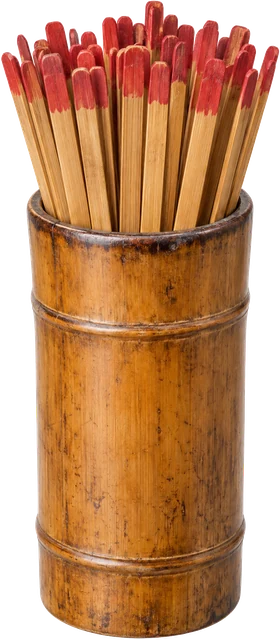
A bamboo fortune-stick cup

Draw another stick , or for a straight yes or no, throw the moon blocks

The verse follows the BW Monastery edition of the Guanyin set; the English rendering and reading are Jade Almanac's own. A drawn stick is a tradition and a prompt for reflection, not advice about health, money or the law.

Stay in the loop.

Chinese mythology, the zodiac, and the meaning behind names and symbols, rooted in the classics and read back to you. No spam. Unsubscribe anytime.