Guanyin fortune stick

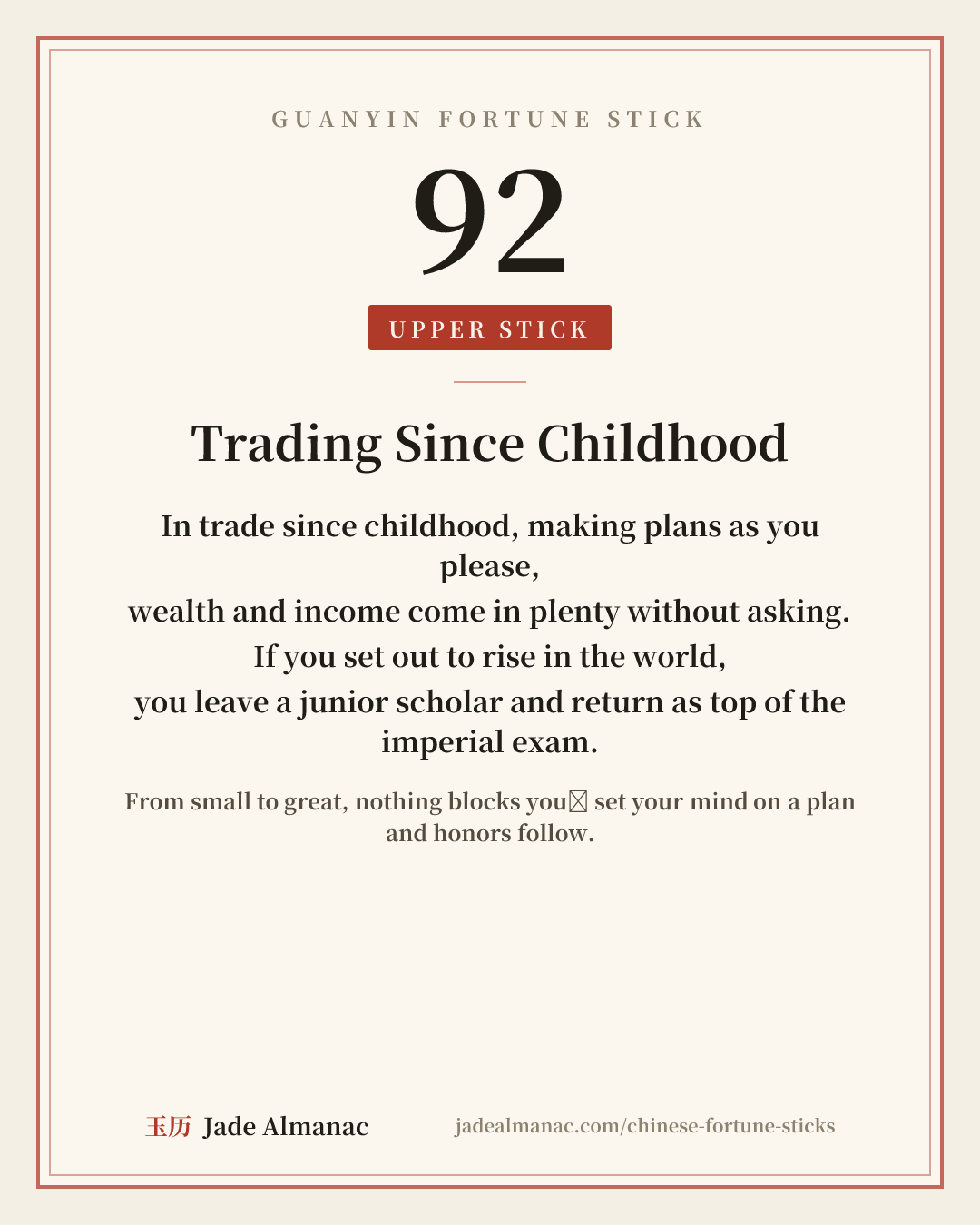
92

Upper stick

Guanyin fortune stick 92: Trading Since Childhood

In trade since childhood, making plans as you please,
wealth and income come in plenty without asking.
If you set out to rise in the world,
you leave a junior scholar and return as top of the imperial exam.

jadealmanac.com

Save image

The verdict
From small to great, nothing blocks you; set your mind on a plan and honors follow.
What it says to you
The figure in this poem learned to trade as a child and never had to chase money, because the habit of careful planning did the chasing. The image is about thrift and diligence, and the stick promises a life without worry to whoever keeps both. Then the poem raises the stakes: go out as a junior scholar, come back as top of the exam. If you are weighing a bigger step, take it. Your groundwork is solid. Keep the small daily disciplines that got you here, the budgeting, the follow-up, the early start, and let them carry you further.

Matter by matter

Love
The two of you are well matched.
Money
Smooth and as you wish.
Work and study
Smooth, and you get what you aimed for.
Health
Recovery is near.
Home
Peaceful.
Travel
Still on the way.
Lost things
It is still there.

The story behind the stick

The story is Cai Repays a Kindness, from The Lute, a fourteenth-century play by Gao Ming; one edition offers a different tale as an alternative. Cai Bojie left his new wife Zhao Wuniang to sit the imperial examinations and placed first, but stayed in the capital and was made to marry the prime minister's daughter. At home famine struck, and Wuniang kept his parents alive with help from the neighbor Zhang Guangcai. After years of hardship she traveled to the capital and found him. The couple, with his second wife, went home to tend the family graves, and Cai rewarded Zhang for his help. It fits an upper stick whose last line says a junior scholar goes out and returns as top graduate, with gratitude settled at the end.
Line by line

  1. Trading since childhood and planning freely means skill learned young and practiced long. The usual reading takes it as a sign that your experience is deep enough to trust your own judgment.

  2. Wealth coming in plenty without asking means income follows naturally from good habits. Interpreters see it as steady prosperity for business and household, linked to thrift and diligence.

  3. Setting out to rise in the world turns from trade to career. Most readings take it as a question about promotion, study or office, and the stick answers it with full encouragement.

  4. A licentiate who leaves and comes back top of the palace exam is the highest success the old system offered. Readers understand it as complete victory in exams, applications and competitions.

The original verse

自幼为商任设谋
财禄盈丰不用求
若是进身谋望事
秀才出去状元游

Seven characters a line, as printed in the BW Monastery edition.

Sources for the story: zhouyi.cc Guanyin lot 92: https://www.zhouyi.cc/lingqian/guanyin/5475.html; ttlingqian.com Guanyin lot 92 (cites The Lute): https://www.ttlingqian.com/guanyin/92.html; masterseanchan.com Guanyin oracle lot 92 (alternative: Li Guyan).

Optional: the temple way

At a temple the stick is not yours until two moon blocks agree: one flat side up and one round side up, a holy cup.

About stick 92

Is Guanyin stick 92 good or bad?

Stick 92, "Trading Since Childhood", is a upper stick, a favorable stick. From small to great, nothing blocks you; set your mind on a plan and honors follow.

What does Guanyin stick 92 say about love?

The two of you are well matched.

What does Guanyin stick 92 say about money?

Smooth and as you wish.

What does Guanyin stick 92 say about work?

Smooth, and you get what you aimed for.

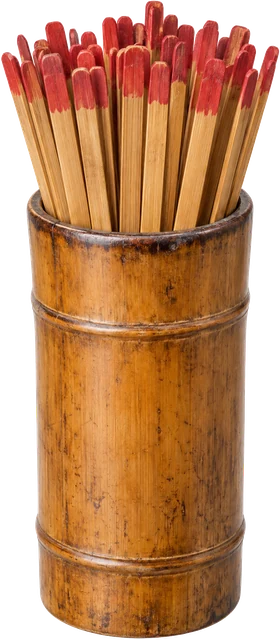
A bamboo fortune-stick cup

Draw another stick , or for a straight yes or no, throw the moon blocks

The verse follows the BW Monastery edition of the Guanyin set; the English rendering and reading are Jade Almanac's own. A drawn stick is a tradition and a prompt for reflection, not advice about health, money or the law.

Stay in the loop.

Chinese mythology, the zodiac, and the meaning behind names and symbols, rooted in the classics and read back to you. No spam. Unsubscribe anytime.