Chinese Symbol for Love (爱): Meaning and Origin
The Chinese symbol for love is 爱 (ài, said like the English 'eye') if you write it the simplified way used across mainland China, or 愛 in the traditional form kept in Taiwan and Hong Kong. Look at the traditional one and there is a tiny heart, 心, tucked into the middle. The simplified version quietly drops it. Same word, same sound, same meaning, and yet those two little strokes have started more arguments than almost any character in the language.
- Strokes
- 10
- Radical
- 爪 (claw)
- Formation
- Phono-semantic compound
Trace 爱 yourself, or watch it drawn
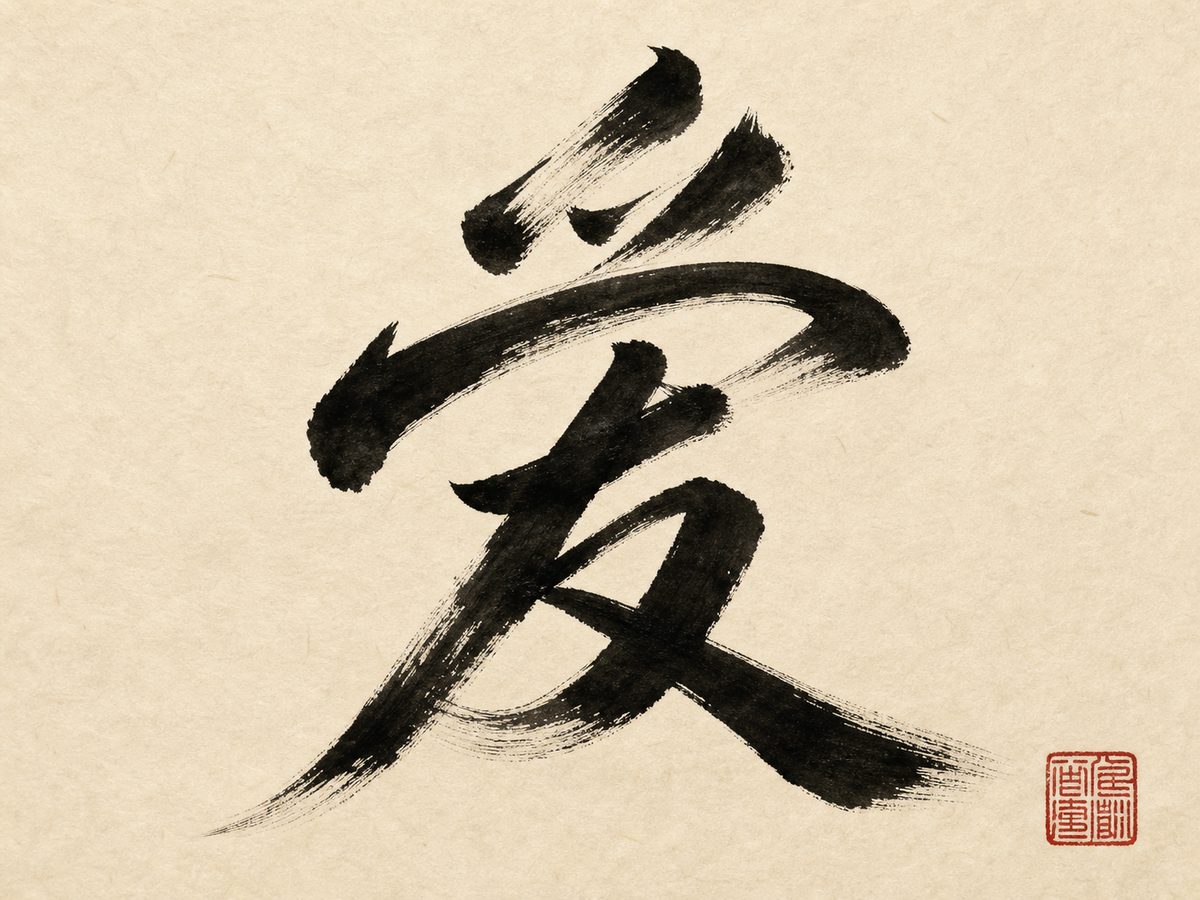
How it's written
It helps to see the character as a little stack of parts. The simplified 爱 sits under 爪, a clawed hand reaching down, then a flat 冖 like a roof, with 友, "friend," underneath: ten strokes, written top to bottom and left to right, starting with that hand. The traditional 愛 is the fuller build, the same hand and roof but with 心, heart, and then 夊, a slow-walking foot, at the very bottom: thirteen strokes in all. A good way to remember the traditional form is the picture it almost draws, a hand and a heart above a pair of walking feet, as if someone were carrying their heart across to another person. That is a memory trick rather than real history (the true origin is stranger, and it is just below), but it is a reliable one for getting the strokes in the right order.
What it means
爱 (ài) is just the everyday word for love, and it is every bit as greedy as the English one: you love a person, you love your country, you love the way your grandmother makes dumplings. It works happily as both a verb and a noun. Chinese does not make one word do all the heavy lifting, though. Right beside it sits 情 (qíng), the broader, warmer word for feeling and affection, and 恋 (liàn), the restless, lovesick kind of longing that cannot quite sit still on its own. Where English hands you a single overworked word and expects it to cover everything from your spouse to your sandwich, Chinese gives you a small family of them, each at its own temperature.
| 爱 (ài) | 情 (qíng) | 恋 (liàn) | |
|---|---|---|---|
| Temperature | The everyday workhorse | Broader and warmer | Restless and lovesick |
| Covers | A person, a country, your grandmother's dumplings | Feeling and affection at large | Longing that cannot sit still |
| Meet it in | 母爱 (mǔ'ài), a mother's love; 爱国 (àiguó), patriotic | 爱情 (àiqíng), romantic love, where it meets 爱 | 恋爱 (liàn'ài), to date |
- 爱情 — romantic love
- 可爱 — lovable, cute
- 爱国 — to love one's country; patriotic
- 恋爱 — to date, to be in a relationship
- 母爱 — a mother's love
- 溺爱 — to dote on, to spoil a child
- 恩爱 — (of a couple) devoted and affectionate
- 亲爱的 — dear, darling (as a form of address)
Idioms
- 爱屋及乌“love the house, and the crows on its roof too”when you love someone, you come to love everything connected with them; the Chinese 'love me, love my dog.' (the Great Commentary on the Book of Documents)
- 爱不释手“love it, cannot put it down”so fond of something that you refuse to let go of it. (Xiao Tong's preface to the collected works of Tao Yuanming (6th c.))
- 爱莫能助“love it, but powerless to help”you sympathize but genuinely cannot help. (the Book of Songs, Major Odes)
- 相亲相爱“mutually close, mutually loving”to love one another dearly, said of a couple or a close family.
Right vs wrong forms
| Form | Type | Note |
|---|---|---|
| 爱 | simplified ✓ | The everyday form in mainland China and Singapore. Its lower half is a fast-handwriting shortcut, not a dropped heart. |
| 愛 | traditional ✓ | Standard in Taiwan, Hong Kong, and Macau. Keeps the visible heart (心), which is why it is a favorite for tattoos and calligraphy. |
| 爱 (flipped or rotated) | mirrored | Not a real variant. Stencils pulled from low-resolution images sometimes come out mirrored or rotated; check against a dictionary before inking. |
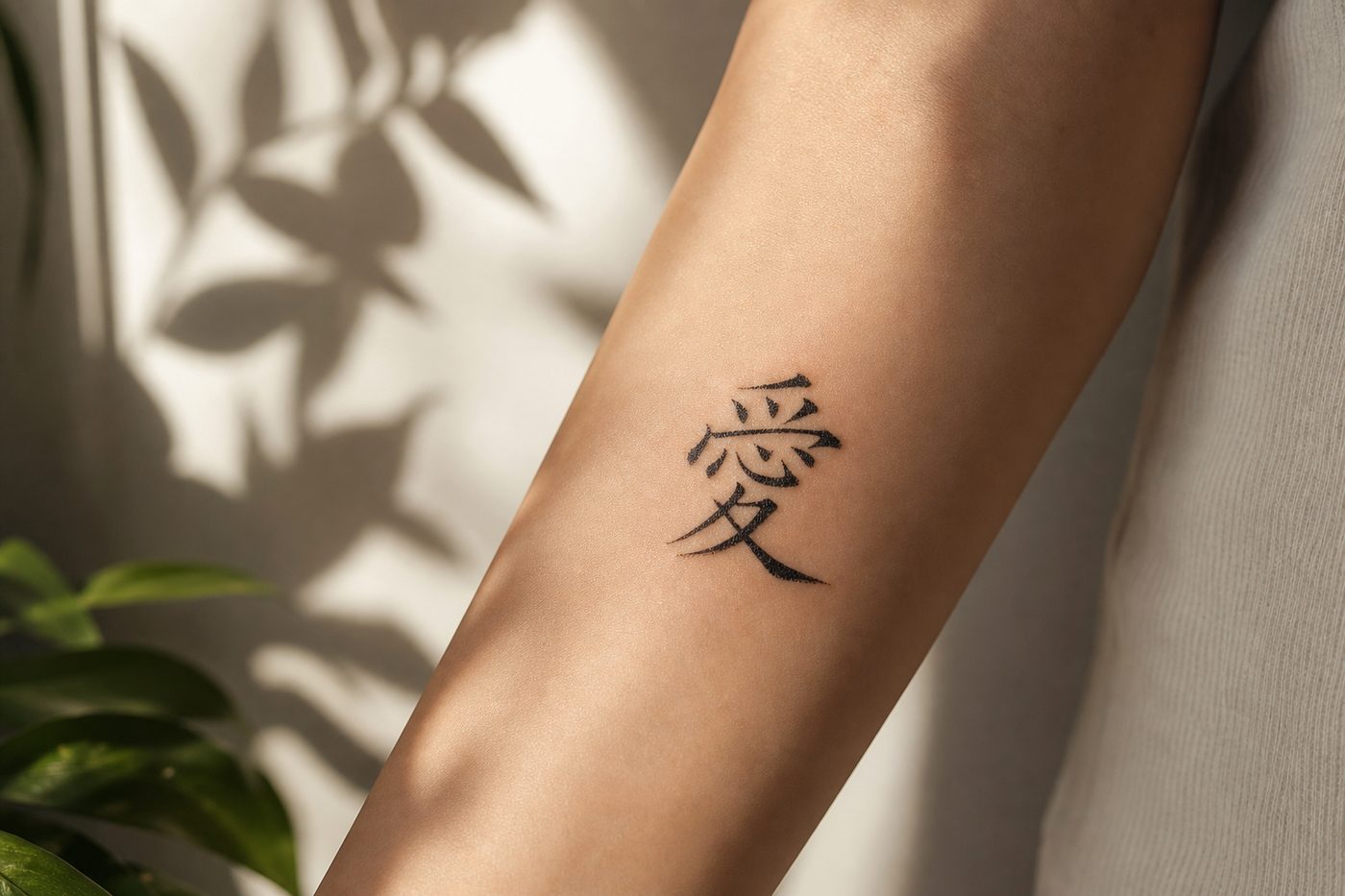
For a tattoo
If you are getting 爱 tattooed, two choices matter more than the artist's line-work. First, simplified 爱 or traditional 愛. The traditional form keeps the visible heart, 心, which is exactly why many people pick it; the simplified form is the everyday mainland character. Neither is wrong, and both say the same thing. Second, and this is the one that actually goes wrong: check your reference against a real dictionary before anyone comes at you with a needle. Low-resolution images get flipped, rotated, or quietly garbled, and a mirrored character reads as a plain mistake to anyone who can read it. Print it at size, look hard at the strokes, and have one Chinese-reading friend give it a nod first.
Love in life today
The love that is shown, not said
Here is the part most likely to surprise a Western reader: traditionally, Chinese people say "I love you" out loud remarkably little. The word 爱 is heavy. You would never spend it on a plate of food the way English lets you "love" pizza, and older parents can go a lifetime without once saying it to a child while meaning no less by the silence. Love is proved by doing, not saying: cooking your favorite dish, nagging you to put on more layers, quietly leaving a plate of peeled fruit by your elbow. Even the everyday way to check on someone you care about skips the word completely. It is not "I love you"; it is "Have you eaten yet?"
Love that pushes
There is a harder-edged version of the same instinct, and it catches a lot of foreigners off guard. In plenty of families, love shows up as high expectations and blunt correction rather than praise. A parent who never once says the word may spend twenty years on your posture, your grades, and your choice of partner, all of it filed under one phrase every Chinese kid knows: this is for your own good. Compliments get rationed on the theory that praise makes a child complacent, and almost every Chinese adult can still feel the old sting of being measured against the mythical "kid from another family" who always scored higher. It can look cold from the outside, and it can genuinely wound, but the logic underneath is the same as the plate of cut fruit: love is something you do for a person's future, not something you say to make them feel good today. Amy Chua's Battle Hymn of the Tiger Mother turned this into a Western talking point; the idea it describes is very old.
Love, online and out loud
The internet has done what centuries of reserve could not: it got young people saying it constantly, mostly in code. The favorite trick is a number, 520. Said aloud in Mandarin, five-two-zero sounds almost exactly like wǒ ài nǐ, "I love you," so you can confess without ever facing the actual words, and May 20th (5/20) has quietly become the country's unofficial Valentine's Day, complete with red-packet gifts of 520 yuan. From there it spirals into a whole economy of slang: smug couples are teased for "scattering dog food" in front of their single friends, who cheerfully call themselves "single dogs" in return, and anyone so lovestruck they have lost all judgment is said to have a "love-brain," usually with an eye-roll. None of it has retired the old romance. Qixi, a festival more than two thousand years old, still marks the one night a year a cowherd and a weaver-girl may cross the Milky Way to meet, and the shops now sell it as Chinese Valentine's Day.
A name, from Eileen Chang to Eileen Gu
爱 has always been a favorite to fold into a name, especially a girl's, and it travels well. The great Shanghai writer Eileen Chang was born Zhang Ying; at ten, bound for an English-language school, she was renamed Zhang Ailing, the "Ai" picked partly to chime with the sound of "Eileen." Three generations later the Olympic skier Eileen Gu carries the same pun in her Chinese name, Gu Ailing. The character emigrated long ago as well: in Japan it is read "Ai," one of the most common girls' names there, and it means exactly what it does in Chinese.
Want a Chinese name built around 爱, or the character that best fits a meaning you have in mind? Our Chinese name generator matches the sound of your own name to a real, well-omened character.
Where the character comes from
Everyone "knows" the sad little story about this one: the traditional 愛 has a heart in it, 心, and when China simplified its writing in the 1950s the heart got heartlessly deleted, leaving 爱. It is a great story. It is also not quite true, and the real version is more fun. Open the Shuowen Jiezi, the first Chinese dictionary, put together around the year 100, and you find the character for love filed not under "heart" but under a squiggle meaning, of all things, "to walk slowly." It defines the whole character as "the look of walking." The word that actually meant love and kindness was a separate character, and that one carried the heart. Over the centuries the walking character muscled in, borrowed the meaning, and the original quietly retired, a swap you can already see in silk manuscripts buried around 200 BCE. So the heart inside 愛 was never really the point; it was along for the ride. And the "deleted heart" in 爱? Blame lazy handwriting, not politics. It is what a heart turns into when you scribble the character in a hurry, a shortcut people were carving into stone fifteen hundred years ago.
History & roots
The first poem in Chinese literature is a love poem
Open the Book of Songs, the oldest anthology of Chinese poetry, and the very first poem is about a man who cannot sleep for thinking about a woman. "The ospreys cry on the river islet," it begins; "the fair and gentle girl is a fine match for the gentleman." He tosses and turns, then daydreams of winning her over with zithers and bells. Confucius admired the poem for being "joyful without going too far, sad without being wounded," a compliment recorded in the Analects. Three thousand years later, that is still roughly the job description for a good love song.
How much should you love, and whom?
Asked what "benevolence," his central virtue, actually meant, Confucius answered in two words, recorded in the Analects: "love people." His follower Mencius sharpened it into "the benevolent love others." But the Confucians thought love had a shape: it starts with your parents, then your siblings, then radiates outward. The rival philosopher Mozi disagreed completely and preached impartial love, loving strangers exactly as much as your own family. Mencius found this so unnatural that he accused Mozi of "denying his own father." That argument, over whether love should be equal or graded, ran for centuries, and the Confucian version won.
Buddhism gives the same word the opposite job
Here is a twist that would have baffled Confucius. When Buddhism reached China, it borrowed 爱 to translate a very different idea, the Sanskrit taṇhā, "craving" or "thirst." In Buddhist teaching this kind of 爱 is not a virtue at all. It is the eighth link in the chain of dependent origination, the grasping attachment that keeps us bound to suffering and rebirth, and the entire point of the path is to extinguish it. So the same character Confucius held up as the highest human good, Buddhism marks as the very thing to let go of. One tradition tells you to grow your love and let it radiate outward; the other warns that clinging is precisely the trap.
Questions people ask
What is the Chinese symbol for love?
It is 爱 (ài) in the simplified form used across mainland China, and 愛 in the traditional form kept in Taiwan and Hong Kong. Same sound, same meaning. The traditional 愛 has a small heart, 心, in the middle; the simplified 爱 swaps that part for a quicker shape.
Does the Chinese character for love contain 'heart'?
The traditional 愛 does. But here is the twist: the oldest dictionaries file 愛 under 'walking', not 'heart', and the original word for love was a separate character. The heart rode in as part of an old sound component, not because anyone drew love as a picture of a heart. The simplified 爱 later traded that heart for a faster stroke.
How do you say 'I love you' in Chinese?
The words are wǒ ài nǐ (我爱你), which sounds roughly like 'waw eye nee'. Be aware that it lands much more heavily than the English phrase: it is said sparingly, usually reserved for serious moments, and many families never say it out loud at all. In everyday life people often reach for the softer wǒ xǐhuān nǐ (我喜欢你), 'I like you', or simply show it through care.
How do Chinese people show love if they rarely say it?
Through actions rather than words. Cooking your favorite meal, reminding you to dress warmly, or leaving cut fruit beside you are all classic ways of saying it without the sentence. Even the everyday greeting 'Have you eaten?' is really a small check that someone cares about you.
Should I get the simplified or traditional Chinese symbol for love as a tattoo?
Whichever you like the look of; they are the same word. Go traditional 愛 if you want the visible heart in the design, which is a popular reason. Go simplified 爱 for the everyday mainland form. Either way, check the reference against a dictionary so it does not end up flipped or rotated.
What does the Chinese symbol for love mean besides romance?
Plenty. Asked what his central virtue really meant, Confucius answered in two words: 'love people.' 爱 covers loving your country, your family, and treating people well, not only romance. The romance-specific word is 爱情 (àiqíng).
What's the difference between the Chinese words for 'love' and 'affection'?
爱 (ài) is love, and works as a verb or a noun. 情 (qíng) is the wider word for feeling or affection, the raw material that love is made from. Put them together and you get 爱情 (àiqíng), romantic love.
What is 520 in Chinese?
It is a pun. Said aloud in Mandarin, the numbers five-two-zero sound close to wǒ ài nǐ, 'I love you', so May 20th (5/20) has become an unofficial online Valentine's Day, popular for confessions and small gifts of 520 yuan.
Sources
- Zdic (zdic.net): the dictionary entry for 愛 (Shuowen Jiezi, Kangxi, etymology)
- Guangming Daily: how 愛 was simplified to 爱 (2016)
- The Book of Songs, Guan Ju (Chinese Text Project, ctext.org)
- The Analects, Yan Yuan (Chinese Text Project, ctext.org)
- Mencius, Li Lou II (Chinese Text Project, ctext.org)
- Mozi, Universal Love II (Chinese Text Project, ctext.org)
- Zdic (zdic.net): the idiom 爱屋及乌
- The Twelve Nidānas / dependent origination (Wikipedia)
- Chinese Internet slang (Wikipedia)
- Battle Hymn of the Tiger Mother, Amy Chua (Wikipedia)
- Eileen Chang (Wikipedia)
Make Love your own
See 爱 in calligraphy
From ancient seal script to flowing cursive. Pick a look before a tattoo or a card.
Get a Chinese name
A name matched to the sound of yours, with a meaning that fits.
Try the Chinese Gender Predictor
A different corner of Chinese culture: the old Qing-palace birth chart, worked out from your lunar birth date, with the math shown and its coin-flip odds honestly weighed.
Related: peace · friendship · family · i love you · beautiful · listening
By Julian 祝君瑜 · sourced from the classics and from modern life · updated 2026-07-16