Chinese Symbol for Family (家): Meaning and Origin
The Chinese symbol for family is 家 (jiā, roughly "jyah"), and here is a rare kindness from a language not known for them: it is written exactly the same way in simplified and traditional Chinese, so there is no fork in the road to agonize over. Look closely and you will find something faintly absurd tucked inside it: a roof, 宀, with a pig, 豕, parked underneath. The character for home is, quite literally, a pig in the house.
- Strokes
- 10
- Radical
- 宀 (roof)
- Formation
- Phono-semantic compound
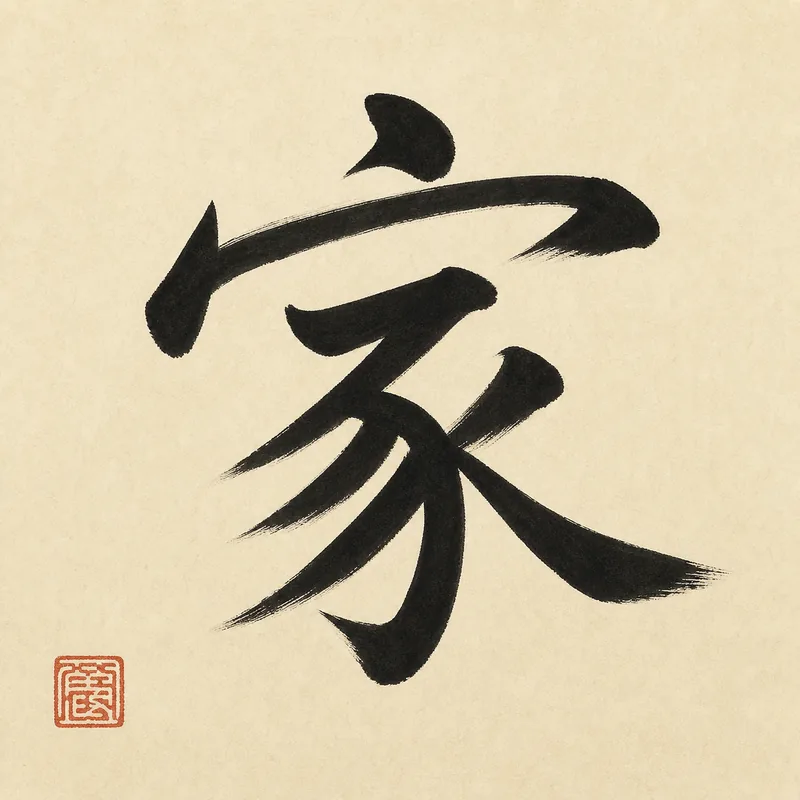
Trace 家 yourself, or watch it drawn
How it's written
The character stacks up in a way you can almost read straight off the page. On top sits 宀, the "roof" radical, a single dot above a wide flat cover that Chinese schoolchildren nickname the "treasure lid." Underneath it goes 豕 (shǐ), the old word for a pig, drawn as a snouted animal up on its hind legs. Ten strokes in all, written top to bottom: the roof first, then the pig tucked safely inside. Best of all, this is one of the characters where the mainland and traditional forms never parted ways, so what you learn here is what you write everywhere, from Beijing to Taipei. Whether that pig is present for its meaning or only for its sound turns out to be a genuinely good question, and the answer is stranger than the pig-in-a-house story everyone repeats.
What it means
家 (jiā) is the word for both your home and the people in it, and Chinese feels no need to split the two. The same character covers the building you live in, the family who lives there, and the warm, portable idea of "home" you get homesick for. It is not the same as fángzi, the word for the physical house, the walls and the mortgage; you go "back home," never back to your "building." Widen it a step and 家 even stands in for the household as a social unit and the relatives who fill it. One small character, quietly doing the work that English spreads across "home," "house," "family," and "household."
- 家庭 — family; household (as a unit)
- 家人 — family members
- 回家 — to go home
- 国家 — country; nation (literally 'state-family')
- 大家 — everyone (literally 'big family')
- 家乡 — hometown; native place
- 搬家 — to move house
- 全家 — the whole family
- 专家 — expert; specialist (literally a 'specialist-house')
Idioms
- 家和万事兴“when the family is harmonious, ten thousand affairs flourish”when a household lives in peace, everything else prospers; still hung on kitchen walls as a blessing.
- 成家立业“start a family, establish a career”to settle into adult life; marrying and building a career were long treated as the twin markers of growing up.
- 四海为家“take the four seas as your home”to be at home wherever you are; to roam the world without a fixed base. (the Book of Han (Han Shu), Annals of Emperor Gao)
- 家喻户晓“understood by every family, known in every household”so widely known that everyone has heard of it.
Right vs wrong forms
| Form | Type | Note |
|---|---|---|
| 家 | simplified ✓ | The everyday form on the mainland, in Singapore, and in Taiwan and Hong Kong alike. 家 was never simplified, so every Chinese-writing region uses this identical form; there is no simplified-versus-traditional decision to make. |
| 傢 | traditional | A rare variant with an added 亻 (person) on the left, seen in a couple of words like 傢俱 (furniture) and 傢伙 (a guy, a gadget). It is never used for family or home; the plain 家 is correct there. |
| 家 (flipped or rotated) | mirrored | Not a real variant. Stencils pulled from low-resolution images sometimes come out mirrored or rotated; check against a dictionary before inking. |
For a tattoo
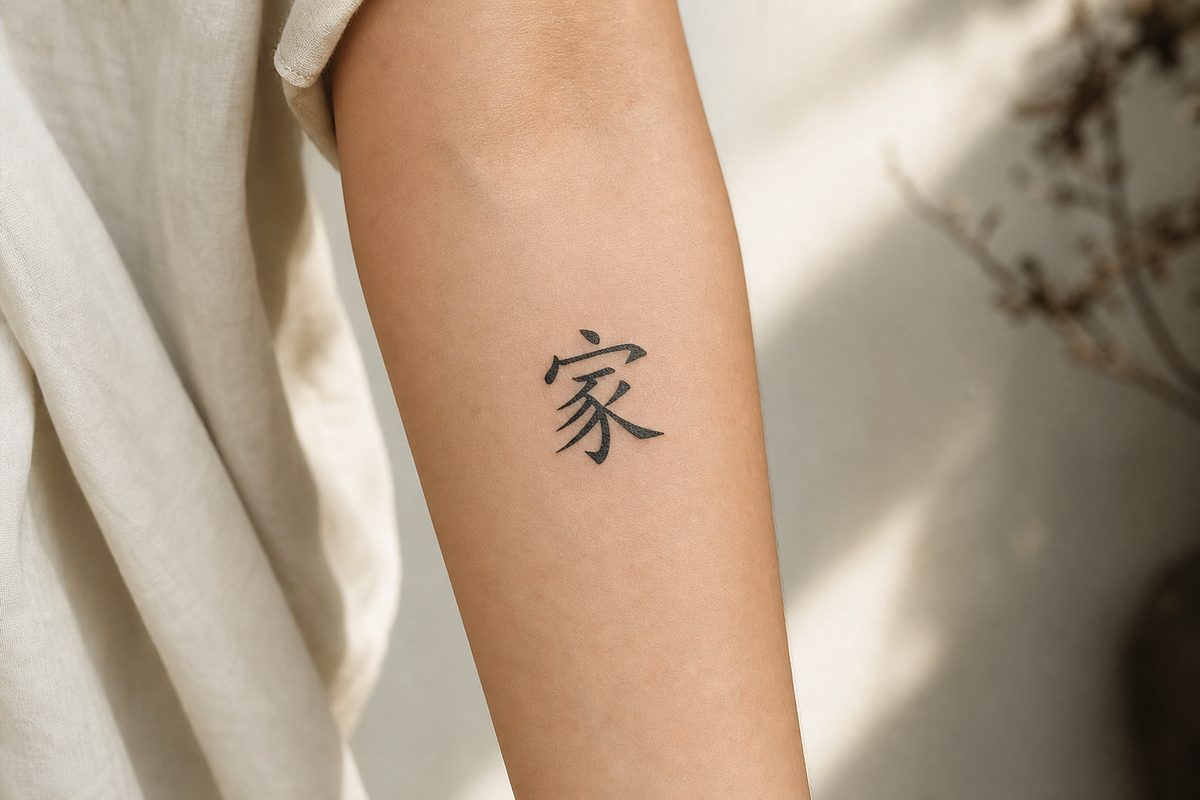
If you are thinking of wearing 家, you have picked one of the easier characters to get right. The best news is that it is identical in simplified and traditional Chinese, so unlike 爱, the character for love, there is no "which version" question to lose sleep over; the 家 you see here is the 家 they write everywhere. It also happens to sit well on skin: the roof caps a tidy, roughly square body, so it balances cleanly on its own and pairs neatly beside a second character if you want a name or another word alongside it. The one real rule is the one every Chinese tattoo shares: check your final stencil against a reliable dictionary, printed at size, before anyone switches on a needle. Low-resolution images get flipped, rotated, or subtly mangled, and a mirrored character reads as a plain mistake to the billion-odd people who can read it. When it truly has to be right, having one native reader nod at it first is the cheapest insurance there is.
Family in life today
The one word that moves a billion people
Nothing shows what 家 means to Chinese people better than what they will do to reach one. Every winter, in the weeks around the Lunar New Year, the entire country tries to get home at the same time, and the result, called the Spring Festival travel rush, is reliably the largest movement of human beings on the planet. In 2026 it was expected to generate something like nine billion trips across about forty days; on the single busiest day, more than three hundred million trips were logged, as if the entire population of the United States had picked up and moved between breakfast and bed. They are all chasing the same small thing: the reunion dinner, the whole family back around one table for a single meal. High-speed trains, weeks of refreshing the ticket app, twelve-hour standing-room journeys, all of it to be home for supper.
"Fam": how 家 took over the internet
Young Chinese may still spend the heavy words sparingly, but online they have made it wonderfully casual. Livestreamers open by calling their entire audience 家人们 (jiārénmen), "family," the way an American host might say "you guys" or "fam," and the warmth is half the sales pitch, because you do not haggle with family. From there it spun into one of the internet's favorite openers, a hook that means roughly "fam, does anyone else get this?" and launches any story the poster is sure everyone will recognize. A word for blood relatives now belongs to a few million strangers in a comment section, and nobody finds that strange.
A home you can carry
For all the pull of one particular house, 家 travels surprisingly well. Ask where someone is from and you are really asking for their jiāxiāng, their "home village," a word soaked in more nostalgia than any tidy English equivalent; a person can spend thirty years in Shanghai and still call a town they left as a teenager home. The character is generous in other directions too. The ordinary word for "everyone" is built straight on it and means, if you take it apart, "the big family," so to address a room of strangers in Chinese is technically to call them one large household. And the character has always been a favorite to fold into a given name, quietly wishing the child a settled, well-anchored life.
Want a Chinese name built around 家, or the character that best matches a meaning you have in mind? Our Chinese name generator pairs the sound of your own name with a real, well-omened character.
Where the character comes from
Now, about that pig. Every beginner is told the same charming story: a home is a roof with a pig underneath because a settled family kept livestock, so a full pen meant food, wealth, and domestic bliss. It is a lovely idea, and it may even be half true, but the oldest dictionary in China tells a cooler one. Open the Shuowen Jiezi, the first Chinese dictionary, compiled around the year 100, and it defines 家 simply as "a dwelling," built from the roof 宀 for its meaning and from 豭 (jiā), a word for a boar, for its sound; the pig, in other words, is mostly there because it rhymed. Not everyone accepted this even in imperial times: the great Qing-dynasty scholar Duan Yucai found the sound-only reading clumsy and argued the character first meant the place where you kept pigs, only later stretching to cover the people who lived alongside them. Modern paleographers, looking at oracle-bone forms that plainly show an animal under a roof, mostly land on the sound reading anyway: 家 and 豭 have been near-homophones for three thousand years, so a boar makes a perfectly serviceable phonetic. The neat "pig equals wealth equals home" version turns out to be folklore. The truth, a homophone hiding in plain sight for three millennia, is the better story anyway.
History & roots
Why a country is a "state-family"
Here is a piece of the language that quietly reveals how China has understood itself for two thousand years. The ordinary word for a country is 国家 (guójiā), literally "state-family," the word for the state and the word for the family bolted together. That is no accident. The philosopher Mencius, writing in the fourth century BCE, laid out the logic plainly: the root of the realm lies in the state, the root of the state lies in the family, and the root of the family lies in the self. The family was seen as the state in miniature, and the state as the family grown large.
The ladder from self to the whole world
The most famous version of that idea is a single, endlessly quoted chain from the Confucian classic known as the Great Learning. To bring peace to the world, it argues, you must first govern your state well; to govern your state, first bring order to your family; to order your family, first cultivate yourself. Run the ladder the other way and it reads as a promise: put yourself right and an ordered family follows, then a well-run state, then a world at peace. The family sits on the second rung, the hinge between private virtue and public order. For most of Chinese history, being a good son or daughter was not a soft domestic nicety; it was treated as basic training for everything larger.
Every school of thought was a "house"
The character has one last career worth knowing. When China's great age of philosophy got going, each rival school came to be called a 家, a "house" or lineage, and the whole dazzling argument among them is still remembered as the Hundred Schools of Thought, the hundred houses. It is the same move English makes in speaking of a "school" of painters or a "house" of design, a family you enter by conviction rather than by blood. It never quite stopped, either: modern Chinese still tacks the same character onto a craft to name a master of it, so that the words for a writer and a painter are, literally, "houses" of their art.
Questions people ask
What is the Chinese symbol for family?
It is 家 (jiā). Helpfully, it is written exactly the same way in both simplified and traditional Chinese, so there is only one form to learn. The same character means both 'home' and 'family', the place and the people in it.
Why is there a pig in the Chinese character for family?
Because 家 is built from a roof, 宀, sitting over 豕, an old word for a pig. The popular explanation is that a home was where you kept livestock, so a pig meant a settled, prosperous household. The oldest dictionaries, though, suggest the pig is mainly there for its sound: the boar-word 豭 sounded almost identical to jiā. Charming folklore versus likely phonetics, and the debate is genuinely unsettled.
Is the Chinese symbol for family the same in simplified and traditional?
Yes. 家 was never simplified, so mainland China, Taiwan, Hong Kong, and Singapore all write it identically. Unlike 爱 (love), there is no simplified-versus-traditional version to choose between.
What's the difference between 'family' and 'household' in Chinese?
家 (jiā) is the broad word for home and family, the place and the people and the feeling all at once. 家庭 (jiātíng) is more specific: the family as a social unit, closer to 'household'. For 'my family members' you would reach for a related compound, jiārén.
How do you say 'home' or 'go home' in Chinese?
'Home' is 家 (jiā). 'To go home' is huíjiā, literally 'return home'. Note that you go back home, not back to your fángzi, the physical house; 家 carries the belonging, not just the building.
Is the Chinese symbol for family a good tattoo?
It is one of the safer choices. It means home and family, it is identical in simplified and traditional, and its roof-over-a-square shape balances well as a single design. Just check the final artwork against a dictionary so it is not accidentally flipped or rotated.
Why does the Chinese word for 'country' contain 'family'?
Because the word literally joins 'state' (国) and 'family' (家). In classical thought the family was the state in miniature and the state the family enlarged; Mencius said the root of the state lies in the family. The word still carries that idea two thousand years later.
What else does the Chinese character for family mean?
Quite a lot. It means home and household, it turns any craft into its master (the words for a writer and a painter are both built on it), and it once named each school of philosophy, which is why the classical thinkers are remembered together as the 'Hundred Schools of Thought'.
Sources
- Zdic (zdic.net): the dictionary entry for 家 (Shuowen Jiezi, etymology, Duan Yucai's note)
- Wiktionary: 家 (glyph origin, oracle-bone forms, phono-semantic analysis)
- The Great Learning, in the Book of Rites (Chinese Text Project, ctext.org)
- Mencius, Li Lou I (Chinese Text Project, ctext.org)
- Chunyun, the Spring Festival travel rush (Wikipedia)
- The World of Chinese: gamer and livestream slang, incl. 家人们 (2022)
- Hundred Schools of Thought (Wikipedia)
Make Family your own
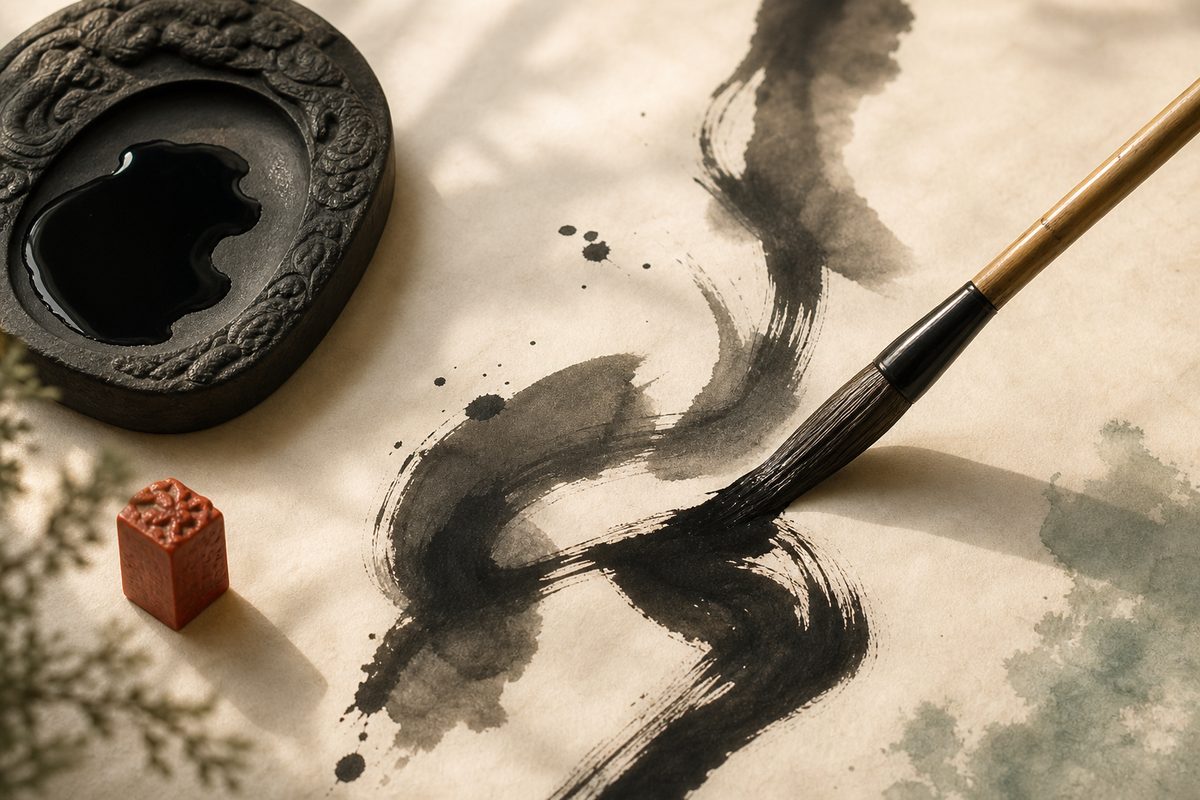
See 家 in calligraphy
From ancient seal script to flowing cursive. Pick a look before a tattoo or a card.
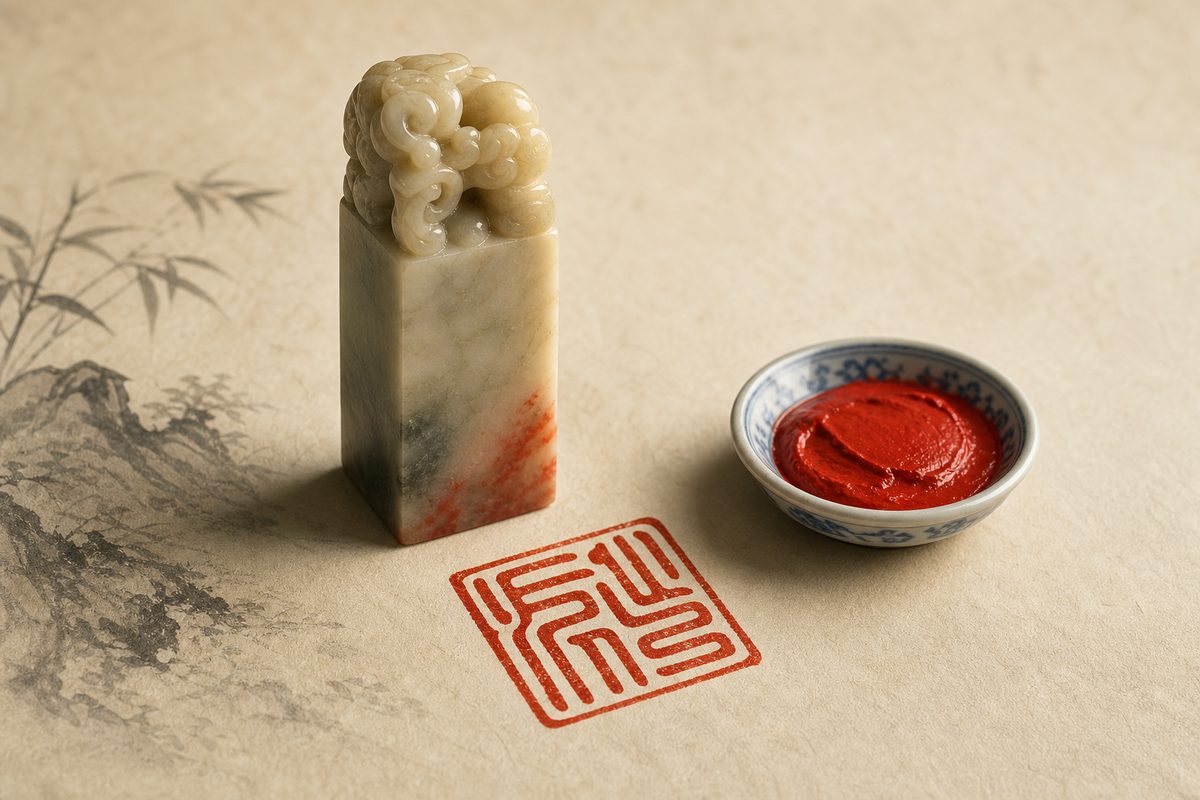
Get a Chinese name
A name matched to the sound of yours, with a meaning that fits.
Try the Chinese Gender Predictor
A different corner of Chinese culture: the old Qing-palace birth chart, worked out from your lunar birth date, with the math shown and its coin-flip odds honestly weighed.
Related: love · peace · friendship · strength
By Julian 祝君瑜 · sourced from the classics and from modern life · updated 2026-07-07