Chinese Symbol for Peace (和): Meaning and Origin
The Chinese symbol for peace is 和 (hé, said a bit like 'huh'), and unlike most famous characters it looks exactly the same in simplified and traditional writing. There is a catch, though, and it matters before you ink anything: it really means harmony, or concord. Peace as in 'no more war' is a different word, hépíng; peace as in 'safe and sound' is píng'ān. For the single-character idea most people are chasing, 和 is the one you want.
- Strokes
- 8
- Radical
- 口 (mouth)
- Formation
- Phono-semantic compound
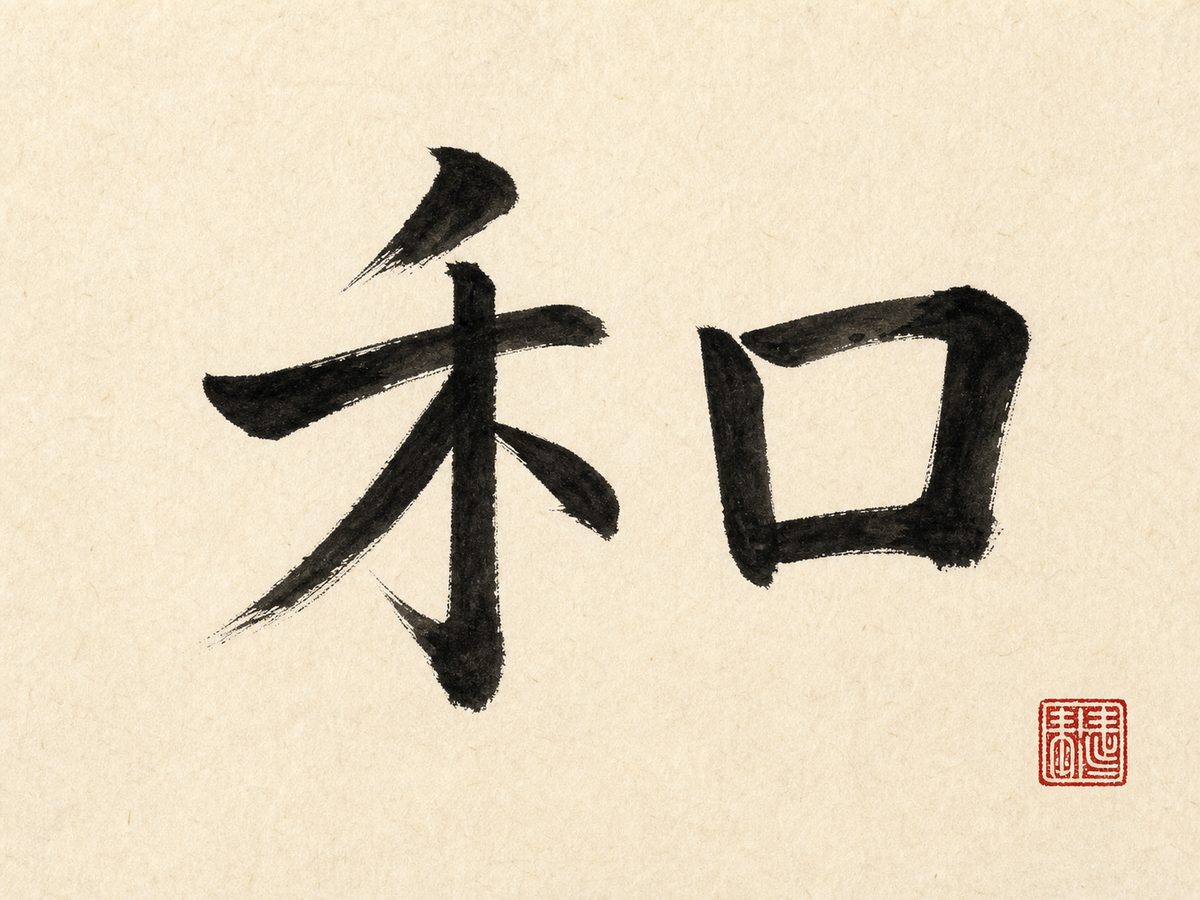
Trace 和 yourself, or watch it drawn
How it's written
和 is a tidy character to write: eight strokes, two parts, sitting side by side. On the left is 禾, a stalk of grain bending under its ripe head; on the right is 口, a mouth, drawn as a simple open box. You write the whole thing left to right, finishing the grain before you start the mouth, which is the natural order for almost every left-and-right character. It is tempting to read those two parts as a little picture: grain plus mouth equals food in the mouth equals a full belly equals contentment and peace. That story is all over the internet, and it is charming, and it is not what actually happened (the real account is just below). For getting the strokes in the right order, though, "grain beside a mouth" is a perfectly good memory hook. As a curiosity, the oldest Chinese dictionary lists the two parts the other way around, mouth on the left and grain on the right, a mirror of today's layout. The modern order is the one to learn.
What it means
和 (hé) is the word Chinese reaches for when things fit together: people getting along, a group in agreement, sounds blending, weather that is neither too hot nor too cold. Its center of gravity is harmony and concord rather than the political "peace" an English speaker might expect, and that gap is the single most useful thing to understand about the character. English makes one word, "peace," cover a small crowd of ideas. Chinese hands you a different word for each. 和 (hé) is harmony, the fit between things. 和平 (hépíng) is peace as the absence of war, the diplomat's word, the one you see in "world peace." 平安 (píng'ān) is peace as safety and well-being, the "safe and sound" you wish a traveler. Behind those sit 安 (ān), the building block for anything safe, calm, or settled, and 平 (píng) on its own, meaning level, even, or calm. So harmony is what a temple bell carries, hépíng what a peace treaty declares, and píng'ān what a grandmother wishes a traveler heading out the door.
| Word | What it says | Where it lives |
|---|---|---|
| 和 (hé) | Harmony, the fit between things | What a temple bell carries |
| 和平 (hépíng) | Peace as the absence of war | What a peace treaty declares |
| 平安 (píng'ān) | Safety and well-being, "safe and sound" | What a grandmother wishes a traveler |
| 安 (ān) | The building block for safe, calm, settled | Inside 平安 and the words around it |
| 平 (píng) | Level, even, calm | On its own, and inside both words above |
和 is also a quiet shape-shifter. Read hé, it is harmony. Read hè, it means to join in or echo a song, the sense hiding inside the old saying about a tune so lofty that almost no one can sing along. Read huó or huò, it means to mix or blend, the word for kneading dough or making up a medicine. And at a mahjong table, read hú, it is the triumphant cry for a winning hand. Every one of those readings circles the same idea you will meet in the etymology below: voices and things answering one another, coming into accord.
- 和平 — peace (as the opposite of war)
- 和谐 — harmony, harmonious
- 温和 — mild, gentle, moderate
- 和睦 — on good terms; a harmonious household
- 和气 — amiable, good-natured
- 平和 — calm, mild, even-tempered
Idioms
- 和而不同“harmonious, yet not the same”to get along without having to agree on everything; genuine unity that leaves room for difference. (the Analects (Book 13))
- 和光同尘“soften the glare, merge with the dust”to keep a low profile; not to flaunt your gifts, but to blend in with ordinary people. (the Dao De Jing)
- 曲高和寡“the loftier the tune, the fewer sing along”work so highbrow that almost no one can appreciate it. Note the 和 here is read hè, 'to join in singing.' (Song Yu, 'In Reply to the King of Chu' (Warring States era))
- 政通人和“government running smoothly, the people in harmony”good governance and a contented society; a place that is well-run and at peace. (Fan Zhongyan, 'Record of Yueyang Tower' (1046))
- 和衷共济“of one heart, crossing the river together”to pull together and help one another through hard times. (the Book of Documents)
Right vs wrong forms
| Form | Type | Note |
|---|---|---|
| 和 | simplified ✓ | The standard form, and here is the surprise: it is identical in simplified and traditional Chinese. There is no dropped-heart drama like the character for love, where 愛 loses its heart to become 爱. What you write is what everyone from Beijing to Taipei writes. |
| 龢 | traditional | An archaic variant that carried the older 'musical harmony' sense, built from a set of reed pipes. It is effectively retired from modern writing and survives mainly in historical personal names. Do not use it as a stand-in for 和. |
| 和 (flipped or rotated) | mirrored | Not a real variant. Stencils pulled from low-resolution images sometimes come out mirrored or rotated, and a reversed 和 reads as an obvious error to anyone literate. Check against a dictionary before inking. |
For a tattoo
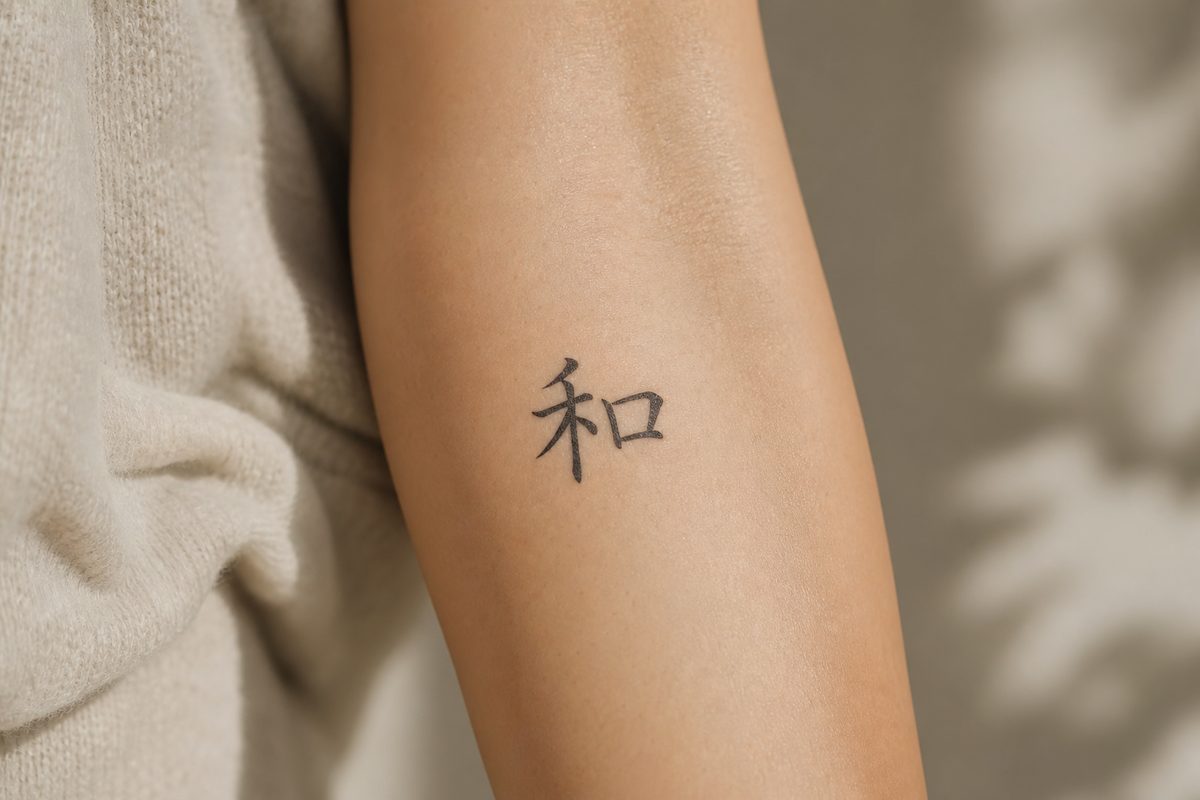
If you are getting a peace tattoo, the choice of character matters more than the artist's line-work, and it is an easy one to get wrong. For the single-character idea of inner peace, calm, and harmony, you almost certainly want 和. What you probably do not want is hépíng, the specific, formal word for peace as the opposite of war: a fine sentiment, but it reads on skin more like a diplomatic slogan than a personal quality, and it is two characters, not one. If the feeling you are after is closer to "come home safe," the word to look at instead is píng'ān. One reassurance: 和 is identical in simplified and traditional Chinese, so there is no wrong regional version to fret over, which is not true of every character. The real risk is mechanical. Stencils pulled from low-resolution images get flipped or rotated surprisingly often, and a mirrored 和 reads as a plain mistake to anyone who can actually read it. Print your reference at full size, check the strokes against a dictionary, and have one Chinese-reading friend glance at it before the needle comes out.
Peace in life today
"Harmonious society," and how it became a joke
和 spent most of the 2000s as the most political character in China. In 2004, at a major Party meeting, and again in a 2005 speech, President Hu Jintao made 和谐社会, the "harmonious society" (héxié shèhuì), his signature slogan, a promise to smooth over the inequalities that breakneck growth had opened up. For a few years the word for harmony was on every banner and news bulletin in the country. Then the internet got hold of it, and produced some of the sharpest slang the Chinese web has ever made. When a post or a video was deleted by the censors, netizens started saying it had been 被和谐, "harmonized" (bèi héxié): my comment got harmonized, my account got harmonized. Officialdom's favorite virtue had been turned into a wry verb for censorship. Then it went one better. The word for harmony, héxié, sounds almost exactly like héxiè, the everyday word for "river crab," 河蟹, differing only in the tone on the last syllable. So the humble river crab became the mascot of the censor. Cartoon crabs scuttled across Chinese forums, everyone understood precisely what they meant, and no filter could ban a picture of a crab. It is one of the great jokes of the modern Chinese internet, and it works entirely because two ordinary words happen to sound the same.
The sayings people actually live by
Step away from politics and 和 turns into one of the warmest, most everyday words there is, threaded through the little proverbs Chinese households run on. A harmonious family makes everything else possible: jiā hé wàn shì xīng, "when a family is at peace, all things prosper," is the one framed on the living-room wall. In business and in arguments, the counsel is yǐ hé wéi guì, "take harmony as the thing to prize," a line lifted straight from the Analects (more on that below). Shopkeepers like hé qì shēng cái, "a friendly manner brings wealth," though that one is worth flagging honestly as a modern, popular coinage rather than an ancient proverb: it turns up in a Lu Xun story from the 1920s, not in the classics. And when tempers fray, the goal is xīn píng qì hé, to be "calm in heart and even in breath," level-headed and unruffled. The same character 和 keeps surfacing. So does its cousin from the peace-word family, in the blessing you send with anyone leaving the house: yī lù píng ān, "safe the whole road," which reaches for píng'ān, the safety word, not 和.
A name that means harmony
和 is a real given-name character, chosen roughly the way English-speaking parents might pick Grace or Serenity: it wishes gentleness, concord, and an even temper on the child. It reads as calm and civilized rather than showy, which is why it turns up in the names of scholars and officials, and why the archaic musical twin 龢 lingered in names like Weng Tonghe long after it left ordinary writing. The most famous names built on 和, though, are Japanese. Japan borrowed the character wholesale (read "wa") as shorthand for group harmony and for anything traditionally Japanese, and it even names the imperial eras: 昭和 (Shōwa, "bright harmony") was the long reign of Hirohito, and 令和 (Reiwa, "beautiful harmony," drawn from an eighth-century poetry anthology) is the current era, begun in 2019 and announced on front pages around the world. As a given-name element (read "kazu") 和 also sits inside everyday names like Kazuko.
Curious what 和, or the character that best fits a quality you have in mind, would look like in a real Chinese name? Our Chinese name generator matches the sound of your own name to a well-omened character.
Where the character comes from
Open the Shuowen Jiezi, the first Chinese dictionary, compiled around the year 100, and the folk story about grain and full bellies quietly falls apart. The dictionary does not file 和 under "grain" at all. It files the character under 口, the mouth, and glosses it with two words meaning "to respond, to answer in accord." The grain element, 禾, is there only for its sound: this is what scholars call a phono-semantic compound, a mouth (the meaning) paired with a grain-stalk that simply told an ancient reader how to pronounce it. The Qing-dynasty commentator Duan Yucai, whose annotated edition of the Shuowen is still the standard, spells out the same reading: mouth for the sense, grain for the sound. So the harmony here was never about a satisfied stomach. It was about voices. The clearest proof is a nearly forgotten twin character, 龢, which the same dictionary glosses as "to attune, to bring into tune," and which is built not from a mouth but from 龠, a picture of a set of bound reed pipes. That twin was the original word for musical harmony, the sound of pipes tuned to one another, and 和 borrowed its job so completely that the older form all but vanished, surviving today mostly inside old personal names like that of the Qing statesman Weng Tonghe. Harmony, in other words, began as a musical idea: separate voices answering each other and landing in tune. Everything the character later came to mean, from a peaceable family to a well-run state, grows out of that one image.
History & roots
"Harmony is the thing to prize"
The most quoted line about 和 sits near the start of the Analects, and it belongs not to Confucius himself but to one of his disciples, the man James Legge calls "the philosopher You." "In practising the rules of propriety," he says in Legge's translation, "a natural ease is to be prized." The phrase Legge renders as "a natural ease" is 和, harmony, and this is the line behind the everyday saying about taking harmony as the thing to prize. But the disciple immediately adds a warning the fridge-magnet versions always drop: harmony chased for its own sake, "without regulating it by the rules of propriety," will not do either. Harmony is the goal, but it is not the same as everyone meekly going along to get along. Which happens to be the whole point of the next famous line.
Harmony is not sameness
Twelve books later comes the four-character phrase Chinese thinkers have been polishing for two and a half thousand years: 和而不同. Legge translates the full sentence, a little opaquely, as "The superior man is affable, but not adulatory; the mean man is adulatory, but not affable." Read the original and the contrast is sharper than that makes it sound. The good person harmonizes but does not merely conform; the small-minded person conforms but is never truly in harmony. It is an argument for real agreement over hollow consensus, for a chord made of different notes rather than everyone humming the same one. Chinese writers still reach for 和而不同 to defend disagreement and difference: you can get along, it says, without pretending to be identical.
The harmony that holds up the universe
The boldest claim for 和 comes from the Doctrine of the Mean, a short, dense classic beloved of later Confucians. Before the feelings stir, it says, the mind rests in a state Legge calls Equilibrium; once they are roused and act in due measure, "there ensues what may be called the state of Harmony." Harmony here is not mere social smoothness but emotional balance, feeling the right thing to the right degree. Then the text goes cosmic. "Let the states of equilibrium and harmony exist in perfection," Legge translates, "and a happy order will prevail throughout heaven and earth, and all things will be nourished and flourish." Get the balance right inside yourself, the argument runs, and you fall into step with the workings of the universe. That is a great deal of weight for one eight-stroke character to carry.
Above heaven and earth, people getting along
Mencius, the great follower of Confucius, hands 和 one last promotion. Ranking the ingredients of success, he lays them out in ascending order: "Opportunities of time vouchsafed by Heaven are not equal to advantages of situation afforded by the Earth," Legge translates, "and advantages of situation afforded by the Earth are not equal to the union arising from the accord of Men." Good timing loses to good ground; good ground loses to people pulling together. The word for that highest factor is 人和, human harmony, and Mencius, writing about war and statecraft, puts it flatly above anything heaven or earth can offer. Twenty-three centuries on, Chinese coaches, generals, and executives still quote the line to make the same point: get your people in accord and you can give up every other advantage and still win.
The Daoist version: dim your own glare
The Confucians made 和 a public virtue. The Daoists gave it a quieter, more inward turn. The Dao De Jing advises the sage to "attemper his brightness, and bring himself into agreement with the obscurity" of others, in Legge's rendering, a line that later condensed into the idiom 和光同尘, softening your light to merge with the dust. Where Confucian harmony means tuning a whole society, Daoist harmony means not standing out, dimming your own glare so as not to jar with the world around you. Same character, two very different pieces of advice: lead the chorus, or blend into it.
Questions people ask
What is the Chinese symbol for peace?
The character most people mean is 和 (hé), which really translates as harmony or concord. One handy quirk: it is written exactly the same in simplified and traditional Chinese, so there is no wrong version to worry about. If you specifically mean peace as the opposite of war, that is the two-character word 和平 (hépíng); peace as in safe and well is 平安 (píng'ān).
What's the difference between the Chinese words for 'harmony' and 'peace'?
和 (hé) on its own means harmony or getting along, and it is the single character people usually want for the general idea of peace. 和平 (hépíng) is a specific two-character word meaning peace as the absence of war, the term used in diplomacy and in the phrase for 'world peace.' For a tattoo or a piece of art, 和 is almost always the better pick; 和平 reads more like a political slogan.
Does the Chinese symbol for peace mean 'peace' or 'harmony'?
Harmony, first and foremost. The oldest Chinese dictionary, the Shuowen Jiezi (around the year 100), files 和 under the 'mouth' radical and explains it as responding or answering in accord, an idea rooted in music and blending voices, not in politics. English speakers reach for it as 'peace' because harmony and peace overlap so much, but the core sense is things fitting together. For peace as no-war, the word is 和平 (hépíng).
Is the Chinese symbol for peace a good tattoo?
It is a popular and safe choice if the meaning you want is inner peace, calm, and harmony. Two practical notes. First, prefer the single character 和 over 和平 (hépíng), which specifically means political or anti-war peace and reads like a slogan on skin. Second, 和 is identical in simplified and traditional Chinese, so your only real risk is a stencil that comes out flipped or rotated; check it against a dictionary before inking.
What does the Chinese saying 'harmony is precious' mean?
It means roughly 'harmony is the thing to prize,' and it comes from the Analects. In James Legge's translation the line reads, 'In practising the rules of propriety, a natural ease is to be prized.' It is spoken not by Confucius but by one of his disciples, and the fuller passage adds a caveat that is usually left off: harmony still has to be kept in check by good manners and rules, not pursued blindly.
Sources
- The Analects, Xue Er (Chinese Text Project, ctext.org)
- The Analects, Zi Lu (Chinese Text Project, ctext.org)
- The Doctrine of the Mean, Zhong Yong (Liji, Chinese Text Project, ctext.org)
- Mencius, Gong Sun Chou II (Chinese Text Project, ctext.org)
- Dao De Jing (Chinese Text Project, ctext.org)
- The Book of Documents, Counsels of Gao Yao (Chinese Text Project, ctext.org)
- Shuowen Jiezi dictionary entry for 和 (Chinese Text Project)
- Zdic (zdic.net): the dictionary entry for 和 (Shuowen, Kangxi, readings)
- Zdic (zdic.net): the dictionary entry for the archaic variant 龢
- China Media Project: 'Harmonious Society' (the CCP dictionary)
- Euphemisms for Internet censorship in China (Wikipedia)
- Record of Yueyang Tower, Fan Zhongyan (Gushiwen)
Make Peace your own
See 和 in calligraphy
From ancient seal script to flowing cursive. Pick a look before a tattoo or a card.
Get a Chinese name
A name matched to the sound of yours, with a meaning that fits.
Try the Chinese Gender Predictor
A different corner of Chinese culture: the old Qing-palace birth chart, worked out from your lunar birth date, with the math shown and its coin-flip odds honestly weighed.
Related: love · family · friendship · happiness
By Julian 祝君瑜 · sourced from the classics and from modern life · updated 2026-07-16