Chinese Symbol for Friendship (友): Meaning and Origin
The Chinese symbol for friendship is 友 (yǒu), and it is one of the oldest and plainest characters there is: a picture of two hands, reaching the same way. Four strokes, written identically in simplified and traditional, it stretches all the way from a casual buddy to the rarest thing of all, a zhīyīn, "the one who knows your tune," the friend who understands you without a word.
- Strokes
- 4
- Radical
- 又 (right hand)
- Formation
- Ideographic compound
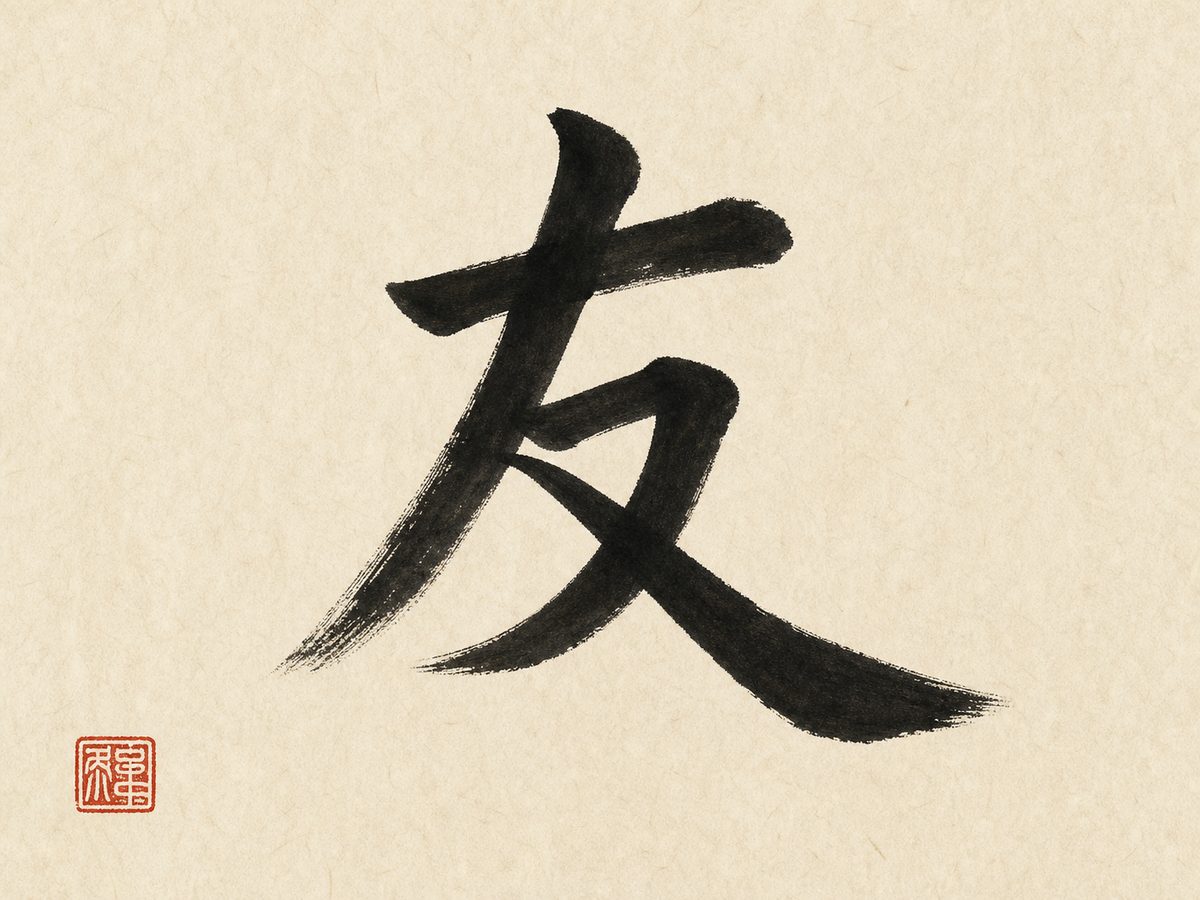
Trace 友 yourself, or watch it drawn
How it's written
友 is four strokes, and for once the character means almost exactly what it looks like. It is two hands. The top is a hand drawn as a short stroke crossed by a down-left sweep; below it sits 又, which is itself an old drawing of a right hand. Two hands, one above the other, both reaching the same direction, which is about as neat a picture of friendship as writing gets. You write it top to bottom, the upper hand first. There is no simplified-versus-traditional trap here, either. 友 is written exactly the same on both sides of the strait, so unlike a character such as 龙 / 龍, there is no second version to weigh up.
What it means
友 (yǒu) is the friend idea at its most basic: a companion, an ally, someone on your side. English leans on the one word "friendship," where Chinese spreads the idea across a small family of terms, and it is worth knowing which is which. 友 on its own is the bare root, "friend" or "friendly," and the single character people usually want as a symbol. Stack it into 友谊 (yǒuyì) and you get friendship as a noun, the bond itself, the word that goes on a certificate or a treaty. 友情 (yǒuqíng) is the feeling, the warmth between friends. And the ordinary word for "a friend," the one you actually say out loud, is 朋友 (péngyou). For a tattoo or a piece of art, 友 is the clean single-character choice; the longer words are for sentences.
| Word | What it names | Where it belongs |
|---|---|---|
| 友 (yǒu) | The bare root: friend, friendly | A single-character symbol or tattoo |
| 朋友 (péngyou) | A friend, the everyday word | The one you actually say out loud |
| 友谊 (yǒuyì) | Friendship, the bond itself | A certificate or a treaty |
| 友情 (yǒuqíng) | The feeling, the warmth | Between the friends themselves |
- 朋友 — friend (the everyday word for a friend)
- 友谊 — friendship (the bond, as a noun)
- 友情 — the feeling of friendship; friendly affection
- 友好 — friendly, amicable (as between people or nations)
- 好友 — a good/close friend; a 'friend' on social media
- 队友 — teammate (a friend on your team)
Idioms
- 高山流水“high mountains and flowing water”a rare, deep understanding between friends; the bond of a true zhīyīn. From the tale of Bo Ya and Zhong Ziqi. (the Liezi (列子, Tang Wen) and Lüshi Chunqiu)
- 管鲍之交“the friendship of Guan and Bao”a friendship of total trust and generous understanding, standing by each other through everything. (Sima Qian, Records of the Grand Historian (史记))
- 君子之交淡如水“a gentleman's friendship is bland as water”the best friendships are plain and undemanding, not built on flattery or favors, and so they last. (the Zhuangzi (庄子, Shan Mu))
- 患难之交“friends in adversity”friends who have been through hardship together, the kind whose loyalty has been tested. (a classical set phrase)
- 莫逆之交“friends who never cross each other”the closest of friends, completely of one mind, with no friction between them. (the Zhuangzi (庄子, Da Zong Shi))
Right vs wrong forms
| Form | Type | Note |
|---|---|---|
| 友 | simplified ✓ | The standard form, and a rare piece of good luck: it is written exactly the same in simplified and traditional Chinese. There is no second version to choose between, in Beijing, Taipei, or anywhere else. |
| 友 (flipped or rotated) | mirrored | Not a real variant. Low-resolution stencils sometimes come out mirrored, and a reversed 友 reads as an obvious error to anyone literate. Check against a dictionary before inking. |
For a tattoo
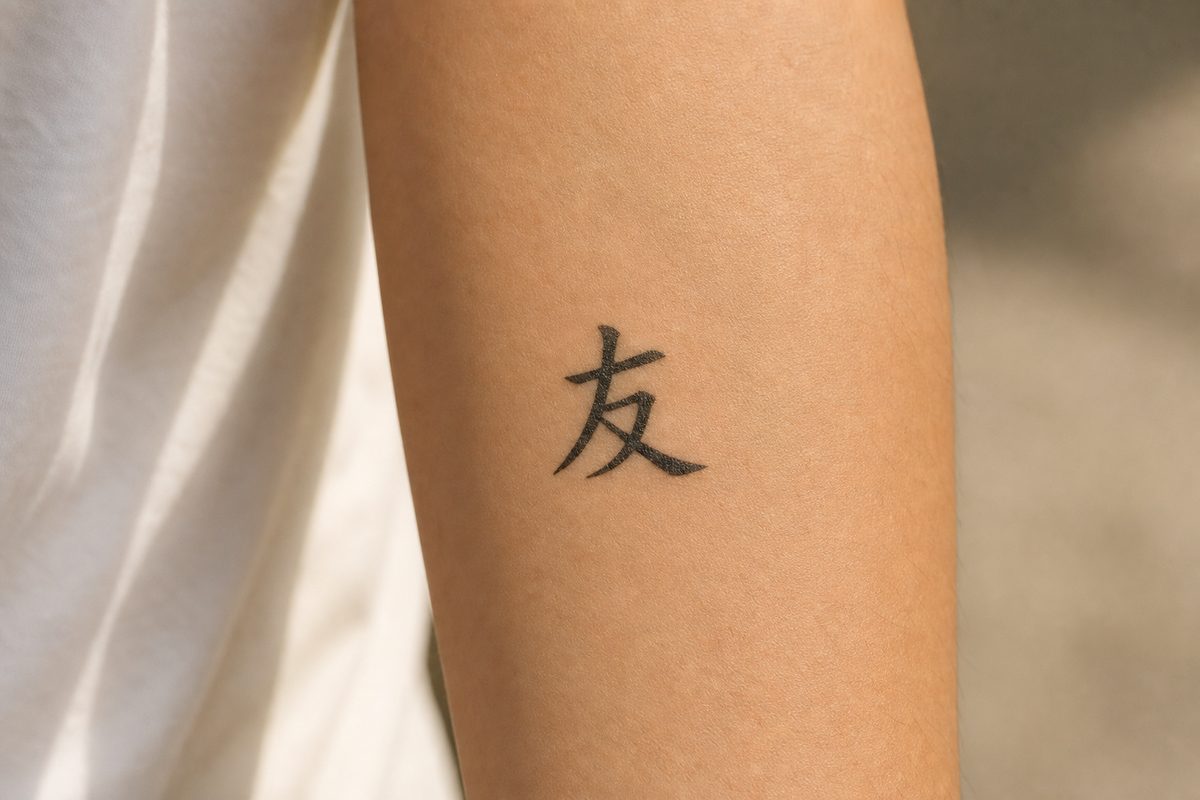
Friendship tattoos are usually a pair thing, two friends getting matching ink, and 友 is a clean, meaningful choice for it: it reads unambiguously as "friend," with a warm, uncomplicated sense. One reassurance up front: 友 is written identically in simplified and traditional Chinese, so there is no regional version to get wrong, which is not true of many characters. A couple of notes. The single character 友 says "friend / friendly"; if you want the fuller noun "friendship," that is the two-character 友谊 (yǒuyì). Some pairs like to split a two-character phrase between them, one character each. And as with any Chinese tattoo, print the reference at full size, check it against a dictionary, and have someone who reads Chinese confirm it is not flipped or rotated before the needle goes in.
Friendship in life today
Life inside the friend-circle
If you want to see how central friends are to daily Chinese life, open WeChat. Its social feed, where a billion people post photos, gripes, and humblebrags, is called the péngyouquān, literally the "friend-circle." To be in someone's friend-circle is to be in their life; to be quietly dropped from it is a small modern heartbreak. The entire social internet, in other words, is filed under the word for friend.
Bros, besties, and plastic sisters
Spoken Chinese has warm, specific slang for the kinds of friends. A close male buddy is a gēmenr, roughly "bro"; an inseparable female best friend is a guīmì, a bestie. And the internet, ever sharp, coined a phrase that translates to "plastic sisterhood," for friends who are all sweetness in public and knives in private, the fake-friend group given a perfect, brittle name.
The friendship boat that keeps capsizing
In 2016 the Chinese web produced one of its stickiest jokes, a line that translates to "the ship of friendship capsizes at the slightest thing." It began as a cartoon and became the template for a whole genre of memes about how easily a friendship can be sunk by something petty, one friend graduating first, say, and over the little boat goes. It is affectionate and faintly cynical at once, which is exactly the register modern friendship jokes live in.
A name that means friend
友 is a genuine given-name character, chosen to wish a child warmth and loyalty. Its most famous bearer is the Cantopop legend Jacky Cheung, 张学友, one of Hong Kong's "Four Heavenly Kings" and a singer so dominant he is nicknamed the "God of Songs." His given name, 学友, means, almost sweetly, "study-friend," a schoolmate. Curious what your own name would look like as a Chinese one built the same way, from sound and a well-omened meaning?
Build a Chinese name from the sound of your own name and a well-omened meaning.
Where the character comes from
The two-hands reading is not a folk invention; it is what the oldest sources say. The Shuowen Jiezi, the first Chinese dictionary, compiled around the year 100, glosses 友 as "those of the same aim are friends," and then explains the character flatly: it is built "from two hands," clasped in mutual good faith. The oracle-bone and bronze forms from three thousand years ago back this up, showing two right hands side by side, fingers pointing the same way. That image, two hands moving together, quietly sets the terms for the whole idea. A Chinese friend, in the oldest sense of the word, is not just someone you like. It is someone whose hand is pointed the same direction as yours, who shares your aim and pulls with you toward it.
History & roots
What Confucius said about friends
Friendship sits, quite literally, at the opening of the Chinese classical tradition. The very first passage of the Analects, the third line Confucius is recorded as speaking, is about friends. In James Legge's translation it runs, "Is it not delightful to have friends coming from distant quarters?" It is the sentence Chinese schoolchildren memorize first, and it makes the arrival of a far-off friend one of life's defining joys. Confucius was clear-eyed about choosing them, too: elsewhere in the same book he advises, again in Legge's words, "Have no friends not equal to yourself," a bracingly practical note on keeping company that lifts you rather than drags you down.
The one who knows your tune
The most beautiful Chinese idea about friendship is the zhīyīn (知音), "the one who knows the sound." It comes from the story of Bo Ya, a master of the ancient zither, and a woodcutter named Zhong Ziqi. When Bo Ya played a piece imagining high mountains, Ziqi heard the mountains in it; when he played of rushing water, Ziqi heard the great rivers. No one else had ever truly heard what Bo Ya was playing. When Ziqi died, the story goes, Bo Ya smashed his zither and never played again, because the one person who understood his music was gone. That is what a zhīyīn is: not just a friend, but the rare soul who understands you completely. The idiom for it, "high mountains and flowing water," still means precisely that kind of understanding.
Guan and Bao
For loyalty, the model is the friendship of Guan and Bao, recorded in the Records of the Grand Historian. Guan Zhong and Bao Shuya were friends from youth, and Bao Shuya stood by Guan Zhong through failed ventures, cowardice in battle, and worse, always reading his friend's actions in the most generous light, and later gave up his own position to recommend Guan Zhong as prime minister. Guan Zhong's famous verdict was, "It was my parents who gave me birth, but it was Bao Shuya who truly knew me." Their names are still shorthand for a friendship of complete mutual trust.
Bland as water
A quieter note comes from the Daoist philosopher Zhuangzi: the friendship of a gentleman, he wrote, is "bland as water." It sounds like faint praise and is actually the highest kind. A friendship that runs on flattery, favors, and rich dinners, Zhuangzi warns, curdles the moment the favors dry up; one that is plain and undemanding as water lasts a lifetime. Chinese culture has prized the understated, low-maintenance friendship ever since.
Questions people ask
What is the Chinese symbol for friendship?
It is 友 (yǒu), a four-stroke character that pictures two hands reaching the same way. It means friend or friendly, and it is written identically in simplified and traditional Chinese. For the fuller noun 'friendship,' Chinese uses the two-character word 友谊 (yǒuyì), but the single symbol most people want is 友.
Does the Chinese character for friendship mean 'friend' or 'friendship'?
Both, loosely, but strictly it leans to 'friend / friendly.' 友 (yǒu) on its own is the root idea. Friendship as a noun, the bond itself, is 友谊 (yǒuyì); the feeling is 友情 (yǒuqíng); and the everyday word for 'a friend' is 朋友 (péngyou). As a single-character symbol or tattoo, 友 is the clean choice.
Is the Chinese friendship character a good tattoo?
Yes, and it is a popular choice for matching tattoos between friends. 友 reads clearly as 'friend,' its meaning is warm and uncomplicated, and it is identical in simplified and traditional Chinese, so there is no regional version to get wrong. Just have a Chinese reader confirm the stencil is not flipped before you ink it.
What does 'high mountains and flowing water' mean?
It is the idiom gāo shān liú shuǐ (高山流水), and it means a rare, deep understanding between friends. It comes from the story of the zither master Bo Ya and the woodcutter Zhong Ziqi, the only person who truly heard the mountains and rivers in his music. When Ziqi died, Bo Ya broke his instrument and never played again. A friend like that is a zhīyīn, 'one who knows the tune.'
What does the Chinese 'friendship boat' meme mean?
It refers to yǒuyì de xiǎochuán shuō fān jiù fān (友谊的小船说翻就翻), 'the ship of friendship capsizes at the slightest thing.' It began as a 2016 cartoon and became a whole genre of jokes about how easily a friendship can be sunk by something petty. It is the internet's affectionately cynical take on how fragile friendships can be.
Sources
- Shuowen Jiezi dictionary entry for 友 (Chinese Text Project)
- The Analects, Xue Er — friends from afar; choosing friends (Chinese Text Project, Legge translation)
- The Liezi, Tang Wen — Bo Ya and Zhong Ziqi (高山流水 / zhīyīn) (Chinese Text Project)
- Records of the Grand Historian, Guan-Yan liezhuan — 管鲍之交 (Chinese Text Project)
- The Zhuangzi, Shan Mu — 君子之交淡若水 (Chinese Text Project)
- Zdic (zdic.net): the dictionary entry for 友 (definitions, readings)
- Jacky Cheung 张学友 — Cantopop singer, one of the 'Four Heavenly Kings' (Wikipedia)
Make Friendship your own
See 友 in calligraphy
From ancient seal script to flowing cursive. Pick a look before a tattoo or a card.
Get a Chinese name
A name matched to the sound of yours, with a meaning that fits.
Try the Chinese Gender Predictor
A different corner of Chinese culture: the old Qing-palace birth chart, worked out from your lunar birth date, with the math shown and its coin-flip odds honestly weighed.
By Julian 祝君瑜 · sourced from the classics and from modern life · updated 2026-07-16