Chinese Symbol for Listening (聽): Ear, Eyes, and an Undivided Heart
The Chinese symbol for listening is 听 (tīng, said like "ting") in everyday simplified writing, but the version people fall in love with is the traditional 聽: twenty-two strokes that pack an ear, a pair of eyes, and a heart into a single character. A thousand leadership seminars have built a slide out of that anatomy. The slide is half right, the true story is better, and the simplified form has a confession to make involving a mouth and an ax.
- Strokes
- 7
- Radical
- 口 (mouth)
- Formation
- Phono-semantic compound
Trace 聽 yourself, or watch it drawn (the full traditional form)
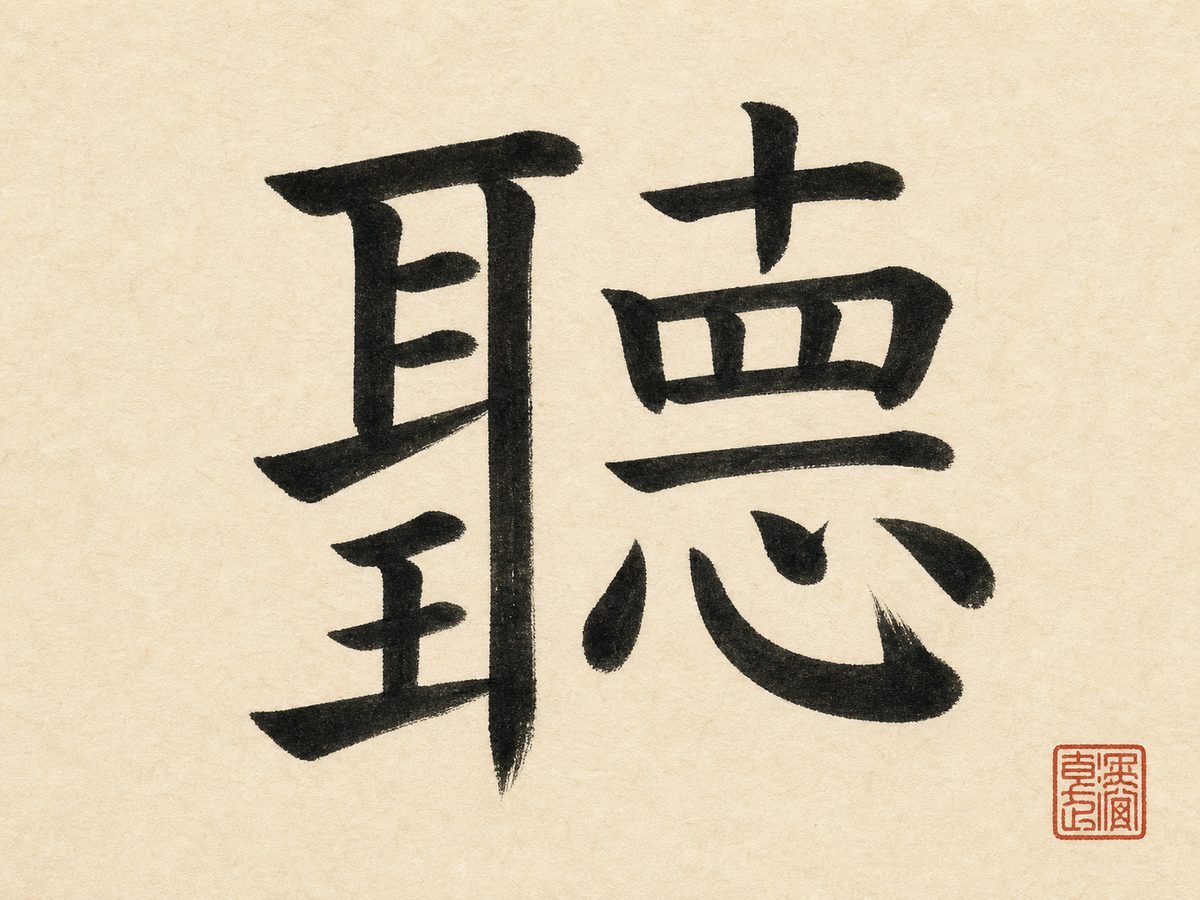
How it's written
The everyday 听 is quick to write: seven strokes, a mouth 口 on the left and 斤, an ax, on the right. Why listening should involve a mouth and an ax is a fair question, and the honest answer is that it shouldn't; the next section explains the borrowing. The traditional 聽 is the one worth slowing down for. On the left, an ear 耳 stands over a component the seminar posters read as "king" 王; on the right sit what look like ten 十 eyes 目 above one 一 heart 心. Twenty-two strokes, written left column first, top to bottom. The numbers on the card above describe the everyday seven-stroke form; the full traditional form is the copybook challenge in the tracer beside it. If you want to see it flow from a real brush instead, type 聽 into our calligraphy tool and watch all twenty-two strokes behave.
What it means
听 is the everyday verb for using your ears: you 听 music, 听 a lecture, 听 the rain. From there it stretches, the way "listen" does in English when a parent says "you never listen," into heeding and obeying; the dictionaries give "to comply" as a core sense, and a child described as 听话 (tīnghuà), "listens to speech," is simply a well-behaved one. Classical Chinese kept a useful partner word: 闻 (wén) meant to hear, the passive arrival of sound, while 听 meant to listen, the active turning of attention. Modern Mandarin reassigned 闻 mostly to smelling, which means a two-thousand-year-old verb for hearing now handles noses, and 听 does nearly all the ear's work alone.
- 听话 — obedient, well-behaved; lit. 'listens to speech'
- 好听 — nice-sounding, pleasant to hear
- 听说 — 'I hear that...'; to know by hearsay
- 倾听 — to listen attentively, lean in and listen
- 听众 — audience, listeners
- 听力 — listening ability; the listening section of an exam
- 动听 — moving to hear, melodious
- 听劝 — willing to take advice (internet tag)
Idioms
- 道听途说“heard on the road, told on the road”hearsay passed along without checking; Confucius called it virtue thrown away. (the Analects, Yang Huo)
- 兼听则明,偏信则暗“listen to all sides and see clearly; trust one side and stay in the dark”the classic maxim of balanced judgment, from the counsel tradition of Tang minister Wei Zheng. (attributed to Wei Zheng's counsel to Emperor Taizong)
- 洗耳恭听“wash one's ears and listen respectfully”'I'm all ears': playful, courteous full attention.
- 言听计从“every word heeded, every plan followed”to trust someone so completely you follow all their advice.
Right vs wrong forms
| Form | Type | Note |
|---|---|---|
| 聽 | traditional ✓ | The full form, standard in Taiwan and Hong Kong: ear 耳 plus the old 'straight heart' 悳. The one to choose when the anatomy is the point, as in calligraphy. |
| 听 | simplified ✓ | The mainland standard: a borrowed old character built from mouth 口 and 斤, whose original meaning was 'smiling.' Quick to write, nothing to do with ears. |
| 聴 | simplified | Japan's own simplification (shinjitai). It kept the ear and the heart but dropped other strokes; correct in Japanese, not standard in Chinese. |
Listening in life today
The word your childhood was built on
If you grow up in a Chinese-speaking family, one compound follows you from the crib to the classroom: 听话 (tīnghuà), literally "listen to speech," meaning to be good, to do as you are told. A 听话 child is the standing compliment; its absence is the standing complaint. The word folds a whole theory of childhood into two syllables, in which goodness and listening are the same activity, and it is the first place most people meet the idea that in Chinese, listening shades naturally into heeding.
The internet decides to take advice
Then, in the 2020s, China's internet took the obedience out of listening and made it a game. On the lifestyle platform Xiaohongshu, users began posting photos of themselves, their haircuts, their travel plans, tagged 听劝 (tīngquàn), "willing to take advice," promising to actually do what the comments said. The tag became one of the platform's defining trends; Sixth Tone reports that brands and even city tourism bureaus now run "listen to advice" campaigns, overhauling products because the comment section asked. China Daily found foreigners joining in, posting their outfits to be renovated by strangers. It is the national talent for listening-as-doing, running in reverse: this time the internet talks, and the poster obeys.
When sound is beautiful
The ear also gets the last word on beauty: 好听 (hǎotīng), "good to listen to," is the everyday verdict on a song, a voice, or a name. Tell Chinese friends your new Chinese name and the highest casual praise it can earn is that it is 好听. The opposite, 难听, "hard to listen to," retires bad karaoke and unkind nicknames alike.
Where the character comes from
Start with the version you may have met in a conference room: to listen like the Chinese, says the slide, use your EAR, treat the speaker like a KING, watch with TEN EYES, and give your ONE HEART. It is a lovely sermon, and as philology it is roughly half true. Here is the scholars' ledger, part by part.
| Part | The seminar version | What scholars say |
|---|---|---|
| 耳 (ear) | Listen with your ear | Correct: the ear is the character's radical and its subject |
| 王 ("king") | Treat the speaker as royalty | Not a king: it is 壬 (tǐng), a sound component that tells you how to say the word |
| 十 + 目 ("ten eyes") | Watch the speaker attentively | Part of 悳, "a straight heart": the eye sits above the heart in that old character |
| 一 + 心 ("one heart") | Give undivided attention | Genuinely there: the heart anchors 悳, so wholehearted attention really is built in |
The right side of 聽, in other words, is not a checklist but a single old character: 悳, a heart looking straight ahead, the same "straight heart" that grew into 德, virtue. The Shuowen Jiezi, China's first dictionary, parses 聽 exactly this way and glosses it simply as "to heed." So the character does not say "treat the speaker like a king." It says something quietly better: listening is an ear attached to an upright heart, virtue's next-door neighbor. As for the simplified 听, the reformers of the 1950s did not invent it; they borrowed an existing rare character, a mouth 口 with an ax-shaped sound component 斤, whose original dictionary meaning was "the look of smiling." The ear worked overtime for three thousand years and was replaced by a grin.
History & roots
Sixty years to grow a good ear
When Confucius summed up his life in the Analects, he gave each decade one achievement: at thirty he stood firm, at forty he had no doubts, at fifty he knew the will of heaven. Sixty got this: "At sixty," in James Legge's translation, "my ear was an obedient organ for the reception of truth." Not his arguments, not his judgments: his ear. In the Confucian ladder of self-cultivation, hearing other people accurately, without flinching or filtering, ranks above knowing heaven's will and just below doing whatever you want without going wrong, which he reserved for seventy. Anyone who has tried to take criticism calmly can confirm the ordering.
Don't listen with your ears
Zhuangzi, the Daoist who never met a faculty he didn't want to dissolve, pushed listening one step further inward. In the chapter Man in the World, he has Confucius (a fictionalized, Daoist-friendly one) coach his disciple: do not listen with your ears but with your mind, and then, in Legge's rendering, "not even for the hearing of your mind, but for the hearing of the spirit." He called this the fasting of the mind: emptying yourself until attention has no static left in it. It reads like a mystical instruction until you remember the traditional character had already taken his side, wiring the heart directly into 聽.
The one who listens to the world
Chinese Buddhism gave listening its patron. Guanyin, the bodhisattva of compassion, is short for Guanshiyin, "the one who perceives the sounds of the world": she is defined not by speaking, judging, or saving on a schedule, but by hearing every cry that rises. The most beloved figure in the Chinese pantheon is, at the level of her own name, a listener. And for the human version of being truly heard, Chinese keeps the word zhīyīn, "the one who knows your sound," a story about a lute player and the friend who understood him that lives on our friendship page.
Questions people ask
What is the Chinese symbol for listening?
In everyday simplified Chinese it is 听 (tīng); the traditional form is 聽. The traditional character famously combines an ear (耳), eye (目), and heart (心) components in one glyph, which is why it is a favorite in calligraphy and in talks about the art of listening.
Is the ear, eyes, heart, and king story about the Chinese listening character true?
Half true. The ear is real, and the heart genuinely anchors the character. But the 'king' 王 is actually 壬, a sound component, and the 'ten eyes' belong to an old sub-character, 悳, meaning 'a straight heart,' the same element that built 德, virtue. The seminar version is a charming memory aid rather than the real etymology.
Why does the traditional Chinese character for listening contain a heart?
Because its right side is the ancient character 悳, 'a straight heart' (an eye looking straight, above a heart), which also evolved into 德, the character for virtue. So in the traditional script, listening is literally an ear joined to an upright heart, which is why the character gets quoted in essays on paying real attention.
What is the difference between the traditional and simplified characters for listening?
Traditional 聽 is twenty-two strokes and contains the ear, eye, and heart components. Simplified 听 is seven strokes, built from a mouth 口 and 斤; it was an existing rare character, originally meaning 'the look of smiling,' that the 1950s reforms borrowed for its sound. Same word, same pronunciation, very different anatomy.
How do you pronounce ting in Chinese?
Tīng sounds like the English 'ting' of a small bell, said on a high, level tone (the first tone). Keep the pitch flat and slightly high, without the falling melody English gives one-syllable words.
What does ting hua mean in Chinese?
Tīnghuà (听话) literally means 'listen to speech' and describes someone, usually a child, who is obedient and well-behaved. In Chinese family vocabulary, being good and listening are close to the same thing, which says a lot about how the culture ranks the skill.
Sources
- Zdic (zdic.net): the dictionary entry for 聽 (Shuowen Jiezi, structure, stroke count)
- Zdic (zdic.net): the dictionary entry for 听 (the borrowed character, originally 'smiling')
- The Analects, Wei Zheng, with Legge's translation (Chinese Text Project, ctext.org)
- The Analects, Yang Huo (Chinese Text Project, ctext.org)
- Zhuangzi, Man in the World, with Legge's translation (ctext.org)
- Guanyin: the name means 'perceives the sounds of the world' (Wikipedia)
- Sixth Tone: brands learn to love the 'listen to advice' trend
- China Daily: foreigners seek advice on Chinese social media (2024)
Make Listening your own
See 听 in calligraphy
From ancient seal script to flowing cursive. Pick a look before a tattoo or a card.
Get a Chinese name
A name matched to the sound of yours, with a meaning that fits.
Try the Chinese Gender Predictor
A different corner of Chinese culture: the old Qing-palace birth chart, worked out from your lunar birth date, with the math shown and its coin-flip odds honestly weighed.
Related: friendship · love
By Julian 祝君瑜 · sourced from the classics and from modern life · updated 2026-07-17