Who writes Jade Almanac
I write Jade Almanac under the name Julian, or in Chinese, 祝君瑜 . It is a pen name, and I chose it the way any good Chinese name is made: a little from the sound, and a lot from the meaning.
From Julian to 祝君瑜
Turning an English name into a Chinese one is the exact thing our name generator does, and it is worth seeing how, because there is a cheap way and a good way. The cheap way is pure sound-alike: characters picked only because they rhyme with "Julian," meaning whatever they happen to mean. The good way catches a thread of the sound, then chooses characters that say something together. So 祝 answers the "Ju" in Julian, and from there I chose the rest for what they mean, not how they sound.
See a name in calligraphy →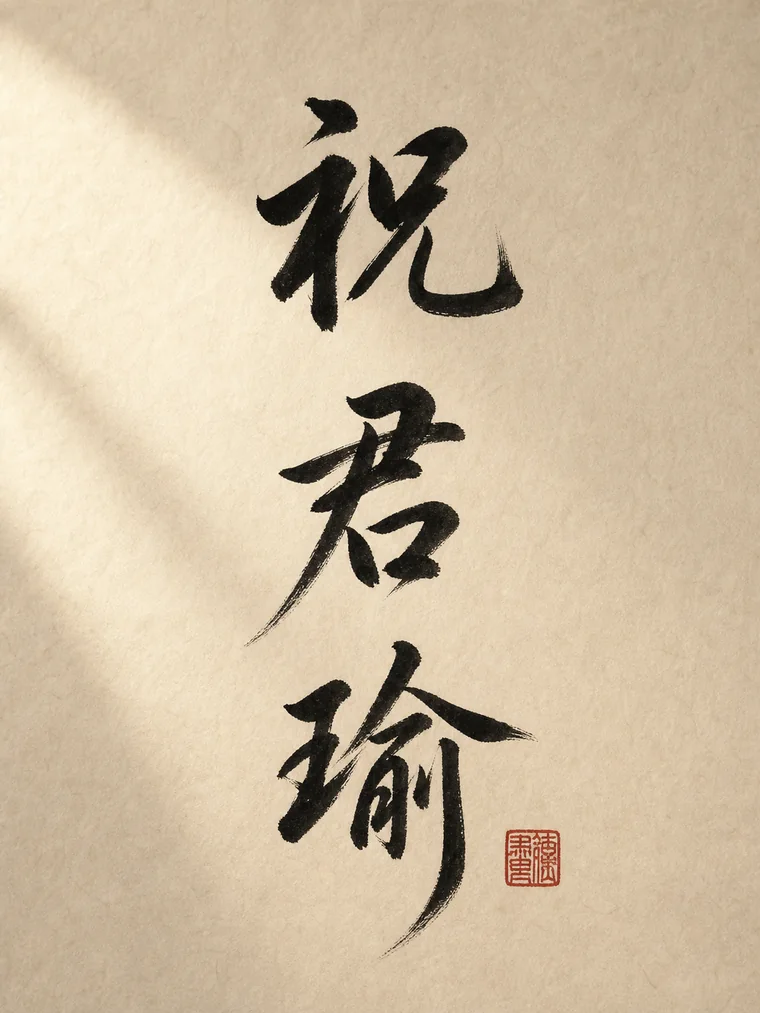
What the name says, and how I'd read yours
Character by character, it leans on the classics:
- 祝 : the ancient invocator, the one who read the heavens and carried words to the spirits.
- 君 : the junzi, the noble-minded person; an old line in the rites has it that "the gentleman measures his virtue against jade."
- 瑜 : the glow of a flawless jade. It is also the jade (玉) in Jade Almanac.
A name is only the first thread, though. Give Jade Almanac a birthday and it reads much further, so here is my own, as a taste. I was born on the Mid-Autumn Festival, 1999: a Rabbit year, and by the old sixty-year reckoning an Earth Rabbit (己卯).
The Rabbit is the zodiac's quiet aesthete: gentle, tactful, a lover of harmony who would rather persuade than push, with dawn for its hour and the east for its direction. Set that on the Earth element, and the soft, cultivating kind of earth at that (己 is garden soil, not mountain rock), and you get someone patient and methodical, happier tending a thing slowly than forcing it. Which is, more or less, the temperament this whole site runs on.
The festival ties it in a bow. Mid-Autumn is the night of the full moon and of the Jade Rabbit, who lives up there pounding the elixir of immortality: a rabbit, made of jade, under the moon. The same jade that sits in my name (瑜) and in Jade Almanac (玉). I did not plan that. The calendar did.
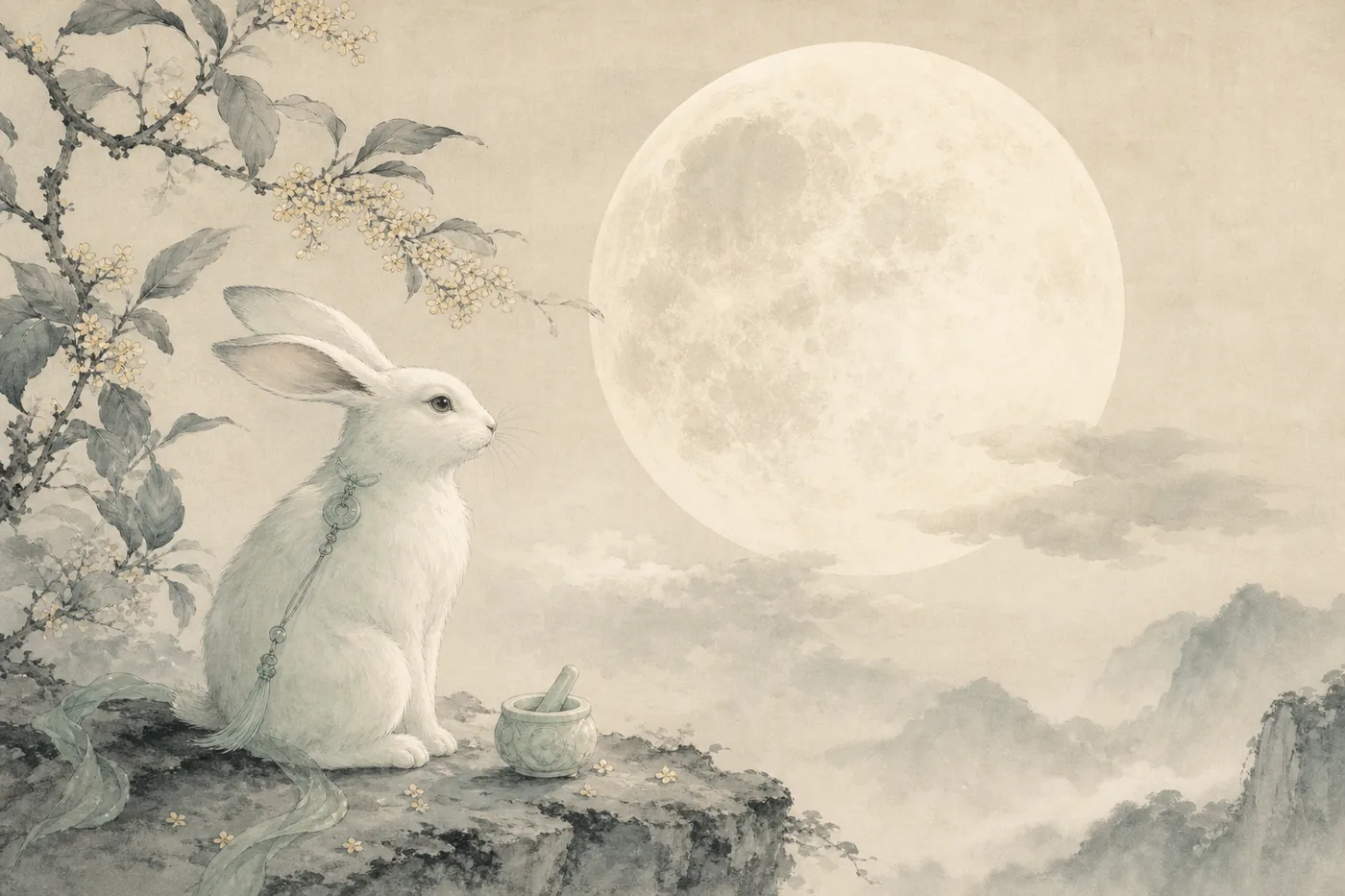
That is the kind of picture the site draws from a single birthday: your sign, your element, and the festival you arrived under, read as one story rather than a horoscope soundbite. Expecting a baby? The Chinese gender predictor reads a due date the same way, legendary chart included. And your own name can be built the same way, sound and meaning together.
Get your own Chinese name →A name that is also a wish
Said aloud, the name keeps a secret — in English you would call it a pun. 祝君瑜 is, syllable for syllable, the sound of a small blessing, , "wishing you joy": only the last character is swapped, the jade of 瑜 for its exact homophone, which means joy. And 君 is not only "the noble one"; it is an old, courteous word for you, the way you would address someone you hold in regard. So 祝君 reads as "(respectfully) wishing you," which in English lands almost exactly on best regards.
Which is why the byline at the foot of every page is quietly doing two things at once. It is my name, and it is a small bow to whoever is reading.
So, best regards,
Julian (祝君瑜)
You can write to me directly at julian@jadealmanac.com.
Why the site is called Jade Almanac
The Chinese name is 玉历 : jade, and a calendar. For centuries the almanac was the one book nearly every Chinese household kept. It was the calendar you consulted with a date in hand: which animal governs this year, which days favor a wedding, when spring actually begins. A book you bring your dates to, and it reads them back to you. Since that is precisely what this site does, the name felt less like branding than like labeling. The jade is the stone the classics reach for when they mean precious and lasting, and it is the same jade that sits in my own name.
One honest footnote, because I would rather you hear it from me. The name has an old namesake: a Qing-dynasty morality tract, the Yuli Baochao, usually translated as the Jade Record and now and then as the "Jade Almanac," which tours the ten courts of the underworld and itemizes the punishments waiting in each. A fascinating text, and a story for the mythology shelf another day, but not this site. Here the gravest fate on record is a tattoo inked from a mirrored stencil.
Why you can trust it
The one thing I will claim plainly: I am a native reader with an international outlook. I can open the Chinese record and read it, then carry it across to a global audience in plain English. That is the gap most English-language writing on Chinese culture cannot cross.
Authority here does not come from a title. It comes from method. Every non-obvious claim is traced to a primary source: the Shuowen Jiezi for a character's origin, the Analects or the Book of Songs for a line of classical text. Where I quote a classical passage in English, I use a named published translation (Anne Birrell for the Classic of Mountains and Seas, Anthony C. Yu for Journey to the West), never a quiet do-it-yourself rendering. Popular but mistaken "folk" explanations I name and correct rather than repeat. And I keep an honest line between what is legend and what is historically recorded.
What this is, and isn't
I treat Chinese culture as something to understand deeply and enjoy, not as fortune-telling sold as fact. Where the site touches divination or the fortune traditions, I present them as living tradition and honest cultural context, and say so plainly. The aim is insight you can trust and a tradition worth knowing, never a prophecy.
A good place to start is the Chinese symbols, where every character gets this treatment in full.
New entries, sourced and read back to you.