Chinese Symbol for Beautiful (美): Meaning and Origin
The Chinese symbol for beautiful is 美 (měi, said like "may"), and it is one of the rare characters that saves you a decision: simplified and traditional Chinese write it exactly the same way. Look closely and it is a sheep, 羊, standing on top of 大, "big." The oldest dictionary in China explains, with complete confidence, that a big sheep is a beautiful thing. Scholars have been arguing about that sheep for the better part of two thousand years.
- Strokes
- 9
- Radical
- 羊 (sheep)
- Formation
- Compound ideograph
Trace 美 yourself, or watch it drawn
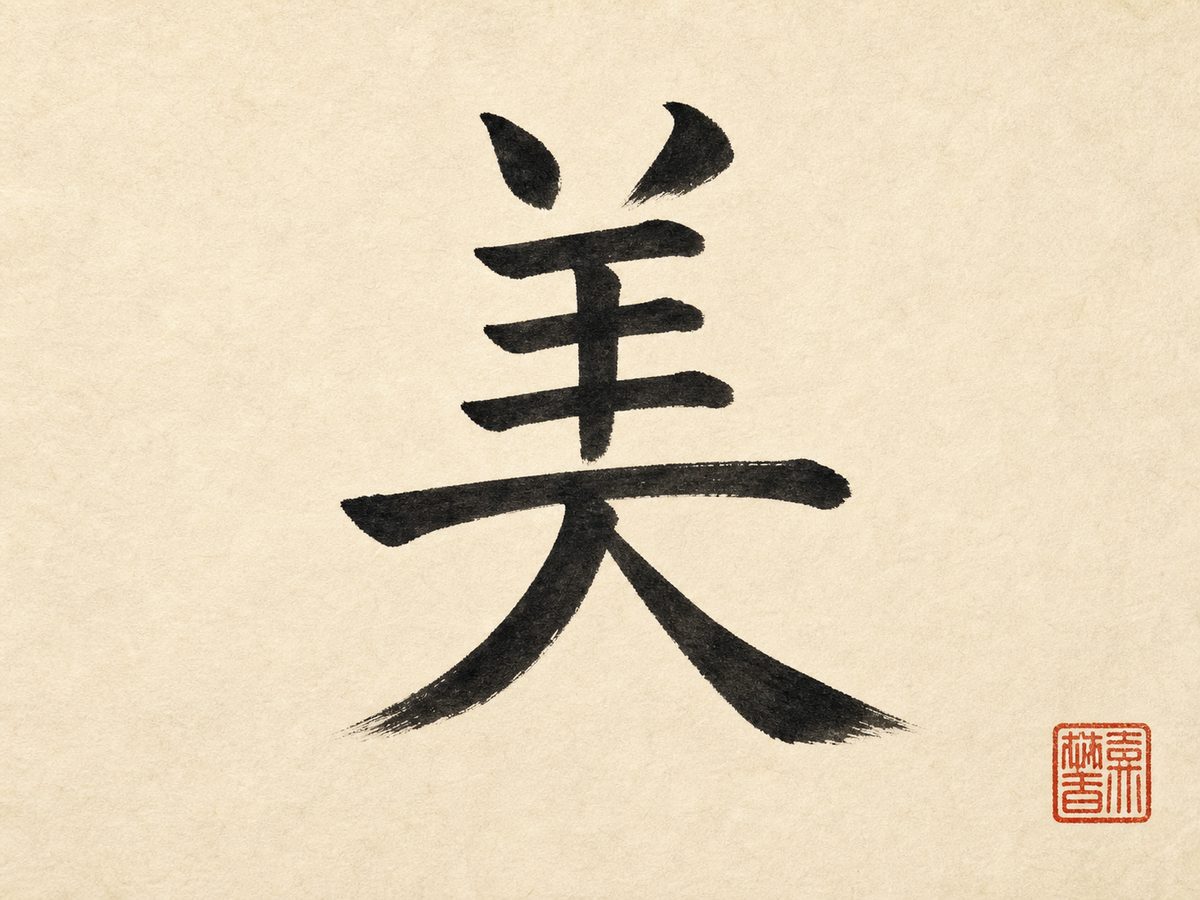
How it's written
美 is nine strokes in two stacked parts. On top sits 羊, the sheep, wearing its two little horns as the first strokes; below it stands 大, "big," which is really a person with arms and legs spread wide. Write the sheep first, top to bottom, and let the person underneath catch it; the central vertical stroke stops inside the sheep and does not spear through into the figure below. As a memory aid you can picture either reading the scholars offer: a sheep so big it is a thing of beauty, or a person wearing a magnificent horned headdress. One of those is probably the true story, and the argument over which is half the fun of the next section. If you want to see the character written with a real brush first, type 美 into our calligraphy tool and compare it across seal, brush, and cursive styles.
What it means
美 is the elevated word for beautiful, and it works harder than its English counterpart. It praises a face, certainly, but also scenery, music, a plan coming together, and, tellingly, food: 美食 (měishí), "beautiful food," just means delicious. For everyday compliments, spoken Chinese usually reaches for lighter words, and the differences are worth knowing before you deploy any of them. 漂亮 (piàoliang) is "pretty," the workhorse for outfits and haircuts; 好看 (hǎokàn) is a casual "good-looking"; 帅 (shuài) is "handsome," for men and for anything done with flair. Calling a person 美 to their face is formal enough to feel slightly literary, which is why the compliment usually arrives packaged as 美女, "beautiful woman," a phrase so worn by daily use that waitresses answer to it.
| Word | Say it | What it praises | Where you'll hear it |
|---|---|---|---|
| měi | may | Beauty at its most elevated: people, places, ideals, food | Writing, compliments with weight |
| měilì | may-lee | "Beautiful," the full formal adjective | Descriptions, essays, song lyrics |
| piàoliang | pyow-lyang | "Pretty": clothes, haircuts, work well done | Everyday spoken compliments |
| hǎokàn | how-kan | "Good-looking," casual and broad | Chat about anything visible |
| shuài | shwye | "Handsome," dashing | Men, and stylish moves of any kind |
- 美丽 — beautiful (the full adjective)
- 美女 — a beauty; also just 'miss'
- 美食 — delicious food, lit. 'beautiful food'
- 美好 — lovely, fine (of times, memories, hopes)
- 完美 — perfect
- 赞美 — to praise
- 美颜 — beauty filter, to 'beautify' a photo
- 美国 — the United States, lit. 'beautiful country'
Idioms
- 沉鱼落雁“sinks fish, fells geese”devastatingly beautiful; from the epithets of the Four Great Beauties, inverting Zhuangzi's original joke. (Zhuangzi, The Adjustment of Controversies)
- 尽善尽美“utterly good, utterly beautiful”flawless; the state of being both perfectly made and perfectly right. (the Analects, Ba Yi)
- 成人之美“complete another's beauty”to help someone achieve a good thing; a gentleman helps others succeed. (the Analects, Yan Yuan)
- 美中不足“within the beauty, a lack”a fly in the ointment; one flaw in an otherwise lovely thing. (Slapping the Table in Amazement (Ming story collection))
Right vs wrong forms
| Form | Type | Note |
|---|---|---|
| 美 | simplified ✓ | Identical in simplified and traditional Chinese, and in Japanese kanji. One form everywhere, which makes reference-checking easy. |
| 羙 | wrong | An old shorthand variant that still lurks in fonts and signage (it doubles as a variant of the character for lamb). Not the standard form; don't ink it. |
| 美 (flipped or rotated) | mirrored | Not a real variant. Stencils pulled from low-resolution images sometimes come out mirrored; check against a dictionary before committing. |
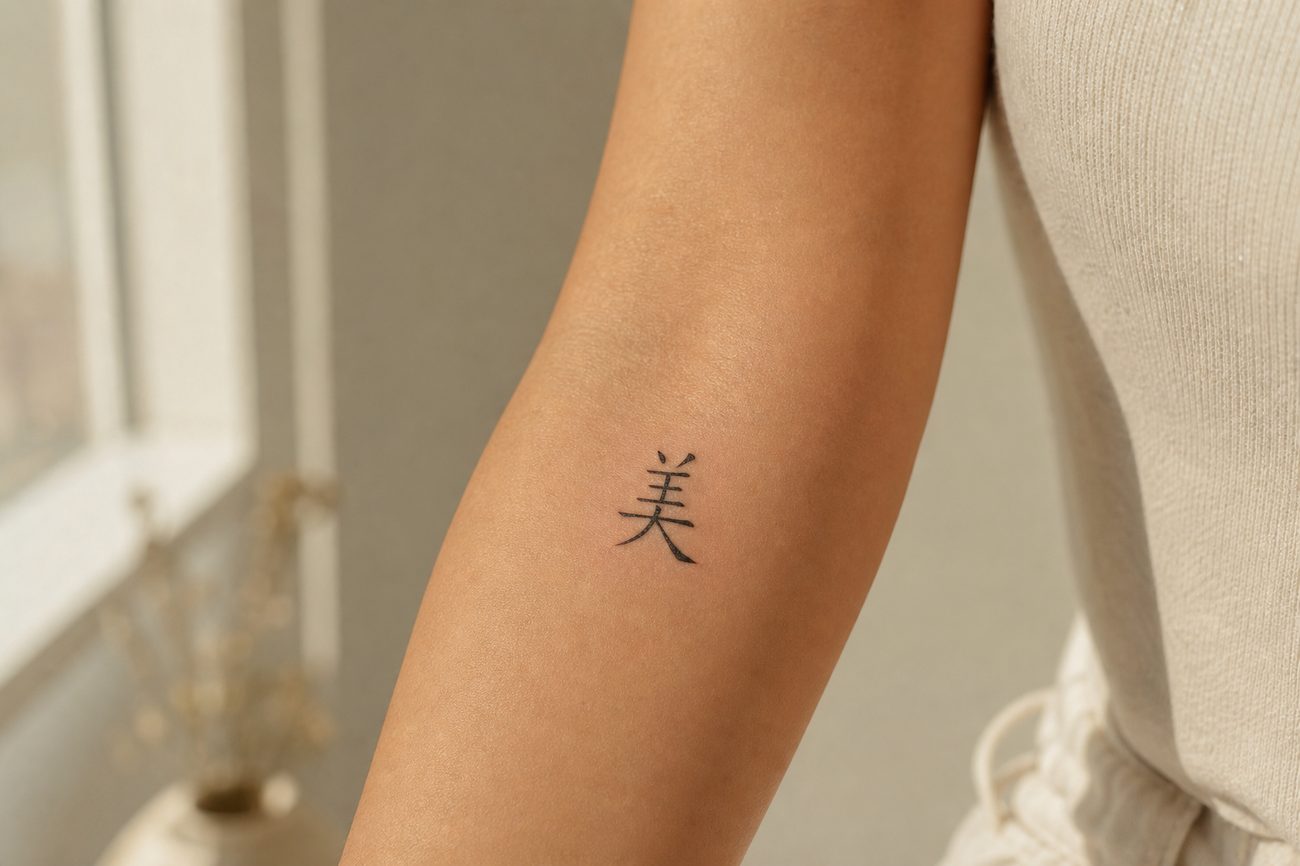
For a tattoo
If you are considering 美 as a tattoo, start with the good news: simplified and traditional Chinese write this character identically, so the choice that complicates other characters simply does not exist here. It is nine strokes, compact and symmetrical, and it stays legible at small sizes better than most characters. The meaning is broad and safely positive: beauty, goodness, and by extension things done admirably well. The risks are the boring, practical kind. Stencils traced from low-resolution images come out mirrored or subtly mangled, stylized fonts sometimes crush the two small horn strokes at the top into an unreadable smudge, and there is an old shorthand variant, 羙, that drifts around fonts and signage but is not the standard character. Print your reference large, compare it against a dictionary entry, and have one Chinese-reading friend nod at it before the needle comes out.
Beautiful in life today
The beautiful country
Open any Chinese newspaper and 美 is everywhere, usually meaning the United States. The Chinese name for America is Měiguó, "beautiful country," and before anyone in Washington takes a bow, the truth: it is a sound-borrow, not a compliment. Nineteenth-century translators rendered "America" phonetically as Měilìjiān, then Chinese did what it does with long foreign names and shortened it to one syllable plus "country." The character 美 got the job because it sounded right, not because anyone had surveyed the scenery. Other nations drew similarly flattering tiles from the same phonetic bag: Germany is Déguó, the "virtue country," and France is Fǎguó, the "law country." Still, Chinese takes the luck of names seriously, and as accidents go, "beautiful country" is the kind you keep.
A compliment, a filter, and a stat
In daily life 美 has quietly become infrastructure. Strangers hail a young woman as měinǚ, "beauty," the way English once used "miss," and the word has been sanded smooth of any actual flirtation. Phone cameras ship with 美颜 (měiyán), the "beautify" filter, switched on by default, and an entire company grew out of the habit: Meitu, literally "beautiful picture," built its selfie-editing empire on the national instinct that a photo is a draft until it has been improved. Internet slang even turned looks into a stat: yánzhí, your "face score," gets rated, compared, and mock-lamented online the way gamers talk about attack points.
A name that travels
美 has been folded into girls' names for centuries, promising beauty the way other name characters promise jade or fragrance. The most famous bearer may be Soong Mei-ling, the formidable Madame Chiang Kai-shek, who addressed the US Congress in 1943 with "beautiful" sitting in the middle of her name. The character emigrated early, too: in Japan it is read "mi" and remains a staple of girls' names there.
Want a Chinese name with 美 in it, or a character matched to what you'd like your name to mean? Our Chinese name generator pairs the sound of your name with a real, well-omened character.
Where the character comes from
The Shuowen Jiezi, China's first dictionary, compiled around the year 100, defines 美 with the cheerful bluntness of a working farmer: beautiful means "sweet," it says, from sheep plus big, because the sheep was the chief of the six domestic animals that ended up on the table. A big sheep is a good dinner; a good dinner is a beautiful thing. Case closed for nearly two millennia, until archaeologists started reading the oracle bones, the oldest Chinese writing we have, and noticed that the earliest 美 does not look much like livestock. It looks like a person, standing tall, wearing a great horned or feathered headdress: someone dressed for a ritual dance. On that reading, beauty in Chinese begins not with dinner but with performance, a shaman in full regalia. The aesthetician Li Zehou, whose book The Path of Beauty set off a nationwide "aesthetics fever" in the 1980s, argued the two stories work together: the sweetness of the senses and the dignity of the ceremony, fused into one character. Dinner or dancing. Chinese beauty never did pick a side.
History & roots
Perfectly beautiful is not perfectly good
Around five centuries before anyone in the West thought to separate the two, Confucius listened to music and drew a line that Chinese aesthetics has walked ever since. Of the ancient Shao music he said, in James Legge's translation, that it was "perfectly beautiful and also perfectly good"; of the martial Wu music, "perfectly beautiful but not perfectly good." The remark, recorded in the Analects, splits beauty from virtue with surgical calm: a thing can dazzle and still be wrong. His verdict on the Shao hardened into the idiom for flawlessness that Chinese still uses, and the underlying point still lands. Plenty of things are perfectly beautiful and not remotely good.
The fish were not impressed
China's most famous compliment began life as a philosophical prank. The Daoist Zhuangzi, writing in the fourth century BCE, named two celebrated beauties and observed, again in Legge's rendering, that they "were accounted by men to be most beautiful, but when fishes saw them, they dived deep in the water from them; when birds, they flew from them aloft." His point was that beauty is relative: the fish are not overwhelmed, they are frightened, because a fish has no use for a human face. Later centuries cheerfully inverted him. Folk tradition assigned each of the Four Great Beauties of Chinese history an epithet in which nature is undone by their looks: Xi Shi made the fish forget to swim and sink, Wang Zhaojun's music brought geese down from the sky, Diaochan (a purely fictional addition) shamed the moon behind the clouds, and Yang Guifei made the flowers curl their petals. The idiom "sinks fish, fells geese" now simply means devastatingly beautiful, which would have amused Zhuangzi: his argument that fish have no taste in women became the highest compliment a woman could receive.
Beauty that keeps quiet
Zhuangzi supplies the other pole of Chinese beauty as well. "Heaven and earth," he wrote, "proceed in the most admirable way, but they say nothing about them": the seasons keep perfect law without discussion, and all things carry their own completeness without a word. That sentence, from the chapter Knowledge Rambling in the North, became something like a design principle. The centuries of landscape painting that leave most of the silk empty, the gardens built to be glimpsed rather than surveyed, the preference for suggestion over statement: all of it descends from the conviction that the greatest beauty does not announce itself.
Questions people ask
What is the Chinese symbol for beautiful?
It is 美 (měi), pronounced roughly like 'may.' It covers beautiful, good, and admirable, and it is written identically in simplified and traditional Chinese. The character stacks 羊 (sheep) on top of 大 (big): the first dictionary explained that a big sheep is a beautiful thing.
How do you pronounce mei in Chinese?
Like the English 'may,' with a dipping tone: měi starts mid, drops, and rises again. It is the third tone, the same contour as in nǐ hǎo.
Is the Chinese symbol for beautiful the same in simplified and traditional Chinese?
Yes. 美 is one of the characters the simplification reforms never touched, so mainland China, Taiwan, Hong Kong, and Japan all write it the same way. For a tattoo, that means there is no simplified-versus-traditional decision to make.
Why is America called the beautiful country in Chinese?
By sound, not by verdict. 'America' was transliterated as Měilìjiān, and Chinese shortened it to Měiguó, 'beautiful country,' keeping the syllable měi because it fit the sound. Germany similarly became the 'virtue country' (Déguó) and France the 'law country' (Fǎguó).
What is the difference between mei and piaoliang?
Piàoliang means 'pretty' and is the everyday spoken compliment for outfits, haircuts, and nice work. Měi is the more elevated, literary word: it praises people but also landscapes, music, ideals, and food. Telling a friend her dress is piàoliang is normal chat; calling something měi gives it weight.
Is the Chinese symbol for beautiful a good tattoo?
It is one of the safer choices: positive meaning, nine compact strokes, and the same form in simplified and traditional Chinese, so it cannot be 'wrong script.' The practical risks are mirrored stencils and over-stylized fonts crushing the small strokes; check the reference against a dictionary and have a Chinese reader confirm it.
Does mei also mean delicious in Chinese?
Effectively, yes. 美食 (měishí), 'beautiful food,' means fine food or delicious cuisine, and 美味 (měiwèi) means delicious flavor. The link is ancient: China's first dictionary defined 美 itself as 'sweet,' reasoning from a well-fed sheep.
Sources
- Zdic (zdic.net): the dictionary entry for 美 (Shuowen Jiezi, readings, stroke count)
- Zdic (zdic.net): the idiom 沉鱼落雁 and its Zhuangzi source
- The Analects, Ba Yi, with Legge's translation (Chinese Text Project, ctext.org)
- Zhuangzi, The Adjustment of Controversies, with Legge's translation (ctext.org)
- Zhuangzi, Knowledge Rambling in the North, with Legge's translation (ctext.org)
- Li Zehou, author of The Path of Beauty (Wikipedia)
- Names of the United States: the Chinese Měiguó (Wikipedia)
- Chinese exonyms: how foreign names are shortened (Wikipedia)
- The Four Great Beauties and their epithets (Wikipedia)
- Meitu, the 'beautiful picture' app company (Wikipedia)
- Soong Mei-ling (Wikipedia)
- Zdic (zdic.net): the variant form 羙
Make Beautiful your own
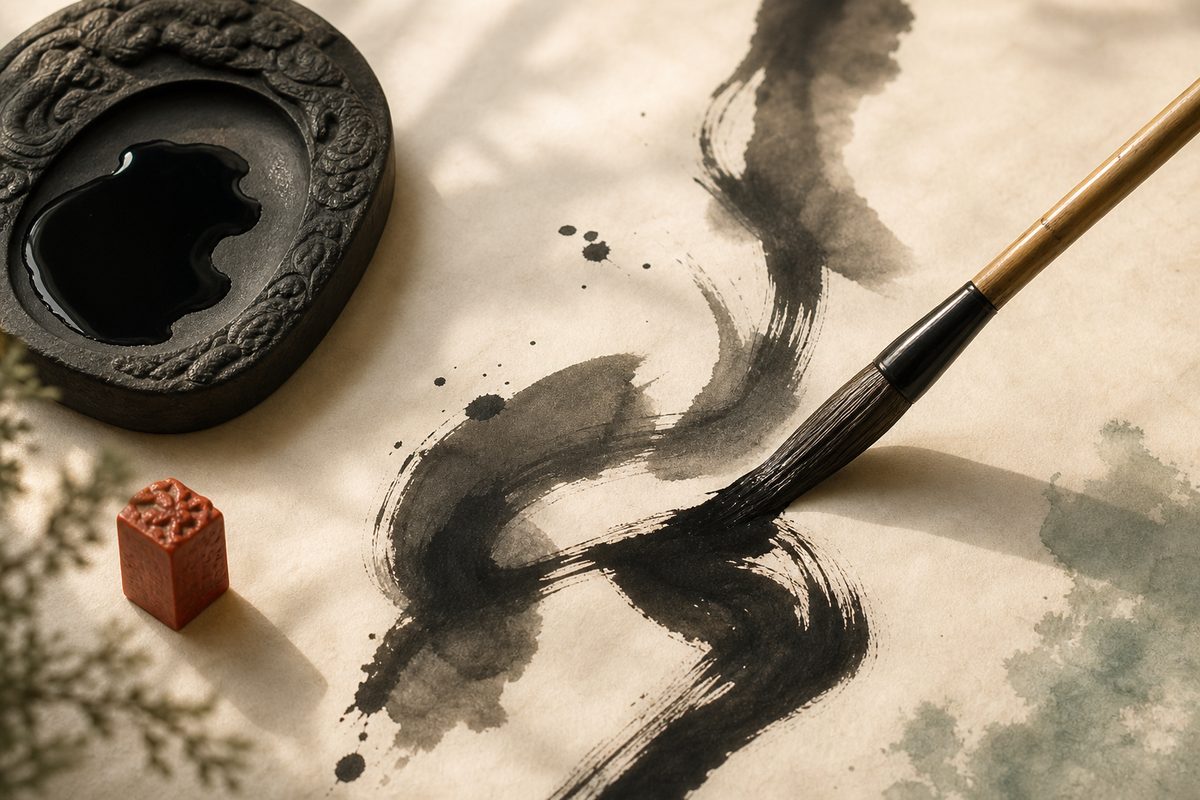
See 美 in calligraphy
From ancient seal script to flowing cursive. Pick a look before a tattoo or a card.
Get a Chinese name
A name matched to the sound of yours, with a meaning that fits.
Try the Chinese Gender Predictor
A different corner of Chinese culture: the old Qing-palace birth chart, worked out from your lunar birth date, with the math shown and its coin-flip odds honestly weighed.
By Julian 祝君瑜 · sourced from the classics and from modern life · updated 2026-07-17