Bazi Calculator
Somewhere on your timeline sits a ten-year stretch the old texts would tell you to spend, not save: your peak years. Maybe they are still ahead of you. Maybe you are standing inside them right now and cannot tell. For a thousand years, bazi, the Four Pillars of Destiny, has claimed it can point to that stretch using nothing but the moment you were born. This calculator runs the thousand-year math on your birthday, then draws your whole life the way traders chart a stock: one candle per year, green when a year lifts you, red when it makes you work, your ten-year chapters shaded behind. People have started calling this a life k-line; ours is the one that shows its math. Ten seconds. And it draws the years you have already lived first, so you can check it before you believe it.
Cast your chart
Four pillars, day master, luck pillars, and your life chart. Free, no sign-up.
Sex is a mechanical input here: the classical rule runs your luck pillars forward or backward depending on it, nothing more. No birth time? Leave it blank and we cast an honest three-pillar chart. Time is read as the local clock time on your birth certificate; we do not adjust for true solar time, and we tell you when that could matter. Nothing you enter is stored.
See it on a life you already know
Talk is cheap; charts are checkable. Three public lives, run through the exact engine you get above. The thirty-second key: every candle is one year (green lifts, red grinds), the shaded bands are ten-year luck cycles, and the red seal stamps the strongest stretch. Now verify every claim against the record before you trust it with yours:
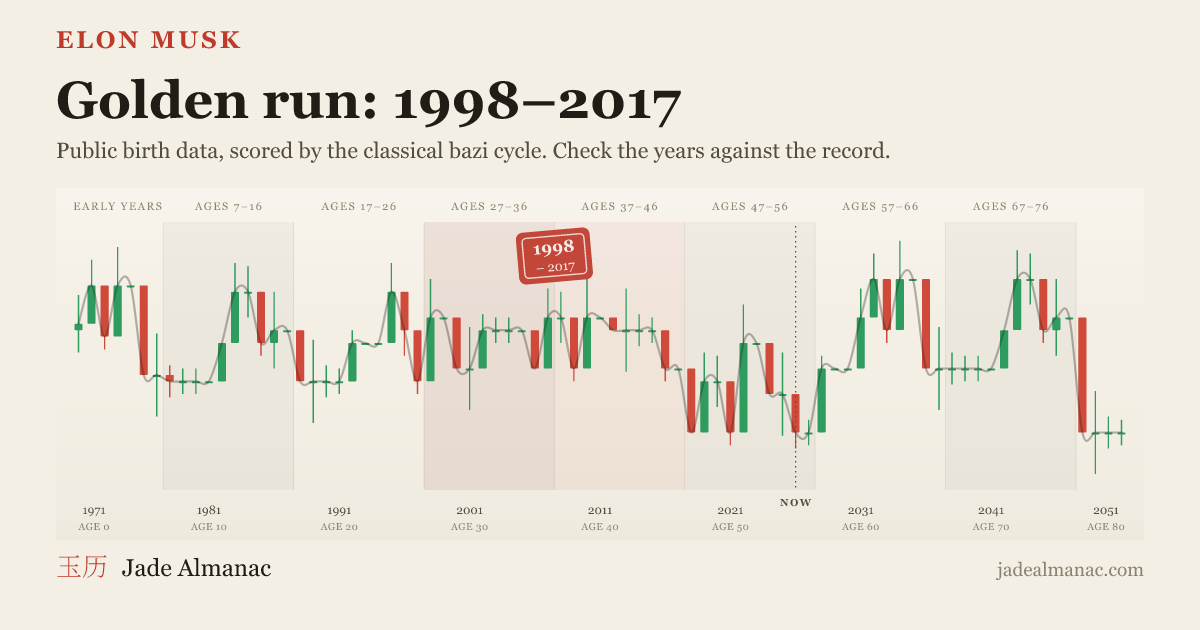
Elon Musk (born June 28, 1971; birth time unpublished, so this is an honest three-pillar chart).
- The chart hands him a twenty-year run, 1998 to 2017. Zip2, PayPal, SpaceX, Tesla: the entire empire got built inside it.
- The run ends in 2017. Ask him about 2018. He called it the most painful year of his career. The lowest candle on his chart agrees, and the arithmetic picked it on its own.
- 2008 wears a clash mark: the whipsaw year. Both companies nearly died that fall; both were saved by Christmas. That is exactly what a long wick means.
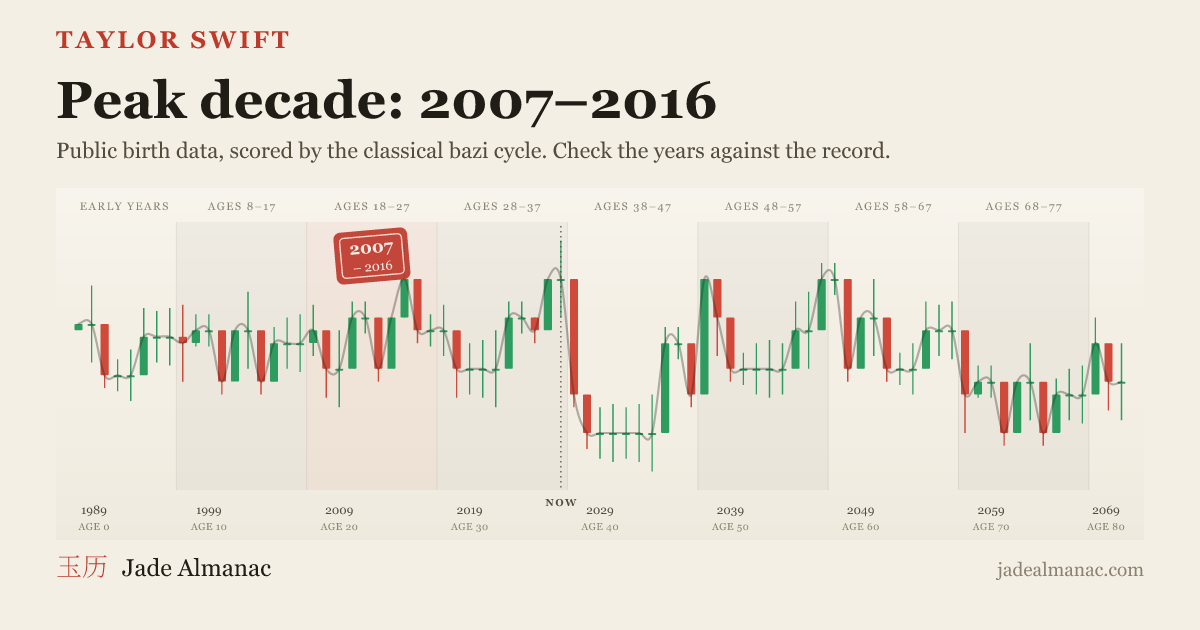
Taylor Swift (born December 13, 1989).
- Her chart's best ten-year window computes to 2007–2016. Fans call that exact stretch the imperial era. Nobody tuned the math; the math just agrees with the fandom.
- The strongest single year inside it: 2014. The year 1989 made her the biggest act on earth.
- 2009 wears a clash mark: the year of the snatched microphone. The tradition reads clash years as friction shoved into the open. You could not script it better.
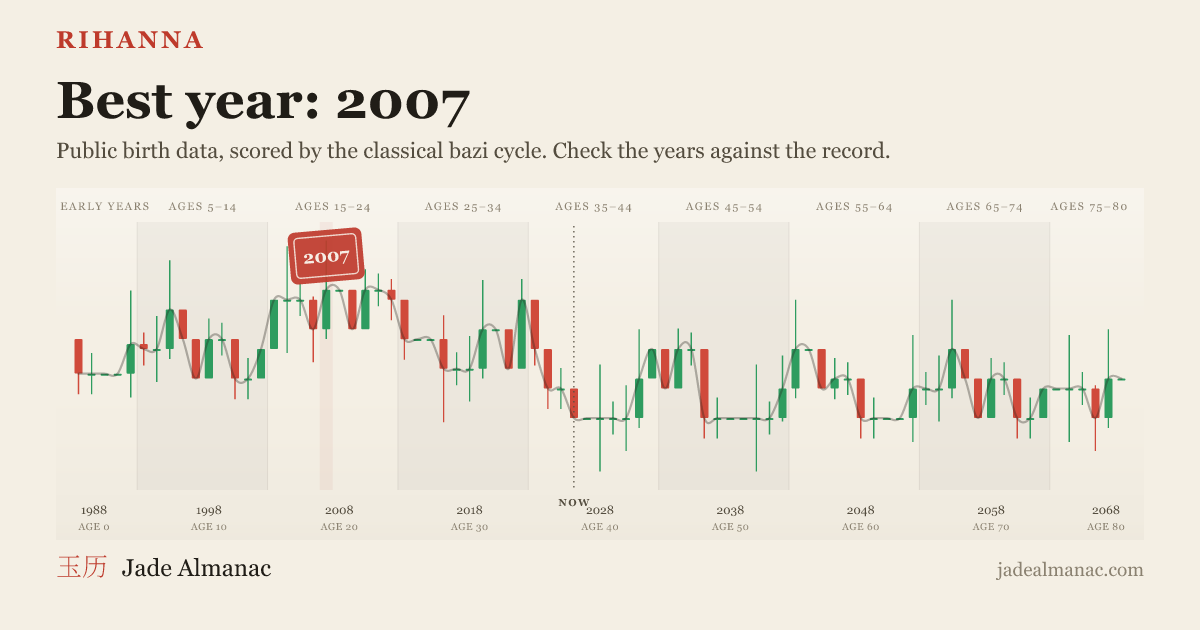
Rihanna (born February 20, 1988; birth time unpublished, three-pillar chart).
- The chart hands her a twenty-year golden run: 2003–2022. Signed in 2005, owned the charts for fifteen years, walked out a billionaire. The run is the career.
- Its single best year computes to 2007. The year of Umbrella. The engine did not know that. Now you do.
- 2007 also carries the travel-horse star, the movement year: the year the girl from Barbados took over the world. Sometimes the old language is just literal.
Public birth data, one method, no cherry-tuning: the same engine scores your chart the moment you enter a birthday above.
What is a bazi chart?
Bazi, 八字 (bāzì, "eight characters"), also known as the Four Pillars of Destiny, is the oldest continuously practiced system of Chinese astrology. It writes your birth moment as four pillars, one each for the year, month, day, and hour, and each pillar is a pair: a heavenly stem and an earthly branch, drawn from the sixty-character cycle that has ordered Chinese time since the Shang dynasty. Eight characters total, hence the name.
The reading revolves around one character: the stem of your day pillar, called the day master. It stands for you. Every other character helps it, drains it, or disciplines it through the five elements, and the first judgment of any reading is whether your day master stands strong or weak in its season. From that follows which elements are favorable for you, and from that follows the part people actually come for: timing.
Timing is what sets bazi apart from Western astrology's natal charts. Your chart walks through ten-year luck pillars (大运, dà yùn) and yearly cycles, each one strengthening or straining your chart in a way the method scores concretely. Plot those scores year by year, in the candlestick grammar traders use for markets, and you get what recent tools have taken to calling a life chart or "life k-line": your whole timeline, readable at a glance. That is the chart this calculator draws.
How to read your life chart
The chart borrows the candlestick, finance's most literate little glyph, and defines it honestly. Each candle is one year. Its close is that year's overall score: fifty is neutral, above it the year's elements feed your chart, below it they tax it. Its open is simply last year's close, so the body shows the year-over-year move. The thin wicks are event range: years whose branch clashes, combines, or frictions with your natal pillars swing wider, in both directions, and the chart marks them so you can see which years were built to be eventful.
The shaded bands behind the candles are your luck pillars: ten-year chapters, each tilting its whole decade before any single year is counted. This is why the chart has visible eras rather than noise, and it follows the classical weighting, where the decade matters more than the year. The red seal stamps the highest ten-year window on your chart: your peak years. A jade candle rises; a gray candle eases. Gray is not loss: the tradition reads quiet stretches as consolidation years, when the chart says build, not harvest.
And because no honest chart is a black box, every candle opens: tap a year on your result and it shows its arithmetic in plain English, which element arrived, what it does to your day master, what the decade around it was doing.
Where the method comes from
The pillars themselves are standard: solar calendar, year boundary at Lichun (立春, ~February 4), month stems by the five-tigers rule, hour stems by the five-rats rule, luck pillars running forward or backward by the classical parity-of-year-and-sex rule. Any orthodox practitioner would cast the same eight characters we do.
The scoring follows the strength-and-support method that has anchored bazi teaching since Wei Qianli's 1935 textbook Qianli Minggāo (千里命稿): judge the day master by three things, seasonal timing (does your birth month feed your element?), rooting (does it have feet in the branches?), and support (do other stems stand with it?). We quantify those three with the standard modern position weights, the month branch counting heaviest, and read favorable elements by the old rule of the Yuanhai Ziping (渊海子平): strengthen the weak, drain the strong. Yearly and decade scores follow from there, decade first, year second, exactly the priority the classics assign.
One honest caveat, stated here and on every result: this is one school's reading, simplified so it can be shown in the open. Pattern-school and blind-school practitioners would weigh the same chart differently, and charts near the strong/weak boundary are exactly where schools disagree most. We flag those charts rather than pretending the argument does not exist.
Questions people actually ask
What is a bazi calculator?
Bazi (八字, "eight characters"), also called the Four Pillars of Destiny, encodes your birth moment as four pairs of characters: one pillar each for the year, month, day, and hour of birth. A bazi calculator converts your birthday to the traditional solar calendar and casts those pillars for you. Ours goes two steps further: it reads the strength of your chart by the classical method, then scores all eighty years of your luck cycle into one life chart you can actually read.
What is a day master?
The day master (日主) is the heavenly stem of your day pillar, and in the Ziping method it stands for you; every other character in the chart is read by its relationship to it. A day master is called strong when the season, roots, and companions support its element, and weak when they drain it. That single judgment decides which elements count as favorable in your chart, which is why practitioners argue about it so much. We show you the arithmetic behind ours.
What are luck pillars?
Luck pillars (大运, da yun) are the ten-year chapters of a bazi reading. Starting from a computed age in childhood, your chart walks through the sixty-character cycle one pillar per decade, forward or backward depending on your birth year and sex. Each pillar colors its whole decade favorable or unfavorable before any single year says a word. They are the reason the life chart has visible chapters instead of just noise.
I do not know my birth time. Can I still get a chart?
Yes. The year, month, and day pillars do not depend on the hour, so we cast a three-pillar chart and say so honestly on the result. You lose the hour pillar (about a quarter of the strength reading) and the chart is slightly less precise, but the decade structure and year scores stand. Most online calculators quietly assume noon; we would rather tell you what we do not know.
Why does the bazi year start at Lichun and not Chinese New Year?
Because bazi runs on the solar calendar, not the lunar one. The year pillar turns at Lichun (立春, "Start of Spring"), the solar term around February 4, and so do the month pillars at their own terms. A January or early-February birthday therefore often belongs to the previous bazi year. Calculators that split years at January 1 or at the lunar New Year will hand those birthdays a different chart; this one uses the classical boundary.
What does "peak years" actually mean here?
It is the ten-year window where your scored chart runs highest: the stretch where your luck pillars and yearly elements line up most strongly with what your day master wants. The tradition reads such a window as the years to act, launch, and spend momentum rather than hoard it. And when the chart shows a quieter stretch instead, the tradition calls those consolidation years, groundwork rather than loss.
How seriously should I take this?
Take it as a cultural lens, not a forecast. This is one school’s simplified reading (the strength-and-support method taught since the 1930s), applied honestly and shown step by step; other schools would read the same chart differently, and we say so on every result. It is entertainment built on a real tradition. Do not use it for medical, financial, or legal decisions, and do not let any chart talk you out of a good year.
Sources
- • 韦千里《千里命稿》 (Wei Qianli, Qianli Minggao, 1935), the Republican-era textbook whose day-master strength test the scoring follows: full text at the Chinese Text Project
- • 《渊海子平》 (Yuanhai Ziping, Song-dynasty compilation), the founding manual of the day-master method; favorable elements follow its strengthen-the-weak, drain-the-strong principle: Wikisource edition
- • Hong Kong Observatory: the 24 solar terms (the Lichun boundary the year pillar turns on)
- • Hidden-stem strength shares follow the proportions standardized in modern mainland scoring practice (Zhu Zuxia, 命理应用精解, 1999)
What your day master means →
The ten types, and the full arithmetic behind strong and weak, worked start to finish.
Your zodiac animal →
The twelve-year wheel behind your year pillar's branch.
Your kua number →
Feng shui's answer to the same question: which way do you face?
Your date on the lunar calendar →
Month, day, leap months, and your year's full identity.