I Love You in Chinese (我爱你): Pronunciation, 520, and When to Say It
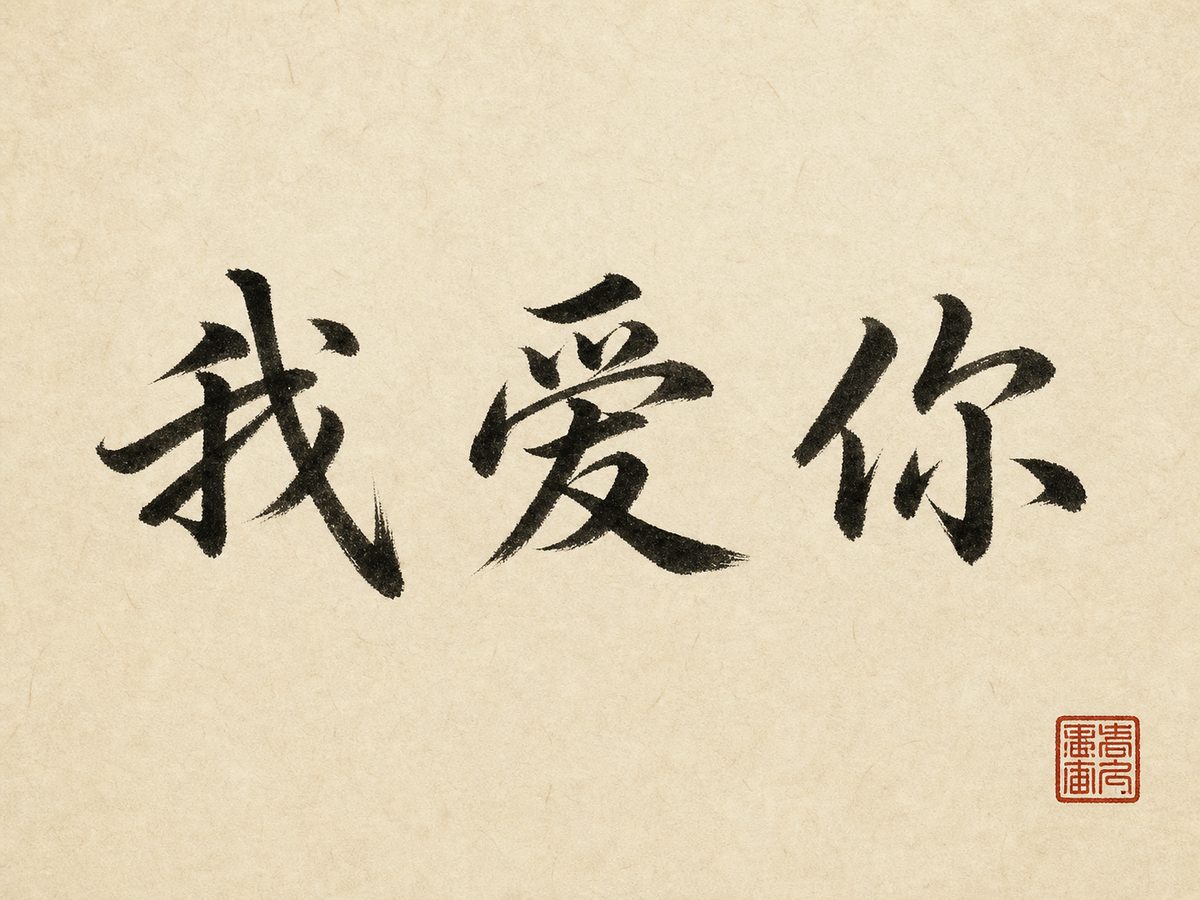
To say I love you in Chinese, the words are 我爱你: wǒ ài nǐ, roughly "waw eye nee." Three characters, subject then verb then object, exactly the order English uses, and not a conjugation in sight. Learning them takes about a minute. Saying them is another matter entirely, because Chinese treats this particular sentence as heavy artillery, fired rarely and with care, and has invented a whole system of number codes so people can text it instead.
- Strokes
- 24
- Characters
- 我 + 爱 + 你
- Formation
- Subject-verb-object phrase
Trace 爱 yourself, or watch it drawn (the heart of the sentence)
How it's written
Take the three characters one at a time. 我, "I," is seven strokes, and its ancestor on Shang oracle bones was, of all things, a serrated battle-ax; how a weapon came to mean "me" keeps scholars busy, but the dictionary record at zdic is clear that the pointy version came first. 爱, "love," is ten strokes, and it has enough history packed into it, including a famously missing heart, that it has a whole page of its own here. 你, "you," is seven strokes: the person radical 亻 standing politely on the left, with 尔, an old word for "you," on the right. Write them in that order and you have the sentence. Write them in the wrong order and you have a different sentence: 你爱我 reads "you love me," which turns a declaration into a demand. It is the one mistake worth double-checking before this phrase goes on a card, a cake, or anything more permanent. If you want to see the whole sentence written with a proper brush, type it into our calligraphy tool and it will render all three characters in seal, brush, and cursive.
What it means
Word by word it could not be friendlier: 我 (wǒ) is "I," 爱 (ài) is "love," and 你 (nǐ) is "you." No verb endings, no gender, no formal register to trip over. What English does with grammar, though, Chinese does with weight. Wǒ ài nǐ is not an everyday sentence; it is a serious declaration, and using it too early in a romance reads roughly the way a marriage proposal on a second date would. The standard opening move is the gentler 我喜欢你 (wǒ xǐhuān nǐ), "I like you," which in a confession carries most of the force English gives to "I love you." From there the ladder runs upward, one rung at a time.
| Phrase | Say it | What it carries | When to use it |
|---|---|---|---|
| wǒ xǐhuān nǐ | waw shee-hwan nee | "I like you," the standard confession | Declaring interest; the usual first move |
| wǒ xiǎng nǐ | waw shyang nee | "I miss you," warm and safe | Everyday affection at a distance |
| ài nǐ | eye nee | "Love ya," clipped and light | Texts between partners and close friends |
| wǒ ài nǐ | waw eye nee | The full, weighty "I love you" | Serious moments; not small talk |
| 520 | wǔ èr líng | The same sentence, in numbers | Texting it without having to say it |
- 我也爱你 — I love you too (the reply)
- 爱你 — love ya (clipped, casual)
- 我喜欢你 — I like you (the standard confession)
- 我想你 — I miss you
- 表白 — to confess your feelings
- 情话 — sweet nothings, lovers' talk
- 土味情话 — corny pickup lines, lit. 'earthy love talk'
- 么么哒 — mwah, a texted kiss
Idioms
- 山盟海誓“vows of the mountains, oaths of the seas”to promise eternal love; vows meant to stand as long as mountains and seas. (an anonymous Yuan-dynasty play, The Green Peach Blossom)
- 白头偕老“white-haired, growing old together”to stay a couple into old age; the standard wedding blessing. (grown from the Book of Songs vow 'to grow old together with you')
- 一生一世“one life, one world”for a whole lifetime; the phrase behind the texting code 1314. (Dream of the Red Chamber, ch. 93)
- 天长地久“as lasting as heaven and earth”love that endures; borrowed for romance from a line about the cosmos. (Laozi, ch. 7)
Right vs wrong forms
| Form | Type | Note |
|---|---|---|
| 我爱你 | simplified ✓ | The everyday mainland form. This is what you will see texted, printed, and taught. |
| 我愛你 | traditional ✓ | Standard in Taiwan, Hong Kong, and Macau. The traditional 愛 keeps the visible heart 心 in the middle, which many people choose on purpose. |
| 我愛妳 | traditional | Addressed specifically to a woman: 妳 is a 'you' written with the woman radical, common in Taiwan and Hong Kong love notes. Use it only if the reader is a woman. |
| 你爱我 | wrong | The same three characters in reversed order say 'YOU love ME.' A real copy-paste hazard: always check the order starts with 我. |
I love you in life today
The number that says it for you
Say the digits five, two, zero aloud in Mandarin: wǔ èr líng. Squint your ears and it lands close to wǒ ài nǐ. That coincidence has grown into the most charming workaround in modern romance. Texting 520 means "I love you" with a built-in safety net, deniable as a typo if the answer is silence, and May 20, written 5/20, has become China's unofficial online Valentine's Day. The trade publication China Internet Watch traces the code back to a late-1990s pop song, "Digital Love" by the Taiwanese singer Fan Xiaoxuan, which spelled it out in the lyrics; e-commerce platforms discovered the date around 2010 and never let go. The dialect has grammar of its own: 521 covers May 21 and the reply, 1314 sounds like yī shēng yī shì, "one life, one world," so 5201314 means "I love you for a lifetime," and a red envelope of exactly 520 yuan does the talking where words would blush. The holiday has real-world consequences: China Daily reported that ahead of May 20, 2026, every one of Guangzhou's fifteen marriage-registration offices was fully booked, and Nanjing had more than 1,400 couples reserved for the day. An entire country queues to marry on a pun.
Why the words themselves are rare
Now for the part that surprises Western learners most: having learned the sentence, you will almost never hear it. Between the generations especially, wǒ ài nǐ is close to unsayable; a Peking University sociologist told China Daily that many Chinese people are simply not practiced at voicing positive emotion, having been raised on correction rather than praise. Affection runs through actions instead, a subject the love page covers properly. What matters for the phrase itself is knowing the register: couples may reach the full sentence only at genuine turning points, parents may never say it at all and mean no less by the silence, and the softer wǒ xǐhuān nǐ or a well-timed 520 does the daily work. If a Chinese friend ever does say the three words to you out loud, treat the moment accordingly.
The moon does the talking
The whole culture of not-quite-saying-it has an anthem. In 1977 Teresa Teng recorded "The Moon Represents My Heart," the ballad that would become one of the first outside pop songs to sweep mainland China as the country reopened. Asked "how deeply do you love me?", the song answers with a deflection so graceful it became the definitive Chinese love lyric: go look at the moon, that is how my heart feels. Half a century later it remains the song most likely to be sung, badly and sincerely, at any karaoke confession, and it says the three words precisely by not saying them.
Cantonese, and a "you" written just for her
The same three characters travel. In Cantonese, written the traditional way as 我愛你, the sentence comes out ngo5 oi3 nei5, a different music for the same meaning. And in Taiwan and Hong Kong, a writer addressing a woman often swaps the last character for 妳, a "you" with the woman radical, so a love note can literally spell out whom it is for. Mainland simplified writing mostly skips the distinction, but on a handwritten card, 我愛妳 is a small, deliberate act of precision.
Where the phrase comes from
Here is the pleasant surprise for anyone who has suffered through French verb tables: 爱 never changes form. I love, she loves, we loved, they will love; in Chinese the word sits there unchanged through all of it, and time is handled by context or a small helper word. The sentence itself, though, is younger as everyday speech than its parts. The characters are ancient, but classical Chinese, which wrote about longing constantly, almost never lined them up into a flat declaration. The old texts preferred oblique verbs: the boatman's song preserved in the Shuoyuan, a Han-dynasty anthology, reaches for 悦 (yuè), "to delight in," where a modern speaker would say love. The blunt three-word sentence is a creature of the modern vernacular. The classical world got there by way of moons, branches, and held hands, and mostly let the reader do the math.
History & roots
The oldest I-love-you on record is a boatman's song
The Shuoyuan, an anthology compiled by the Han scholar Liu Xiang around the first century BCE, preserves the story of a boatman from the southern state of Yue who, rowing a young lord across the water, sang to him in his own tongue. Translated for the lord, the song said that the mountain has trees and the trees have branches, but the delight in the singer's heart was something the lord did not know. Chinese readers have long heard a pun buried in it: the word for "branch" sounds exactly like the word for "know," so the line aches twice. The lord's response, the text says, was to wrap the boatman in his embroidered quilt. The song has been quoted for two thousand years by people who loved someone who had no idea, which may make it the most durable unsent text message in history.
Hold your hand, grow old together
The line Chinese couples actually reach for at weddings is older still. In the Book of Songs, in a poem from the Odes of Bei, a soldier far from home recites a vow: in James Legge's translation, "For life or for death, however separated... We held their hands; we were to grow old together with them." The four-character heart of it, "hold your hand, grow old with you," is now the standard shorthand for lifelong love, printed on wedding invitations and engraved inside rings. Honesty requires a footnote: in the original poem the vow is spoken amid war and separation, and scholars have argued for centuries over whether it first bound a man to his wife or soldiers to each other. Either way, the promise outlived the battlefield, which is rather the point of promises.
Vows of mountains and seas
Long before texting compressed devotion into digits, Chinese had a formal vocabulary for promising forever. Lovers swore shān méng hǎi shì, vows of the mountains and oaths of the seas, a phrase the dictionaries trace to an anonymous Yuan-dynasty play; they hoped to grow old together white-haired, bái tóu xié lǎo, an image that grows straight out of that Book of Songs vow; and they promised yī shēng yī shì, "one life, one world," a phrase that turns up in chapter 93 of the Qing novel Dream of the Red Chamber. That last one should look familiar: compressed to the digits 1314, it is the same promise texted around the clock by people who may never have opened the novel. The vow survived; only the keyboard changed.
Questions people ask
How do you pronounce wo ai ni?
Roughly 'waw eye nee.' In pinyin it is wǒ ài nǐ: wǒ dips down and rises, ài falls firmly (it sounds like the English word 'eye'), and nǐ dips again. Keep the three syllables even and unhurried; Mandarin gives each one its own weight.
Why does 520 mean I love you in Chinese?
Said aloud, the digits five-two-zero (wǔ èr líng) sound close to wǒ ài nǐ, 'I love you.' The code spread from a late-1990s pop song and early internet chat, and May 20 (5/20) has grown into China's unofficial online Valentine's Day, complete with 520-yuan red envelopes and a rush of couples booking marriage registrations for the date.
What does 5201314 mean?
It is 520 plus 1314. The digits 1314 (yī sān yī sì) sound like yī shēng yī shì, 'one life, one world,' a phrase for a whole lifetime that appears in Dream of the Red Chamber. Together, 5201314 reads 'I love you for a lifetime.'
What is the difference between wo ai ni and wo xihuan ni?
Wǒ xǐhuān nǐ means 'I like you' and is the standard way to confess romantic interest in Chinese; it does most of the work English gives to 'I love you.' Wǒ ài nǐ is a heavier, rarer declaration reserved for serious moments. Climbing from one to the other is a milestone in a Chinese relationship, not a synonym swap.
Do Chinese people actually say I love you?
Far less often than English speakers. The spoken sentence is treated as weighty, and many parents never say it to their children at all, showing love through actions instead. Couples may say it only at real turning points. In daily life, the lighter 'I like you,' 'I miss you,' or a texted 520 carries the affection.
How do you say I love you in Cantonese?
The same three characters, usually written in traditional form as 我愛你, are pronounced ngo5 oi3 nei5 in Cantonese (Jyutping romanization). The meaning and the emotional weight are the same; only the sounds change.
How do you respond to wo ai ni?
If you feel the same, the reply is wǒ yě ài nǐ (我也爱你), 'I love you too.' A lighter, common return is ài nǐ, 'love you.' By text, answering 520 with 5201314, 'I love you for a lifetime,' raises the stakes in the nicest possible way.
Sources
- Zdic (zdic.net): the dictionary entry for 我
- Zdic (zdic.net): the dictionary entry for 你
- Zdic (zdic.net): the dictionary entry for 妳 (the feminine 'you')
- Shuoyuan, Shan Shuo: the Song of the Yue Boatman (Chinese Text Project, ctext.org)
- The Book of Songs, Ji Gu, with Legge's translation (Chinese Text Project, ctext.org)
- Zdic (zdic.net): the idiom 山盟海誓
- China Daily: why Chinese parents seldom say 'I love you' (2015)
- China Daily: couples rush to say 'I do' on the 'I love you' day (2026)
- China Internet Watch: 520 Day, China's online Valentine's Day
- The Moon Represents My Heart (Wikipedia)
- Chinese Internet slang (Wikipedia)
- Zdic (zdic.net): the phrase 一生一世 behind the code 1314
- Words.hk (粵典): the Cantonese reading of 愛
Make I love you your own
See 我爱你 in calligraphy
From ancient seal script to flowing cursive. Pick a look before a tattoo or a card.
Get a Chinese name
A name matched to the sound of yours, with a meaning that fits.
Try the Chinese Gender Predictor
A different corner of Chinese culture: the old Qing-palace birth chart, worked out from your lunar birth date, with the math shown and its coin-flip odds honestly weighed.
Related: love · double happiness
By Julian 祝君瑜 · sourced from the classics and from modern life · updated 2026-07-17