Chinese Symbol for Happiness (福): Meaning, Luck, and Origin
The Chinese symbol for happiness is 福 (fú, roughly "foo"), and it promises considerably more than a mood. 福 means blessing, good fortune, luck: the entire condition of a life going well. It may be the most-displayed character on Earth. Every Lunar New Year it goes up on hundreds of millions of doorways across China, and on a healthy share of them it hangs upside down, entirely on purpose.
- Strokes
- 13
- Radical
- 礻 (altar, the spirit radical)
- Formation
- Phono-semantic compound
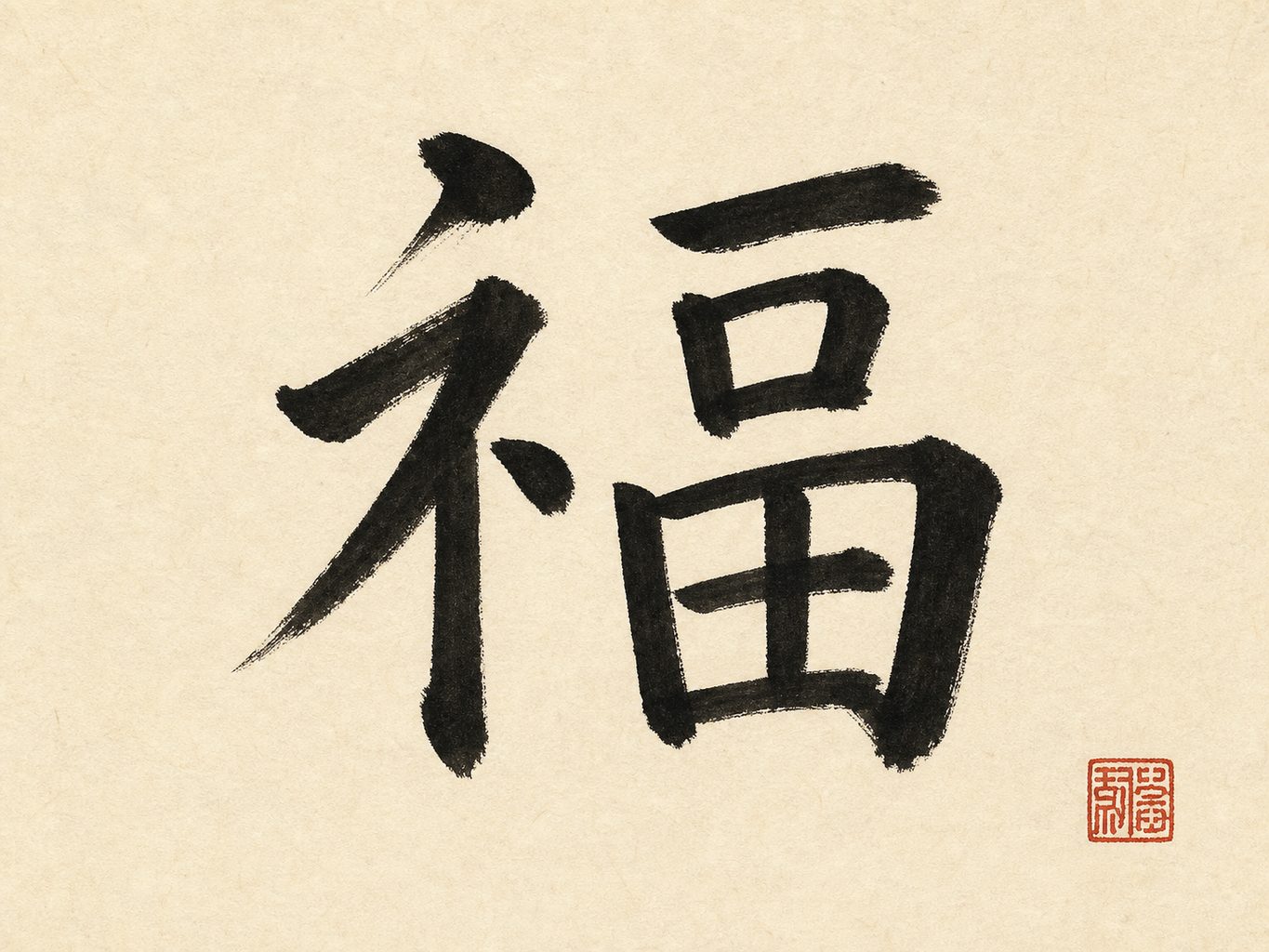
Trace 福 yourself, or watch it drawn
How it's written
福 runs to thirteen strokes, written left to right, and it splits cleanly in two. The left half is 礻, the altar radical: a compressed drawing of an altar table, and the standard signal that a character has one foot in the temple. The right half is 畐 (also read fú), a tidy stack of three parts: a short horizontal 一, a small square 口, and the field grid 田. Generations of Chinese teachers have sold that stack as "one mouth and a field," which is to say: everyone fed, with land to feed them. Treat that as the memory trick it is rather than real etymology (the older story below is better), but it works. Draw an altar, a mouth, and a field, and you have written fú. One practical warning for anyone writing it by hand or pricing it as a tattoo: the altar radical takes exactly one dot. Add a second and you have written 衤, the clothing radical, which produces 褔, a rare and entirely different character. The difference between blessed and dressed is one dot.
What it means
Here is the honest small print: fú is not quite the feeling of being happy. Chinese keeps separate shelves for this. The feeling of joy is lè; delight attached to an occasion, good news or a wedding or a baby, is xǐ (喜). The modern everyday word for happiness, the one in dictionaries and pop lyrics, is xìngfú, and you will notice it ends in the same fú. Fú itself is the condition underneath all of those: blessedness, protection, luck, the general state of things going your way. This is also why the character does double duty. If you arrived here hunting for the Chinese symbol for luck, you can stop hunting; fú covers blessing and luck in one, and a Chinese reader would not think to split them. The English habit of calling it "happiness" owes a lot to the three porcelain star gods on restaurant shelves the world over, Fu, Lu, and Shou, conventionally translated "Happiness, Prosperity, and Longevity." The first of the trio is our character, and the label stuck. And here is a small consolation for anyone who feels "happiness" is a sloppy fit: English used to agree with the Chinese. The "hap" buried inside happy is an old word for luck, the same one hiding in perhaps, mishap, and hapless, so a happy person was originally just a fortunate one. When the great Victorian translators reached for happiness to render fú, English still carried that older sense of good luck, and the match was tighter than it now looks. Then the English word drifted toward pure mood and left the luck behind. Fú never did. One relative deserves a namecheck before we go on. Xǐ doubled into a single character is 囍, "double happiness," the red emblem of Chinese weddings. It is a separate symbol with a separate story, and it gets its own page.
- 幸福 — happiness, well-being (the modern everyday word for being happy)
- 福气 — good fortune, luck (said of a person: blessed)
- 祝福 — to bless; blessings, well-wishes
- 口福 — mouth-luck: the good fortune of eating well
- 福利 — welfare, benefits; perks
- 有福 — blessed, lucky
Idioms
- 五福临门“the five blessings arrive at the door”the classic New Year wish for a full, lucky life: long life, riches, health and peace, love of virtue, and a good end. (the five are enumerated in the Book of Documents (尚书, Great Plan))
- 塞翁失马,焉知非福“the frontier old man lost his horse; who could know it was not a blessing”apparent bad luck may turn out to be good luck, and vice versa; judge nothing too soon. (the Huainanzi (淮南子, Ren Xian Xun))
- 福如东海“fortune like the Eastern Sea”a birthday blessing: may your luck be as vast as the sea. Usually paired with a matching longevity line. (a traditional congratulatory couplet)
- 因祸得福“gaining fortune through misfortune”a blessing in disguise; good luck arrived by way of bad. (proverbial, from the same turn-of-luck logic as the Huainanzi tale)
- 福无双至,祸不单行“blessings never come in pairs; misfortunes never come alone”the wry folk arithmetic of luck: good things arrive singly, troubles in bunches. (a folk proverb, common in Ming-era vernacular novels)
Right vs wrong forms
| Form | Type | Note |
|---|---|---|
| 福 | simplified ✓ | The standard form, and a rare piece of good luck in itself: 福 was never simplified, so it is written identically in simplified and traditional Chinese. Whatever the region, era, or font, this is the character. |
| 褔 | wrong | The one-dot-too-many trap. With the clothing radical 衤 instead of the altar radical 礻, this is a rare, different character. The two look near-identical at a glance; count the dots before printing or inking. |
| 福 (upside down) | wrong | Deliberate on doors at New Year, where the pun says 'fortune has arrived.' A mistake everywhere else: on a tattoo, a sign, or a print, keep it upright. |
| 福 (mirrored) | mirrored | Not a variant. Low-resolution stencils sometimes come out flipped, and a mirrored 福 reads instantly as an error to anyone literate. Check against a dictionary before committing. |
For a tattoo
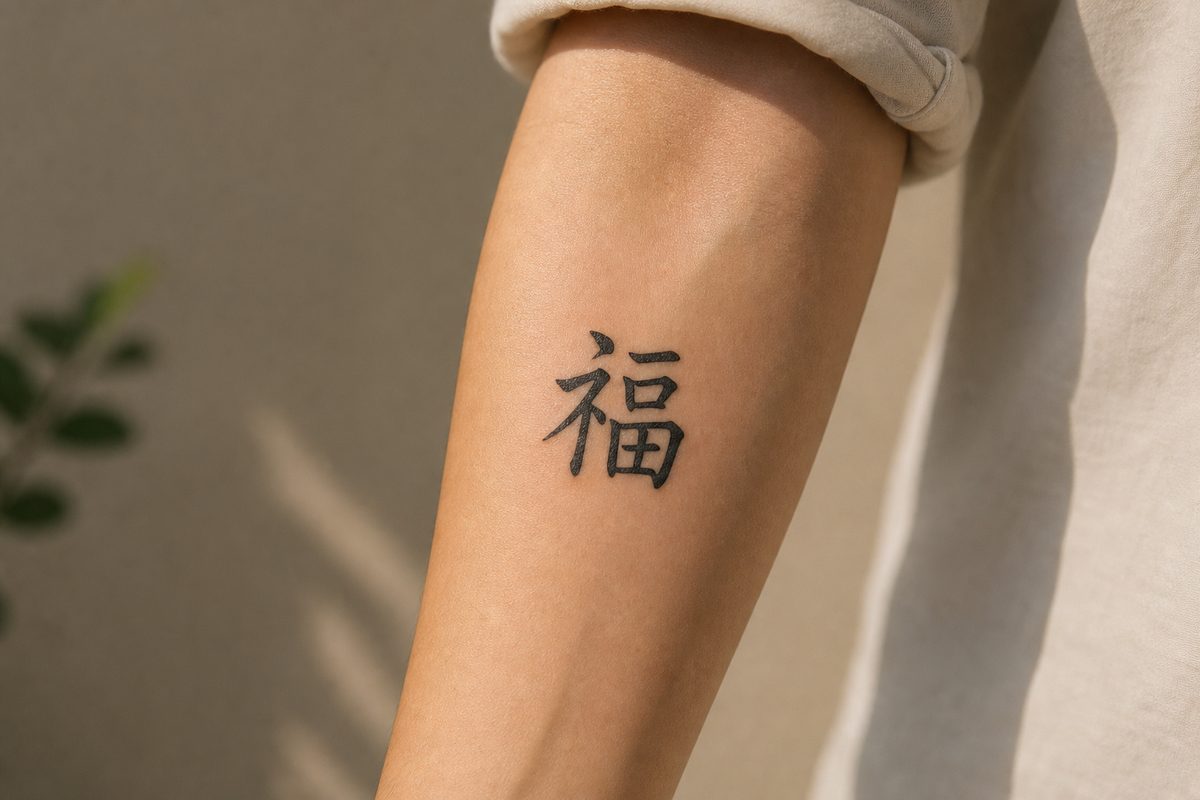
As Chinese tattoos go, 福 is one of the safer choices, and it is worth saying why. It is written identically in simplified and traditional Chinese, so there is no regional-version decision to get wrong. It is common, it is positive, and it is unambiguous: a blessing in the most literal sense. Three cautions, all cheap to take. First, orientation: on skin, keep it upright. The upside-down version is a door custom, a pun that announces "fortune has arrived," and the joke does not transfer; on a shoulder it simply reads as if the stencil slipped. Second, count the dots on the left radical: the altar radical takes exactly one dot, and a second dot turns it into a different, obscure character. Third, the universal rule: print the design at full size and have someone who actually reads Chinese confirm it before the needle goes in. And if what you wanted was the modern two-character word for happiness as a feeling, that is xìngfú; the single character says blessing and luck, which, on reflection, is usually what people meant.
Happiness in life today
The right way up is upside down
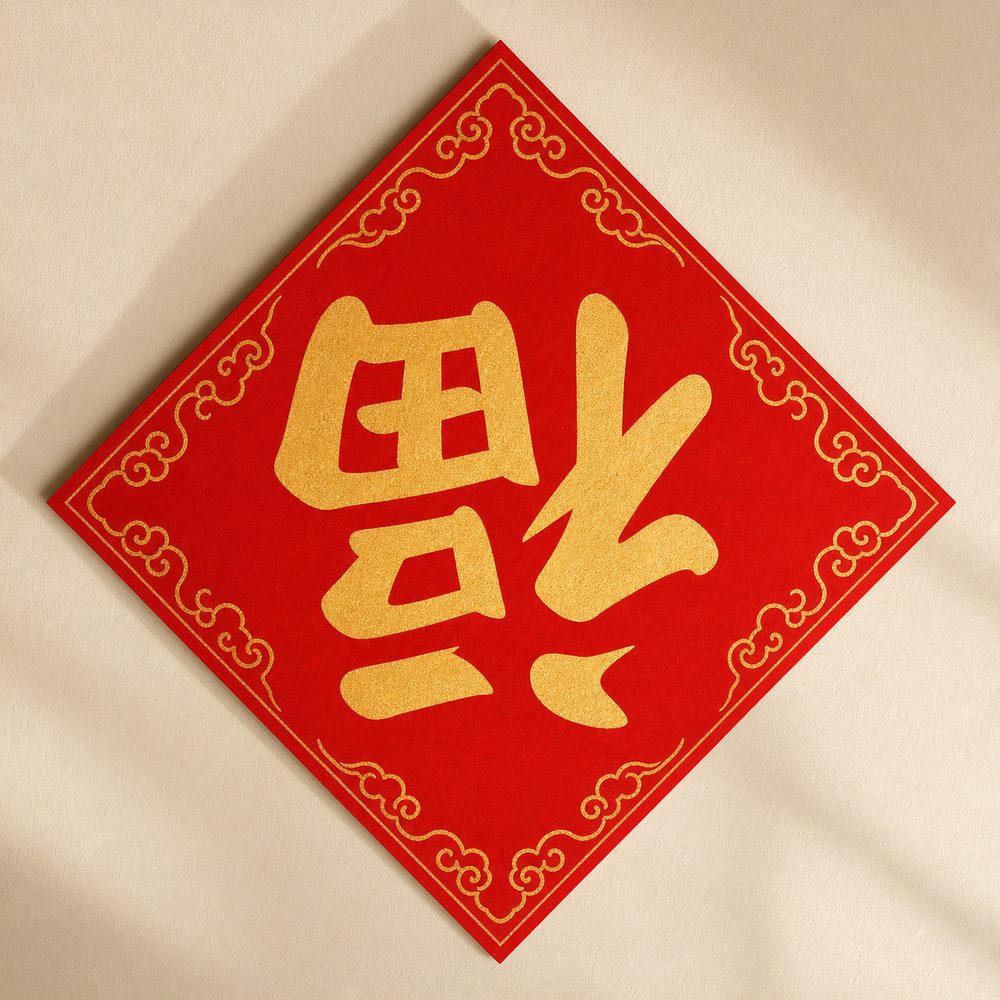
Walk down any street in China in the weeks around Lunar New Year and 福 is everywhere: gold on red, printed on diamond-shaped paper squares, pasted to doors, windows, elevator lobbies, and the occasional car hood. A remarkable number hang upside down, and every one of those is upside down on purpose. In Mandarin, "the fu is inverted" (fú dào le) sounds exactly like "the fu has arrived." Hang the character wrong way up, and any literate passerby will involuntarily announce that fortune has arrived at your house. It is a pun that installs itself on the front door, and hundreds of millions of households renew it every winter.
The national scavenger hunt
Since 2016 the payment app Alipay has run a Lunar New Year game called Ji Wufu, "collect the five fortunes": point your phone camera at any 福 out in the world, on a door, a poster, a friend's screen, and the app deals you digital fortune cards. Assemble all five kinds and, on New Year's Eve, you split a cash pot with everyone else who managed it. China Daily has put cumulative participation near 900 million people across the game's first decade. For two weeks every winter, one of the larger rituals on the planet consists of people photographing doorways.
Luck, sold in small denominations
Everyday Mandarin breaks fú into charming small change. Kǒufú is "mouth-luck," the specific good fortune of being present when something delicious appears. Yǎnfú is "eye-luck," a feast for the eyes; ěrfú, "ear-luck," covers catching a great song. When something works out thanks to another person, the graceful reply is tuō nín de fú, "by your luck": I was riding on your good fortune. English speakers brush against this constantly without noticing, because the TOEFL exam's official Chinese name, tuōfú (托福), borrows the sound of the English initials while spelling out "entrusted to fortune." Millions of students a year, quite literally, sit the luck.
A name that wishes you well
As a name element, fú is a plain, warm wish for a lucky life, and it has been bestowed on children, shops, and dogs with equal enthusiasm. Especially dogs: Láifú, "fortune arrives," is the classic Chinese dog name, the local Lucky. When Beijing hosted the 2008 Olympics, its five mascots were the Fuwa, the "fortune dolls," which put the character on lunchboxes on every continent. Curious what your own name would look like built the Chinese way, from sound plus a well-omened meaning?
Build a Chinese name from the sound of your own name and a well-omened meaning.
Where the character comes from
The Shuowen Jiezi, the first Chinese dictionary, compiled around the year 100, files 福 under the altar radical and defines it in a single word: blessing, literally the aid the spirits send down. Its formula for the character reads "from the altar 示, with 畐 as the sound." The sound half, though, was carrying more than sound. On the oracle bones of three thousand years ago, where the earliest forms survive, 畐 is a drawing of a wine jar, full-bellied and narrow-necked, and early forms of 福 set the jar beside the altar, in some versions lifted toward it by a pair of hands. The oldest picture of good fortune in the Chinese record, in other words, is a person pouring wine out for the spirits, in the hope that heaven pours something back. That original bargain never really left the character. Blessing, in the fú sense, is not something you feel; it is something granted, sent down on a household from somewhere above, which goes some way to explaining why the character lives on doorways rather than in diaries. The oracle-bone and bronze forms are collected in Richard Sears' Chinese Etymology database, if you would like to see the jar for yourself.
History & roots
The five blessings
When Chinese literature first sat down to define the good life, it made a list. In the "Great Plan" chapter of the Book of Documents, among the oldest of the classics, the good life is counted out as the five blessings, the wǔfú. In James Legge's translation: "The first is long life; the second, riches; the third, soundness of body and serenity of mind; the fourth, the love of virtue; and the fifth, fulfilling to the end the will (of Heaven)." Notice what happiness is on this list: not a feeling anywhere in sight, but a completed life, long, solvent, healthy, decent, and finished properly. That is the freight one small character was built to carry. The greeting wǔ fú lín mén, "may the five blessings arrive at your door," still goes up on doorframes every New Year, roughly three thousand years after the list was drawn.
Why there are bats on everything
Once you know fú, Chinese art starts confessing a secret: the bats. Vases, silk robes, carved screens, and window lattices flutter with bats, an animal the West files under Halloween. The reason is a homophone. The word for bat, fú (蝠), sounds exactly like 福, so a bat painted on a bowl is a blessing on the wing, and five bats arranged around a longevity symbol spell out the five blessings themselves, a design that turns up on everything from imperial robes to teacups. Chinese decorative art runs on puns of this kind, and the bat is the hardest-working pun in the catalog.
The old man who lost his horse
The definitive Chinese story about luck sits in the Huainanzi, a compendium assembled at a princely court in the second century BCE. An old man near the northern frontier loses his horse; it wanders off into nomad country. The neighbors come to commiserate, and the old man only asks how anyone can know this is not a blessing. Months later the horse returns leading a string of fine steppe horses, the neighbors come to congratulate, and he asks how anyone can know this is not a disaster. His son takes up riding the new horses, falls, and shatters his thigh. Commiseration again; the same shrug again. Then the nomads invade, every able-bodied man on the frontier is drafted, and, the text records, nine in ten of them die. The lame son is passed over, and father and son both survive. The proverb the story left behind, sài wēng shī mǎ, "the frontier old man lost his horse," is what a Chinese friend will say, consolingly, when your flight gets canceled. Too soon to tell.
Fortune leans on misfortune
Laozi compressed the same philosophy into twelve characters. Chapter 58 of the Dao De Jing, in Legge's rendering: "Misery! - happiness is to be found by its side! Happiness! - misery lurks beneath it!" Fortune and misfortune, fú and huò, run through the classics as a rotating pair, each quietly growing inside the other. Which explains something about the doorway custom: a culture that trusted luck to sit still would not feel the need to re-paste the invitation every single year.
The emperor's handwriting
The Kangxi Emperor ruled for sixty-one years and, as the Prince Kung's Palace Museum notes, hardly ever left inscriptions, which makes the one big 福 in his handwriting a celebrity in its own right. Carved onto a stele some eight meters long and set into an artificial grotto in the garden of Prince Gong's Mansion in Beijing, it is billed as the "Number One fu under Heaven," and the museum will happily point out the trick in the brushwork: worked into its strokes a reader can find the characters for sons, talent, fields, and long life. One character, written so that it quietly contains the entire wish list. Visitors line up to touch it. Three centuries on, the stroke of one emperor's brush is still handing out luck, one palm at a time.
Questions people ask
What is the Chinese symbol for happiness?
It is 福 (fú), a thirteen-stroke character that means blessing, good fortune, and luck: the whole condition of a life going well, rather than a momentary feeling. It is identical in simplified and traditional Chinese, and it is the character pasted on doorways across China every Lunar New Year. The modern two-character word for happiness as a feeling is 幸福 (xìngfú), which contains it.
What does fu mean in Chinese?
Fú (福) means blessing, good fortune, luck. The Shuowen Jiezi, the first Chinese dictionary, defined it as the aid the spirits send down, and its oldest written forms show a wine jar offered at an altar. In everyday Mandarin it appears in words like fúqi (good fortune), zhùfú (to bless), and xìngfú (happiness).
Why is the Chinese happiness symbol hung upside down?
It is a pun. In Mandarin, 'the fu is upside down' (fú dào le) sounds exactly like 'the fu has arrived,' so hanging the character inverted on a door announces that fortune has arrived at the house. It is a Lunar New Year custom for doors and windows, and it does not transfer to tattoos or artwork, where an inverted character just reads as a mistake.
Is the Chinese symbol for happiness the same as the symbol for luck?
Effectively yes. 福 (fú) covers blessing, good fortune, and luck in a single character, and a Chinese reader would not split those meanings. If you searched for a single Chinese lucky character, 福 is the standard answer. Related but different words: jí (吉) means auspicious, and yùnqi (运气) is the neutral word for how your luck happens to be running.
Is the Chinese symbol for happiness a good tattoo?
Yes, with three checks. Keep it upright, because the upside-down version is a door pun that does not transfer to skin. Make sure the left radical has exactly one dot, since two dots produce a different character. And have someone who reads Chinese confirm the final design before inking. 福 is written identically in simplified and traditional Chinese, so there is no regional version to get wrong.
Sources
- Shuowen Jiezi dictionary entry for 福 (Chinese Text Project)
- Book of Documents, The Great Plan: the Five Blessings (Chinese Text Project, Legge translation)
- Huainanzi, Ren Xian Xun: the frontier old man's horse (Chinese Text Project)
- Dao De Jing, chapter 58 (Chinese Text Project, Legge translation)
- Zdic (zdic.net): the dictionary entry for 福 (readings, strokes, Shuowen text)
- Chinese Etymology database (Richard Sears): oracle-bone and bronze forms of 福
- Fu (character): the upside-down 福 New Year custom (Wikipedia)
- Alipay expands virtual fortune card collection campaign (China Daily, 2025)
- The Kangxi 'Fu' Character Stele (Prince Kung's Palace Museum, official site)
- TOEFL's official Chinese-language site, under the test's Chinese name 托福 (NEEA)
- Fuwa: the five Beijing 2008 Olympic mascots (Wikipedia)
Make Happiness your own
See 福 in calligraphy
From ancient seal script to flowing cursive. Pick a look before a tattoo or a card.
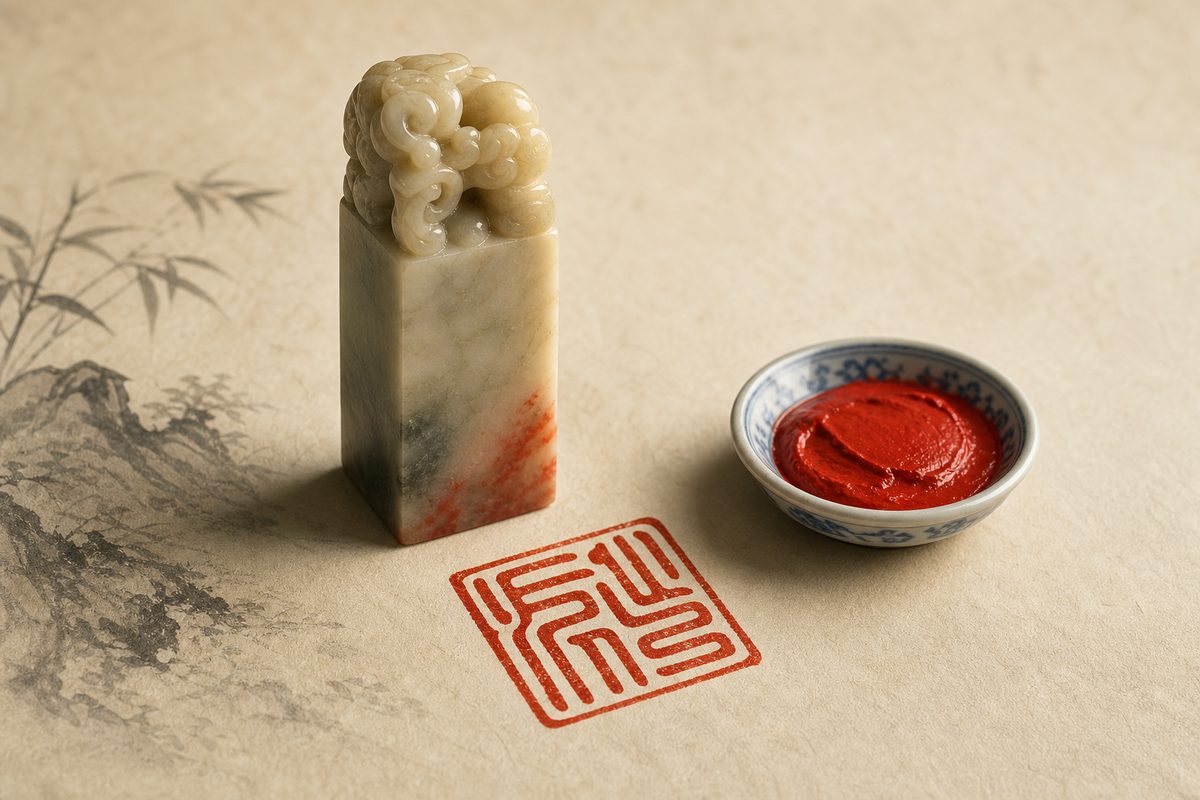
Get a Chinese name
A name matched to the sound of yours, with a meaning that fits.
Try the Chinese Gender Predictor
A different corner of Chinese culture: the old Qing-palace birth chart, worked out from your lunar birth date, with the math shown and its coin-flip odds honestly weighed.
Related: double happiness · love · family · peace · beautiful
By Julian 祝君瑜 · sourced from the classics and from modern life · updated 2026-07-10