Double Happiness Symbol (囍): Meaning, Origin, and Use
The double happiness symbol is 囍 (shuāngxǐ, roughly "shwahng-shee"): two copies of 喜, the Chinese character for joy, welded shoulder to shoulder into one emphatic glyph. It is not really a word. You cannot use it in a sentence, and dictionaries mostly shrug at it. It is the emblem of Chinese weddings, pasted up in red at every scale from a window paper-cut to a hotel facade, and it means exactly what it shows: joy, times two.
- Strokes
- 24
- Radical
- 口 (mouth)
- Formation
- Ligature (two 喜 joined)
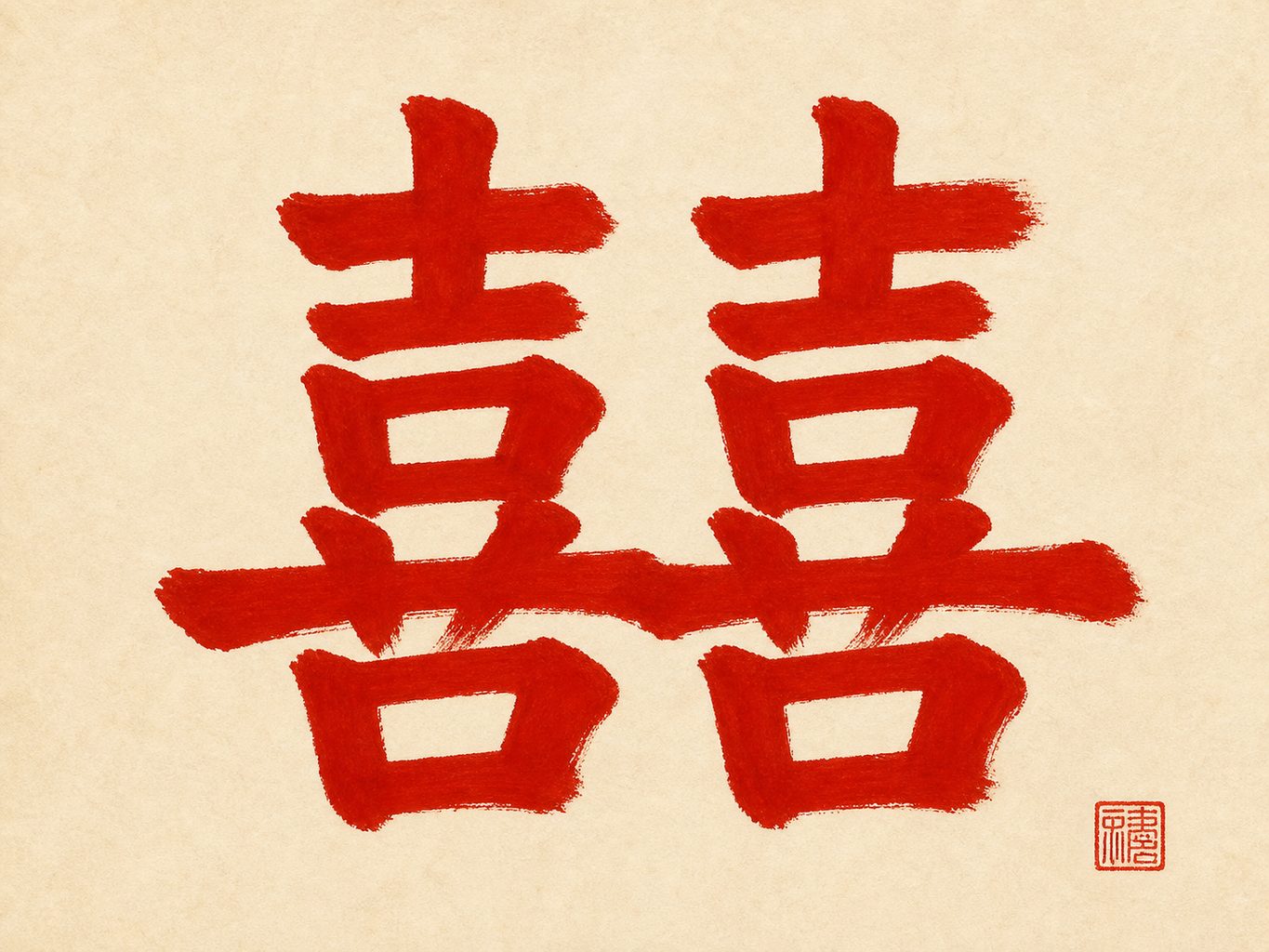
Trace 喜 yourself, or watch it drawn (囍 doubles it)
How it's written
Each 喜 is twelve strokes, read top to bottom: a scholar's 士 cap, a small 口, a wide bar with two flaring strokes, and a final 口 at the base. The wedding symbol simply writes it twice, side by side, joined at the hip and squeezed into the square footprint every Chinese character must occupy. Twenty-four strokes in all, and a character so wide it seems built for double doors, which is in fact where it most often hangs. Chinese has a small, delightful tradition of these welded lucky characters, called ligatures: several characters compressed into one for luck rather than language. 囍 is by far the most famous of them, and the only one most people will ever need to recognize.
What it means
Start with the half. 喜 (xǐ) is joy of the announced kind: not a private mood but a happy event, the good news, the occasion. A wedding in Chinese is simply "a joy event," xǐshì, and the word family runs through the whole celebration: the wedding banquet is "joy liquor," the candy handed to guests is "joy candy," and the congratulations you offer, gōngxǐ, as in the New Year greeting gōngxǐ fācái, is literally "respectful joy." Double the character and you get the marital application: two people, two families, one occasion, joy counted twice. Worth separating from its neighbors: 喜 is the joy of an occasion, where lè (乐) is fun as a feeling and fú (福) is blessing, the broad good fortune of a life going well, which has its own page here. The glyph itself is read xǐ, like the single character; shuāngxǐ, "double joy," is the name of the design. And unlike most famous characters, 囍 belongs to no classical text at all, which is part of its charm, as we are about to see.
| 喜 (xǐ) | 囍 (shuāngxǐ) | |
|---|---|---|
| What it is | A real word: joy, the happy occasion | A ligature, two 喜 welded into one glyph |
| Strokes | 12 | 24 |
| In a sentence | Works everywhere: xǐshì, gōngxǐ | Never; it is a design, not a word |
| Read aloud | xǐ | Still xǐ; "shuāngxǐ" names the design |
| Where you meet it | The whole joy word-family, banquets to New Year greetings | Weddings, pasted up in red |
- 双喜 — double joy; the name of the 囍 design
- 喜事 — a happy occasion; in practice, a wedding
- 喜糖 — wedding candy, handed to guests and coworkers
- 喜酒 — the wedding banquet (literally joy liquor); to 'drink joy liquor' is to attend a wedding
- 恭喜 — congratulations (as in gōngxǐ fācái, the New Year greeting)
- 有喜 — to be expecting a baby (literally to have joy)
Idioms
- 双喜临门“two joys arrive at the gate”two happy events landing at once; the exact situation the 囍 symbol commemorates. (a set phrase; the scenario of the Wang Anshi legend)
- 皆大欢喜“all are greatly delighted”everyone is happy with the outcome; also the standard Chinese title of Shakespeare's As You Like It. (the closing formula of the Diamond Sutra)
- 喜出望外“joy beyond what one hoped for”overjoyed by an unexpected turn; delighted past expectation. (a set phrase, in literary use since the Song)
- 喜上眉梢“joy climbs to the eyebrow tips”visibly delighted; the joy shows on your face. Painted as a magpie on a plum branch, a pun on plum and eyebrow. (a set phrase, standard in decorative art)
- 喜新厌旧“delights in the new, tires of the old”fickle in love; fond of novelty and quick to discard. The wry opposite of everything 囍 stands for. (a set phrase)
Right vs wrong forms
| Form | Type | Note |
|---|---|---|
| 囍 | simplified ✓ | The standard ligature, identical in simplified and traditional Chinese and everywhere else. Always red in celebratory use; it is a symbol more than a word. |
| 喜 | simplified | The single joy character: correct everyday Chinese for happiness and occasions. Use it for general joy; the doubled form is specifically marital. |
| 㐂 | wrong | A Japanese calligraphic shorthand of 喜 built from three 七, used in Japan for the 'joyful' 77th birthday. It is not the Chinese wedding symbol; don't substitute it. |
| 囍 (mirrored) | mirrored | Not a variant. The design looks symmetric but each half is directional; a flipped stencil reads as an error to anyone literate. Check against a dictionary rendering. |
For a tattoo
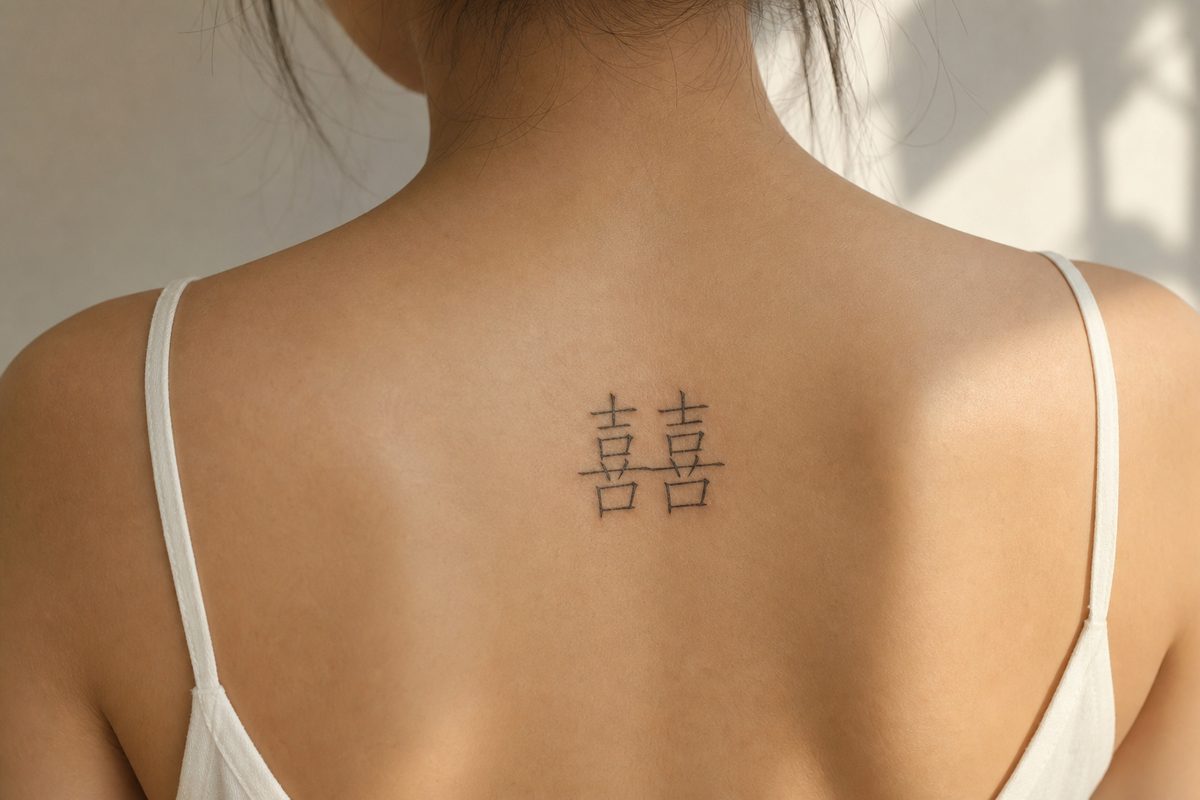
One thing to know before anything else: 囍 is not a general happiness tattoo. It is the emblem of marital joy, and to a Chinese reader it says wedding as plainly as a white dress does. Inked as a couple's matching tattoo or an anniversary mark, it is warm, specific, and reads perfectly. Inked because "double happiness sounded nice," it will prompt friendly questions about a spouse you may not have. The mechanical checks are simple. Both halves must be the same correct 喜, so count the parts: cap, mouth, bar, mouth, twice. Keep it upright and unmirrored, and check the stencil against a dictionary rendering before the needle goes in. Skip the antique-looking Japanese shorthand for joy, which is a different tradition entirely. And if what you actually wanted was general good fortune rather than marriage, the joy character on its own, or 福 for blessing, says that without the ring.
Double happiness in life today
The wedding kit
When a Chinese couple sets a date, 囍 goes up: on the double doors of both family homes, on windows as red paper-cuts, on the headboard of the marriage bed, on the invitation, the candy boxes, the envelopes, and, in a modern touch, the rear windshield of the wedding car. It goes up in red, always red, the color of celebration. The staying power is remarkable: a couple marrying in a glass hotel tower will still order the same red double-joy stickers their great-grandparents pasted on a courtyard gate. If you have attended a Chinese wedding anywhere on Earth, you have seen this character.
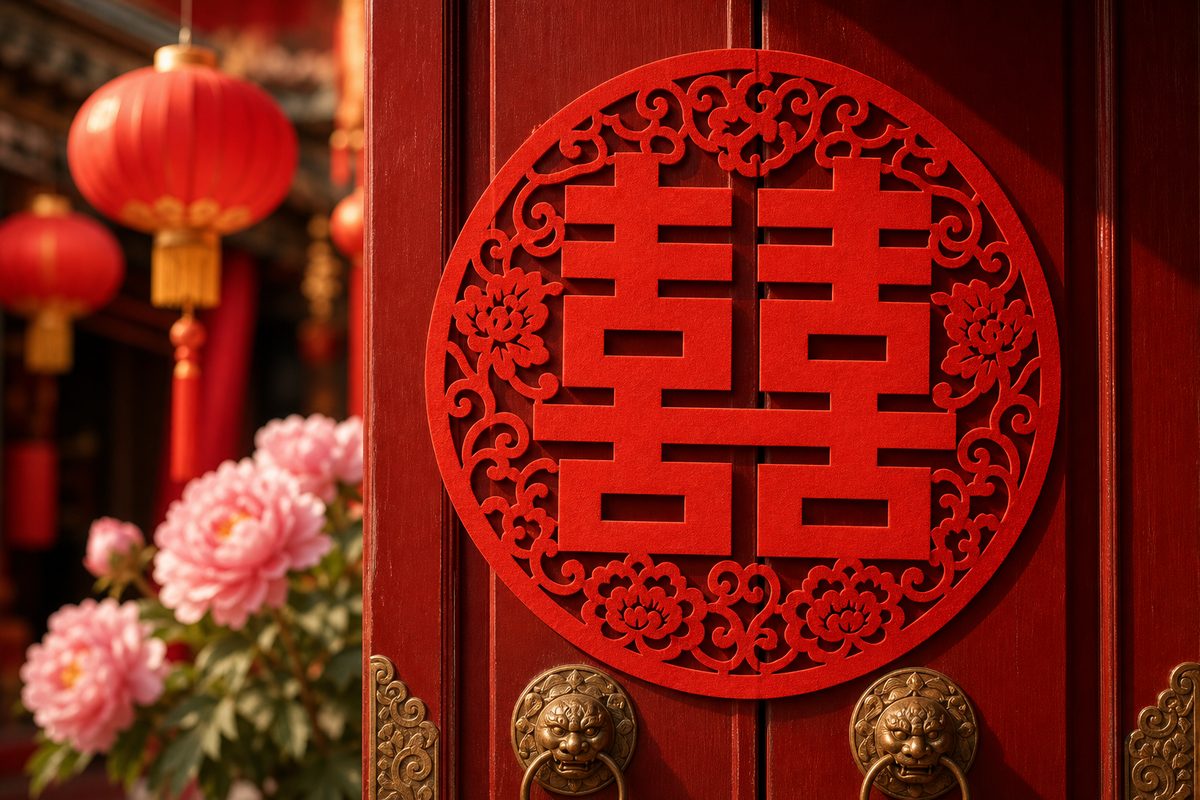
Planning one yourself? Make your own 囍 in brush or cursive to print for the invitations and the door.
Joy, doubled, at the Olympics
In 1959, as China Daily tells the story, Premier Zhou Enlai looked at two events landing in one year, the tenth anniversary of the People's Republic and Rong Guotuan's first-ever table-tennis world championship for China, and called them a "double happiness." The name stuck to a new Shanghai sports company, and DHS, Double Happiness Sports, went on to supply the official balls and tables of multiple Olympic Games. Somewhere in a warehouse there are Olympic ping-pong balls stamped, in effect, with wedding joy. There is a best-selling cigarette brand by the same name too, passed around by the pack at wedding banquets.
Pregnant with joy
Everyday Mandarin keeps 喜 busy. To "have joy," yǒuxǐ, means to be expecting a baby, no further explanation needed. Good news is "reported joy," bàoxǐ. And in one of the language's most disarming turns, a funeral for someone who lived a long, full life is a "white joy event," bái xǐshì, mourned in white but counted, gently, as a kind of completion. Red joys and white joys together, hóngbái xǐshì, is the standard phrase for the big occasions of family life, weddings and funerals in one breath.
The character that outgrew the dictionary
囍 sits in a strange bureaucratic limbo: too famous to ignore, too wordless to define. It has a seat in Unicode, at code point U+56CD, so your phone can type it, though it remains a character you display rather than a word you can use in a sentence. In 2017 Unicode went further and added a rounded emoji-style version for good measure. Not bad for a character with no pronunciation entry of its own beyond the borrowed xǐ, no grammar, and no meaning except congratulations.
Where the character comes from
The half-character has an ancient pedigree, and it is a musical one. The Shuowen Jiezi, the first Chinese dictionary, compiled around the year 100, defines 喜 as joy and builds it "from 壴 and 口": a drum on its stand, and a mouth. The oracle-bone forms, three thousand years old, draw the same scene. Joy, in the oldest Chinese analysis, is a drumbeat plus a voice, percussion and song, which remains hard to argue with. The doubled form is another story, and honesty requires saying so plainly: 囍 is not ancient. It appears in no classical dictionary, and it is not a word so much as a piece of folk typography, a celebratory sticker built out of language. That is not a weakness. It means the wedding symbol was invented by ordinary people for one specific human occasion, and it earned its place on a billion doorways by use alone, without a single classical text to lean on.
History & roots
The legend of the double joy
The story everyone tells stars Wang Anshi, the great Song-dynasty statesman. On his way to the capital for the imperial examination, the young Wang sees a challenge couplet hung on a rich man's gate, offered by the household for a matching line; he has no answer, and walks on. In the examination hall, the emperor's test happens to hand him a perfectly matching line. Wang passes, and on his way home he answers the rich man's couplet too, winning the daughter's hand. On his wedding day, word arrives that he has passed the exam. Two joys, one day: Wang, the story goes, wrote 喜 twice in one breath and pasted it on the door. It is a wonderful story, and it should be labeled honestly: China Daily, retelling it, calls it "one folk story," which is the right shelf. None of the tellings point to a Song source, and legends of this kind attach themselves to famous names the way lint attaches to wool. What the legend records faithfully is not history but the symbol's exact grammar: two independent joys, arriving together, written as one character.
Joy is a drum
Behind the wedding sticker sits the old percussion. The Shuowen's recipe for 喜, a drum plus a mouth, describes any Chinese wedding you will ever attend: noise, music, voices, toasts. Twenty centuries after the dictionary, the character is still doing exactly what it says on the label, twice.
Why doubled
Chinese celebration runs on pairs. Blessings are wished in even numbers, couplets hang on both sides of a door, gifts arrive two by two, and the proverb hào shì chéng shuāng insists that good things come in pairs. A marriage is the pair of pairs, two people and two families, so its emblem could hardly have been a single anything. The idiom the symbol embodies, shuāng xǐ lín mén, "two joys arrive at the gate," predates no one's wedding and fits them all.
The bird on the plum branch
喜 also has a bird. The magpie is the "joy bird," xǐquè, the traditional messenger of good news, and Chinese decorative art uses it as a walking pun: two magpies face to face mean double joy, and a magpie perched on a plum branch is read "joy up to your eyebrow tips," because the words for plum and eyebrow sound alike. If you have ever wondered why so much Chinese porcelain features cheerful black-and- white birds in flowering trees, you now hold the decoder: it is the same rebus logic that puts bats all over the luck symbol's world, and it means someone was being wished a very specific happiness.
Questions people ask
What does the double happiness symbol mean?
The double happiness symbol, 囍 (shuāngxǐ), is two copies of 喜, the Chinese character for joy, joined into a single glyph. It stands for marital happiness: two people, two families, joy doubled. It is the standard emblem of Chinese weddings, displayed in red on doors, windows, invitations, and gifts for the couple.
Where does the double happiness symbol come from?
A folk legend credits the Song-dynasty statesman Wang Anshi, said to have passed the imperial exam and married on the same day, writing 喜 twice in celebration. It is a legend rather than recorded history; no early source documents it. The ligature itself is folk typography: it appears in no classical dictionary and became the wedding emblem through centuries of popular use.
Is the double happiness symbol only for weddings?
Primarily, yes: 囍 specifically means marital joy, and in decoration it signals a wedding. The doubled-joy idea also lives on in brand names, most famously Double Happiness (DHS), the Shanghai maker of Olympic table-tennis balls, named after the 'double happiness' of 1959. For general happiness or luck, the single characters 喜 (joy) or 福 (blessing) are the right choice.
How do you write or type the double happiness symbol?
By hand, write the twelve-stroke character 喜 twice, side by side, joined as one square glyph: twenty-four strokes in all. Digitally, it is the Unicode character U+56CD, and Chinese input methods produce it by typing its reading; since 2017 Unicode also includes a rounded emoji-style version.
Is a double happiness tattoo a good idea?
It depends on the message you want. 囍 reads specifically as marital joy, so it works beautifully as a couple's or anniversary tattoo, and it is identical in simplified and traditional Chinese. Make sure both halves are the same correct 喜, keep it upright and unmirrored, and avoid the Japanese shorthand 㐂. For general good fortune, 福 is the usual single-character choice.
Sources
- Zdic (zdic.net): the entry for the ligature 囍 (24 strokes, shuangxi)
- Zdic (zdic.net): the dictionary entry for 喜, incl. the Shuowen analysis (drum + mouth)
- Double Happiness (calligraphy): the ligature and its Unicode history (Wikipedia)
- Unicode Unihan database: U+56CD 囍
- The symbol for happiness: the Wang Anshi folk story (China Daily, 2013)
- A double hit of happiness: Zhou Enlai and the 1959 naming (China Daily, 2014)
- DHS (Double Happiness Sports) official brand history
Make Double happiness your own
See 囍 in calligraphy
From ancient seal script to flowing cursive. Pick a look before a tattoo or a card.
Get a Chinese name
A name matched to the sound of yours, with a meaning that fits.
Try the Chinese Gender Predictor
A different corner of Chinese culture: the old Qing-palace birth chart, worked out from your lunar birth date, with the math shown and its coin-flip odds honestly weighed.
By Julian 祝君瑜 · sourced from the classics and from modern life · updated 2026-07-16