Tiger and Monkey Compatibility: The Front Door and the Window
Liu chong — one of the six clashes: the two signs sit directly opposite on the wheel.
The old punishment (xing) tables also flag this pair — details under the wheel below.
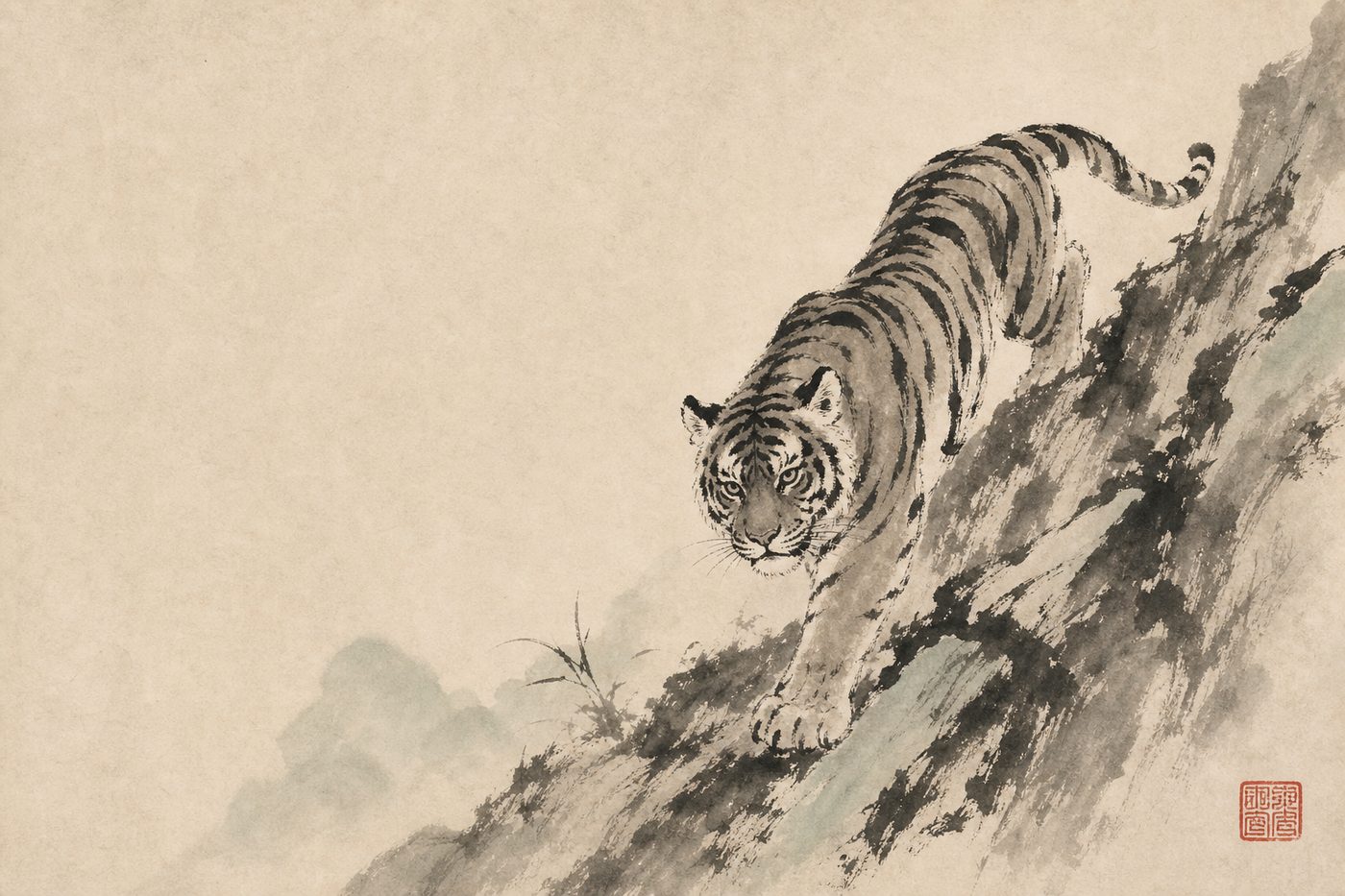
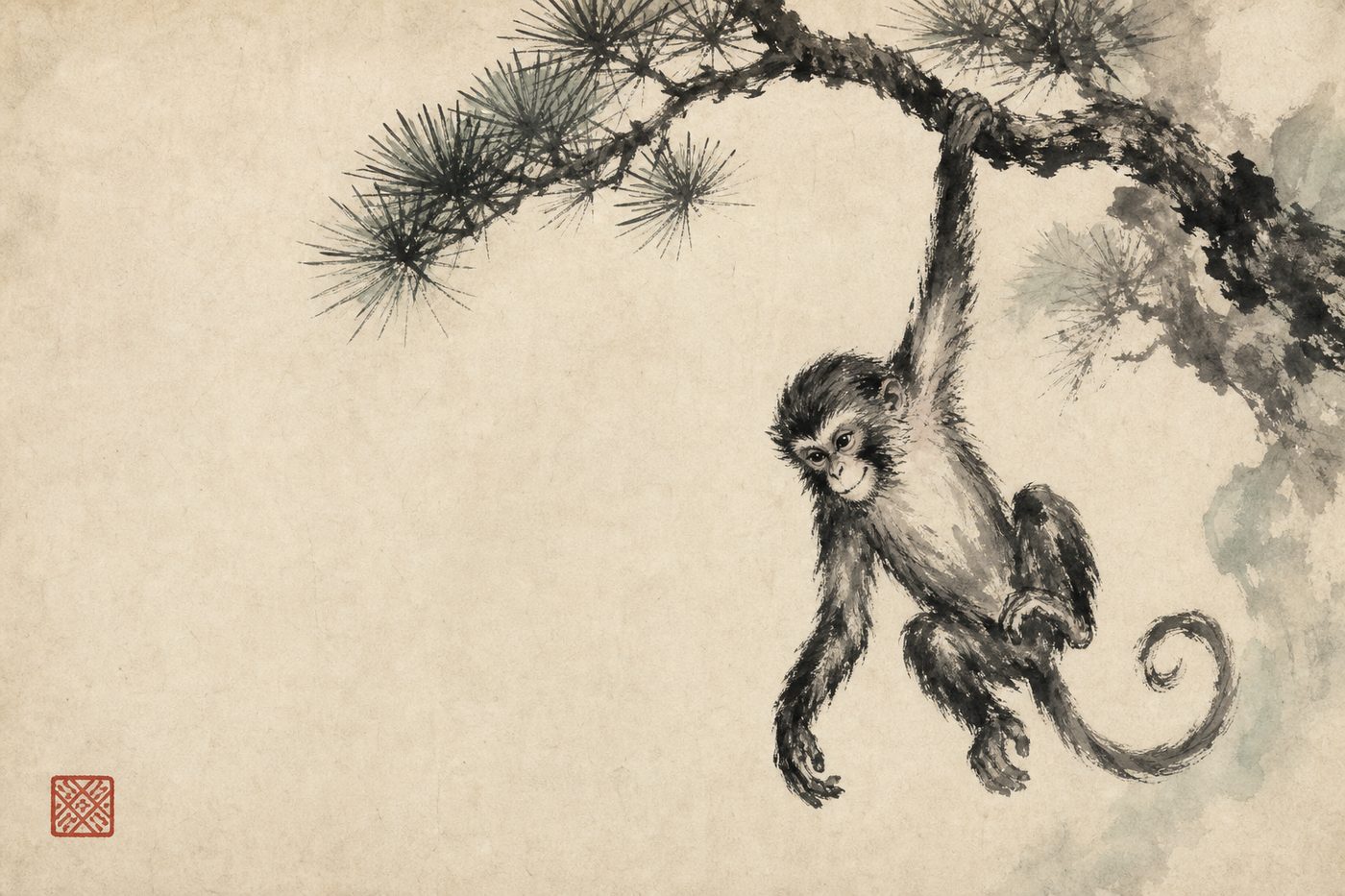
Tiger and Monkey sit directly opposite each other on the Chinese zodiac wheel, one of the six clashes the branch system calls liu chong, and the traditional sketch of this one is a door: the Tiger charges through the front of it while the Monkey is already halfway out a window it opened for fun. Authority meets mischief, force meets finesse, and the old sources call the pairing exhausting, which is the tables at their most conversational. The tables also list these two in one of the punishment (xing) groups, a second caution layered on the first, so this page owes its readers precision about both, and gets to it below.
How the wheel reads this pair
Chinese zodiac verdicts are positions, not vibes. The Tiger holds position 3 on the twelve-branch wheel (branch yín) and the Monkey position 9 (branch shēn); their verdict follows from that geometry alone.
- Verdict
- Challenging
- Bond
- Liu chong · the six clashes
- Branches
- yín 寅 + shēn 申
- Fixed elements
- Wood + Metal
One honest footnote: the branch tables also list this pair under xing, the punishments, a third and murkier layer of the old system. Sources disagree about how much weight it carries, and most modern readings treat it as a caution rather than a verdict. We flag it because it is in the tables, not because it settles anything.
The Tiger and the Monkey, side by side
Love and romance
The attraction is real and has a shape worth respecting: each is the other's most interesting problem. The Monkey, connoisseur of rooms it can predict, meets in the Tiger a force with no script at all, conviction moving at full commitment, magnificent and, to a mind built for puzzles, begging to be tested. The Tiger, surrounded by people who flinch or flatter, meets in the Monkey the one creature that does neither, a wit entirely unafraid of it, and a Tiger's respect goes, always and only, to what does not back down.
So the courtship crackles. The Monkey teases at an amperage nobody else dares, the Tiger roars and secretly enjoys the audacity, and both mistake the game for compatibility, which it is not quite. The game runs on the Monkey testing and the Tiger withstanding, and it is glorious until the day the Tiger notices the testing never stops. A Tiger wants, eventually, to be followed, or at least believed; a Monkey follows nothing on principle and believes things provisionally, pending further probing. What each loved at the door, the unscripted force, the unfrightened wit, is exactly what each files grievances about by year three.
Trust
The trust problem is structural, and it is worth naming without euphemism. The Tiger's code is frontal: say it to the face, charge the front door, despise the flank. The Monkey's code is flexible: rules are puzzles, routes are multiple, and the window is not a betrayal of the door, merely a second door with better comedy. Neither code is dishonest, but they audit each other terribly. To the Tiger, the Monkey's workarounds read as scheming, the one thing a frontal creature cannot respect; to the Monkey, the Tiger's demand for straight lines reads as a rule, and its mind picks rules the way fingers pick locks, reflexively, without malice, often without noticing.
The punishment listing sharpens the same point. Tradition groups Tiger and Monkey, with the Snake, in one of the xing clusters, an old caution layer about relationships that erode through friction of temperament rather than any single betrayal, and sources gloss this particular cluster as trouble born of presuming on strength. Whatever weight one gives the old tables, the operational reading is sound: this is a pairing where nobody has to do anything wrong for trust to thin. He tests, she commands, or the reverse, and each round of the game shaves a little from the account. Couples who last treat trust here as a built structure, never a default: promises few, explicit, and kept with an exactness both codes can verify.
Communication
In fair weather, the channel is the pairing's best asset. Both signs are quick, funny, and allergic to boredom, and their banter runs at a speed that clears the room of slower company; the Tiger declaims, the Monkey riffs, and each genuinely improves the other's material. Neither hoards information, neither hints, and a household of two blurters, whatever its other bills, never pays the tax of the unsaid.
In weather, the mismatch of weapons decides everything. The Tiger fights at volume, frontally, and is finished within the hour; the Monkey fights with accuracy, the joke that lands exactly on the sore spot, the imitation of the Tiger's roar performed once, perfectly, at dinner. The Tiger's weapon bruises; the Monkey's punctures, and a punctured Tiger does not laugh, it remembers, which for a sign with no ledger is a measure of the wound. The two rules that keep these couples alive are symmetrical and cheap. The Monkey retires the mockery, entirely, in front of witnesses, because command laughed at in public is the one loss a Tiger cannot absorb. The Tiger converts orders into requests, because a command issued to a Monkey is not instruction, it is materials.
Marriage and family
A Tiger-Monkey household, when it runs, runs on adrenaline and comedy, and it should budget for both. Two restless signs make a home that is never boring: plans erupt, trips materialize, the furniture migrates, and the children, if any, grow up quick-witted, unshockable, and fluent in both dialects, charge and workaround. The pairing's genuine gift is energy, and couples who aim it outward, at ventures, adventures, shared campaigns, report the clash quieting for whole seasons, because a Monkey with a worthy puzzle and a Tiger with a worthy hill have no attention left over for auditing each other.
Aimed inward, the same energy is the whole problem. The Tiger tries to run the household as a column, and the Monkey cannot be columned; the Monkey treats the Tiger's arrangements as drafts, and the Tiger reads every unauthorized improvement as insubordination. Money follows the same fault line, the Tiger spending boldly on the mission, the Monkey opportunistically on the interesting, with neither playing treasurer. The stabilizers are jurisdiction and a third book: separate domains each rules absolutely, joint decisions negotiated as between sovereigns, and the accounts kept by an instrument neither can charm, an automatic transfer, a standing order, a spreadsheet with no sense of humor.
Work and money
Professionally, at the right distance, this pairing is formidable, and the casting is proverbial: force and finesse. The Tiger supplies command, momentum, and the credibility of total commitment; the Monkey supplies the workaround, the negotiation, the third option when the front door is barred. Campaigns, launches, and rescues use both natures at full draw, the Tiger taking the hill while the Monkey discovers the hill has a service entrance. Teams led by such a pair describe the experience as thrilling, which is accurate, and stabilizing, which nobody has said yet.
Adjacent desks need treaties. The Monkey's improvements on the Tiger's plan, offered mid-meeting, cost the commander face in front of the column, and the Tiger's orders, issued to the one subordinate who reads orders as puzzles, generate exactly the creative compliance that drives commanders mad. The working arrangements mirror the marriage: fix the jurisdictions, route the Monkey's genuinely good amendments through private channels before the meeting, and give the Monkey the unscripted portfolio, negotiations, crises, new markets, where its disobedience is the job description.
Where it breaks
The terminal pattern is the game with the affection drained out, and both the clash and the punishment tables describe its mechanics fairly. The Monkey, feeling commanded, escalates the testing, and the testing curdles from play into sabotage in increments too small to police: the plan improved without asking, the authority punctured at dinner, the window used not because it is faster but because the door was his. The Tiger, feeling mocked, escalates the command, and command curdles into occupation, rules multiplying precisely because they keep being picked. Each partner is now supplying the other's grievance at industrial volume, and each experiences its own escalation as self-defense.
The end is asymmetric. The Tiger leaves loudly, in a final, genuinely frontal scene it has usually rehearsed as a speech; the Monkey leaves sideways, out the window, often having furnished the landing months earlier, and each departure confirms the other's whole case. None of this is fate. The clash names a real mismatch of codes, force and finesse, and the couples who beat it, who exist, all describe the same trade: the Monkey grants the Tiger the one thing it never grants, a small territory of promises kept with boring exactness and mockery permanently retired, and the Tiger grants the Monkey the one thing it never grants, a life inside its walls with no orders in it.
How to fix it
- 1
Retire the public mockery. The imitation, the puncturing joke, the improvement offered mid-meeting, all of it moves to the empty room. Command laughed at with witnesses is the single unabsorbable loss for a Tiger.
- 2
Requests, not orders. A command issued to a Monkey is raw material for creative compliance. The same content, framed as a request between sovereigns, gets kept, because nothing in it needs picking.
- 3
Fix the jurisdictions. Separate domains ruled absolutely, joint decisions negotiated, and the money managed by an instrument neither can charm. Most of this clash is two sovereigns disputing an unmarked border.
- 4
Aim the energy outward. A worthy hill for the Tiger, a worthy puzzle for the Monkey, ideally the same project. This pairing audits itself only when it has nothing better to do, so ensure it always does.
Share this pairing
The card carries both portraits and the verdict.
Questions people ask
Are Tiger and Monkey compatible in the Chinese zodiac?
This is one of the six clashes (liu chong). Tiger and Monkey sit directly opposite on the wheel, and tradition reads the opposition as force versus finesse, the frontal charge versus the window left open for fun. It is a caution about mismatched codes, not a prohibition, and couples override it with structure.
Why do Tiger and Monkey clash in the zodiac?
Position first. The Tiger holds the third seat and the Monkey the ninth, exactly opposite, and all six opposite pairs are clashes. This pair is also grouped with the Snake in one of the old punishment (xing) clusters, a second caution layer that most modern readings treat as emphasis, trust here erodes through friction rather than any single betrayal.
Can a Tiger and Monkey relationship work?
Yes, with treaties rather than transformation. The working couples retire mockery in public, trade orders for requests, mark the borders of who rules what, and point the shared restlessness at outward projects. The pairing fails when the game turns inward and each partner starts supplying the other's grievance.
Year of the Tiger 虎
Personality, years, matches, and where the sign comes from.
Year of the Monkey 猴
Personality, years, matches, and where the sign comes from.
← All 66 zodiac pairings, with verdicts
Signs turn over at Chinese New Year, not January 1 — a January or February birthday can belong to the previous animal. Check a birthday on the lunar calendar →
Sources & further reading
By Julian 祝君瑜 · verdict derived from the twelve-branch system, not assigned by hand · updated 2026-07-14