Tiger and Dog Compatibility: The Commander and the Conscience
San he — both belong to the Fire trine, signs four apart that pull in the same direction.
Tiger and Dog is one of the Chinese zodiac's strongest pairings, the third leg of the Fire trine those two share with the Horse, and it is the trine's most serious marriage. The traditional casting assigns the roles cleanly: the Tiger supplies conviction, the Dog supplies loyalty and maintenance, and the Horse, absent from this particular pairing, supplies the momentum. What the tables endorse is a commander finally issued a conscience it can trust at its back. What follows is that endorsement in full, plus the one argument these two will have for forty years.
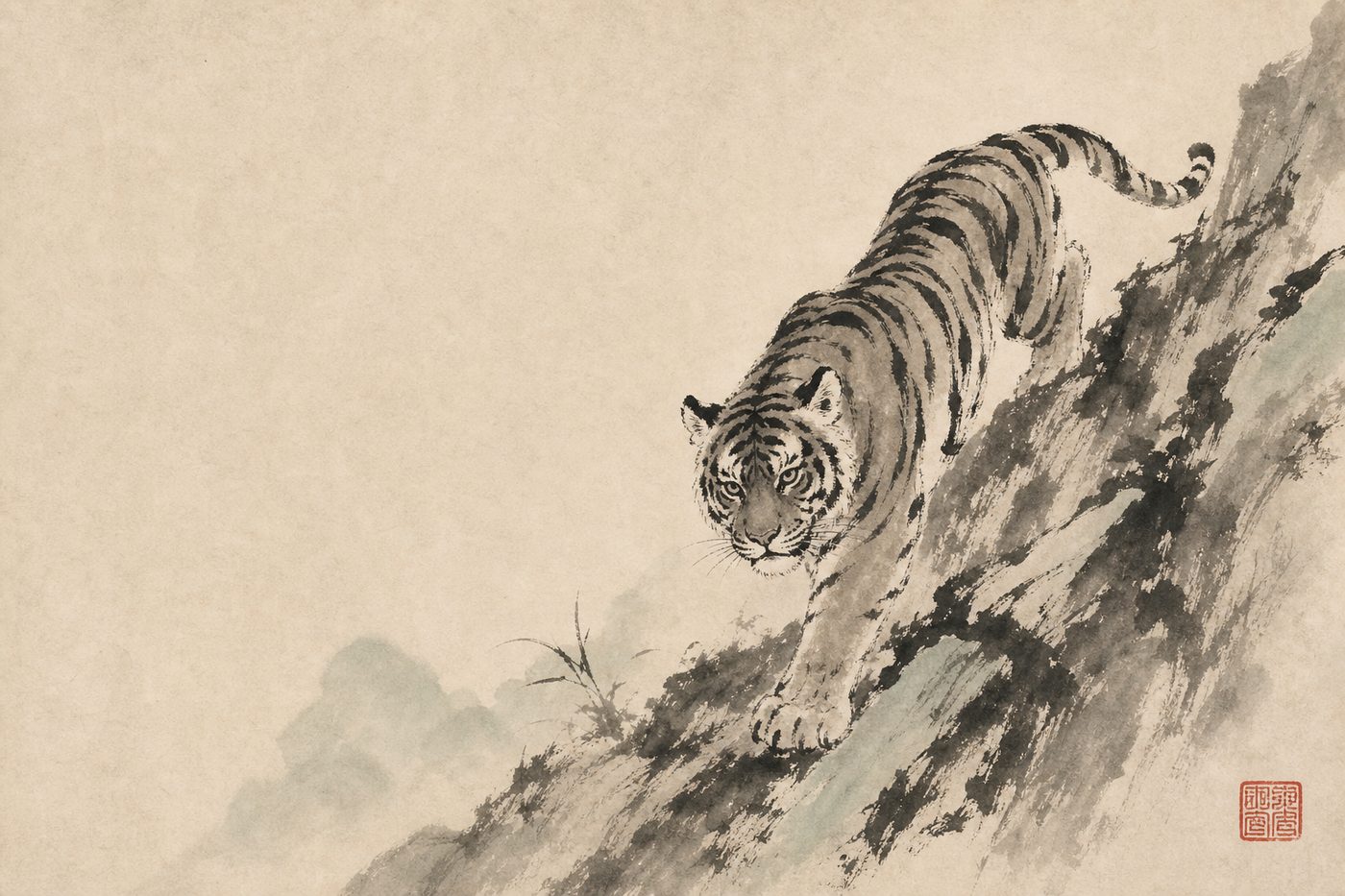
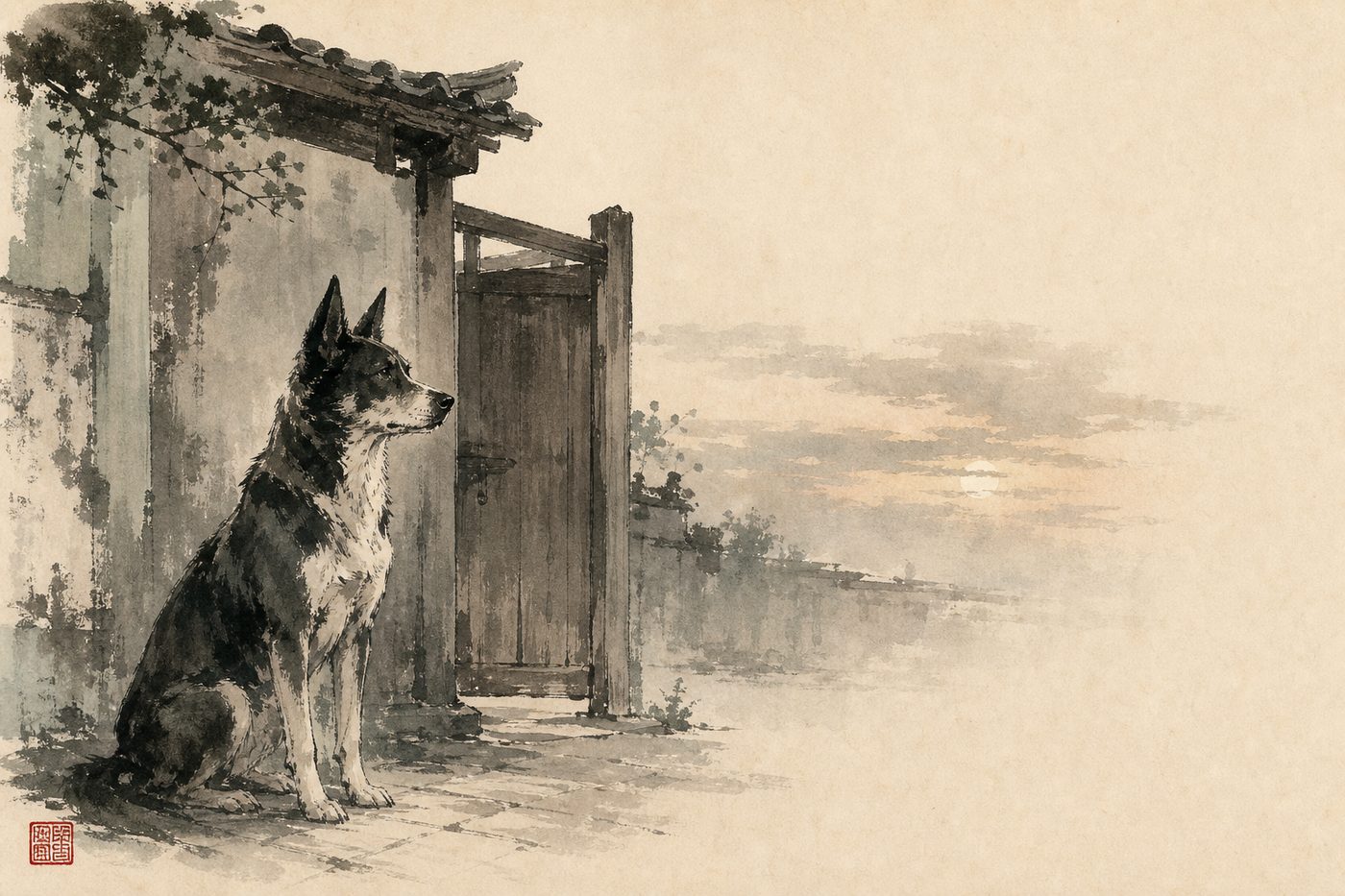
How the wheel reads this pair
Chinese zodiac verdicts are positions, not vibes. The Tiger holds position 3 on the twelve-branch wheel (branch yín) and the Dog position 11 (branch xū); their verdict follows from that geometry alone.
- Verdict
- Best match
- Bond
- San he · trine allies
- Branches
- yín 寅 + xū 戌
- Fixed elements
- Wood + Earth
The Tiger and the Dog, side by side
Love and romance
The Dog spends its life scanning rooms for what might go wrong, and auditioning, mostly in vain, for a cause worth its extraordinary loyalty. The Tiger walks in already being one. Conviction is the Tiger's native state, the hill chosen, the charge committed, and to a sign that runs on trust and receipts, a partner this frontal is a settlement of accounts in advance: nothing hidden, nothing performed, the whole position visible from the doorway. Dogs fall for Tigers the way garrisons fall in behind a general they have actually vetted, slowly, thoroughly, and then completely.
The Tiger's side of the bargain is rarer than it looks. Tigers collect followers easily and equals almost never, and the Dog is the one Fire sign that will neither race it nor flatter it. A Dog's admiration has to be earned and stays earned; its criticism arrives to your face, unvarnished, before the charge rather than after the wreck. For a sign whose entourage always says yes, the partner who says "not this hill" and demonstrably means it in your interest is not an obstacle. It is the only security a Tiger ever gets, and the good ones know it early.
Trust
This is the pairing's fortress, and both signs built it on purpose. The Dog is constructed from loyalty the way the Ox is constructed from patience: given whole once earned, returned with interest, decade after decade. The Tiger is constitutionally frontal, incapable of the back door, and says the hard thing to your face by reflex. Between one partner who cannot scheme and another who checks, betrayal has nowhere to live. The Dog's famous vigilance, so exhausting in softer pairings, finds in the Tiger a partner who never once triggers it, and stands down to a degree that surprises the Dog itself.
What strains instead is the vigilance redirected. A Dog's worry is its metabolism, and with the home front secure it aims forward, at the Tiger's plans, which supply a lifetime of material. Every charge gets audited: the funding questioned, the timing doubted, the worst case named at the dinner table. The Tiger, who reads its own conviction as evidence, can come to hear the auditing as something worse than caution, as a vote against it personally, from the one voter whose vote it cannot dismiss. The distinction both must hold onto is the one the whole marriage runs on: the Dog questions the hill precisely because it has already decided to die on it with you, and no other sign on the wheel offers that order of operations.
Communication
Both signs deal in plain declarations, so the channel is direct, honest, and never passive; nothing in this house is implied, hinted, or filed for later. Arguments are loud on one side, grave on the other, and genuinely about the thing itself, which puts this pairing ahead of most of the wheel before breakfast. The Tiger roars and is finished within the hour. The Dog does not roar; it broods, and there sits the mismatch. Tiger weather passes; Dog weather settles in, and a Tiger that treats a brooding Dog as a passing squall will be baffled to find the cloud still there on Thursday.
The recurring argument has a shape worth naming: the veto fight. The Dog says "not this one," the Tiger hears a fence, and the Tiger's lifelong policy on fences is well documented. But a Dog's objection is not a fence, it is a receipt, an itemized account of specific risk, and it is presented exactly once with full sincerity. Override it casually and the Dog does not argue louder; it goes quiet, files the outcome, and volunteers less next time. The couples who last learn the procedure early. The worry gets a full hearing before the charge, not during, and when the Tiger overrides, it owns the outcome out loud if the Dog was right, because a Dog can forgive any decision except the unacknowledged one.
Marriage and family
A Tiger-Dog household is built like a garrison town, and lives in one direction: forward, but defended. The Tiger generates the motion, the venture, the relocation, the audacious bet on itself, and the Dog runs everything that keeps motion survivable, the insurance renewed, the promises tracked, the children's world patrolled with a thoroughness the Tiger never sees and entirely relies on. Where a Tiger-Horse house famously lacks a maintenance department, this one ships with the department built in, fully staffed, and mildly underappreciated.
The negotiations are two. First, pace: this is the Fire trine without its cavalry, and the Dog's caution can throttle the Tiger's throttle until the household idles in excellent repair. Both partners should notice when the last bold thing happened, and if neither can remember, that is the Dog's cue to approve the next one on purpose. Second, gloom: a Dog's pessimism is weatherproofing, not prophecy, but a Tiger lives on morale, and years of worst cases named at dinner can read as a running vote of no confidence. The working couples ration it, one named worry per plan, in the hearing, with everything after that held as private weatherproofing.
Work and money
Hire them where the mission is real and the stakes are moral: turnarounds, emergency services, advocacy, medicine, any venture whose pitch includes the word "should." The Tiger is the cycle's front-of-column commander; the Dog is its conscience and quartermaster, and the combination produces that rarest of enterprises, one that charges hard and can pass an audit. Colleagues trust such teams instinctively, because the Tiger's conviction arrives pre-checked by the one auditor who cannot be charmed.
The frictions are the marriage's, transposed. The Dog under-promotes what it maintains, and a Tiger can forget to name the quartermaster while accepting the medals, an omission the Dog logs politely and permanently; one public, specific credit per season is the entire price. And the missing Horse shows up here too: conviction plus caution generates superb decisions and modest throughput, so the venture needs its momentum hired, delegated, or scheduled, because neither founder naturally supplies speed for its own sake.
Where it breaks
The terminal pattern is the veto war, fought in the pairing's two native styles. The Tiger, overridden once too often or audited once too publicly, stops submitting plans for review and starts announcing them, and a Dog cut out of the loop does not sulk; it patrols harder, questions later, and converts from partner to inspector. The Tiger now has what it always technically wanted, a free hand, and finds it comes at the one price it cannot afford, which is charging alone. Nobody guards the flank of a general who stopped listening.
The slower route down is morale. A Dog's worry, unrationed, becomes the household's climate; the Tiger's appetite for the bold move starves in it, and a Tiger without a next hill turns its force inward or elsewhere, neither of which any marriage survives well. Both routes have the same prevention, and it is procedural rather than romantic: the worry gets its full hearing, the charge gets its honest chance, the outcome gets owned by whoever called it wrong, and once a season the Dog backs a bet it cannot fully underwrite, as a gift, because that, in the Dog's own currency, is what loyalty spends like.
How to fix it
- 1
Hear the receipt before the charge. The Dog's objection is itemized risk, presented once, in your interest. Give it a full hearing pre-launch, and the marriage never has to relitigate it mid-wreck.
- 2
Own the overrides out loud. When the Tiger charges anyway and the Dog was right, the Tiger says so, plainly, unprompted. A Dog forgives any decision except the unacknowledged one.
- 3
Ration the weatherproofing. One named worry per plan, delivered at the hearing; the rest stays in the Dog's private files. Pessimism is maintenance, and maintenance does not belong at every meal.
- 4
Hire the missing Horse. Conviction plus caution yields great decisions and slow wheels. Schedule the momentum, delegate the sprint, and once a season the Dog approves a bold thing on purpose.
Share this pairing
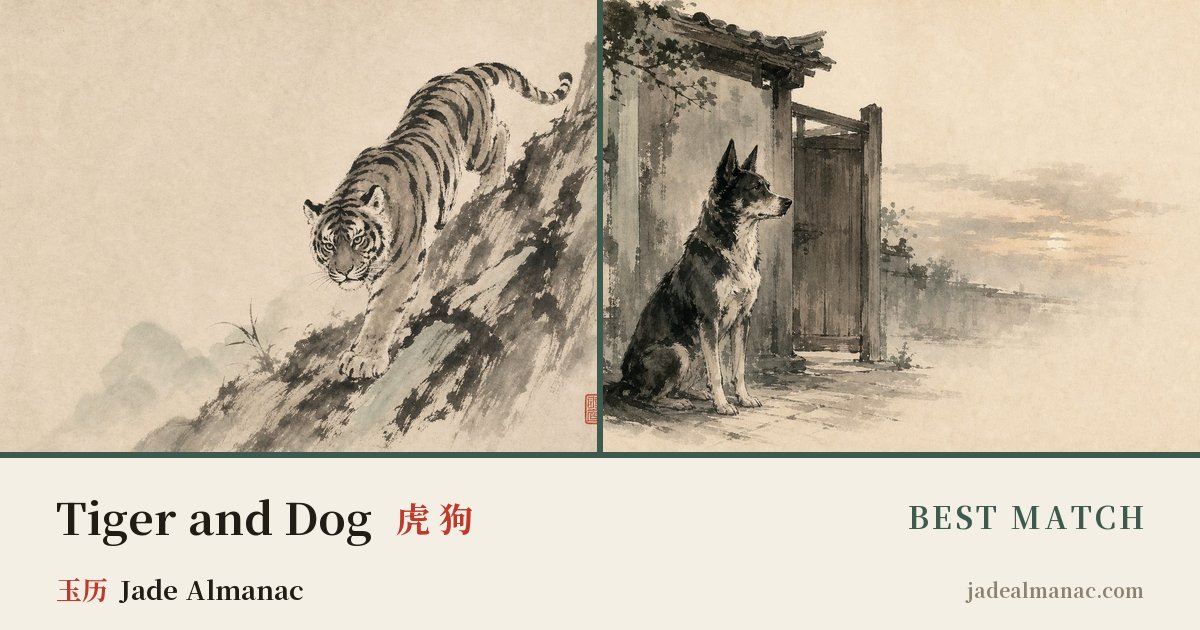
The card carries both portraits and the verdict.
Questions people ask
Are Tiger and Dog compatible in the Chinese zodiac?
Yes, emphatically. Tiger and Dog share the Fire trine (san he) with the Horse, sitting four positions apart on the wheel, and trine pairs are the system's designated best matches. The traditional casting gives the Tiger the conviction and the Dog the loyalty and maintenance.
Why are Tiger and Dog considered a best match?
The verdict is positional. Signs four apart form trines with a shared elemental character, and both of these belong to the Fire trio. Temperamentally it holds up because both signs are frontal and neither can scheme, so the Dog's hard-won trust and the Tiger's need for one honest equal land in the same place.
What problems do Tiger and Dog couples have?
The veto fight, mostly. The Dog audits every charge and the Tiger hears fences, so overridden objections and unrationed pessimism can grind the pairing into inspector versus general. The classic advice is procedural, a full hearing before the launch, owned outcomes after it, and one worry per plan rather than a climate of them.
Year of the Tiger 虎
Personality, years, matches, and where the sign comes from.
Year of the Dog 狗
Personality, years, matches, and where the sign comes from.
← All 66 zodiac pairings, with verdicts
Signs turn over at Chinese New Year, not January 1 — a January or February birthday can belong to the previous animal. Check a birthday on the lunar calendar →
Sources & further reading
By Julian 祝君瑜 · verdict derived from the twelve-branch system, not assigned by hand · updated 2026-07-14