Dragon and Monkey Compatibility: The Nerve and the Invention
San he — both belong to the Water trine, signs four apart that pull in the same direction.
Dragon and Monkey is one of the Chinese zodiac's certified best matches, the second leg of the Water trine those two share with the Rat, and it is the trine's loudest pairing by a comfortable margin. The traditional casting gives the Monkey the invention and the Dragon the nerve: one mind produces the trick, the other has the audacity to bet the house on it. The alliance is real, the couples tend to be unmissable at parties, and the machine has exactly one missing part, which is anybody counting the exits.
How the wheel reads this pair
Chinese zodiac verdicts are positions, not vibes. The Dragon holds position 5 on the twelve-branch wheel (branch chén) and the Monkey position 9 (branch shēn); their verdict follows from that geometry alone.
- Verdict
- Best match
- Bond
- San he · trine allies
- Branches
- chén 辰 + shēn 申
- Fixed elements
- Earth + Metal
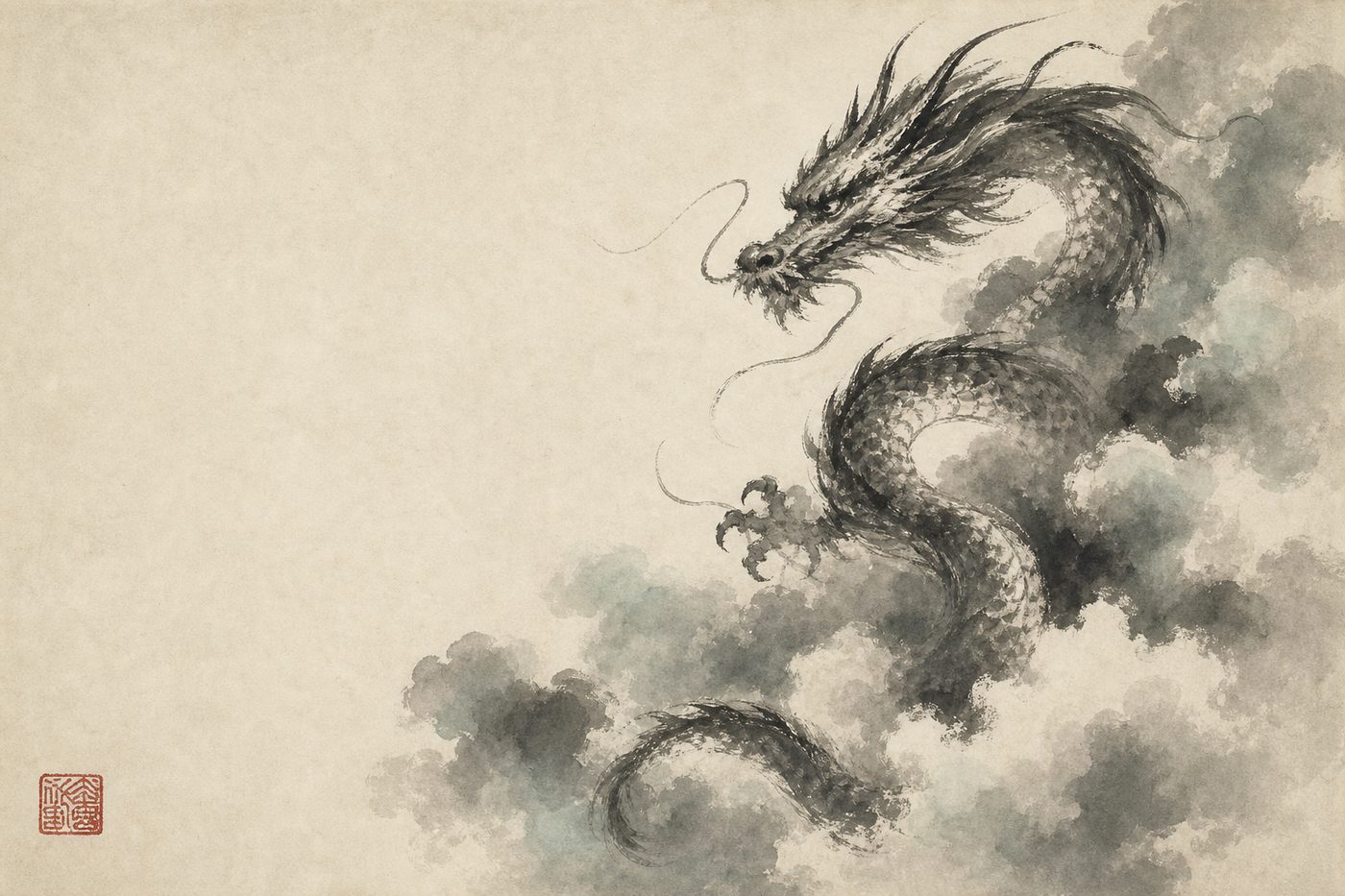
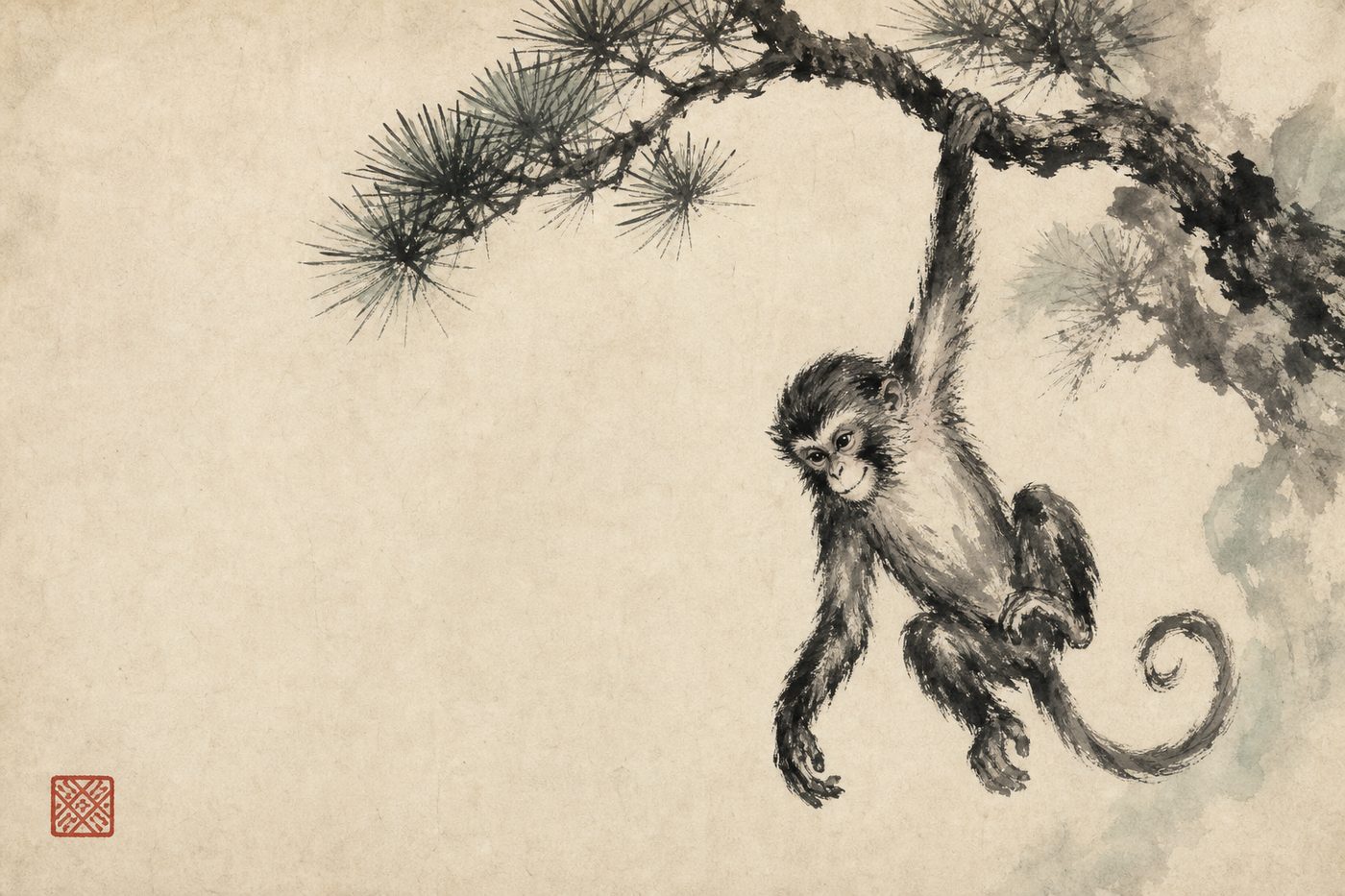
The Dragon and the Monkey, side by side
Love and romance
The attraction is fast, public, and mutual, because each sign is the other's ideal audience with the seats reversed. A Dragon in love wants to be believed in, and the Monkey, the wheel's quickest appraiser, is the rare admirer whose belief means something; flattery from someone who sees the mechanism of every trick is not flattery, it is a verdict. A Monkey in love wants to be kept interested, the sign's one genuine hunger, and the Dragon is the only partner on the wheel guaranteed never to bore it, because the Dragon does not have a boring register.
Watch them at a dinner party and the division of labor is already running. The Dragon holds the table with the plan; the Monkey, two seats down, improvises the counterpoint, tests the plan's seams in real time, and hands back a sharper version disguised as a joke. The Dragon, no auditor of jokes, takes the upgrade and announces it at volume as its own, and the Monkey, crucially, does not mind. It never wanted the podium; it wanted the game. Couples built on that trade describe the early years as one long escalating dare, and most of them mean it as praise.
Trust
Trust here is sturdier than two performers deserve, and the reason is transparency of opposite kinds. The Dragon conducts its entire life in public, announcing plans, grudges, and bank balances unprompted, so the Monkey's restless intelligence finds nothing hidden to pick at. The Monkey is more curated, but a Dragon does not audit; suspicion requires an attention to small print that the Dragon has never once possessed. Each, in effect, is unsuited to catching the other, and since neither is malicious, the arrangement mostly holds.
The live wire is doubt, which the Dragon cannot metabolize from a partner. The Monkey's mind tests everything as a reflex, including, inevitably, the Dragon's plan, and there is a version of that testing the Dragon receives as treason: the raised eyebrow at the announcement, the clever aside that lands as mockery, the improvement offered in front of witnesses. To the Monkey it is quality control with a punchline. To the Dragon it is a no-confidence vote from the one voter who counts. The durable couples learn the distinction early: test the plan in private, back it in public, and never make the Dragon the punchline in a room it is performing for.
Communication
At its best the channel is spectacular, a headline act with a live writer. The Dragon speaks in declarations, the Monkey in variations, and each genuinely improves the other: the Monkey gives the Dragon's grand statements their wit, the Dragon gives the Monkey's cleverness a stage worth the material. Arguments, when they come, are fireworks rather than siege warfare, loud, fast, inventive on both sides, and finished by morning, since neither sign files grievances. On the wheel's ledger-keeping spectrum, these are the two signs without a ledger between them.
The recurring failure is competitive escalation. Both signs perform under pressure, so a disagreement in company can turn into a show neither can afford to lose: the Dragon raises the volume, the Monkey raises the wit, and the Monkey's weapon is the crueler one at close range, because it is accurate. A Monkey in full flight can dismantle a Dragon's dignity in one sentence, and dignity is the one possession a Dragon cannot laugh off. The rule that saves them is the oldest one in the repertoire, and it works because both are professionals: never mid-show. Whatever it is, it waits for the empty room.
Marriage and family
The household runs at Dragon scale with Monkey ingenuity, which means it is never dull and never quite finished. Both signs are builders of momentum rather than maintainers of it: the Dragon launches the renovation, the venture, the relocation, and the Monkey solves the eleven problems the launch created, brilliantly, while quietly opening two side projects of its own. Visitors describe such homes as exciting, which is accurate, and as restful, which nobody has ever said once.
In the full trine, the Rat holds the reserve, prices the risk, and keeps the pantry deep through every relaunch, and a Dragon-Monkey marriage is that syndicate with the risk desk unstaffed. Neither partner naturally saves; the Dragon spends at scale as a form of self-expression, and the Monkey treats money as ammunition for interesting opportunities. The traditional fix is to hire the missing Rat rather than impersonate it: an automatic transfer no one votes on, an accountant with veto power, a reserve number agreed on a calm day and defended like territory. As parents they are the fun house on the street, and their children grow up quick-witted, unafraid of stages, and in occasional need of one adult who checks the homework actually exists.
Work and money
As a working pair they are close to unfair in any field that rewards audacity with a fast iteration loop: launches, campaigns, entertainment, trading, anything with an audience and a scoreboard. The Dragon fronts, absorbs pressure, and supplies the conviction that opens doors and wallets; the Monkey adapts, negotiates, and produces the third option when both official ones are bad. The Monkey is also the one colleague whose speed the Dragon never has to wait for, which for a Dragon is the difference between an ally and an entourage.
The two frictions are credit and boredom. Credit flows to the Dragon, always, and the Monkey genuinely cares less about that than any other sign would, but less is not zero, and a Dragon that never names the inventor in public will eventually find the inventions going elsewhere. One specific, witnessed sentence per season is the entire price. Boredom is the harder one: the Monkey's interest expires exactly when a venture becomes routine, which is exactly when it starts paying, and a Dragon would rather relaunch than maintain anyway. Two accelerants, no flywheel. The fix is structural, one boring, load-bearing hire with permission to say no to both founders.
Where it breaks
When this pairing fails, it fails theatrically, which surprises no one, but the script underneath is always the same and always quieter than the performance. The Monkey's testing drifts from the plans to the planner: the asides get sharper, the improvements arrive more publicly, and the Dragon begins to suspect that its own show has acquired a critic in the family box. The Dragon responds the only way Dragons respond to doubt, by getting bigger, louder, more absolute, which to a Monkey is not a boundary but material. Escalation is now the marriage's native language, and both partners are too good at it.
The end state is a couple still dazzling in company and entirely alone at home, the performance running long after the partnership inside it has stopped. It is preventable, and the prevention is unglamorous for two glamorous signs: the Monkey moves its editing to the empty room and its applause to the full one, and the Dragon shows the Monkey the unfinished plan, the real draft, the thing before it is announceable, because being trusted with the draft is the only applause the Monkey ever actually wanted.
How to fix it
- 1
Test in private, back in public. The Monkey's improvements are welcome behind closed doors and expensive in front of witnesses. The Dragon can absorb unlimited critique without an audience, and almost none with one.
- 2
Never mid-show. Disagreements between two performers escalate into productions. Whatever it is, it keeps until the empty room, and both partners enforce the rule on themselves, not each other.
- 3
Hire the missing Rat. An automatic reserve no one votes on, an accountant with real veto power, a floor number set on a calm day. Neither of you will ever play this position; staff it.
- 4
Name the inventor, feed the game. Once a season the Dragon credits a specific Monkey invention with witnesses present, and brings home a new problem worth solving. Applause and novelty are this pairing's actual wages.
Share this pairing
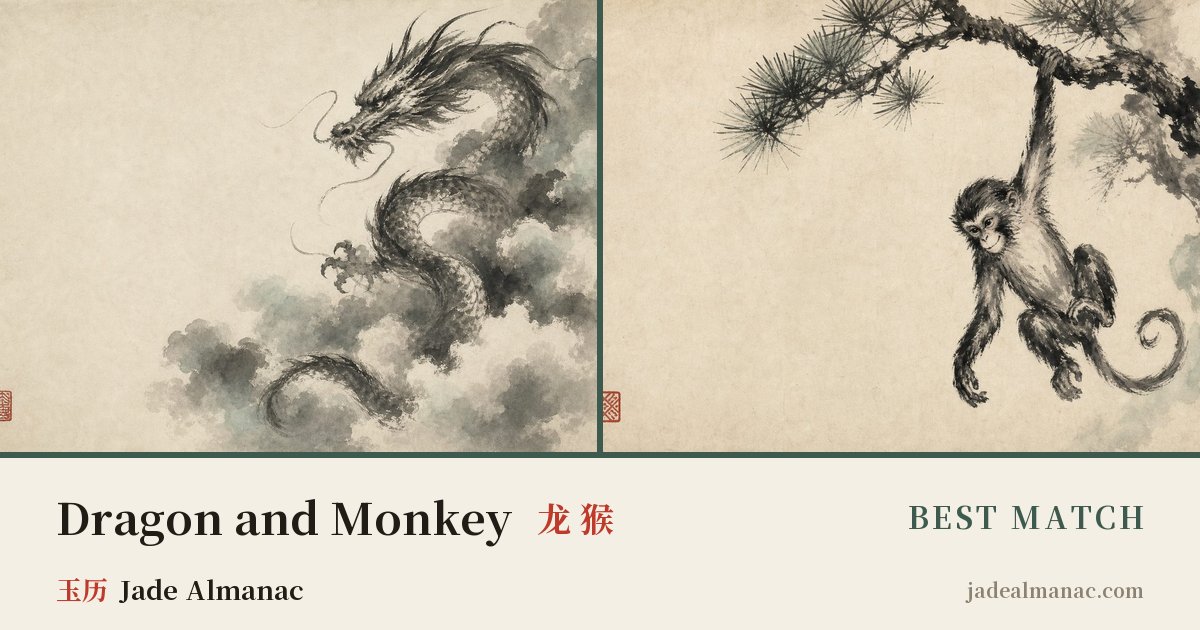
The card carries both portraits and the verdict.
Questions people ask
Are Dragon and Monkey compatible in the Chinese zodiac?
Yes, this is one of the system's designated best matches. Dragon and Monkey sit four positions apart, which places them in the same san he trine, the Water trio they share with the Rat. The traditional casting pairs the Monkey's invention with the Dragon's nerve.
Why are Dragon and Monkey considered a best match?
The verdict is positional. Signs four apart on the twelve-branch wheel form trines with a shared character, and both of these belong to the Water trio of quick, strategic minds. Temperamentally the match works because each is the other's ideal audience, the Dragon supplying scale and the Monkey supplying the material.
What problems do Dragon and Monkey couples have?
Escalation and upkeep. Two performers can turn a disagreement into a show neither will concede, and the Monkey's wit cuts deepest exactly where a Dragon cannot laugh, so critique has to move behind closed doors. Neither partner naturally maintains or saves, which is why the classic advice is to borrow the discipline of their missing trine partner, the Rat.
Year of the Dragon 龙
Personality, years, matches, and where the sign comes from.
Year of the Monkey 猴
Personality, years, matches, and where the sign comes from.
← All 66 zodiac pairings, with verdicts
Signs turn over at Chinese New Year, not January 1 — a January or February birthday can belong to the previous animal. Check a birthday on the lunar calendar →
Sources & further reading
By Julian 祝君瑜 · verdict derived from the twelve-branch system, not assigned by hand · updated 2026-07-14