Tiger and Snake Compatibility: The Roar and the File
Liu hai — one of the six harms, the tradition’s slow-friction pairing.
The old punishment (xing) tables also flag this pair — details under the wheel below.
Tiger and Snake is one of the six pairings the branch system calls the harms, liu hai, the tradition's quieter caution, and the old matchmakers' rhyme gives it the sharpest line in the set: the snake that meets the tiger is cut as if by a blade. These two are not opposites; each is the sworn ally of the other's opposite, the Snake being the secret friend of the Monkey, the Tiger's clash, and the Tiger the secret friend of the Pig, the Snake's. The tables also list the pair in one of the old punishment (xing) groups, a second caution layered on the first. What all of it points at is one collision: the wheel's most public conviction sharing a house with its most private mind, the roar and the file, and neither instrument was built to read the other.
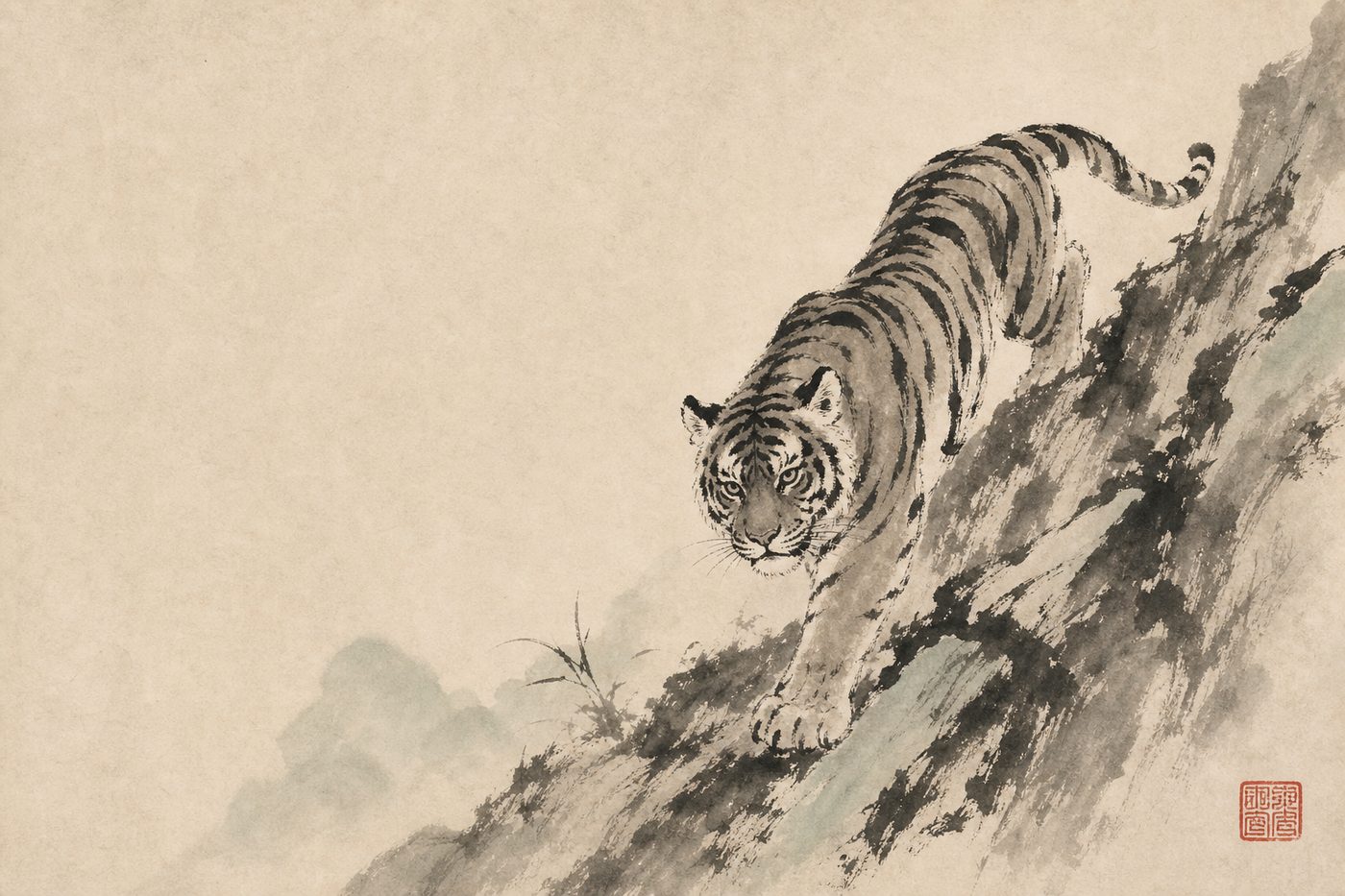
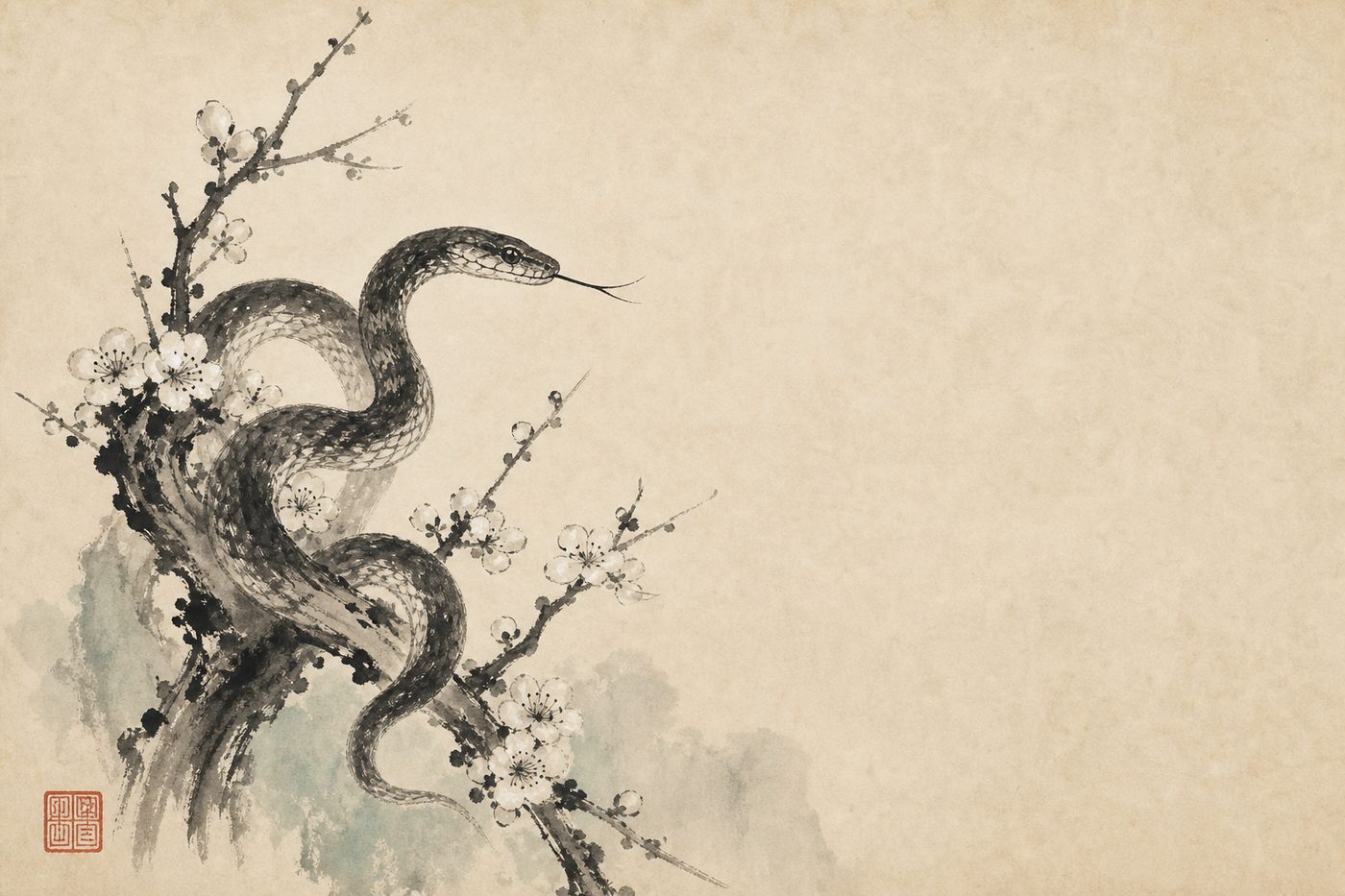
How the wheel reads this pair
Chinese zodiac verdicts are positions, not vibes. The Tiger holds position 3 on the twelve-branch wheel (branch yín) and the Snake position 6 (branch sì); their verdict follows from that geometry alone.
- Verdict
- Challenging
- Bond
- Liu hai · the six harms
- Branches
- yín 寅 + sì 巳
- Fixed elements
- Wood + Fire
One honest footnote: the branch tables also list this pair under xing, the punishments, a third and murkier layer of the old system. Sources disagree about how much weight it carries, and most modern readings treat it as a caution rather than a verdict. We flag it because it is in the tables, not because it settles anything.
The Tiger and the Snake, side by side
Love and romance
The attraction is the pull of the utterly foreign, and it is strongest on the Snake's side first. A Snake spends its life reading rooms full of performances, everyone managing an image, and the Tiger is the one creature on the wheel with nothing behind the curtain: the conviction is real, the courage is real, the roar means exactly what it says. For a connoisseur of hidden agendas, total legibility is exotic beyond resisting. The Tiger, meanwhile, is drawn to the one audience it cannot organize. Everyone else flinches or flatters; the Snake does neither, simply watches with that unhurried attention, and the Tiger cannot tell whether it has won the room, which is, for a Tiger, the definition of fascination.
The early season runs on exactly that current: the Tiger performing at full magnificence for the wheel's least persuadable critic, the Snake enjoying, for once, a show with no hidden trapdoors. The friction arrives with intimacy, because intimacy is where the two codes meet. The Tiger's code says everything is declared; the Snake's says almost nothing is. The Tiger begins to experience the Snake's reserve as territory withheld from it, and a Tiger does not pass a closed door it believes it has the right to open. The Snake begins to experience the Tiger's demands as siege, and a Snake under siege does not argue. It adds locks.
Trust
This is the engine room of the harm, and neither party is wrong by its own law. The Tiger's law is frontal: say it to the face, charge the front door, despise the flank, and a partner's silence is the flank, the one thing its courage cannot charge. The Snake's law is architectural: trust is extended in installments, disclosure is earned rather than owed, and privacy is not a wall against the beloved, it is the load-bearing structure of the self. So the Tiger demands the vault open as proof of love, and to the Snake the demand is precisely the proof it should stay shut, because a partner who respects the vault would knock. Each escalation is self-defense; each lands as offense; and the blade of the old rhyme is this exact geometry, two codes that wound each other on contact without either drawing first.
The punishment listing sharpens the point rather than changing it. Tradition groups Tiger and Snake, with the Monkey, in the xing cluster the old sources gloss as trouble born of presuming on strength, and the gloss fits: the Tiger presumes its force entitles it to the file's contents, the Snake presumes its reading of the Tiger makes asking unnecessary, each substituting power for the request neither will lower itself to make. Couples who survive report one discovery. The Tiger cannot be read silently, it must be asked, and the Snake cannot be roared open, it must be knocked for, and both sentences are the same sentence in different armor.
Communication
The formats are almost comically mismatched. The Tiger communicates in weather, storms that arrive at full volume, mean every word for one hour, and clear completely; the Snake communicates in verdicts, one sentence in ten thoughts, released on a delay, meant permanently. The catastrophe is that each files the other's output in the wrong drawer. The Snake records the Tiger's storm verbatim, every sentence shouted in the hour of heat archived as testimony, and a Snake's archive has no amnesty procedure; the Tiger, meanwhile, treats the Snake's rare, weighed sentences as opening positions to be charged at, when each one was a closing statement.
The repairs are two exchange rates, agreed in advance. The Tiger's hour-one words trade at a steep discount: what is roared in weather is not what is meant in climate, and the Snake waits for the second conversation before filing anything. The Snake's sentences trade at a premium: when this partner finally speaks, the matter has been through ten drafts, and charging at the conclusion only teaches the Snake to stop publishing them. One more clause keeps the channel alive: the Snake's verdicts arrive within the week, because a Tiger can live with any answer and cannot live in a silence its code reads as the flank.
Marriage and family
The household, run well, divides along the two natures cleanly: the Tiger owns the front of the house, the public life, the bold decisions, the family's banner in the world, and the Snake owns the deep structure, the decade plan, the risks priced, the money quietly compounding behind the Tiger's noise. It is, at its best, the general and the counselor sharing a roof: the Tiger supplies the force the Snake's designs need, the Snake supplies the design the Tiger's force never pauses to draw.
Two treaties keep it standing. The first is social: the Tiger lives at volume in public while the Snake rations its public hours like currency, so the quota gets set explicitly, which occasions get both of them, which get the Tiger alone, and no ambush invitations. The second is the veto. An unexplained no from the Snake lands on a commander as insubordination; roared at, the Snake stops explaining entirely, which is worse. The clause that works is reasons attached, in private, before the plan is public, because a Tiger shown the trap in the tall grass will actually turn, but only if the turning never happens in front of the column.
Work and money
Professionally this is the oldest partnership in the strategy books, force and foresight, and at the right distance it wins wars. The Tiger is the campaign: command presence, total commitment, the credibility that only a leader who visibly believes can generate. The Snake is the map: the market read three moves out, the contract read to the last clause, the trap seen before the grass moves. Ventures that let the Snake draw and the Tiger charge take ground that neither could take alone, and hold it, because the Snake also drew the retreat routes the Tiger would never think to want.
The frictions are the marriage's, in office form. The Snake's mid-course corrections read to the Tiger as the flank, quiet redirections of a charge already announced, and the Tiger's improvisations read to the Snake as a client who signs the plan and then burns it. The treaty is jurisdictional and strict: strategy is the Snake's, execution is the Tiger's, changes land at named checkpoints, and the Snake's dissent reaches the Tiger in private, always, before the room, ever. A commander corrected in front of the column will charge the correction instead of the enemy, and a strategist overruled at volume will simply stop showing the map.
Where it breaks
The terminal sequence usually begins with a discovery. The Tiger finds something the Snake never mentioned, not a lie, the Snake does not lie, but a file, a contingency, a held-back fact, and the Tiger's code can draw no distinction between the unsaid and the concealed: it roars, at fullest volume, the one hour of weather that means everything and will mean nothing by morning. But the Snake files the hour verbatim, and somewhere in the transcript is the sentence that closes the account, because a Snake ends things the way it does everything, completely, on evidence, without appeal. The Tiger wakes to clear skies and a decided partner, and no charge ever mounted reaches a Snake that has finished deciding. The blade of the rhyme cuts in one hour, and takes years to be felt.
The slower version is the siege: the Tiger patrolling the marriage for transparency, the Snake yielding ground silently until what remains is a courteous arrangement between a commander and a counselor who no longer shows the map. Neither ending is fated. The couples who beat this pairing run the treaties like sovereign states, weather discounted, verdicts honored, reasons attached, doors knocked on, and they report what the tables never mention: a Tiger never once bores the Snake, and a Snake is the one partner a Tiger never has to perform for twice, which, for two signs this proud, turns out to be worth the diplomacy.
How to fix it
- 1
Discount the weather, honor the climate. What the Tiger roars in hour one gets filed at half weight, pending the second conversation. The Snake's archive keeps only what was still meant the next morning.
- 2
Knock, don't raid. The Tiger converts demands for disclosure into requests with time attached, and the Snake answers real questions within the week. The vault opens on schedule and never under siege.
- 3
Attach reasons to every veto. The Snake shows enough of the map to make its no a judgment rather than a decree, in private, before the plan is public. A Tiger shown the trap will turn; a Tiger decreed at will charge.
- 4
Keep dissent out of the room. Corrections travel to the Tiger before the audience assembles, and the Tiger never prices the Snake's silence in public. The column sees one command; the treaty stays in chambers.
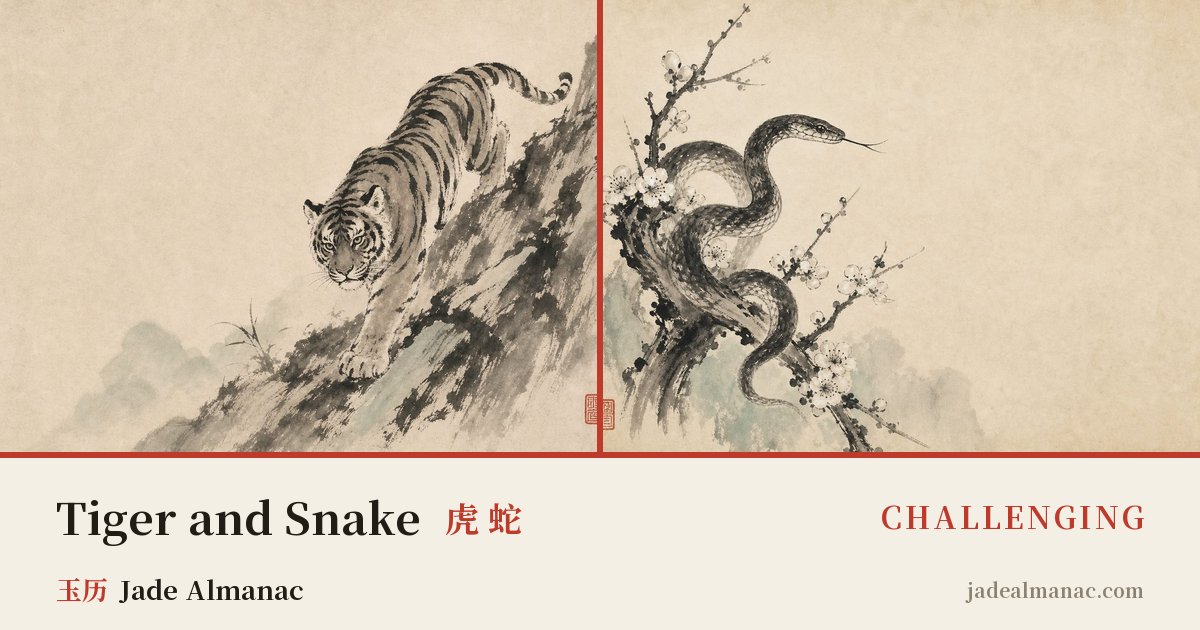
Share this pairing
The card carries both portraits and the verdict.
Questions people ask
Are Tiger and Snake compatible in the Chinese zodiac?
This is one of the six harms (liu hai), the tradition's quieter caution, and the old matchmakers' rhyme gives it the sharpest line in the set, the snake that meets the tiger is cut as if by a blade. It flags a collision of codes, total openness against total privacy, rather than a war, and treatied couples do beat it.
Why are Tiger and Snake a harm pairing?
Position, as always. Each harm pair joins two signs that are each the secret friend of the other's clash. The Snake is the sworn ally of the Monkey, which sits directly opposite the Tiger, and the Tiger is the sworn ally of the Pig, which sits directly opposite the Snake. The pair is also listed with the Monkey in one of the old punishment (xing) groups, a second caution most modern readings treat as emphasis.
Can a Tiger and Snake relationship work?
Yes, as a treaty between sovereigns. The working couples discount what is roared in the heat and honor what is still meant the next morning, move disclosure onto a schedule instead of a siege, attach reasons to the Snake's vetoes, and keep every correction out of the public room. Run that way, the general and the counselor are genuinely formidable.
Year of the Tiger 虎
Personality, years, matches, and where the sign comes from.
Year of the Snake 蛇
Personality, years, matches, and where the sign comes from.
← All 66 zodiac pairings, with verdicts
Signs turn over at Chinese New Year, not January 1 — a January or February birthday can belong to the previous animal. Check a birthday on the lunar calendar →
Sources & further reading
By Julian 祝君瑜 · verdict derived from the twelve-branch system, not assigned by hand · updated 2026-07-15