Snake and Monkey Compatibility: Secret Friends, With a Footnote
Liu he — one of the six harmonies, the branch system’s quiet one-on-one alliances.
The old punishment (xing) tables also flag this pair — details under the wheel below.
Snake and Monkey is the strangest entry in the Chinese zodiac's compatibility tables, and this page will not pretend otherwise. The branch system lists the pair twice: once among the six liu he harmonies, the "secret friends," its strongest one-on-one alliances, and once in the old punishment (xing) tables, a layer of traditional cautions. Most sites quietly pick whichever verdict suits the paragraph. The honest reading is both at once: a genuinely excellent alliance with a documented failure mode, which is more useful than either verdict alone.
How the wheel reads this pair
Chinese zodiac verdicts are positions, not vibes. The Snake holds position 6 on the twelve-branch wheel (branch sì) and the Monkey position 9 (branch shēn); their verdict follows from that geometry alone.
- Verdict
- Best match
- Bond
- Liu he · secret friends
- Branches
- sì 巳 + shēn 申
- Fixed elements
- Fire + Metal
One honest footnote: the branch tables also list this pair under xing, the punishments, a third and murkier layer of the old system. Sources disagree about how much weight it carries, and most modern readings treat it as a caution rather than a verdict. We flag it because it is in the tables, not because it settles anything.
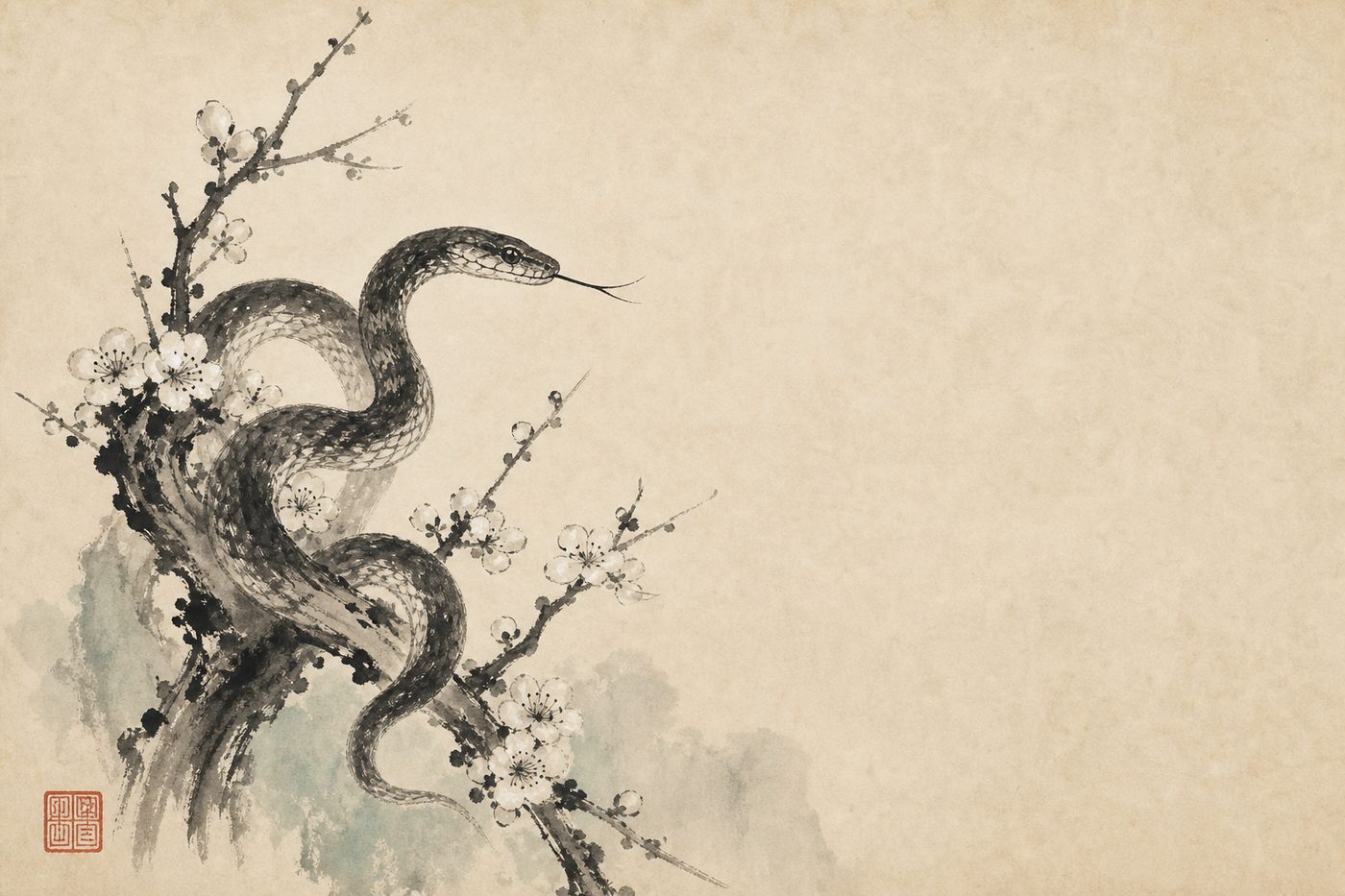
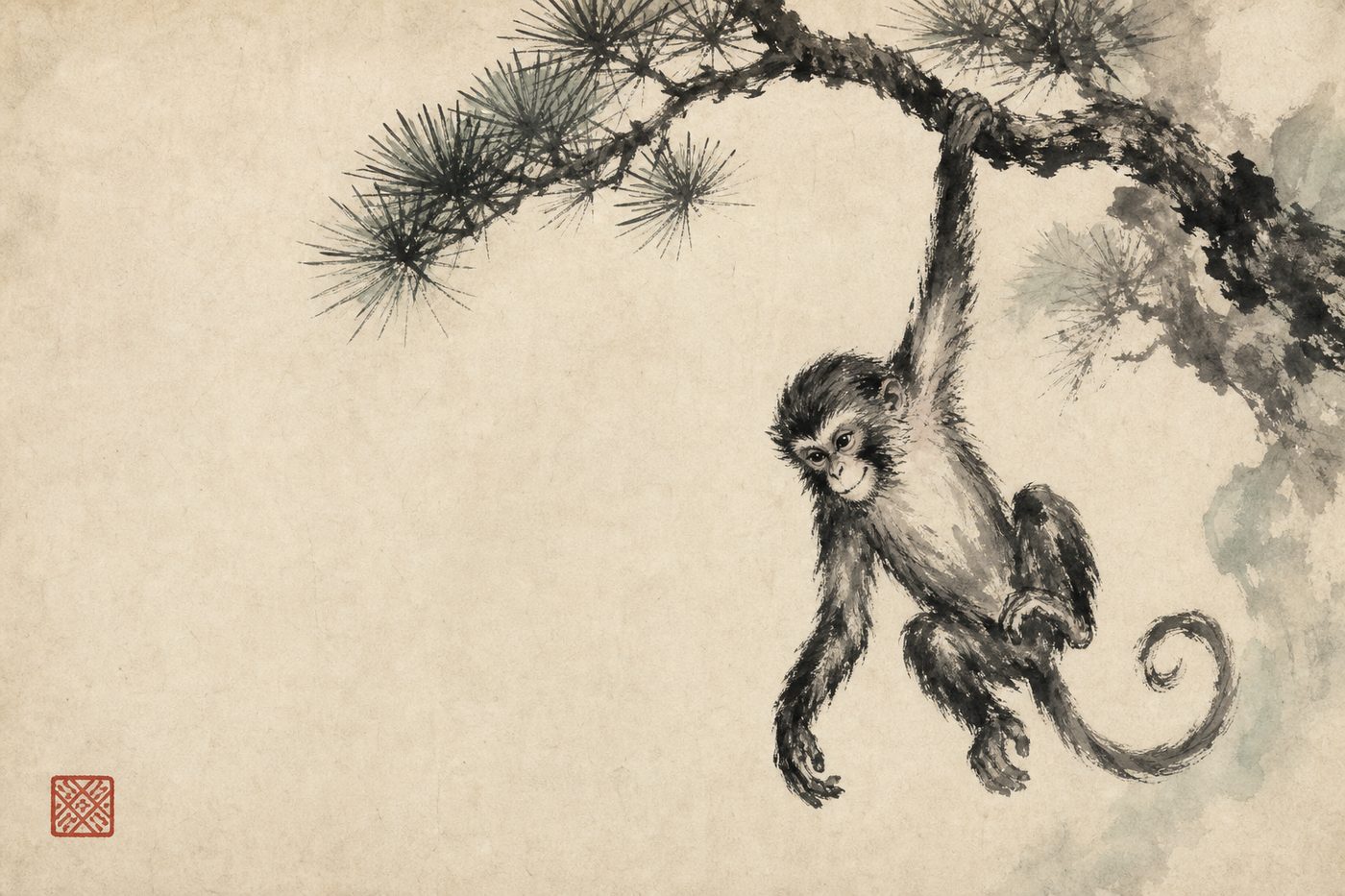
The Snake and the Monkey, side by side
Love and romance
Start with why the harmony tables approve, because the logic is beautiful. The Monkey is the wheel's loudest improviser, a mind that performs its intelligence in real time, for an audience, at speed. The Snake is the wheel's most deliberate one, three sentences ahead and saying none of them. The old gloss survives because it is exact: the Snake thinks what the Monkey says, and both are better for the division of labor. Each finally meets a mind running at its own clock speed, wearing the opposite exterior.
As romance, this makes for the cycle's best conversation. The Monkey, used to dazzling rooms it privately finds slow, discovers an audience of one that catches every reference, sees the trick's mechanism, and is amused anyway; being genuinely followed is a stronger drug than being applauded. The Snake, whose stillness reads as coldness to most of the wheel, gets a partner who treats that stillness as depth worth performing for, and who fills the silences the Snake never intended as punishments. They can talk until four in the morning in the first month. Decades in, the good versions still do.
Trust
Here is where the punishment tables earn their footnote, so let us be precise about what strains. The Snake extends trust slowly, in installments, with references required; it is the sign's famous economy. The Monkey treats rules, categories, and other people's expectations as puzzles, not out of malice but because that is what a Monkey's mind is for. Now run the two natures side by side: the Snake watches everything and forgets nothing, and the Monkey, sooner or later, improvises somewhere it said it wouldn't, a harmless shortcut, a puzzle solved that was supposed to stay a rule.
To most signs, the Monkey's wobble is small weather. To a Snake, it is data, logged in the permanent file, and the trust installments quietly stop. The Monkey senses the account freezing before anything is said, and does what Monkeys do under suspicion: performs harder, improvises more charmingly, which to a Snake reads as exactly the behavior under investigation. This is the punishment dynamic in miniature, mutual and slow. It is also entirely survivable, and the survivors all describe the same treaty: the Monkey keeps its word with this one partner with a discipline it grants no one else, and the Snake says a doubt aloud within the week instead of filing it.
Communication
The channel itself is superb, better than either sign gets elsewhere. The Monkey's improvisations land on the one listener fast enough to enjoy them at full speed; the Snake's compressed, three-steps-ahead remarks land on the one listener quick enough to unpack them. Neither has to slow down, which for two minds this fast is the whole luxury of the pairing.
The asymmetry to manage is disclosure. The Monkey thinks out loud; the Snake thinks, and then decides whether the result is anyone's business. In practice the Monkey narrates ninety percent of its inner life unprompted, and the Snake volunteers perhaps ten, on a delay, which leaves the Monkey negotiating with a partner whose actual position arrives days after the conversation that needed it. The fix is a trade both minds respect: the Snake commits to same-week delivery of real positions, and the Monkey accepts that a Snake's "I'll tell you Thursday" is not evasion but manufacturing time, and stops trying to extract the draft early, which is the one extraction a Snake never forgives.
Marriage and family
Run as designed, the household is quietly formidable. The Snake plans the decade, the Monkey handles the decade's surprises, and between the long game and the short game very little catches the family unprepared. Money benefits from the same split: the Snake's patient strategy sets the structure, the Monkey's opportunism catches what floats past, and each genuinely admires the half it cannot do. Their homes tend to be private, curated, and more fun inside than the neighbors would ever guess.
Two domestic clauses need writing. First, social energy: the Monkey needs rooms, audiences, the party; the Snake rations its public hours and recharges in silence, and neither should convert the other. The working couples run a mixed calendar, the Monkey going out solo without guilt, the Snake staying home without commentary. Second, the file. Every marriage with a Snake in it has a file, the complete archive of everything ever done and not done, and the Monkey, whose own memory is cheerfully selective, must understand that the file is real and admissible. The Snake, in exchange, agrees the file has a statute of limitations: what was raised and settled may not be re-entered into evidence.
Work and money
As colleagues they cover an almost unfair amount of ground. The Snake is the strategist, best at the long, quiet build, the plan that looks obvious only in retrospect; the Monkey is the improviser, best in the room where things are going wrong in new ways. Negotiations run beautifully as theater: the Monkey performs, probes, charms, floats trial balloons, while the Snake sits nearly silent, reads the other side, and names the real price on the drive home. Ventures get the Monkey's speed with the Snake's patience underneath, which is the combination examinations and markets both reward.
The partnership's hazard is credit and control. A Monkey's visible brilliance collects the room's applause while the Snake's architecture goes unseen, and a Snake does not complain about this; it recalibrates, quietly, which is worse. Meanwhile a Snake's unexplained vetoes, delivered without the reasoning, read to a Monkey as arbitrary power. The treaty: the Monkey names the architecture in public, specifically, and the Snake shows enough of the reasoning that its vetoes arrive as judgment rather than decree.
Where it breaks
The terminal pattern is the two natures amplifying in the wrong direction, and the punishment tables, whatever weight one gives them, describe its shape well. The Monkey, feeling the Snake's trust installments slow, escalates the performance: more charm, more motion, more plates spinning, some of them now spinning out of the Snake's sight simply to avoid the audit. The Snake, watching plates leave the room, extends the file and shortens the credit line. Neither lies, exactly. The Monkey curates; the Snake withholds; and two of the wheel's best minds end up running intelligence operations against a marriage they both want.
It ends, when it ends, coldly rather than loudly: the Snake closes the account with the finality that sign reserves for finished decisions, and the Monkey, master of every room, finds no move left in this one. The couples who never get there are the ones who understood the double listing from the start. The harmony is real: no sign suits either of them better. The caution is also real: this pairing runs on a trust that neither nature maintains automatically, so it gets maintained on purpose, by treaty, out loud.
How to fix it
- 1
One partner, full discipline. The Monkey's improvisation stays free everywhere except promises made to the Snake, which get kept with boring exactness. That single discipline funds the whole alliance.
- 2
Doubts filed within the week. The Snake speaks the suspicion aloud while it is small instead of archiving it. A named doubt is answerable; a filed one only compounds.
- 3
Statute of limitations on the file. What was raised and settled is closed to re-entry. The Snake's memory is an asset for strategy, not a docket for the marriage.
- 4
Name the invisible work. The Monkey credits the Snake's architecture in public, specifically; the Snake shows its reasoning with the veto. Applause and judgment both become shared currency.
Share this pairing
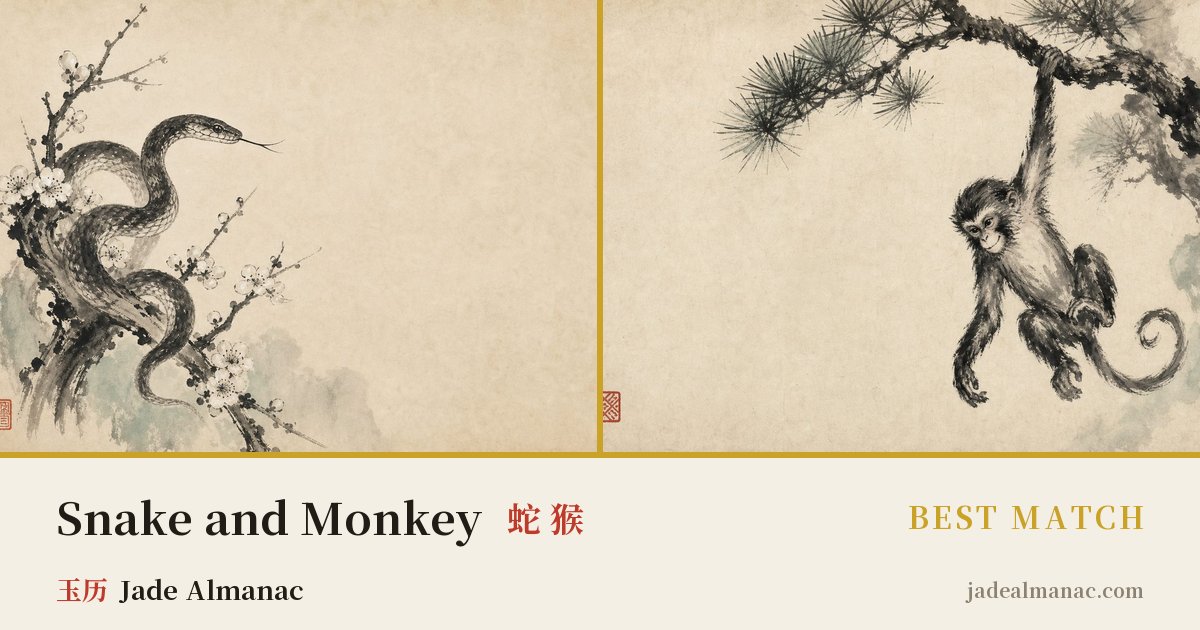
The card carries both portraits and the verdict.
Questions people ask
Are Snake and Monkey compatible in the Chinese zodiac?
Yes, with an honest footnote. Snake and Monkey are one of the six liu he pairings, the "secret friends," the system's designated one-on-one alliances. The same branch tables also list the pair under the old punishments (xing), a caution layer, which is why sources seem to disagree. The alliance is real, and so is the failure mode it warns about.
Why do some sources call Snake and Monkey a bad match?
Because the branch system genuinely lists this pair twice, once in the six harmonies and once in the punishment tables. Sites that check only one table report only half the verdict. Most traditional matchmaking gave the harmony precedence, and modern readings generally treat the punishment listing as a caution about trust, not a veto.
What problems do Snake and Monkey couples have?
Trust maintenance, in one direction each. The Monkey's rule-bending registers permanently in the Snake's files, and the Snake's silent withdrawals of credit push the Monkey into exactly the curated performance a Snake distrusts. The working couples fix it by treaty, kept promises on one side and spoken doubts on the other.
Year of the Snake 蛇
Personality, years, matches, and where the sign comes from.
Year of the Monkey 猴
Personality, years, matches, and where the sign comes from.
← All 66 zodiac pairings, with verdicts
Signs turn over at Chinese New Year, not January 1 — a January or February birthday can belong to the previous animal. Check a birthday on the lunar calendar →
Sources & further reading
By Julian 祝君瑜 · verdict derived from the twelve-branch system, not assigned by hand · updated 2026-07-12