Chinese Symbol for Strength (力): Meaning and Origin
The Chinese symbol for strength is 力 (lì, which sounds a little like "lee"), and it may be the simplest famous character you will ever meet: just two strokes, written exactly the same in simplified and traditional. It carries strength, power, force, and effort all at once. One honest thing to know before you ink it: on its own, 力 leans toward raw force and hard effort rather than the warm, inner "strength" an English speaker usually has in mind.
- Strokes
- 2
- Radical
- 力 (power); its own radical
- Formation
- Pictograph (象形)
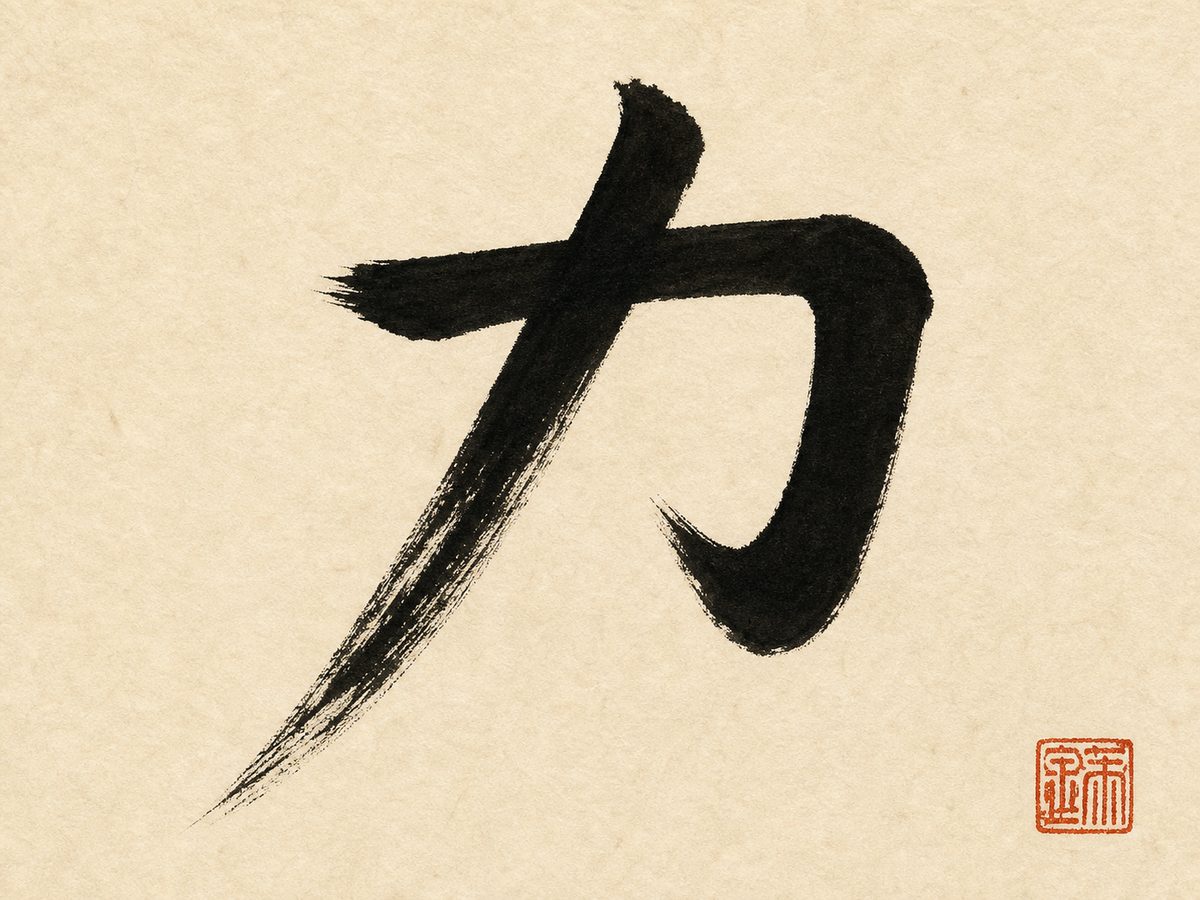
Trace 力 yourself, or watch it drawn
How it's written
There is not much to build here, which is part of the appeal. 力 is only two strokes. You begin with a short horizontal that immediately bends downward on the right and finishes in a small hook, one continuous move calligraphers call a "horizontal-turn-hook," and then you cut a single diagonal down through it from the upper left toward the lower left. That is the entire character. It is among the very first a Chinese child learns to write, and, like the characters for family and peace, it never grew a separate simplified form: the 力 you write today is essentially the 力 of three thousand years ago, give or take a plow, of which more below.
What it means
力 (lì) is the all-purpose Chinese word for strength, power, force, and effort. Physical muscle, mechanical force, political clout, and the plain hard work you pour into something all live inside this one two-stroke character. It is less a single English word than a small family of them. In everyday speech 力 rarely stands alone. It works more like a building block that clicks onto other characters. Joined with the word for "quantity" it becomes lìliàng, the usual word for strength or power in the abstract. With the verb "to exert" it becomes nǔlì, to try hard, quite possibly the most-repeated word in any Chinese classroom or office. With "to press" it becomes yālì, pressure, in both the physics-lab and the ruining-your-week senses. Ability is nénglì; real, tested strength is shílì; even charm qualifies, since the word for it, mèilì, is built on a character meaning "demon," which makes charisma a kind of "demon-force." The character is a workhorse, and you will meet its whole family in the table below. So if the meaning you are chasing is quiet inner strength or resilience, the strength to endure, a native speaker might actually reach for lìliàng, strength in the fuller sense, or for a different character altogether, jiānqiáng, which means "firm and strong." A lone 力 is more elemental than that. It is force and effort themselves, the raw thing, before it ever becomes a virtue.
- 力量 — strength; power (in the abstract, fuller sense)
- 努力 — to make an effort; to try hard
- 压力 — pressure; stress
- 能力 — ability; capability
- 实力 — actual strength; real capability
- 权力 — power; authority (political)
- 暴力 — violence; brute force
- 动力 — motive power; motivation, drive
- 魅力 — charm; charisma (literally 'demon-force')
- 战斗力 — combat power; fighting strength
Idioms
- 力不从心“strength does not follow the heart”to want to do something but lack the power to pull it off; the spirit is willing but the strength falls short. (the Book of the Later Han (History of the Western Regions))
- 力挽狂澜“to haul back the raging tide by main force”to make heroic efforts to save a desperate situation; to turn the tide. (derived from Han Yu, 'Discourse on Advancing in Learning' (813))
- 全力以赴“go toward it with all your strength”to give something everything you have; to spare no effort.
- 自力更生“regenerate through your own strength”to rely on your own efforts; self-reliance, and long a watchword of modern China.
- 力大无穷“strength vast and inexhaustible”possessed of enormous physical strength; immensely strong.
Right vs wrong forms
| Form | Type | Note |
|---|---|---|
| 力 | simplified ✓ | The standard modern form everywhere, and, like the characters for family and peace, it is identical in simplified and traditional Chinese. 力 was never simplified, so mainland China, Taiwan, Hong Kong, and Singapore all write these same two strokes. There is no simplified-versus-traditional choice to make. |
| 力 (flipped or rotated) | mirrored | Not a real variant. A two-stroke character offers little to hide a slip behind, and stencils pulled from low-resolution images sometimes come out mirrored or rotated. A reversed 力 reads as a plain error to anyone literate; check against a dictionary before inking. |
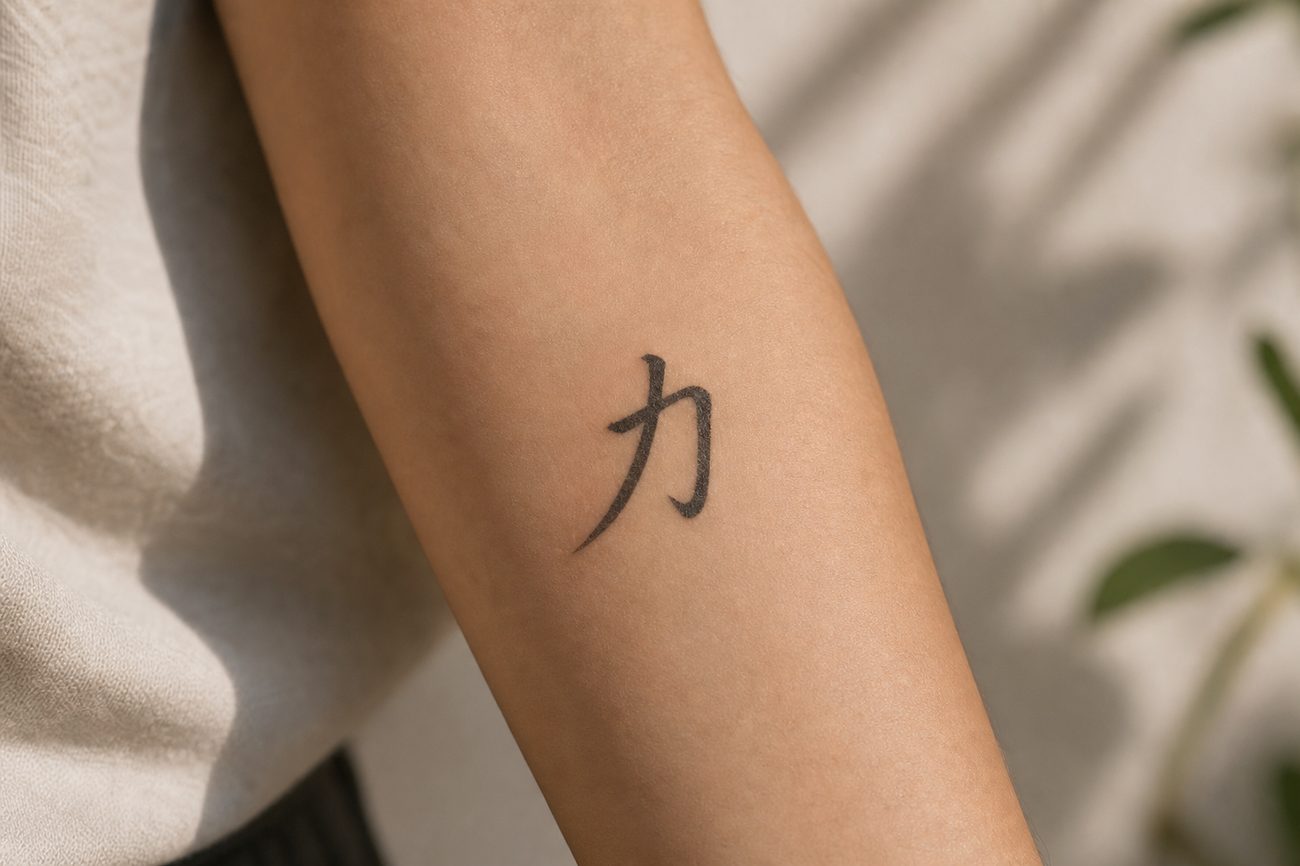
For a tattoo
If you are considering 力 for a tattoo, you have picked one of the cleanest characters going. It is only two strokes, it is identical in simplified and traditional Chinese, so there is no regional "which version" question to lose sleep over, and its lean, hooked shape sits neatly on a wrist, a forearm, or an ankle. The good news is mostly mechanical: about the only way a two-stroke character goes wrong is a stencil pulled from a low-resolution image that comes out flipped or rotated, which reads as an obvious error to anyone literate. Print your reference at full size, check it against a dictionary, and if you can, have one Chinese-reading friend glance at it before the needle comes out. The subtler thing to weigh is meaning, not mechanics. A lone 力 is honest and a little blunt: it says force, power, effort, the raw capacity to push. If that elemental sense is exactly what you want, it is a strong and unfussy choice. But if the feeling you are really after is quiet inner strength, resilience, the strength to carry on, be aware that a Chinese reader may take it as something closer to horsepower than heart. For that meaning people often prefer lìliàng, strength in the fuller sense, or jiānqiáng, "firm and strong," which is the word actually used for a person who endures. None of these is wrong. It is simply worth choosing the one that says what you mean, which is the entire point of wearing a word you cannot yet read.
Strength in life today
The cult of trying hard, and the great giving up
No idea sits closer to the pulse of modern Chinese life than nǔlì, "to make an effort." It is what parents say to children, what managers say to staff, what the entire exam system runs on: just try harder. For decades the formula seemed to hold, and the country's long boom made hard work feel like a law of nature. Then, around 2020, a great many young people stopped believing it. The word that caught the mood was nèijuǎn, usually translated "involution," which went viral in 2020 as a name for the exhaustion of an overly competitive society, everyone sprinting harder and harder only to stay in the same spot. If that named the trap, the escape hatch got its own word the following year. In April 2021 a post titled "Lying Flat Is Justice" spread across the Chinese internet and handed the age its slogan, tǎngpíng, "lying flat": the idea that if effort no longer pays, the sane response is to want less, buy less, and do the bare minimum. Both words are really arguments about 力, about pouring out your strength and getting nothing back for it. Behind the whole debate looms "996," the technology industry's schedule of 9 a.m. to 9 p.m., six days a week, seventy-two hours in all, adopted by firms from Alibaba to Huawei. When Alibaba's founder Jack Ma called that grind "a huge blessing" in 2019, the online backlash was ferocious. The gentler face of all this effort is the cheer you shout to keep someone going, jiāyóu, literally "add oil," as in step on the gas: so woven into everyday encouragement, and into Hong Kong English, that the Oxford English Dictionary formally added "add oil" as an entry in 2018.
Strength as a number: "it's over 9000"
Chinese has also turned strength into a scoreboard. The term zhàndòulì, "combat power," started life as gaming and anime vocabulary. In the cartoon Dragon Ball, alien visors called scouters read a fighter's "power level" as a hard number, and the phrase leaked into ordinary speech, where people now use it to rate almost anything: a phone's combat power, a hotpot joint's combat power, your own before the first coffee of the day. It owes much of its worldwide fame to a single dubbing decision. When the villain Vegeta reads his rival's power level, the English version has him roar "It's over nine thousand!" (the original Japanese said eight thousand), and a 2006 clip of the moment became one of the internet's earliest and most stubborn memes. A phrase for a warrior's raw might is now how you tell a friend they are frighteningly good at karaoke.
A name that means strength, and the "Lee" that doesn't
Here is a small surprise. Most of the famous "Lee" and "Li" names a Western reader knows, Bruce Lee, the action star Jet Li, the tennis champion Li Na, carry a completely different and very common surname that merely means "plum" and only happens to sound like the word for strength. The genuine article is rarer, and when it does turn up it is usually a given name, chosen to wish a child capability and drive. The best-known example in the West is the Mandopop superstar Wang Leehom, an American singer born in Rochester, New York: the "Leehom" of his stage name is his given name lìhóng, which pairs 力, strength, with a character meaning "grand." His name, quite literally, means something close to "magnificent power."
Curious what your own name could become, or which character best fits a quality you have in mind? Our Chinese name generator matches the sound of your name to a real, well-omened character.
Where the character comes from
Here is where two strokes get surprisingly interesting. Open the oldest dictionary in China, the Shuowen Jiezi, compiled around the year 100, and its answer is admirably blunt. 力, it says, is a sinew, a muscle, and the character is a picture of the tendons of a human body pulled taut, the very image of exertion. In the reading of Xu Shen, the scholar who compiled it, that was the whole story, and for most of two thousand years it stood. Then, in 1899, farmers near Anyang began turning up ancient bones inscribed with the earliest Chinese writing anyone had ever laid eyes on: the oracle bones, well over three thousand years old, and a full millennium older than that dictionary. The 力 on them does not look much like a muscle. It looks like a tool, a simple wooden plow or digging spade, the kind you drive into the soil with your whole body. Modern paleographers, who unlike Xu Shen get to study those original shapes, now mostly read 力 that way, not as a muscle but as a plow, with "strength" being the effort of breaking open a field. The quiet irony is that this time it is the ancient dictionary itself that turns out to be the tidy story, corrected by evidence that was buried before the dictionary was ever written. Muscle or plow, the two readings land in the same place: strength is what the body pours out against a load.
History & roots
The virtue China trusted least
For a civilization that produced no shortage of formidable soldiers, classical China was strikingly wary of raw strength, and that wariness is written into the heart of its philosophy. Mencius, the fourth-century-BCE thinker who became Confucianism's greatest champion, drew the line about as sharply as anyone could. In James Legge's translation: "When one by force subdues men, they do not submit to him in heart. They submit, because their strength is not adequate to resist. When one subdues men by virtue, in their hearts' core they are pleased, and sincerely submit." Force wins you obedience; only virtue wins you loyalty. A ruler who leans on force, Mencius went on, is a mere hegemon who makes, in Legge's words, "a pretence to benevolence," never a true king. Twenty-three centuries later, Chinese still dismisses throw-your-weight- around behavior as bàdào, "the way of the hegemon." Confucius himself was even more spare about it. The Analects notes, almost in passing, the handful of subjects the Master declined to discuss. In Legge's rendering they are "extraordinary things, feats of strength, disorder, and spiritual beings." Feats of strength sit right there on the short list of topics the founder of the whole tradition simply would not be drawn on. Muscle was not the measure of a person. Character was.
The strongest man in the room, and how it ended
Which leads to the most famous strongman in Chinese history, and to the cautionary tale the philosophers might have written themselves. Xiang Yu, the warlord who helped topple the Qin dynasty in the third century BCE, was, by the account of the great historian Sima Qian, a giant of a man, strong enough (in the historian's phrase) to lift a bronze ritual cauldron of the sort that normally took several men to shift. For a few dazzling years he was the mightiest man in the country. Then he lost the empire to Liu Bang, a former village constable with far less muscle and far more political cunning, which is very nearly Mencius's point acted out on a battlefield. Trapped at last, his army starving and surrounded, Xiang Yu is said to have sung a short, devastating song to his warhorse and his mistress before the end. It opens with a line every Chinese schoolchild can still recite, a boast that his strength could uproot mountains and his spirit outshone the age, before crumbling into helplessness: the times are against him, and his horse will not run. In four lines it is the entire classical verdict on strength. The strongest man alive, and it was not enough. Strength can move a cauldron. It cannot, in the end, move heaven.
The strength you were allowed to worship
Not everyone in China kept strength at arm's length. While the scholars were busy distrusting it, popular and religious culture openly adored it, and the clearest proof stands at the gate of almost any Chinese Buddhist temple. There you meet two enormous, glowering guardians, bare-chested and impossibly muscled, veins raised, fists or clubs at the ready. They are the "strength-warriors," popularly nicknamed the "Generals Heng and Ha" after the sounds they make with one mouth open and one clamped shut, and they are the bouncers of the Buddha: their entire job is to look strong enough to keep evil out. Here strength is not a moral hazard but a protective virtue, brawn drafted into a good cause. There is a lovely twist in their pedigree. Art historians trace the guardians' Herculean physique back along the Silk Road to the Greek strongman Heracles, whose image was borrowed in Greco-Buddhist art to depict the Buddha's protector and then carried east into China and Japan. The bulging muscles glaring down at you from a temple gate are, in a real sense, a two-thousand-year-old export of a Greek hero. Strength, it turns out, traveled.
Questions people ask
What is the Chinese symbol for strength?
It is 力 (lì), a two-stroke character meaning strength, power, force, and effort. It is written identically in simplified and traditional Chinese, so there is only one form to learn. One nuance worth knowing: on its own 力 leans toward raw force and effort, so for the sense of quiet inner strength a Chinese speaker might use the fuller word lìliàng or the character jiānqiáng.
Is the Chinese symbol for strength a good tattoo?
Mechanically it is one of the safest choices going: 力 is only two strokes, identical in simplified and traditional, and easy to place. The one real risk is a low-resolution stencil coming out flipped or rotated, so check it against a dictionary first. The subtler point is meaning: a lone 力 reads as force or effort more than inner resilience, so if that fuller sense is what you want, look at lìliàng or jiānqiáng.
What is the Chinese character for inner strength?
The single character most people mean by 'strength' is 力 (lì), but on its own it leans toward raw force and effort. For the softer idea of inner strength, resilience, or the strength to endure, Chinese speakers more often use lìliàng (strength in the fuller, abstract sense) or jiānqiáng, which literally means 'firm and strong' and is the word used for a person who keeps going through hardship.
How many strokes does the Chinese symbol for strength have?
Two. It is among the first characters a Chinese child learns to write: a short horizontal that bends down on the right into a hook, then a single diagonal cut through it. Because it is so simple, 力 was never given a separate simplified form, so it looks the same everywhere.
Does the Chinese symbol for strength also mean power?
Yes. 力 (lì) covers the whole cluster: physical strength, power, force, and effort, from muscle to political power to plain hard work. In modern speech it rarely stands alone and instead builds compounds like lìliàng (strength) and quánlì (power). The oldest Chinese dictionary calls it a picture of a human sinew; modern scholars, reading older forms, think it pictures a plow.
Is the Chinese symbol for strength the same in simplified and traditional Chinese?
Yes. 力 was never simplified, so mainland China, Taiwan, Hong Kong, and Singapore all write the identical two strokes. Unlike the character for love, which loses its 'heart' in the simplified form, there is no simplified-versus-traditional version of 力 to choose between.
Sources
- Shuowen Jiezi dictionary entry for 力 (Chinese Text Project, ctext.org)
- Wiktionary: 力 (glyph origin, oracle-bone plow reading, strokes, radical)
- Zdic (zdic.net): the dictionary entry for 力 (Shuowen, Kangxi, readings)
- Mencius, Gong Sun Chou I (Chinese Text Project, ctext.org)
- The Analects, Shu Er (Chinese Text Project, ctext.org)
- Records of the Grand Historian, Annals of Xiang Yu (Chinese Text Project, ctext.org)
- Xiang Yu's 'Song of Gaixia' (Gushiwen)
- Involution (neijuan), the 2020 buzzword (Wikipedia)
- Tang ping, 'lying flat' (Wikipedia)
- 996 working hour system (Wikipedia)
- 'It's Over 9000!' and the power level (Wikipedia)
- 'Add oil' (jiayou) enters the Oxford English Dictionary (Wikipedia)
- Nio, the muscular temple guardians (Wikipedia)
- Wang Leehom (given name 力宏, 'strength' + 'grand') (Wikipedia)
Make Strength your own
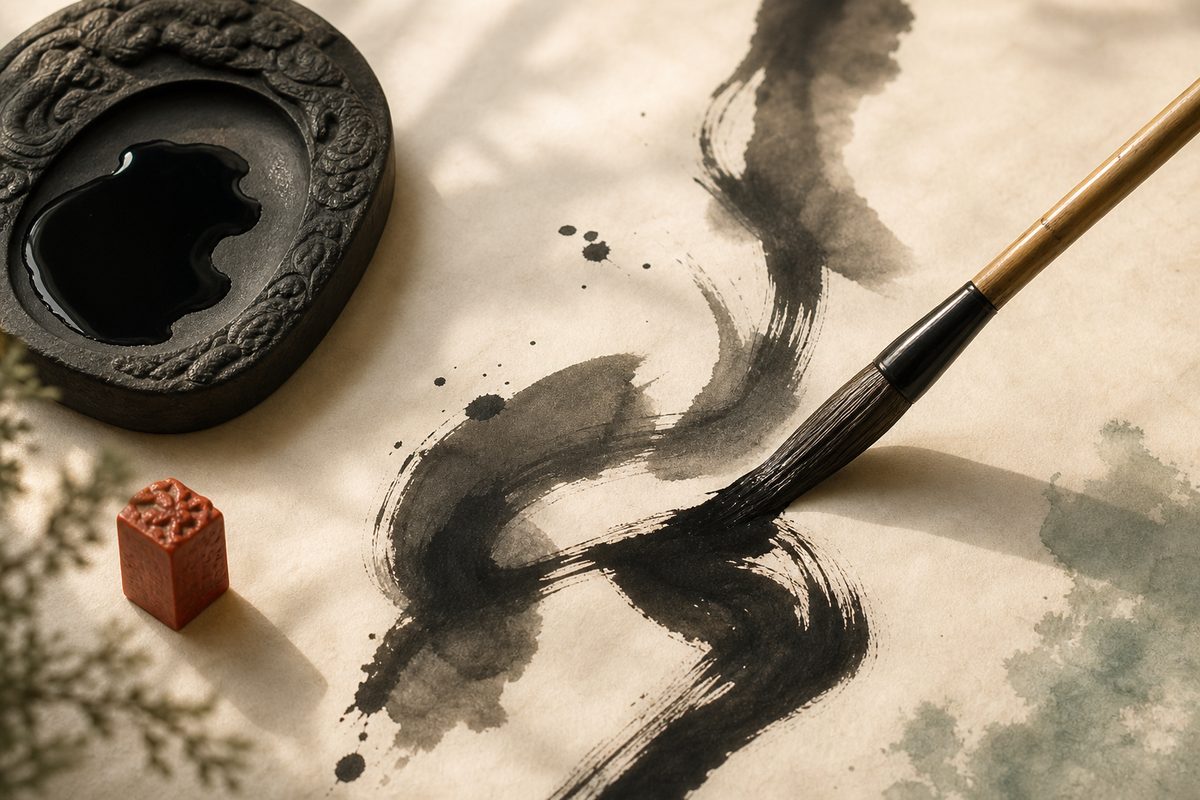
See 力 in calligraphy
From ancient seal script to flowing cursive. Pick a look before a tattoo or a card.
Get a Chinese name
A name matched to the sound of yours, with a meaning that fits.
Try the Chinese Gender Predictor
A different corner of Chinese culture: the old Qing-palace birth chart, worked out from your lunar birth date, with the math shown and its coin-flip odds honestly weighed.
By Julian 祝君瑜 · sourced from the classics and from modern life · updated 2026-07-07