Chinese Symbol for Courage (勇): Meaning and Origin
The Chinese symbol for courage is 勇 (yǒng, rhymes with "gong"), nine strokes with the character for strength planted at the bottom. That placement is a philosophy in miniature: Chinese files courage under strength, as the thing strength becomes when it picks a direction. The first Chinese dictionary defined it, nearly two thousand years ago, in a single word: energy. Modern Mandarin still agrees, and calls courage yǒngqì, "courage-energy."
- Strokes
- 9
- Radical
- 力 (strength)
- Formation
- Phono-semantic compound
Trace 勇 yourself, or watch it drawn
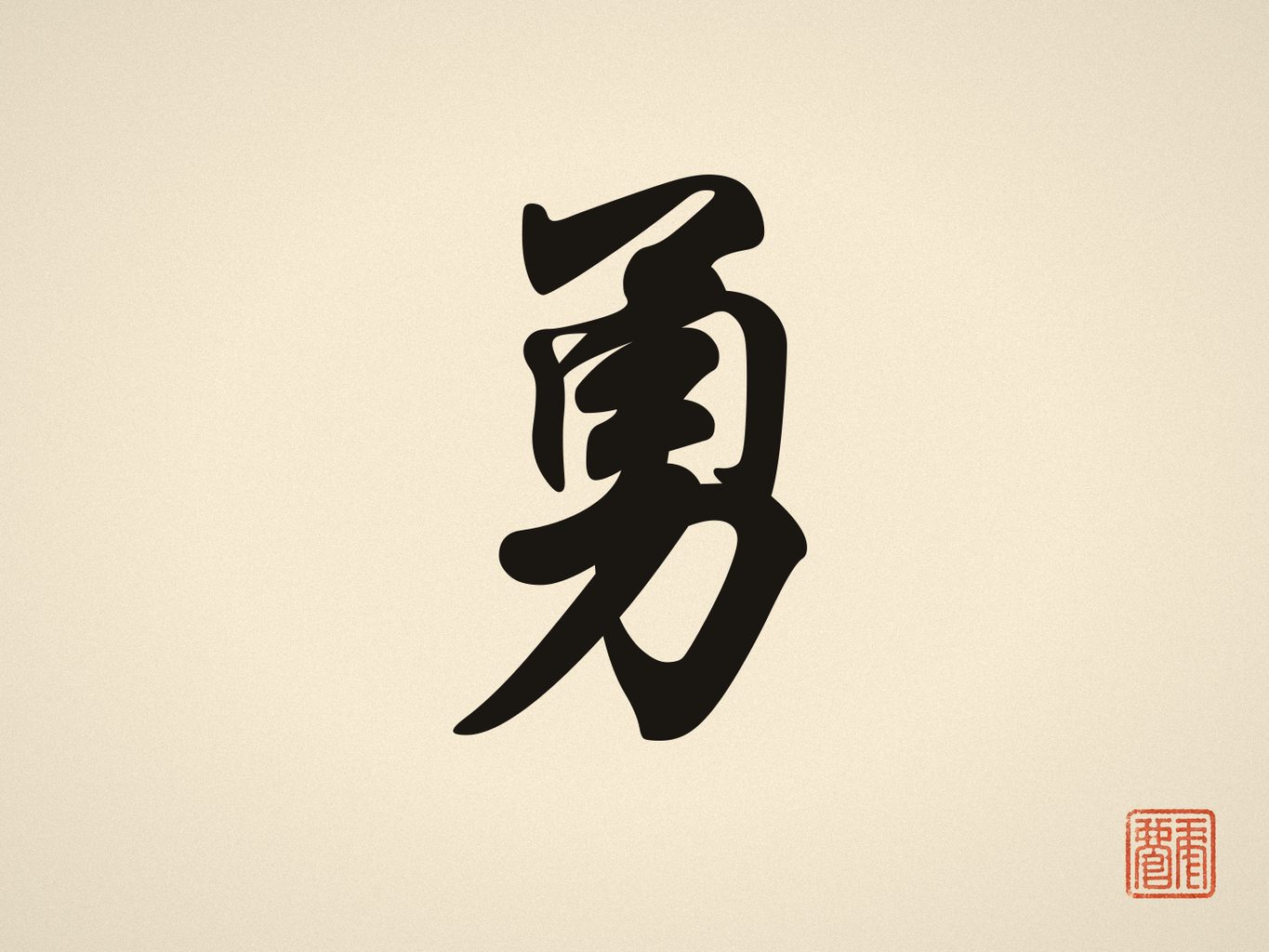
How it's written
勇 is nine strokes in two stacked parts, written top to bottom. The top is 甬 (yǒng), an old character usually read as a picture of a bell with a hanging loop, which mostly earns its keep here by lending the sound. The bottom is 力, strength, a two-stroke drawing that started life as a plow. Sound above, muscle below: courage is the one that rings. One near-miss to know about. Swap the bell for a field grid 田 and you have written 男, "male," the character built of "field plus strength." The two look like cousins, and on a bad stencil they are close enough to trade places. If you are writing 勇, check the top: it wants the little capped bell, not the field.
What it means
Yǒng is the root idea of brave, and as usual the single character sits at the bottom of a small family of words you will actually hear. The noun you possess is yǒngqì, courage, literally "courage-energy," the thing people summon, lose, and borrow. The adjective is yǒnggǎn, brave. A step grander is yīngyǒng, heroic, the word in war memorials. And colloquial Chinese often measures nerve by the gallbladder rather than the heart: dǎn, "gall," gives you the everyday words for daring and for chickening out. For a single-character symbol or a tattoo, 勇 is the clean choice; the longer words are for sentences. It helps to know what yǒng is not. It is not raw power: that is lì (力), strength, which happens to be this character's own foundation and has its own page here. The Chinese reading, baked into the writing itself, is that strength is the ingredient and courage is the recipe: power, pointed at something, usually despite fear.
| Word | What it says | Reach for it when |
|---|---|---|
| 勇 (yǒng) | The root idea: brave | You want the clean single-character symbol or tattoo |
| 勇气 (yǒngqì) | Courage, literally "courage-energy" | Naming the thing people summon, lose, and borrow |
| 勇敢 (yǒnggǎn) | Brave, the adjective | Ordinary sentences |
| 胆 (dǎn) | Nerve, measured by the gallbladder | The everyday words for daring and chickening out |
| 力 (lì) | Raw strength, the ingredient not the recipe | Power that has not picked a direction yet |
- 勇气 — courage (the noun: literally courage-energy)
- 勇敢 — brave, courageous (the everyday adjective)
- 勇士 — a warrior, a brave; the Chinese name of the NBA's Warriors
- 英勇 — heroic, valiant (the word on war memorials)
- 勇于 — to have the courage to (do something hard)
- 胆量 — nerve, daring (literally gall-capacity; the everyday word for guts)
Idioms
- 见义勇为“seeing what is right, bravely act”to do the right thing without hesitation; the civic-courage phrase used for rescuers and good Samaritans. (inverted from the Analects (论语, Wei Zheng): to see what is right and not do it is want of courage)
- 匹夫之勇“the courage of a common fellow”reckless bravado; courage that can face exactly one opponent. The standard put-down for hotheadedness. (Mencius (孟子, King Hui of Liang II))
- 勇往直前“advance bravely, straight ahead”to press forward without flinching; the go-get-it inscription on banners and graduation cards. (a common set phrase)
- 智勇双全“wisdom and courage, both complete”the full package: brave and smart at once, the stock praise for great generals. (a stock phrase of the historical-romance tradition)
- 有勇无谋“has courage, lacks strategy”all bravery, no plan; the standard knock on brawn-over-brains figures in the Three Kingdoms tradition. (a stock phrase of the historical-romance tradition)
Right vs wrong forms
| Form | Type | Note |
|---|---|---|
| 勇 | simplified ✓ | The standard form, identical in simplified and traditional Chinese: it was never simplified. Whatever the region or font, this is the character. |
| 男 | wrong | Not a variant but the classic near-miss: with a field grid 田 on top instead of the capped bell 甬, this reads 'male.' Check the top before printing. |
| 恿 | wrong | The ancient heart-written form of courage, recorded in the Shuowen. In modern Chinese it survives only inside sǒngyǒng, 'to egg someone on,' so inked alone it no longer says courage. |
| 勇 (mirrored) | mirrored | Not a variant. Low-resolution stencils sometimes come out flipped, and a mirrored 勇 reads instantly as an error to anyone literate. Check against a dictionary. |
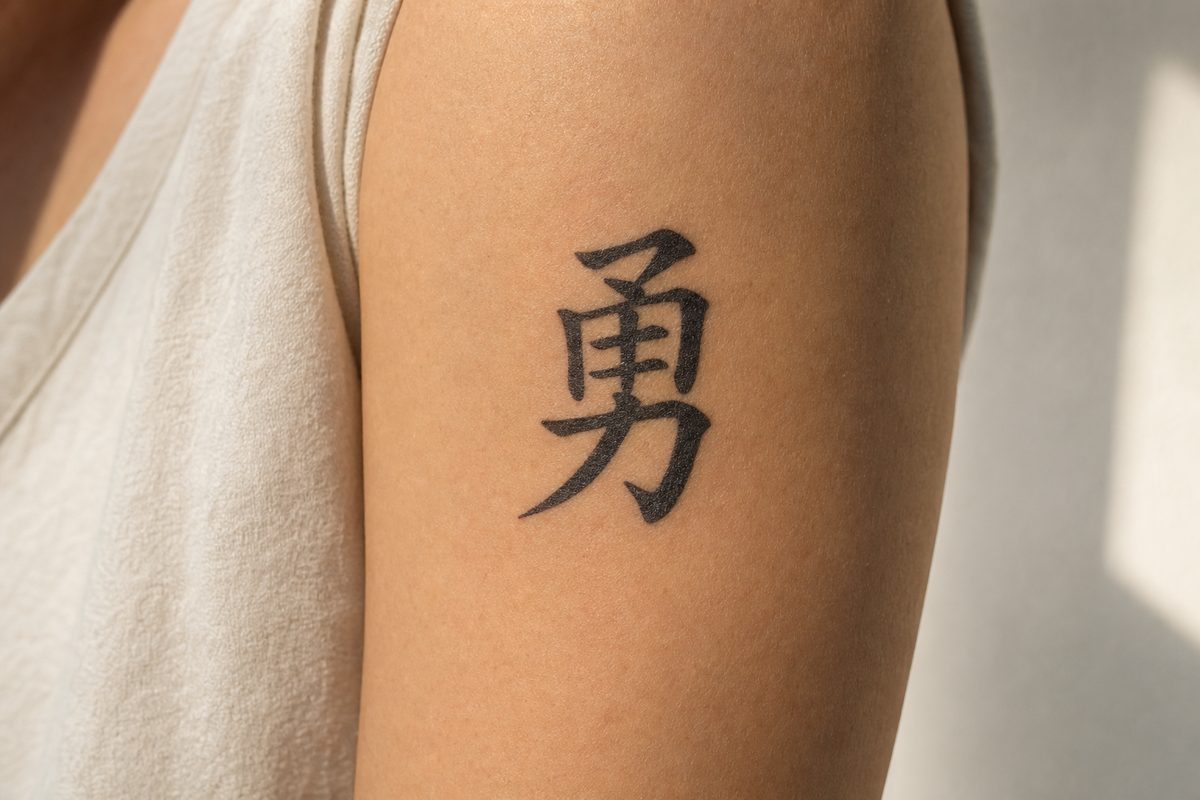
For a tattoo
勇 is a strong tattoo choice with a low error rate, and the reassurances come first: it is written identically in simplified and traditional Chinese, so there is no regional-version decision, and its meaning is unambiguous and entirely positive. The checks are specific to this character. First, the top has to be the small capped bell, not a field grid: put a field on top and 勇 turns into 男, the character for "male," which is a very different statement on a shoulder. Second, skip the antique heart-written version, which in modern Chinese reads as "to egg someone on" rather than courage. Third, the universal rule: print the design at full size, and have someone who actually reads Chinese confirm it is right and not mirrored before the needle goes in. If you want the fuller spoken word for courage, that is the two-character yǒngqì; the single 勇 is the classic choice and reads perfectly on its own.
Courage in life today
Did Fish Leong give you the courage?
Ask for courage in a Chinese karaoke booth and you will get a specific song: "Courage" (yǒngqì), the 2000 hit by the Malaysian Mandopop singer Fish Leong, a ballad about daring to love that a generation knows by heart. The song became so synonymous with the word that the Chinese internet turned it into a stock joke: when someone does something outrageously bold, ask a friend to marvel, "And who gave them the courage? Fish Leong?" The line works the way "hold my beer" works in English, and nobody needs it explained.
The civic virtue with a legal department
Mandarin has a four-character phrase, jiànyì yǒngwéi, "see what is right, act bravely," for the citizen who jumps into the river or confronts the pickpocket. It is not just praise; it is a legal category. Chinese provinces run funds and awards for jiànyì yǒngwéi acts, and, as China Daily reported, a national Good Samaritan provision took effect in 2017 to shield rescuers from liability. The phrase itself is the Analects line about courage (below), flipped from a scolding into a job description.
Warriors, literally
The word for a brave fighter is yǒngshì, "courage-warrior," and American basketball fans already own it without knowing: Chinese sportscasts call the Golden State Warriors the Jīnzhōu Yǒngshì. The same word dignifies veterans, firefighters, and anyone else whose job description includes running the wrong way.
A generation named Brave
勇 has long been a staple of boys' names, a one-syllable parental wish for a fearless kid. It worked, at least statistically: at one point two of China's best-known bosses were both named Zhang Yong, the founder of the hotpot empire Haidilao and the former chairman of Alibaba, a coincidence Chinese business media has had regular fun with. Curious what your own name would look like built the Chinese way, from sound plus a well-omened meaning?
Build a Chinese name from the sound of your own name and a well-omened meaning.
Where the character comes from
The Shuowen Jiezi, the first Chinese dictionary, compiled around the year 100, defines 勇 in one word: qì, energy, the same word Chinese uses for breath and vital force. Courage, on this reading, is not a virtue you reason your way into; it is a charge you carry, and the dictionary's recipe writes it accordingly, "from strength 力, with 甬 as the sound."
The same entry then does something quietly wonderful: it records how else the ancients wrote the word. One old form, 勈, swaps the strength for a dagger-axe, the standard weapon of ancient China. Another, 恿, the form the Shuowen labels the ancient script, swaps it for the heart. Muscle, weapon, heart: the earliest writers of Chinese disagreed about where courage lives in exactly the way people still do. The strength version won the next two thousand years. The heart version survives, and what became of it is one of the better jokes in the language (see below).
History & roots
One of the three virtues
Courage holds a seat at the very small head table of Confucian virtues. The Doctrine of the Mean, one of the Four Books every schoolchild once memorized, names three virtues as universal, in James Legge's translation: "Knowledge, magnanimity, and energy, these three, are the virtues universally binding." The third of those, the one Legge rendered "energy," is 勇. Note the translator's choice: faced with the character for courage, the great Victorian sinologist reached for the same word the Shuowen had used seventeen centuries earlier. Courage as voltage, not swagger.
Courage, calibrated
Confucius admired courage and did not entirely trust it, and the Analects keeps both feelings on record. On one side, the famous triad, in Legge's rendering: "The wise are free from perplexities; the virtuous from anxiety; and the bold from fear." On the other, the definition that matters most, from Book II: "To see what is right and not to do it is want of courage." Read that one twice: cowardice, for Confucius, is not trembling before danger, it is noticing the right thing and finding a reason to keep walking. His brashest student, Zilu, who genuinely loved danger, spends much of the Analects being gently reined in for having the energy without the judgment.
The valor of a common man
A century later, Mencius met a king with a confession. "I have an infirmity - I love valour," King Xuan of Qi tells him, in Legge's translation. Mencius' reply has never been improved on: "If a man brandishes his sword, looks fiercely, and says, 'How dare he withstand me?' - this is the valour of a common man, who can be the opponent only of a single individual." The phrase he coined, pǐfū zhī yǒng, "the courage of a common fellow," is still the standard Chinese put-down for bravado: courage with a blast radius of exactly one person. Great courage, Mencius goes on, is the kind that steadies a whole kingdom.
Courage with a heart
And the ancient heart-written form of courage, 恿? Chinese kept it, with a demotion that borders on cruel. In the modern language it survives only inside sǒngyǒng, "to egg someone on." The version of courage that came from the heart now means goading somebody else into doing the brave thing. Somewhere in that little semantic slide is a whole essay on human nature, and the language wrote it by itself.
Questions people ask
What is the Chinese symbol for courage?
It is 勇 (yǒng), a nine-stroke character built on 力, the character for strength, which serves as its base and radical. It means courage, bravery, valor. It is written identically in simplified and traditional Chinese, and the everyday spoken word for courage is the two-character yǒngqì (勇气), literally 'courage-energy.'
What does yong mean in Chinese?
Yǒng (勇) means brave or courageous. The Shuowen Jiezi, the first Chinese dictionary, defined it as qì, 'energy' or 'vital force,' and modern Mandarin still calls courage yǒngqì, 'courage-energy.' It appears in words like yǒnggǎn (brave), yǒngshì (warrior), and yīngyǒng (heroic).
Are the Chinese symbols for courage and strength related?
Directly: the character for courage, 勇 (yǒng), is built on the character for strength, 力 (lì), which forms its base and serves as its dictionary radical. The relationship is the meaning: in the Chinese analysis, strength is the raw material and courage is strength pointed at something. Each has its own page here.
How do you say courage or bravery in Chinese?
The noun courage is yǒngqì (勇气, roughly 'yong-chee'); brave as an adjective is yǒnggǎn (勇敢); heroic is yīngyǒng (英勇). All are built on the single character 勇, which is the form used for symbols, names, and tattoos.
Is the Chinese symbol for courage a good tattoo?
Yes, and it has a low error rate: 勇 is identical in simplified and traditional Chinese, so there is no regional version to get wrong. Three checks: make sure the top is the capped 甬, not a field grid (that would spell 男, 'male'); avoid the archaic variant 恿, which in modern Chinese means 'to egg someone on'; and have a Chinese reader confirm the stencil is not mirrored before inking.
Sources
- Shuowen Jiezi dictionary entry for 勇 (Chinese Text Project)
- Zdic (zdic.net): the dictionary entry for 勇, incl. the ancient forms 勈 and 恿
- The Analects, Zi Han: the bold are free from fear (Chinese Text Project, Legge translation)
- The Analects, Wei Zheng: to see what is right and not do it (Chinese Text Project, Legge translation)
- The Doctrine of the Mean: the three universally binding virtues (Chinese Text Project, Legge translation)
- Mencius, King Hui of Liang II: the courage of a common man (Chinese Text Project, Legge translation)
- Courage, the 2000 album and song by Fish Leong (Wikipedia)
- China's Good Samaritan law goes into effect (China Daily, 2017)
- Zhang Yong, founder of Haidilao (Wikipedia)
- Daniel Zhang, former Alibaba chairman, Chinese name Zhang Yong (Wikipedia)
Make Courage your own
See 勇 in calligraphy
From ancient seal script to flowing cursive. Pick a look before a tattoo or a card.
Get a Chinese name
A name matched to the sound of yours, with a meaning that fits.
Try the Chinese Gender Predictor
A different corner of Chinese culture: the old Qing-palace birth chart, worked out from your lunar birth date, with the math shown and its coin-flip odds honestly weighed.
By Julian 祝君瑜 · sourced from the classics and from modern life · updated 2026-07-16