Chinese Symbol for Dragon (龙): Meaning and Origin
The Chinese symbol for dragon is 龙 (lóng), and the first thing to know is that it is almost nothing like the dragon you are picturing. Forget the fire-breathing, gold-hoarding monster that knights ride out to kill. The Chinese dragon is a benevolent creature: a bringer of rain and water, the age-old emblem of the emperor, and about the luckiest sign a person can be born under. It is written 龙 in simplified Chinese, five quick strokes, and 龍 in traditional, a magnificent sixteen.
- Strokes
- 5
- Radical
- 龙 (dragon)
- Formation
- Pictograph
Trace 龙 yourself, or watch it drawn
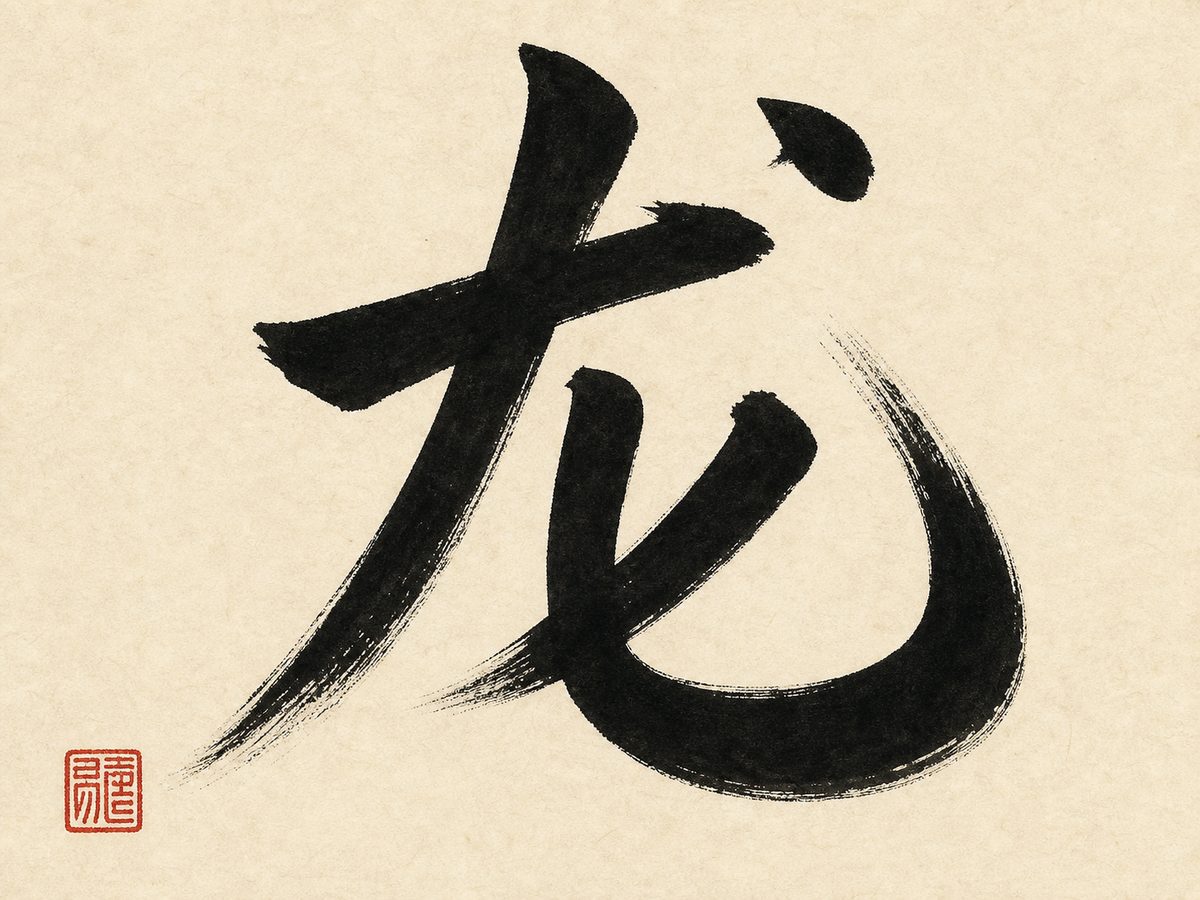
How it's written
Simplified 龙 is a five-stroke sprint, and it helps to see it as one continuous gesture rather than separate parts: a short stroke on top, a long diagonal that drops and hooks, and a small tail flicking off to the right. It is one of the quicker characters to write, and to recognize. Traditional 龍 is a different animal on the page: sixteen dense strokes, a whole menagerie of components stacked left and right. The two are the same word. The mainland writes 龙; Taiwan and Hong Kong keep 龍. Unlike a character such as 和, where simplified and traditional look identical, dragon genuinely forks, which is a live decision if you are choosing one for a tattoo or a scroll (see the variants below).
What it means
龙 is, more than almost any other character, an entire cosmology folded into one word. It names the dragon as China has imagined it for three thousand years: a long, scaled, horned, serpentine being that has no wings and flies anyway, master of rivers, clouds, and rain, and the oldest symbol of imperial power. To call something 龙 is to reach for the most auspicious, most potent image the culture owns. This is where a Western reader has to unlearn something. The dragon you know from Tolkien's Smaug, or the fire-belching beasts of Game of Thrones and House of the Dragon, is a Western dragon: winged, burning, a hoarder and a menace, a thing heroes are sent to slay. The Chinese 龙 is close to its opposite. It breathes no fire; it commands water. It is not hunted; it is prayed to, for rain and good harvests. Where the European dragon stands for greed and destruction, the Chinese one stands for fortune, fertility, and rightful authority. Same English word, nearly opposite creatures, which is exactly why "the Chinese symbol for dragon" tends to surprise people: they brace for something sinister and meet, instead, the luckiest animal in the zodiac.
- 龙王 — the Dragon King, a water deity of myth
- 龙舟 — dragon boat (as in the racing tradition)
- 恐龙 — dinosaur (literally 'terror dragon')
- 龙头 — a leader or flagship; also a faucet or tap
- 龙卷风 — a tornado ('dragon-twist wind')
- 变色龙 — chameleon ('color-changing dragon')
Idioms
- 画龙点睛“paint the dragon, dot the eyes”the final touch that brings the whole thing to life. From the tale of the painter Zhang Sengyou, whose dragons flew off the wall the instant he added their eyes. (Zhang Yanyuan, 'Record of Famous Paintings Through the Ages' (9th c.))
- 望子成龙“hope one's son becomes a dragon”to hold high hopes for a child's success; the classic aspiration of Chinese parents. (a common saying)
- 卧虎藏龙“crouching tiger, hidden dragon”a place or group full of hidden, undiscovered talent. Made globally famous by Ang Lee's 2000 film. (a classical set phrase (and the 2000 film title))
- 龙飞凤舞“dragon flying, phoenix dancing”flamboyant and flowing, most often said of bold, cursive calligraphy. (a classical set phrase)
- 生龙活虎“living dragon, lively tiger”bursting with energy and vigor; full of life. (a common set phrase)
Right vs wrong forms
| Form | Type | Note |
|---|---|---|
| 龙 | simplified ✓ | The modern simplified form, five strokes, standard across mainland China. This is the everyday dragon and the one most people learning today will recognize. |
| 龍 | traditional | The traditional form, sixteen strokes, still standard in Taiwan and Hong Kong. Denser and more dramatic, and a popular pick for tattoos and calligraphy that want the older look. Fully correct, just a different regional standard. |
| 龙 (flipped or rotated) | mirrored | Not a real variant. Low-resolution stencils sometimes come out mirrored, and a reversed dragon reads as an obvious error. Check against a dictionary before inking. |
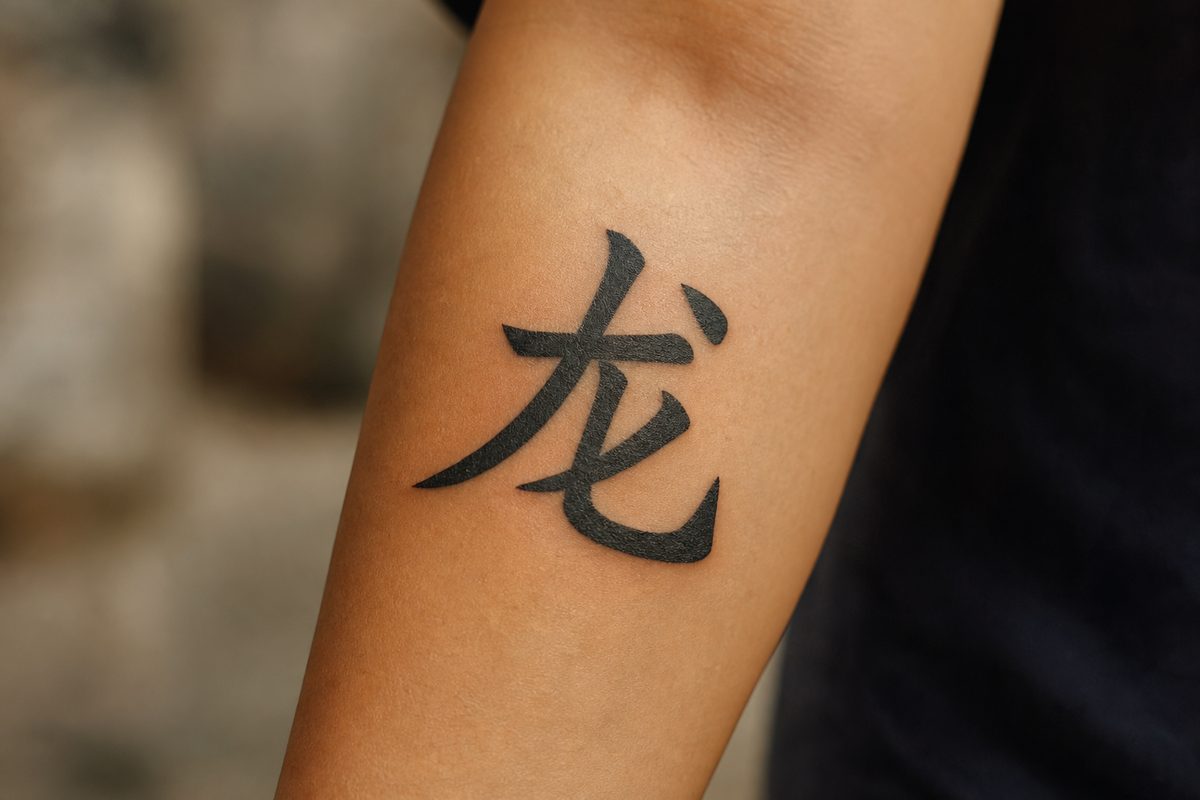
For a tattoo
Dragon is one of the most-requested Chinese tattoos, and for once the meaning is entirely on your side. 龙 reads, to anyone who can read it, as power, luck, and rightful strength, with none of the menace a Western dragon carries. There is no risk of accidentally inking something ominous. Two real decisions, though. First, the character versus the creature: some people want the single character 龙 (clean, unmistakable, and what this page is about), while others want a full illustrated dragon coiling up an arm. Both are legitimate; just know which you are asking for. Second, simplified versus traditional. Dragon is one of the characters that genuinely differs: 龙 is the modern mainland form, while 龍 is the traditional one still used in Taiwan and Hong Kong and often chosen for its density and drama on skin. Neither is wrong. As always, print the reference at full size, check it against a dictionary, and have someone who reads Chinese confirm it is not flipped before the needle goes in.
Dragon in life today
The people who call themselves dragons
Few cultures would pick a dragon as the ancestor they are proud of, but China does. 龙的传人, "descendants of the dragon" (lóng de chuán rén), is a phrase of shared identity, carried into every Chinese household by a much-loved 1978 song of that name. It says something about how thoroughly benign the association is: here the dragon is not the enemy in the story, it is the bloodline.
Hoping your child becomes a dragon
The warmest everyday use is about ambition for one's kids. 望子成龙 (wàng zǐ chéng lóng), "hoping your son becomes a dragon," is what you say of a parent pouring everything into a child's future, dreaming they will rise as high as a person can go. To "become a dragon" is to make it, spectacularly. The same reach shows up in famous names: the martial-arts legend Bruce Lee was 李小龙, "Little Dragon," and the actor Jackie Chan took the stage name 成龙, which means, almost cheekily, "become a dragon."
Dragons in the street
The creature is still loose in public life. A dragon dance snakes through Lunar New Year parades, a long cloth body held aloft on poles and made to chase a pearl. Every summer, teams race long, narrow dragon boats (lóngzhōu) to the beat of a drum, a tradition now paddled in cities worldwide. And 龙 is a real given-name character, chosen to wish a child strength, luck, and a spectacular rise, the exact cluster of hopes packed into wàng zǐ chéng lóng.
Curious how 龙, or a character matched to a quality you have in mind, would sit in a real Chinese name? Our Chinese name generator builds one from the sound of your own name and a well-omened meaning.
Where the character comes from
龙 began as a picture. The oldest forms, scratched onto ox bones and turtle shells more than three thousand years ago, show a coiling, horned, open-mouthed serpent, and the bronze and seal versions that follow keep that same reared-up, twisting body. It is a pictograph, a character that started life as a small drawing of the thing it names. By the time of the Shuowen Jiezi, the first Chinese dictionary, compiled around the year 100, the dragon had a full job description. It calls the creature "the chief of the scaled animals," and then, wonderfully, lists its powers: it can be hidden or bright, fine or huge, short or long; at the spring equinox it climbs into the sky, and at the autumn equinox it plunges into the deep. That is not a monster lurking in a cave. It is a force of nature with a calendar, tied to the turn of the seasons and the coming of the rains, and everything the character later means grows from that root.
History & roots
The dragon as a ladder of life
The oldest and most influential thinking about 龙 is not a story but a diagram. The very first hexagram of the Yijing, the Book of Changes, is Qian, pure creative force, and it maps its six lines onto a dragon at six stages of rising. James Legge's translation climbs the ladder with it. At the bottom sits "the dragon lying hid," of which the text says "it is not the time for active doing," the talent not yet ready to show itself. Higher comes "the dragon appearing in the field," then, at the commanding fifth line, "the dragon on the wing in the sky," the moment of full and flourishing power. At the very top, a warning: "the dragon exceeding the proper limits," where "there will be occasion for repentance." Rise too far, overreach, and even a dragon regrets it. Three thousand years before the modern executive bookshelf, the Chinese had folded the whole arc of ambition into a single animal.
The emperor's animal
From there the dragon climbed onto the throne. The emperor was the 真龙天子, the "true dragon, son of heaven"; his robe was the lóngpáo, embroidered with writhing five-clawed dragons that commoners were forbidden to wear; his seat was the dragon throne. To claim the dragon was to claim the mandate to rule, which is why, for most of Chinese history, the one creature you could not touch was also the one stamped on everything the state produced.
The bringer of rain
Underneath the imperial symbolism runs something older and more agricultural: the dragon as the master of water. In folk belief the Dragon Kings governed the seas and rivers, and villages prayed to them for rain in a drought and for calm in a flood. That deeper well of dragon lore, the Dragon Kings, the four seas, the palaces beneath the waves, is a story for another page. What matters here is the through-line: from the Shuowen's rain-bringer to the farmer's prayer to the emperor's robe, 龙 has always meant a power that gives life rather than takes it.
Questions people ask
What is the Chinese symbol for dragon?
It is 龙 (lóng), written 龙 in simplified Chinese and 龍 in traditional. Unlike the Western dragon, the Chinese dragon is a lucky, benevolent creature tied to water, rain, and the emperor, so 龙 carries meanings of power, good fortune, and success rather than danger.
What is the difference between the simplified and traditional dragon character?
They are the same word, dragon. 龙 (five strokes) is the simplified form used in mainland China; 龍 (sixteen strokes) is the traditional form still used in Taiwan and Hong Kong. For a tattoo or artwork it is a genuine stylistic choice, since the two really do look different, unlike many characters where simplified and traditional are identical.
Is the Chinese dragon good or evil?
Good, and emphatically so. Where the European dragon is a fire-breathing monster to be slain, the Chinese dragon (龙) is an auspicious being that brings rain and good fortune and stands for the emperor. The Chinese even call themselves 'descendants of the dragon.' It is one of the most positive symbols in the culture.
Is the Chinese dragon character a good tattoo?
Yes. 龙 reads clearly as power, luck, and strength, with none of the menace a Western dragon implies, so the meaning is safe. Decide two things first: whether you want the single character 龙 or a full illustrated dragon, and whether you want simplified 龙 or traditional 龍. Then have a Chinese reader confirm the stencil is not flipped.
What does wàng zǐ chéng lóng mean?
Literally 'hoping your son becomes a dragon,' it describes a parent's high hopes for a child's success. Because the dragon is the image of reaching the very top, to 'become a dragon' means to make it in a big way. It is one of the most common expressions of parental ambition in Chinese.
Sources
- Shuowen Jiezi dictionary entry for 龍 (Chinese Text Project)
- The Book of Changes, Qian hexagram (Chinese Text Project, Legge translation)
- Zdic (zdic.net): the dictionary entry for 龙 / 龍 (definitions, readings)
- Encyclopaedia Britannica: 'long', the Chinese mythological creature
- 'Descendants of the Dragon' (龙的传人), the 1978 song (Wikipedia)
- Chinese dragon: symbolism, imperial use, and the Dragon Kings (Wikipedia)
Make Dragon your own
See 龙 in calligraphy
From ancient seal script to flowing cursive. Pick a look before a tattoo or a card.
Get a Chinese name
A name matched to the sound of yours, with a meaning that fits.
Try the Chinese Gender Predictor
A different corner of Chinese culture: the old Qing-palace birth chart, worked out from your lunar birth date, with the math shown and its coin-flip odds honestly weighed.
Related: strength
By Julian 祝君瑜 · sourced from the classics and from modern life · updated 2026-07-07