Chinese Dragon (龙): Mythology & Meaning
The Chinese dragon, 龙 (lóng), is almost the exact opposite of the fire-breathing monster the English word "dragon" brings to mind. It is a benevolent, wingless, serpentine water-god: bringer of rain and rivers, chief of all scaled creatures, emblem of the emperor, and the auspicious ancestor a billion people invoke when they call themselves "descendants of the dragon." Less a beast to be slain than a weather system with a personality.
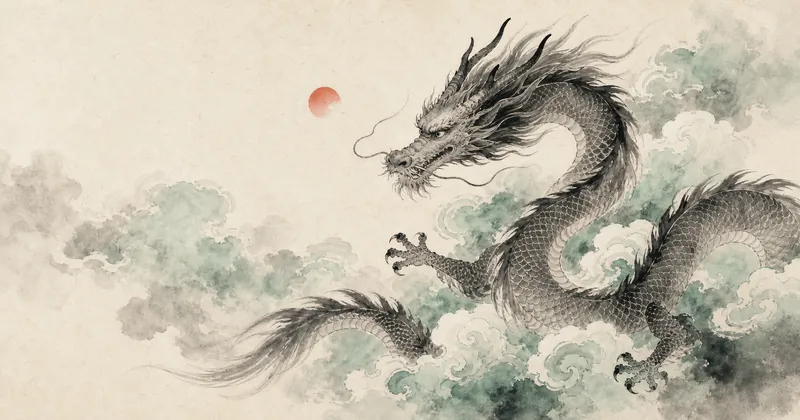
Were you born in a Year of the Dragon?
Enter your birth date to find out your sign and which of the five elements it falls under. We handle the Chinese New Year cutoff, so a birthday in January or early February lands on the right side.
Chinese fortune-telling reads a lot into a birthday. For a playful old birth-chart custom, try our Chinese gender predictor.
Say the word "dragon" to anyone raised on English stories and the same picture assembles itself: a vast fire-breathing lizard hunched on a heap of stolen gold, bat wings folded, the designated villain of the tale, waiting for a knight with a sharp sword and a clean conscience. Now put that picture down and back slowly away from it. The creature the Chinese call 龙 (lóng) is very nearly its opposite: wingless, benevolent, watery, wise, and about as likely to hoard treasure as to breathe fire. It is less a monster than a weather system with a personality. That English files both beasts under the single word "dragon" may be the most quietly consequential mistranslation in the whole history of East-meets-West, and it is why a growing number of people would rather you called the Chinese one a "loong" and left the knights out of it.
Loong, not dragon
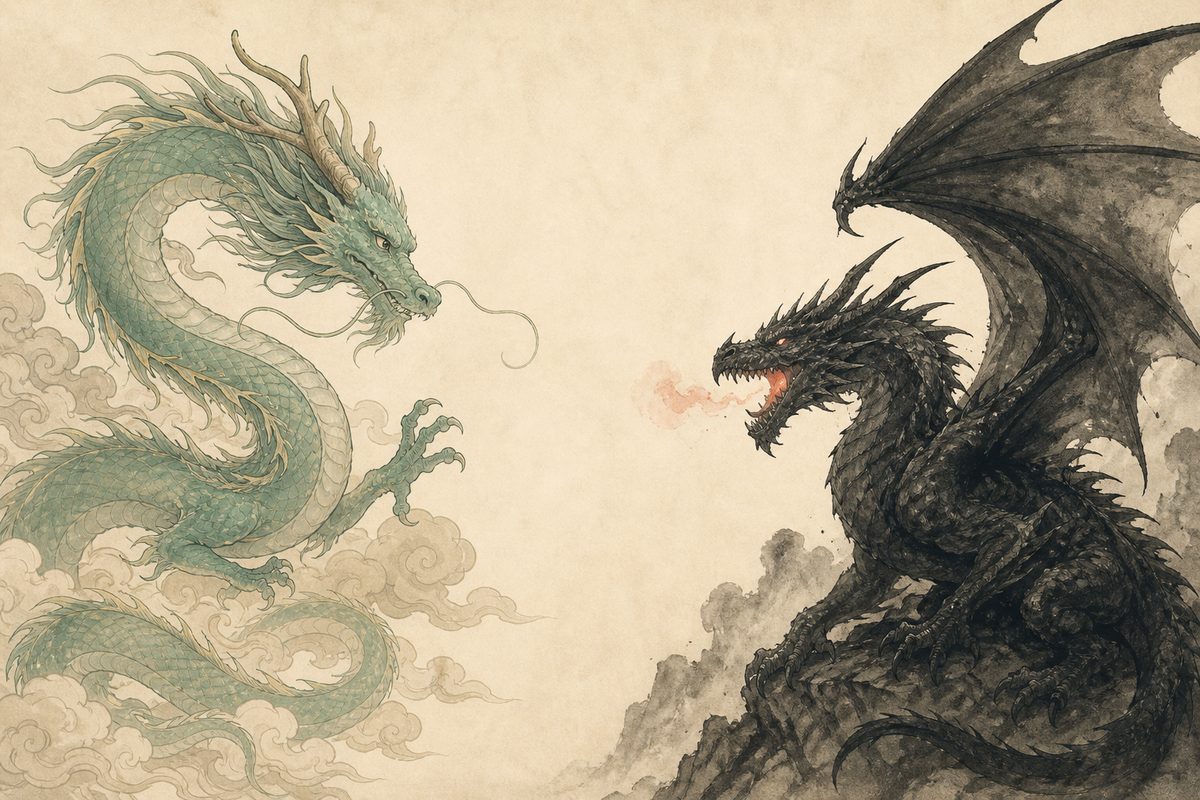
For most of history this was a translator's quibble. Then, in early 2024, it became a minor movement. As that Year of the Dragon arrived, Chinese state outlets from the news agency Xinhua on down began quietly swapping the English word "dragon" for a different spelling, "loong," and the change rippled across official captions, museum signs, and social media almost overnight. The argument behind it is the one this whole page is making: the Chinese loong and the Western dragon are not the same animal, and filing them under one word does a disservice to both. "Loong" is not even a new invention. It survives in older romanizations that never went through the standardizing machine of pinyin, which is why Hong Kong's Kowloon is really "Nine Dragons," and why Bruce Lee was billed in his own lifetime as Lee Siu Loong, "Little Dragon." Critics roll their eyes and call it soft-power branding; the sinologist Victor Mair, for one, has argued the switch is driven more by politics than by language, and they are not entirely wrong. But the linguists have a point too. When a single word carries the opposite moral charge in two cultures, benevolent rain-god here and treasure-hoarding menace there, insisting on the difference is not nationalism. It is just accuracy.
| The Chinese loong (龙) | The Western dragon | |
|---|---|---|
| Moral charge | Benevolent, an omen of fortune | The story's designated villain |
| Element | Water: rain, rivers, and the sea | Fire, usually aimed at knights |
| Wings | None, and it flies anyway | Bat wings |
| Body | Long, serpentine, whiskered | A heavy fire-breathing lizard |
| Treasure | Keeps none; it deals in rain and harvests | Sleeps on a hoard of stolen gold |
| What humans bring it | Prayers for rain | A sword |
The dragon goes global
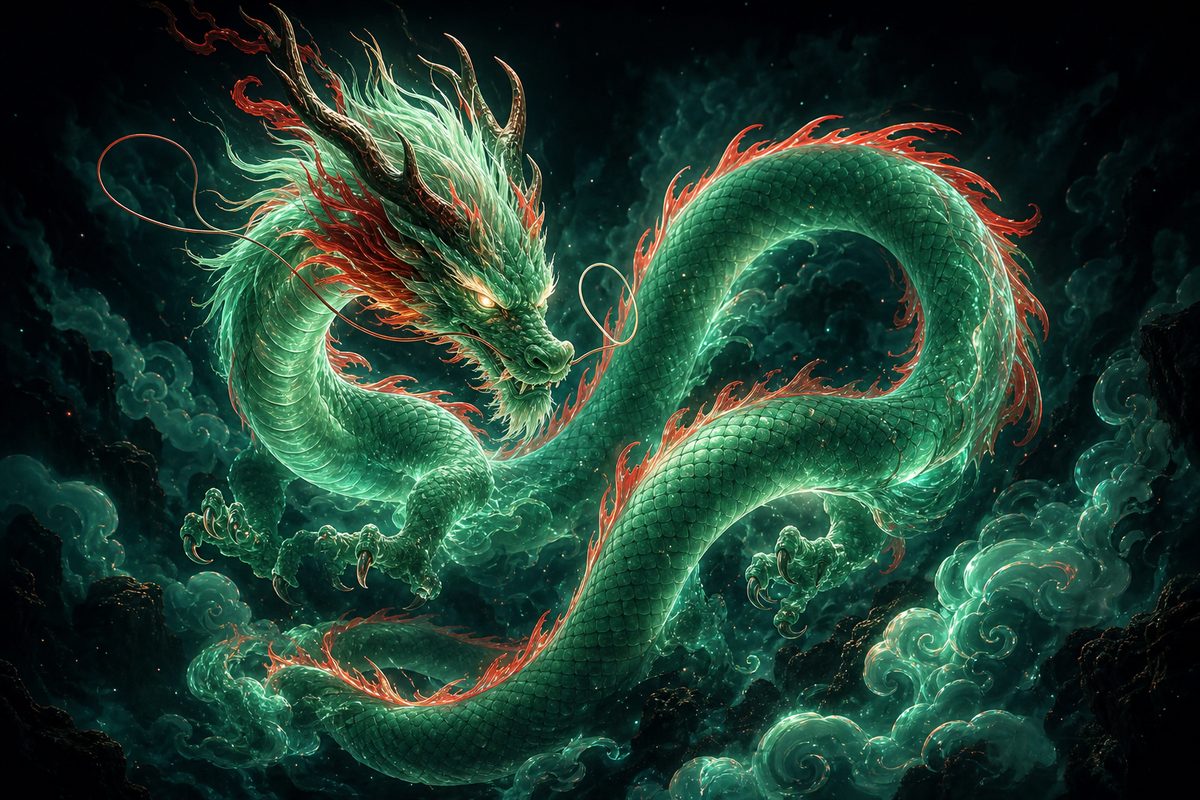
In 2024, a Year of the Dragon as it happened, a Chinese video game called Black Myth: Wukong sold, its studio Game Science announced, ten million copies in three days, and put the loong in front of a planet-sized audience. Its dragons appear as bosses, and its hero wields a shape-shifting staff stolen, exactly as in the sixteenth-century novel Journey to the West, from the Dragon King of the East Sea. It was hardly the dragon's first passage abroad. The wish-granting Shenron of Dragon Ball is a textbook serpentine loong, and the whole franchise is a loving riff on the Monkey King's adventures; Disney's Mushu is a comic, pocket-sized cousin; the river spirit Haku in Spirited Away is another. Each time, the wingless, whiskered, good-tempered silhouette travels intact.
And the rest of the culture, just now, is having a colossal dragon moment of its own, only with the other dragon. In the same years the loong was quietly conquering games, the West was besotted with Smaug crouched on his gold, with the burning skies of Game of Thrones and its prequel House of the Dragon, with the trainable pet-monsters of the How to Train Your Dragon films. Every one of them is winged, fanged, and fond of fire: the medieval European beast in modern costume. That two such opposite creatures should crest at the very same moment, sharing one English name, is exactly the confusion the "loong" campaigners are trying to clear up. Set the two side by side and the case makes itself. One hoards and burns; the other brings the rain.
Born in the Year of the Dragon
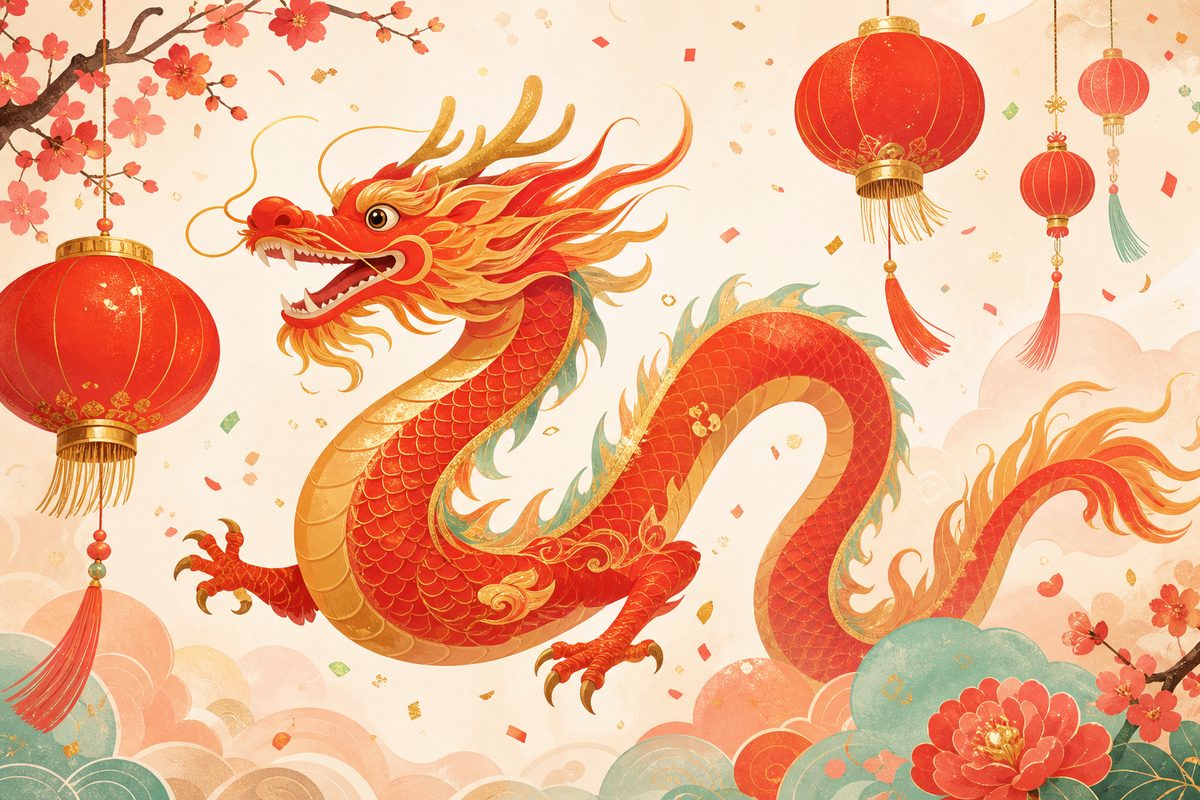
Of the twelve creatures in the Chinese zodiac, eleven are animals you could in principle meet: a rat, an ox, a tiger, a horse. The twelfth is the dragon, the only mythical beast in the lineup, and partly for that reason it is quietly reckoned the most desirable sign in the whole cycle. A child born in a Year of the Dragon is supposed to inherit its ambition, its charisma, and its luck, and enough parents believe it that the effect turns up in the statistics: dragon years, which come around every twelfth year, produce measurable baby booms across the Chinese-speaking world, from Taiwan to Singapore to the mainland: demographers who track the pattern have clocked birth spikes on the order of five to ten percent, as couples time their families to land a "dragon baby." It is one of the few places on earth where a five-thousand-year-old myth still moves a modern birth rate. What the other eleven signs are, and what each is said to confer, is a story for the zodiac. Here it is enough to know that the dragon is the crown of it.
Racing the dragon
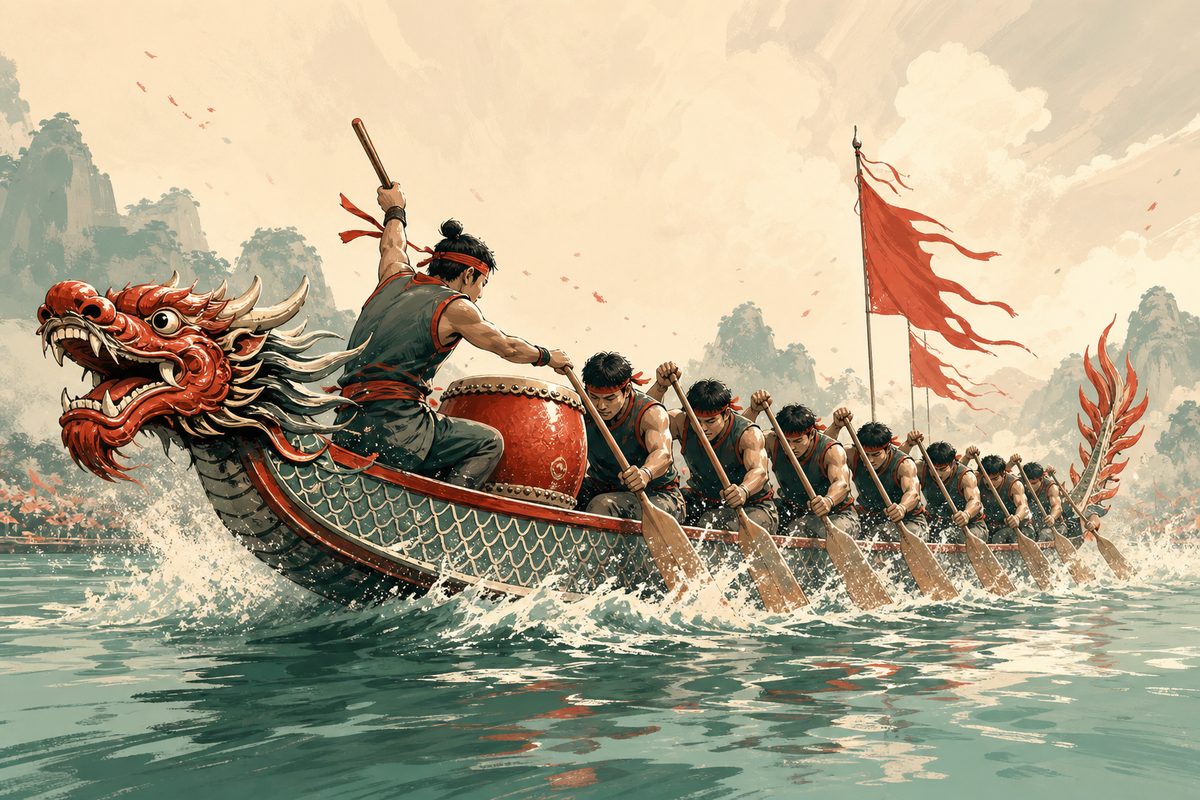
Once a year the dragon takes to the water in person. On the fifth day of the fifth lunar month comes the Dragon Boat Festival, Duanwu, when teams of paddlers drive long, narrow boats, each with a carved dragon's head at the prow and a tail at the stern, down rivers and lakes to the hammering of a drum. The tradition is usually traced to Qu Yuan, a poet and honest minister of the third century BCE who, in despair at his kingdom's corruption, drowned himself in the Miluo River. The story goes that the local people raced out in their boats to save him, or at least to recover his body, and threw parcels of rice into the water so the fish would eat those and leave the poet alone. The parcels became zongzi, the sticky-rice dumplings still eaten on the day, and the frantic paddling became a race. What began as a village rescue is now a global sport: dragon-boat clubs paddle on rivers from London to San Francisco, most of their crews with no idea they are re-enacting the funeral of a heartbroken Chinese poet, under a dragon that was, as ever, presiding over the water.
Descendants of the dragon
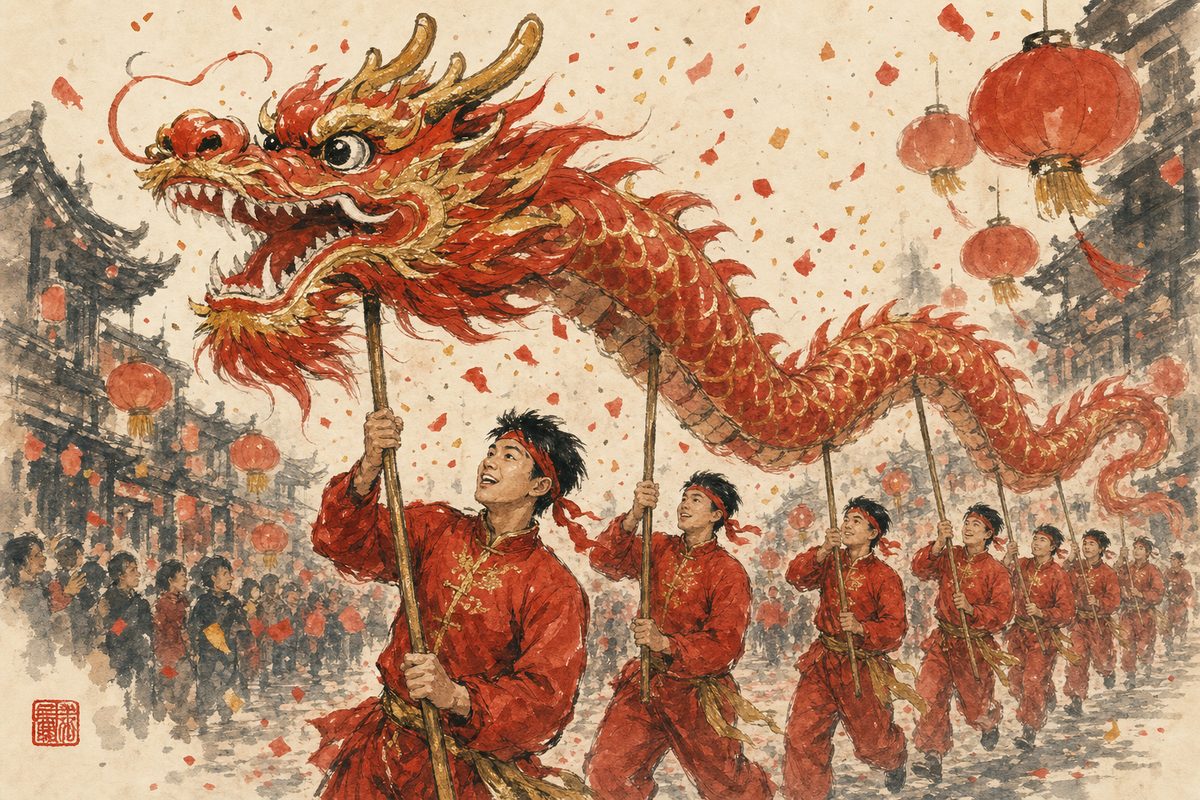
Here is the part that tends to stop visitors in their tracks: the dragon is not only a symbol of China, it is, for a great many Chinese, an ancestor. "Descendants of the dragon," 龙的传人, is a phrase people apply to themselves and genuinely mean, carried around the world by a much-loved 1978 song of that name. You can still meet the creature in the street: at Lunar New Year a dragon dance snakes down the road, a long cloth body held aloft on poles and made to chase a flaming pearl, the same good-natured beast the villages once begged for rain. And as a written character, 龙 goes on to lead a busy second life in Chinese names, tattoos, and everyday sayings about ambition and rising in the world.
The dragon is also a character you can write and wear. See 龙 as a Chinese symbol, its strokes, meaning, and tattoo notes, or render it in living calligraphy.
All of that, the anthem and the boats and the dragon babies, rests on a creature far older and stranger than any of it. To see where the loong comes from, you have to go back to the water.
A god of water, not of fire
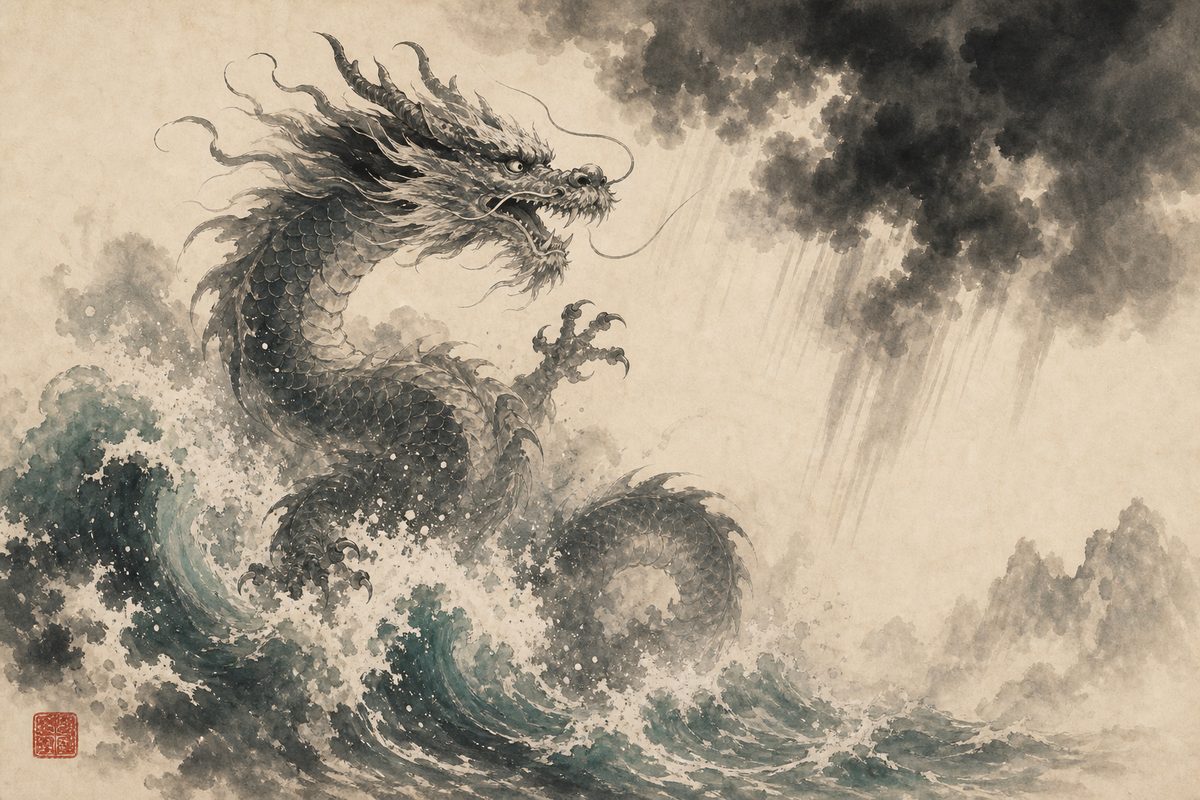
The first thing to understand is that the Chinese dragon is, at heart, a rain god. Its element is water in every form: rivers, seas, clouds, the storm that saves the harvest. In the folk religion, dragon kings hold court beneath every sea and lake, running the empire's rainfall like a somewhat temperamental civil service, answering ultimately to the Jade Emperor at the head of the celestial court; in a drought you paraded the dragon through the fields and begged, and in a flood you begged the same creature to knock it off. The oldest dictionary in China, the Shuowen Jiezi of around the year 100, files the dragon as "the chief of the scaled creatures" and then, with a straight face, notes that it "climbs into the sky at the spring equinox and plunges into the deep at the autumn equinox." This is a god you could set your farming calendar by. Where the Western dragon is a nightmare of the seafaring imagination, all fire and plunder, the Chinese dragon is the patron saint of agriculture: stay on its good side, and the rice comes in.
A creature assembled from nine animals
No wings, and yet it flies, which tells you the flight was never really about aerodynamics. The Chinese dragon is a composite, a body built by committee out of spare parts, and the Han-dynasty scholar Wang Fu left us the famous parts list, the "nine resemblances." Read it aloud and it sounds like an incantation: the antlers of a stag, the head of a camel, the eyes of a demon, the neck of a snake, the belly of a clam, the scales of a carp, the claws of an eagle, the paws of a tiger, and the ears of an ox. Somehow the result is not a monster from a fever dream but the most graceful thing in the Chinese bestiary. And it is startlingly old: craftsmen of the Neolithic Hongshan culture were coiling dragons out of jade some five thousand years ago, which makes the creature older than the first dynasty, older than Chinese writing itself. How those nine animals first got stitched into one, and why, we honestly do not know. The dragon was already ancient by the time anyone first sat down to define it.
The dragon's nine sons
If the dragon is a committee, it also runs a family business. A much-loved tradition holds that the dragon fathered nine sons, 龙生九子 (lóng shēng jiǔ zǐ), no two alike, and anyone who has looked hard at old Chinese architecture has already met them without knowing it. The idea is old, but the famous rosters are surprisingly late and surprisingly bureaucratic in origin: the story goes that a Ming emperor asked his scholar-official Li Dongyang, point-blank, to name the nine, and Li, unable to find an answer anywhere in the Classics, went home and pieced a list together from the ornaments around the palace. A second Ming scholar, Yang Shen, produced a rival version, and the two have been politely disagreeing ever since. What they share is a lovely conceit: each son inherited a single trait and was handed the job that suited it. One loves to bear weight, so he is the stone tortoise straining under every memorial stele (bìxì). One loves to gaze out and swallow, so he perches at the ends of palace roof-ridges, warding off fire (chīwěn). One has a mighty roar, so his shape crowns temple bells, struck by a whale-shaped mallet to make the note carry (púláo). One loves to kill, so he glares from sword-hilts (yázì); one loves to stay shut, so he clamps the iron ring in his teeth on the front door (jiāotú). It is one of the most charming filing systems any culture ever devised: a whole zoo of dragon-children, each doing an honest day's work holding up the built world.
The many kinds of dragon
If the nine sons hold up the architecture, the dragons proper come in a whole taxonomy of their own, sorted by where they live and what they rule. The celestial dragon, the Tianlong, guards the palaces of the gods and draws their chariots across the sky, which is why the ceilings of the Forbidden City swarm with them, watching over the throne. The spiritual dragon, the Shenlong, is the one that mattered most to ordinary people: azure-scaled and cloud-maned, he governs the wind and the rain, and it was to him that a parched village raised its altar. The earth dragon, the Dilong, lives underground and steers the rivers and springs; the routes he carves through the mountains are the "dragon veins" that feng shui masters still trace when siting a house or a grave, and when he shifts in his sleep, the ground quakes. The treasure dragon, the Fucanglong, guards what lies buried, and breaks to the surface now and then as a volcano to file its report with heaven. Add the flood-dragon Jiaolong, who begins life as a fish and needs five hundred years to grow his horns, and you have less a single animal than an entire ecology.
Above them all sit the Dragon Kings, the Longwang, who rule the four seas from undersea palaces of coral and pearl and are on call, like a divine water utility, to send the rain or hold it back. They are why a fisherman prayed before setting out, and why the Monkey King, in Journey to the West, could stride into the East Sea and bully its Dragon King, Ao Guang, out of the shape-shifting iron staff that became his signature weapon. That same scene, staff and all, opens the video game that would carry the loong around the world in 2024.
A dragon for every color
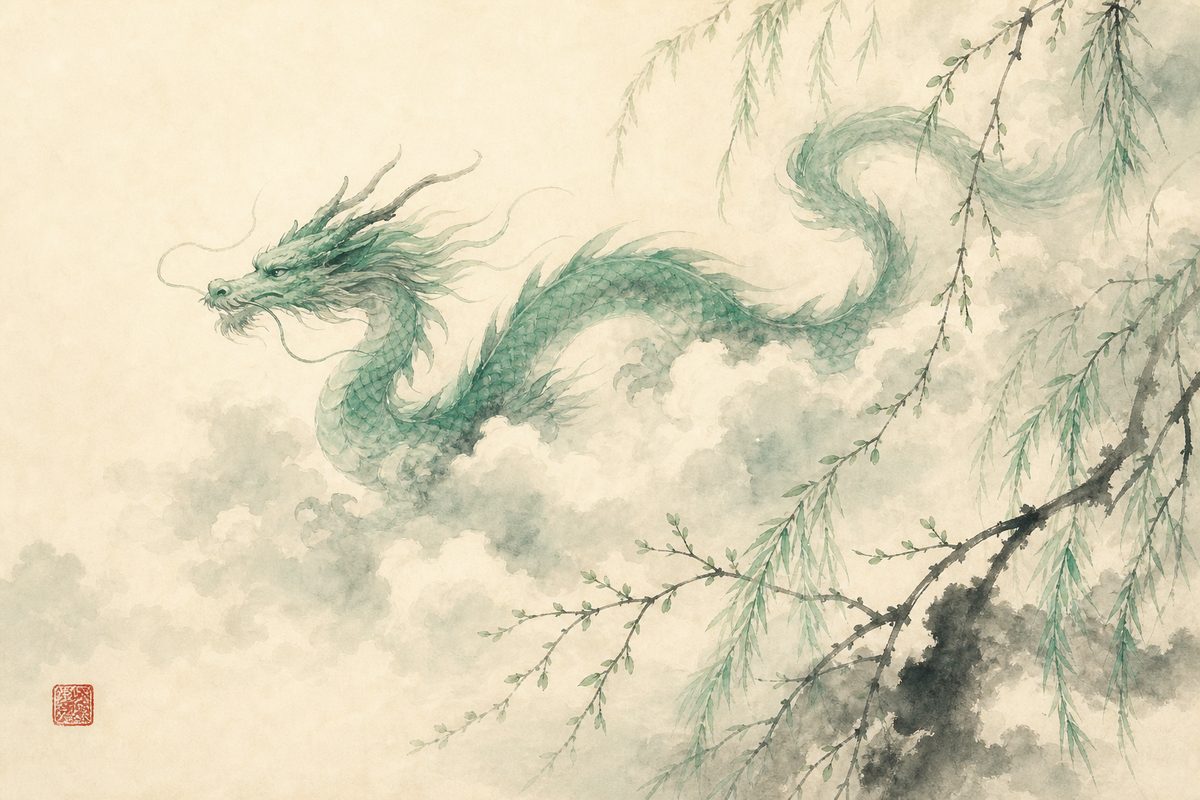
Chinese dragons are also color-coded, and the code is cosmological rather than decorative, keyed to the five elements that organize so much of Chinese thought. Each color pins the dragon to a direction, a season, and an element. The azure or green dragon holds the east, spring, and the element of wood; this is the Azure Dragon, one of the four great celestial animals that guard the compass points alongside the White Tiger, the Vermilion Bird, and the Black Tortoise, and he stands for growth and fresh beginnings. Red is the dragon of the south, of summer and fire, and because red is the luckiest color in China, it is the dragon of weddings and festivals, the one that writhes down the street at New Year. Yellow, or gold, is the color of the center and of the emperor himself: a golden dragon is imperial, wise, and flush with fortune. White keeps the west, autumn, and metal, and carries a cooler, faintly mournful air. Black rules the north, winter, and deep water, and it is the most double-edged of the set, bound up with storms, floods, and revenge, which is why a black dragon is the tattoo of choice for the gangsters of Hong Kong cinema. A Song-dynasty emperor is even said to have made the scheme official, canonizing five colored dragons as kings. Name a dragon's color, then, and you have already told a Chinese viewer which way it faces and what it is for.
The dragon in the oldest books
For a beast with no fixed biography, the dragon turns up in a remarkable amount of serious literature. The Book of Changes, the I Ching, opens its very first hexagram with a whole ladder of them. Read in James Legge's Victorian translation, the lines track a dragon's rise: it begins as a "dragon lying hid" that must not yet act, climbs to the glorious "dragon on the wing in the sky," and ends with the cautionary sixth line, the dragon that "exceeds the proper limits" and lives to regret it. An entire philosophy of timing was hung on one animal: know when to lie low, when to soar, and when you have flown one beat too high. (Readers of a certain kind of kung-fu novel will recognize that last, overreaching dragon as the opening move of a legendary fighting style; the classics never really die, they just respawn in martial-arts fiction.)
Then there is the Classic of Mountains and Seas, a gloriously strange Bronze-Age bestiary that reads like a government survey conducted by someone on very little sleep. It gives us dragons with names. There is Yinglong, 应龙, the winged "responding dragon" who, in the war between the Yellow Emperor and the rebel Chiyou, drowned the enemy's armies and then dragged his tail across the earth to carve out the riverbeds, so that ever after, as Anne Birrell renders it, "when there is a drought, people make an image of Responding Dragon, and they receive a heavy rainfall." And there is Zhulong, 烛龙, the Torch Dragon: a scarlet god with a human face and a serpent's body, a mile long, whose eyes make the difference between day and night. When he closes them there is darkness; when he opens them there is light. Modern readers, not unreasonably, suspect that somebody was trying very hard to explain the aurora.
The painter who would not dot the eyes
The dragon was also the ultimate test of an artist's nerve. The most famous painting anecdote in Chinese history, set down by the Tang art historian Zhang Yanyuan, concerns a sixth-century master named Zhang Sengyou. He painted four dragons on a temple wall in what is now Nanjing and pointedly left them eyeless. Pressed to finish, he warned that if he added the pupils the dragons would leave; his patrons, reasonably, thought this was nonsense and insisted. He dabbed in the eyes of two of them, and the record says thunder cracked, the wall split, and the two finished dragons rode the clouds into the sky, leaving the eyeless pair behind. From this comes a phrase every Chinese schoolchild learns, "dotting the dragon's eyes" (huà lóng diǎn jīng): the tiny final stroke that brings the whole work to life. As bars for a finishing touch go, it is a high one.
The emperor's beast
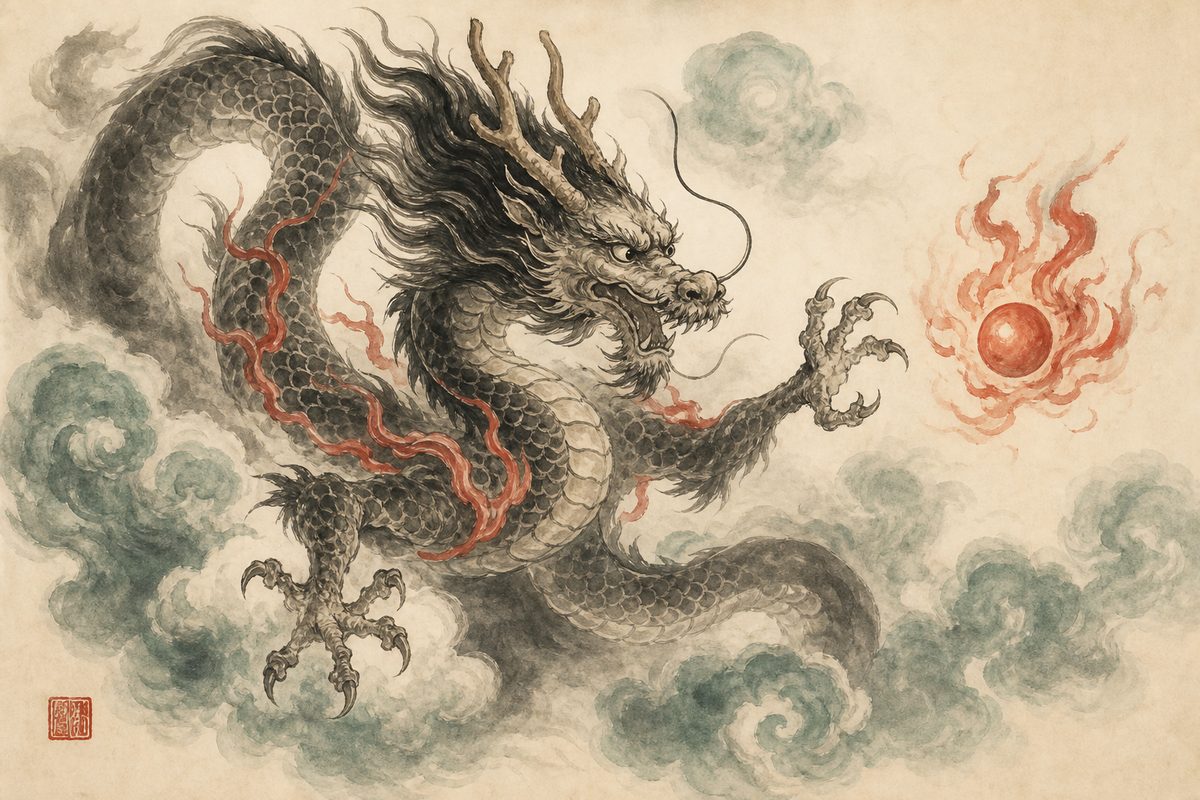
Somewhere along the way, the rain god got promoted. The dragon became the emperor, not his mascot but his actual person. He sat on the Dragon Throne, wore the dragon robe, and was addressed without a flicker of embarrassment as the "true dragon, son of heaven." Rank was counted in claws: the imperial dragon had five on each foot, and lesser nobles had to make do with four, so that using the wrong number of toes on the wrong garment was the sort of clerical error that could end a career, or a life. The Yellow Emperor himself, the legendary founder of the whole enterprise, was said to have turned into a dragon and flown up to heaven once his work on earth was done, which is surely the finest retirement package on record.
That total identification of dragon and ruler produced one of the language's sharpest metaphors. The philosopher Han Fei, writing in the third century BCE, noted that a dragon is a gentle enough creature: you can tame it, even ride it. But under its throat grows a single scale that lies backward, the "reverse scale" (nìlín), and anyone who so much as brushes it will be killed. A ruler, Han Fei warned, has a reverse scale too, and the entire art of advising a king lies in knowing where it is and never touching it. The advice was hard-won: Han Fei wrote the most clear-eyed essay ever composed on surviving a powerful man's moods, then died in a Qin prison, undone by the very difficulty he had diagnosed.
The carp that became a dragon
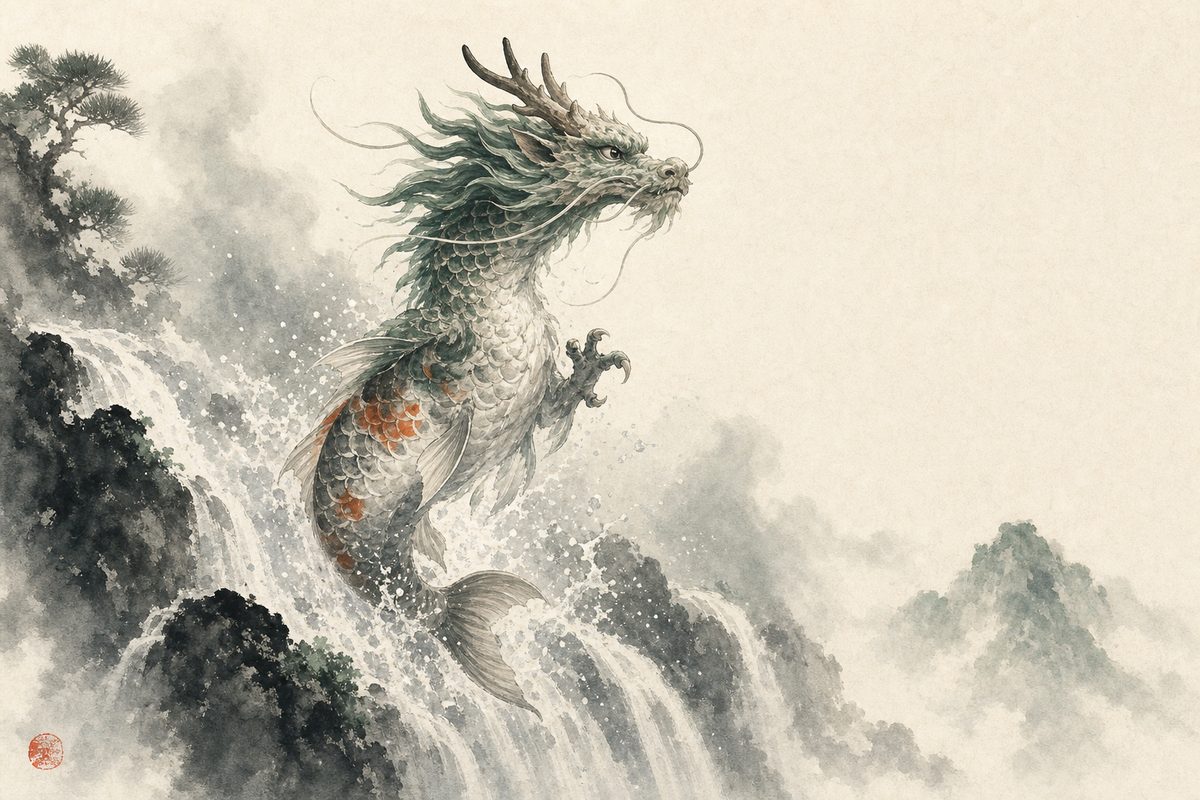
Not everything about the dragon was reserved for emperors; its most democratic legend is about a fish. At a gorge on the Yellow River called the Dragon Gate, the story goes, carp gather each spring and fling themselves at the falls. Almost all are swept back, but the rare carp that clears the top is transformed, there and then, into a dragon. "A carp leaping the Dragon Gate," lǐyú tiào lóngmén, became the great national metaphor for rising above the station you were born to, and for centuries it meant one thing above all: passing the imperial examinations, the punishing written tests that could carry a farmer's son into the government in a single generation. The image is everywhere in Chinese art, and it travelled well; in Japan the leaping carp became the koinobori, the carp-shaped streamers flown for children. Folklore even found a use for the ones that fail: the carp swept back downstream, one version says, are branded by heaven with a red mark on the forehead, which is offered, entirely straight-faced, as the reason some carp have red on their heads to this day.
So the next time you meet the word "dragon" fastened to something Chinese, whether a paper beast snaking down a New Year street, a boss in a game, or a robe behind museum glass, do the small and faintly radical thing and picture the opposite of a monster. Picture a river that has learned to fly, a good-natured god of rain who would sooner fill the reservoirs than burn the village. It has been the wrong translation for a very long time. The creature underneath it may be one of the most benevolent things any civilization ever chose to put at the center of its own story.
In the classics
The original passages behind the story, in the standard published translations.
龍,鱗蟲之長,能幽能明,能細能巨,能短能長,春分而登天,秋分而潛淵。
“The dragon is the chief of the scaled creatures. It can be hidden or manifest, tiny or huge, short or long. At the spring equinox it climbs into the sky; at the autumn equinox it plunges into the deep. ”
初九:潛龍勿用。……九五:飛龍在天,利見大人。……上九:亢龍有悔。
“Nine at the beginning: the dragon lies hid; it is not the time for active doing. … Nine in the fifth place: the dragon is on the wing in the sky; it will be advantageous to meet with the great man. … Nine at the top: the dragon exceeds the proper limits; there will be occasion for repentance. ”
應龍處南極,殺蚩尤與夸父,不得復上,故下數旱。旱而為應龍之狀,乃得大雨。
“Responding Dragon lives at the southern extremity. He killed Chiyou and Kuafu, but could not return above, and so the world below suffers frequent droughts. When there is a drought, people make an image of Responding Dragon, and they receive a heavy rainfall. ”
有神,人面蛇身而赤,直目正乘,其瞑乃晦,其視乃明,不食不寢不息……是燭九陰,是謂燭龍。
“There is a god here with a human face and a snake's body, and he is scarlet. He has vertical eyes that are in a straight seam. When this deity closes his eyes, there is darkness; when the deity looks with his eyes, there is light. He neither eats, nor sleeps, nor breathes. This deity shines his torch over the ninefold darkness. This deity is Torch Dragon. ”
As seen in
Black Myth: Wukong
game · 2024Serpentine loong dragons appear as bosses; the hero's shape-shifting staff is taken, as in the original novel, from the Dragon King of the East Sea — as Loong.
Sold ten million copies in three days, in a Year of the Dragon — a landmark moment for Chinese mythology as global soft power
Dragon Ball
anime · 1984A wish-granting, wingless, serpentine loong summoned by gathering seven magic orbs; the whole series is a riff on the Monkey King's Journey to the West — as Shenron.
Spirited Away
film · 2001A river spirit who takes the form of a white, whiskered, wingless dragon, a textbook East Asian loong rather than a Western beast — as Haku.
Mulan (Disney)
film · 1998A small, comic guardian dragon sent to watch over the heroine — a downsized, wisecracking descendant of the imperial loong — as Mushu.
Questions people ask
Why do some people call the Chinese dragon a 'loong'?
"Loong" is a romanization of 龙 (lóng) that many Chinese now prefer in English, to keep their dragon distinct from the Western one. Around the 2024 Year of the Dragon, state outlets pushed the switch, arguing that the benevolent, wingless, rain-bringing loong has almost nothing in common with the fire-breathing monster the word "dragon" calls to mind. Critics see soft-power branding; supporters see overdue accuracy.
What does the Chinese dragon symbolize?
Water and the power over it: rain, rivers, and the harvests they feed, along with good fortune, wisdom, and imperial authority. The Chinese dragon is a benevolent creature rather than a monster. It brings the rain that saves the crops, it stood for the emperor himself as the "true dragon, son of heaven," and a great many Chinese still call themselves "descendants of the dragon." In short it means life-giving power and luck, not menace.
How is the Chinese dragon different from a Western dragon?
They are nearly opposite creatures that happen to share one English word. The Western dragon is winged, fire-breathing, treasure-hoarding, and a monster to be slain; the Chinese loong is wingless, water-dwelling, benevolent, and revered as a bringer of rain and the emblem of the emperor. One is hunted; the other is prayed to.
What are the nine sons of the dragon?
A much-loved tradition holds that the dragon fathered nine sons, no two alike, each with a trait suited to a job in the built world: one bears weight as the stone tortoise under a memorial stele, one wards off fire from palace roof-ridges, one crowns temple bells for its mighty roar, one guards sword-hilts, one clamps the ring on a door. The famous lists were compiled late, in the Ming dynasty, and two rival versions still politely disagree.
What do the different colors of Chinese dragons mean?
Color keys a dragon to a direction, a season, and one of the five elements. The azure or green dragon holds the east and spring; the red dragon belongs to the south and summer and presides over weddings and festivals; yellow or gold is the imperial color of the center; white keeps the west and autumn; and the black dragon rules the north and deep water. Black is the most double-edged of the set, tied to storms and revenge, which is why it became the classic gangster tattoo of Hong Kong cinema.
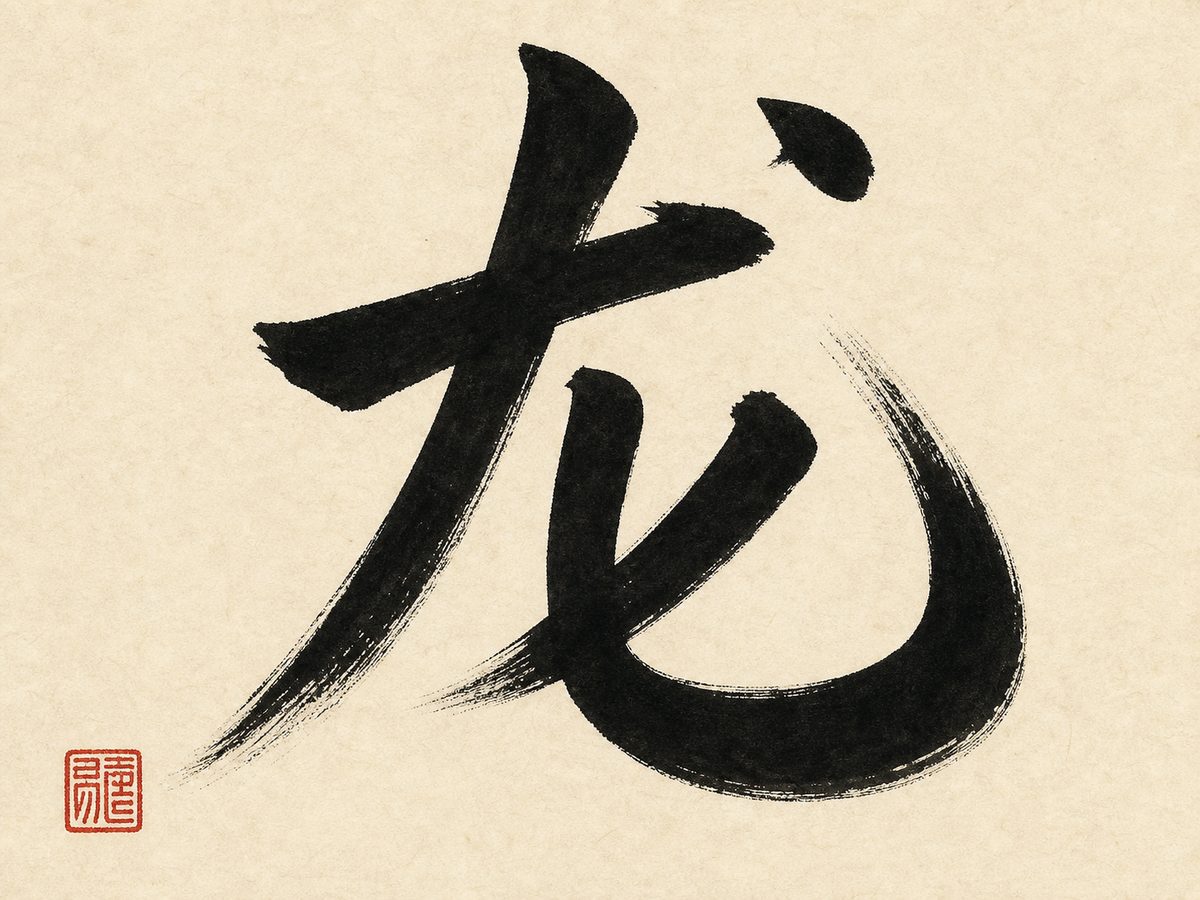
Write and wear 龙
The dragon is also a character you can write. See 龙 as a symbol — its strokes, meaning, and tattoo notes.
Sources & further reading
- Chinese dragon: symbolism, imperial use, and the Dragon Kings (Wikipedia)
- Dragon Boat Festival and its origin in the poet Qu Yuan (Wikipedia)
- Qu Yuan, the poet-minister behind the Duanwu legend (Wikipedia)
- 'Descendants of the Dragon' (龙的传人), the 1978 song (Wikipedia)
- Black Myth: Wukong, sales and reception (Wikipedia)
- 'Happy New Year of the Dragon, or should that be Loong?' (CNN, 2024)
- 'The loong story: China's zodiac animal is not the fire-breathing dragon' (Xinhua, 2024)
- 'The perils of a lunar new year dragon baby boom' (Al Jazeera, 2024)
- 'Dragon Babies': zodiac timing and birth cohorts (Agarwal, Qian et al., AEA)
By Julian 祝君瑜 · retold from the classics, with the original passages cited · updated 2026-07-16