The Jade Emperor (玉皇大帝): Ruler of the Chinese Heavens
The Jade Emperor, 玉皇大帝 (Yù Huáng Dàdì), is the supreme sovereign of the Chinese heavens, the august ruler most people picture when they picture Heaven: robed, crowned, and presiding over a vast celestial bureaucracy of gods and record-keepers. Yet he is famously not the highest power in Daoist theology, he was not born a god, and he was formally promoted to his cosmic office by the decree of an earthly Chinese emperor. He is the ruler of Heaven, and the one Sun Wukong could not defeat.
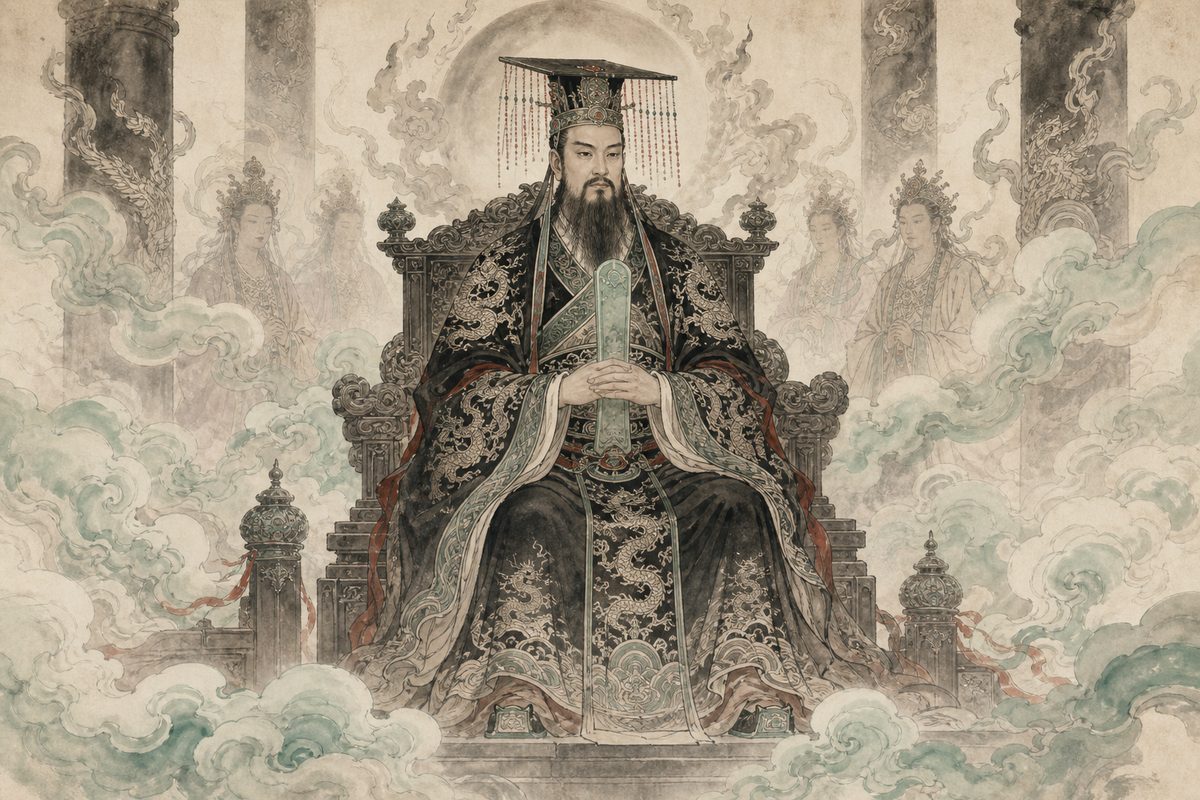
Every heaven needs someone to run it, and China's is run by a bureaucrat. The Jade Emperor, 玉皇大帝, is the supreme ruler of the Chinese heavens, the august sovereign most people picture when they picture Heaven at all: robed, crowned, seated above the clouds, presiding over a court of gods the way a Chinese emperor once presided over a court of officials. He is grand, remote, and immensely powerful. He is also, and this is the first of several delightful surprises, not the highest god in the pantheon, not the creator of anything, and not even born divine. He is the emperor of Heaven who got the job, in the end, rather the way a mortal official might: through a very long career, and a promotion signed off by a man on earth.
Who runs Heaven
To understand the Jade Emperor you first have to understand that the Chinese imagined Heaven as a government. Not a garden, not a void, not a choir of angels, but a government: a vast celestial civil service with departments, in-trays, ranks, audits, and a truly heroic amount of paperwork, modeled with loving exactness on the imperial bureaucracy that ran China on the ground. There is a Ministry of Thunder and a department for epidemics; there are gods for city walls and moats, for literature and the examinations, for wealth, and for the humble kitchen stove; there are celestial registers in which every human lifespan is written down and, now and then, quietly amended. (If the thought of Heaven keeping a file on your life appeals to you, that is more or less the premise of Chinese fortune-telling: our bazi calculator reads the same raw material, the date and hour of your birth, into a four-pillar destiny chart.) And at the top of the whole org chart, holding the apparatus together, sits the Jade Emperor.
He is called 玉帝, "Jade Sovereign," for short (a name you can see brushed in Chinese calligraphy), and the title is worth pausing on. He is an emperor, which in the Chinese scheme means less a warlord than an administrator-in-chief: the still point around whom a well-run cosmos turns, the office to which every other god ultimately reports. The dragon kings who bring the rain file with him. The Kitchen God reports to him. The dead are processed through courts that answer, in the end, to his. Where a Western imagination might put a thunderbolt-hurling king at the summit of the sky, the Chinese put the ancient world's most sophisticated idea of good management. Heaven, in this vision, is not chaos tamed by force. It is a state, and the Jade Emperor is its head of state.
The god who wasn't born a god
So where did he come from? The classic answer sits in a Daoist scripture with a suitably grand name, the Jade Emperor's Scripture of Fundamental Deeds, compiled somewhere around the Tang and Song dynasties and preserved in the Daoist Canon. It tells his origin story, and the story is not at all what you would expect of a supreme god. He began, the scripture says, as a baby.
Ages ago, the scripture begins, in a world long past, there was a kingdom whose name translates as something like Bright-Solemn Wondrous Bliss, ruled by a king named Pure Virtue and his queen, Precious Moonlight. The royal couple were old and childless, until the queen dreamed that a great Daoist lord laid an infant in her arms, and woke to find herself pregnant. The prince was born, the text notes precisely, on the ninth day of the first month, a date worth filing away for later. He grew up clever and kind, inherited the throne, ruled well, and then did the single most consequential thing in his long biography: he gave it all up.
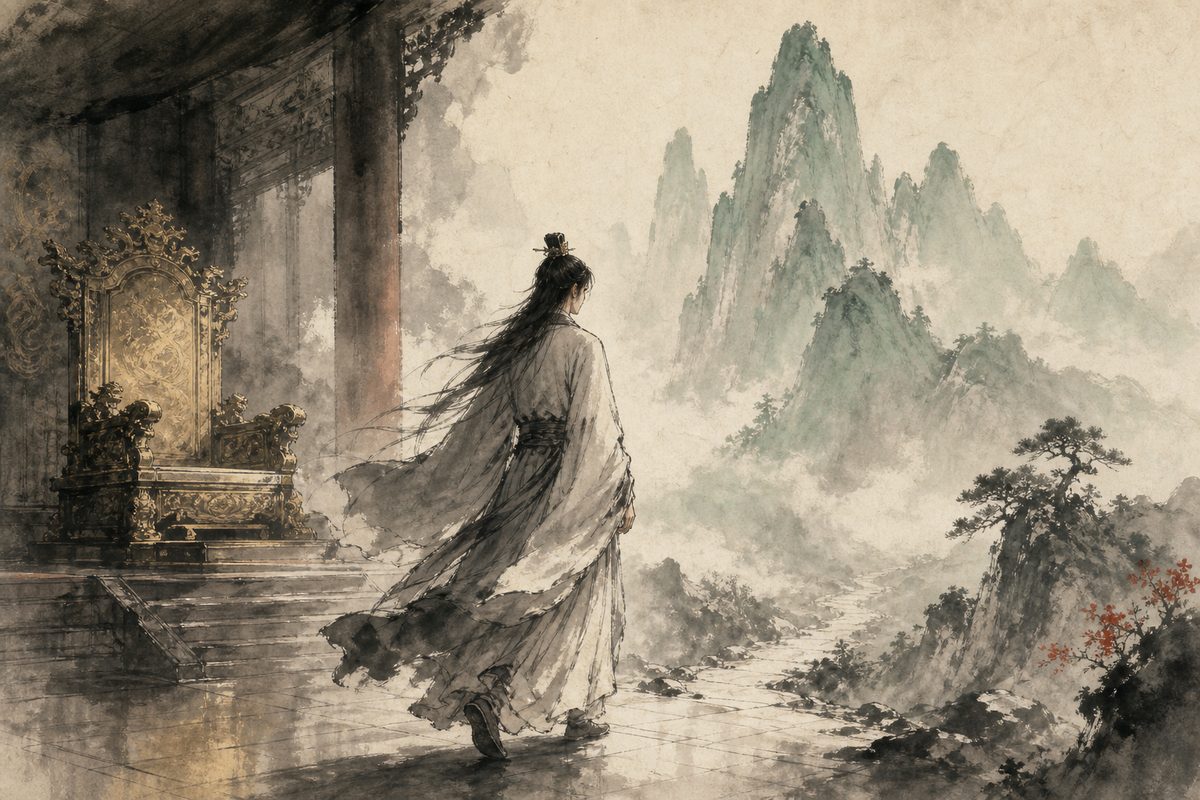
He handed the kingdom to a worthy minister and retired to the mountains to cultivate the Way, and he kept at it for a stretch of time only a religion comfortable with deep time would dare to specify. The scripture counts his progress out in kalpas, the vast cosmic aeons of Buddhist and Daoist reckoning, thousands of them and further ages beyond, before he attained at last the rank of Jade Emperor. A kalpa, for the record, is a unit of cosmic time so long that the usual illustration involves a mountain slowly worn to nothing by the brush of a passing robe. He put in more of them in the lower grades than our universe has years before his current posting. It is, when you sit with it, the most stupendous résumé in world religion, and its moral is pure Chinese officialdom: nobody is born to the top job. You earn it, even if earning it takes longer than the age of the universe.
Not the top of the org chart
Here is the surprise that trips up almost every Western retelling. Powerful as he is, the Jade Emperor is not the highest being in Daoism. Above him, on a plane so rarefied that they scarcely involve themselves in the running of things, sit the Three Pure Ones, the 三清, three primordial emanations of the Dao itself. The first of them, the Celestial Worthy of the Primordial Beginning, is the very figure the origin scripture casts as the narrator of the Jade Emperor's story. The relationship is best understood, once again, as an office. The Three Pure Ones are the abstract, retired founders, the source code of the universe; the Jade Emperor is the sitting chief executive who actually runs it. He does not make the world. He administers it.
That is not a demotion so much as a job description, and it is worth holding onto, because it is the honest version of a god that popular retellings love to flatten into an all-powerful sky-king. The truth is more interesting than the cartoon. The most famous god in China is, in the strictest theological terms, the supreme reality's extremely capable head of operations. And as anyone who has worked in a large organization knows, the person who signs the forms tends to shape your life far more than the founder whose portrait hangs in the lobby.
Promoted by an emperor
And now the best part, the detail that turns the whole celestial-bureaucracy idea from a metaphor into a matter of record. The Jade Emperor did not only rise through Heaven's ranks. He was also promoted, in writing, by the government of China.
In the early eleventh century the Song emperor Zhenzong, smarting after a humiliating peace treaty with the Liao to his north, staged an elaborate campaign of "heavenly texts" said to descend from the sky, a rather transparent effort to borrow some divine prestige, and in its wake he conferred on the Jade Emperor a magnificent official title, the kind of many-syllabled honorific the Chinese state handed to its own grandees. A century later the emperor Huizong, a devout and famously extravagant patron of Daoism, went further. In 1116 he issued a decree folding the Jade Emperor together with 昊天上帝, "August Heaven, Lord on High," the austere, faceless sky-god that Chinese emperors had worshipped at the great state sacrifices since the Zhou dynasty, the better part of two thousand years earlier. At a single stroke, the people's warm, storytelling Jade Emperor and the state's cold High Lord of Heaven became, officially, the same being.
It did not entirely take. Later dynasties quietly returned to sacrificing to the older, nameless Heaven in their most solemn rites. But the fusion is a large part of why the Jade Emperor could come to feel like the supreme god of everyone, folk and court alike. A popular deity had been elevated to the summit of the cosmos partly by centuries of prayer and partly by an act of imperial paperwork. Heaven's chief bureaucrat owed his own throne, in the last analysis, to a bureaucracy.
The monkey who trashed his court
For most people alive today, the Jade Emperor is met not in a scripture but in a story, and nearly always the same one: Journey to the West, the sixteenth-century novel in which a stone-born monkey lays waste to Heaven. Seen from the monkey's side it is a tale of glorious rebellion. Seen from the Jade Emperor's throne it is a masterclass in crisis management, and a slightly unflattering one.
Faced with an unkillable troublemaker making a nuisance of himself on earth, the Jade Emperor tries the oldest tactic of a nervous administration: give the malcontent a job. He summons Sun Wukong up to Heaven and appoints him Keeper of the Heavenly Horses, a post that sounds grand until the monkey works out it is the lowest rank in the building, a sort of celestial stable hand. Insulted, Wukong walks out. The court hurriedly placates him with a grander but entirely hollow title, Great Sage Equal to Heaven, and puts him in charge of the immortal peach orchard, which is a little like making an arsonist the fire warden. He promptly eats the peaches of immortality, drinks the high god's elixir for good measure, and thrashes the assembled armies of Heaven.
And here the Jade Emperor does the most in-character thing in the entire novel. He does not fight. He refers the matter upward. In the novel he simply issues an edict, dispatching two celestial officers to the Western Paradise to invite the Buddha down to subdue the troublemaker. He sends out for the Buddha. It is the perfect bureaucratic solution, and it works: the Buddha pins the monkey under a mountain where a hundred thousand celestial soldiers could not. The Jade Emperor keeps his throne by knowing exactly which department to escalate the problem to. (The monkey, Sun Wukong, has a page of his own, and so do the dragon kings who bring the rain and answer, like everyone else in this story, to the court above.)
Heaven's annual paperwork
If Heaven is a government, then like any government it runs on reports, and ordinary Chinese life is quietly threaded through the Jade Emperor's filing system. The clearest example sits on the kitchen stove. In countless households the Kitchen God spends the whole year watching the family, and in the last week of the lunar year he ascends to Heaven to deliver his report on their conduct straight to the Jade Emperor. This is why families have long seen him off with sticky sweets smeared around his mouth, either to sweeten his words or, depending on how cynical you are, to gum his lips shut before he can tattle.
The Jade Emperor's own feast day is the grandest of all. His birthday falls on the ninth day of the first lunar month, exactly the date the origin scripture gave for the prince's birth, and it is kept with particular fervor by Hokkien communities across Fujian, Taiwan, and Southeast Asia, for whom 拜天公, "paying respects to the Lord of Heaven," is one of the great rituals of the new year, complete with towering three-tiered altars and offerings that traditionally include whole stalks of sugarcane. It is one of those satisfying moments where a line in a medieval scripture and a living, noisy festival turn out to be reading from the same page.
The Great Race
There is one more job popularly pinned on the Jade Emperor, and it is the one to handle with the most care, because it is the least historical. Ask around and you will often be told that he invented the Chinese zodiac by holding a Great Race: he summoned the animals, and the order in which they crossed the line, rat first (by cheating a ride and jumping off at the finish), pig last, became the twelve-year cycle.
It is a wonderful story and a real piece of folklore. But it is folklore, not ancient scripture, and it deserves to be enjoyed as exactly that. The twelve animals themselves are genuinely old, attested as a set by the first century. The charming race that explains their order, however, is a much later folk tale, and even the host changes with the teller: in many versions it is the Jade Emperor who presides, in others it is the Buddha, and the details drift freely, whether it is a race or a banquet, whether a cat is cruelly cheated out of a place at all. That very looseness is the surest sign that we have left the world of record and entered the world of story. Which is entirely fitting. The god of Heaven's paperwork turns out to be the star of one of China's best-loved tall tales as well. (The animals, and the much older history behind them, are the Chinese zodiac, which has a wing of its own here.)
So the next time the Jade Emperor turns up, glowering from a temple altar, losing his patience with a monkey in a cartoon, or receiving the Kitchen God's yearly gossip over the stove, remember what you are actually looking at. Not a thunder-hurling creator in the Western mold, but something stranger and more Chinese: a self-made deity who worked his way up over billions of years, a sovereign who politely reports to three retired abstractions above him, and a folk hero raised to the summit of the universe partly by prayer and partly by an eleventh-century imperial decree. He is the emperor of Heaven precisely because he is the finest administrator in it. And he has been keeping the cosmos in good order, and its temper in check, for a very long time.
In the classics
The original passages behind the story, in the standard published translations.
往昔去世,有國名號光嚴妙樂,其國王者名曰淨德。時王有后,名寶月光。
“Ages ago, in a world long past, there was a kingdom named Bright-Solemn Wondrous Bliss. Its king was called Pure Virtue, and the king had a queen named Precious Moonlight. ”
懷胎一年,于丙午歲正月九日午時誕于王宮。
“After a year in the womb, in a bingwu year, on the ninth day of the first month at the hour of noon, he was born in the royal palace. ”
遂傳旨著遊奕靈官同翊聖真君上西方請佛老降伏。
“He then issued an edict, dispatching the Roving Inspector Spirit-Officer together with the Wing-Sage Perfected Lord to the Western Paradise, to invite the Buddha to come and subdue him. ”
As seen in
The Monkey King
film · 2023The overarching antagonist of the Netflix animated film, a vain celestial ruler whose ordered Heaven is upended by the newborn stone monkey — as The Jade Emperor.
Voiced by Hoon Lee; a loose retelling of Sun Wukong's early rebellion against the celestial court.
Journey to the West (西游记)
drama · 1986The celestial sovereign whose court Wukong storms and who keeps dispatching Heaven's generals against him, in the beloved CCTV series that still reruns today.
Havoc in Heaven (大闹天宫)
donghua · 1961The ruler of the heavenly court overthrown by Wukong in the landmark Shanghai animated film, a touchstone of Chinese animation.
Questions people ask
Who is the Jade Emperor in Chinese mythology?
The Jade Emperor (玉皇大帝, Yù Huáng Dàdì) is the supreme ruler of Heaven in Chinese religion, the sovereign who presides over a vast celestial bureaucracy of gods, ministers, and record-keepers modeled on the imperial court that once governed China. He is the god most Chinese people picture when they picture Heaven, and he appears throughout folklore and literature, most famously as the emperor whose court Sun Wukong storms in Journey to the West.
Is the Jade Emperor the most powerful Chinese god?
He is the most famous, but not, in strict Daoist theology, the highest. Above him sit the Three Pure Ones (三清), three primordial emanations of the Dao who stand apart from the day-to-day running of the cosmos. The Jade Emperor is best understood as Heaven's chief administrator, the sovereign who actually governs the universe, rather than its creator. In a bureaucracy, the official who signs the orders often wields more everyday power than the founders above him.
Where does the Jade Emperor come from?
A Daoist scripture, the Jade Emperor's Scripture of Fundamental Deeds (高上玉皇本行集經), compiled around the Tang and Song dynasties, gives his origin. He was born a prince in a kingdom whose name means Bright-Solemn Wondrous Bliss, renounced the throne to cultivate the Way in the mountains, and attained the rank of Jade Emperor only after thousands of kalpas and more, the vast cosmic aeons of Chinese religious time. In this telling nobody is born to Heaven's top job; it is earned over an almost unimaginable span of time.
What is the Jade Emperor's role in Journey to the West?
He is the ruler of the Heaven that Sun Wukong rebels against. The court first tries to placate the unruly monkey with a menial post as Keeper of the Heavenly Horses, then with the grand but empty title Great Sage Equal to Heaven. When Wukong wrecks the celestial banquet and defeats Heaven's armies, the Jade Emperor does not fight him personally; he sends for the Buddha, who finally pins the monkey beneath a mountain. It is a very bureaucratic kind of victory.
Is the Jade Emperor the same as Shangdi or the god of Heaven?
Over time, yes, the two were merged. Ancient Chinese emperors worshipped a remote sky-god called 昊天上帝, "August Heaven, Lord on High," at the great state sacrifices. In 1116 the Song emperor Huizong issued a decree formally identifying the popular Jade Emperor with this ancient High Lord of Heaven, which is a large part of why the Jade Emperor came to feel like the supreme god of everyone. Later dynasties partly undid the fusion in official ritual, but in popular belief it stuck.
When is the Jade Emperor's birthday?
On the ninth day of the first lunar month, the same date his origin scripture gives for the prince's birth. It is celebrated with particular intensity by Hokkien communities across Fujian, Taiwan, and Southeast Asia as 拜天公, "paying respects to the Lord of Heaven," with towering altars and offerings that famously include sugarcane. For many families it is one of the most important rites of the new year.
Did the Jade Emperor create the Chinese zodiac?
Popularly he is credited with it, through the folk tale of the Great Race in which he summons the animals and the order they finish becomes the twelve-year cycle. But this is folklore, not ancient scripture. The twelve animals themselves are old, attested as a set by the first century, while the race that explains their order is a much later story whose details, and even whose host (sometimes the Buddha rather than the Jade Emperor), shift from one telling to the next.
Sources & further reading
- Jade Emperor (Wikipedia) — role, birthday, and syncretism with Shangdi
- Jade Emperor (Encyclopaedia Britannica)
- 玉皇上帝 (Chinese Wikipedia) — the Song imperial titles and the merger with 昊天上帝
- '宋真宗伪造天书遮澶渊之耻' (China News) — Emperor Zhenzong's heavenly-book affair
- Three Pure Ones (Wikipedia) — the 三清 who rank above the Jade Emperor
- 'Why for some Chinese, the ninth day of Lunar New Year is the most important' (South China Morning Post) — 拜天公
- Kitchen God (Wikipedia) — the Zao Jun's annual report to the Jade Emperor
- 'What is the Chinese zodiac?' (National Geographic) — the Great Race as folklore
- The Monkey King (2023) cast and characters — the Jade Emperor as antagonist (MovieWeb)
- The Jade Emperor's Scripture of Fundamental Deeds (高上玉皇本行集經), full text (Chinese Wikisource)
By Julian 祝君瑜 · retold from the classics, with the original passages cited · updated 2026-07-20