Chinese Mythical Creatures 神兽
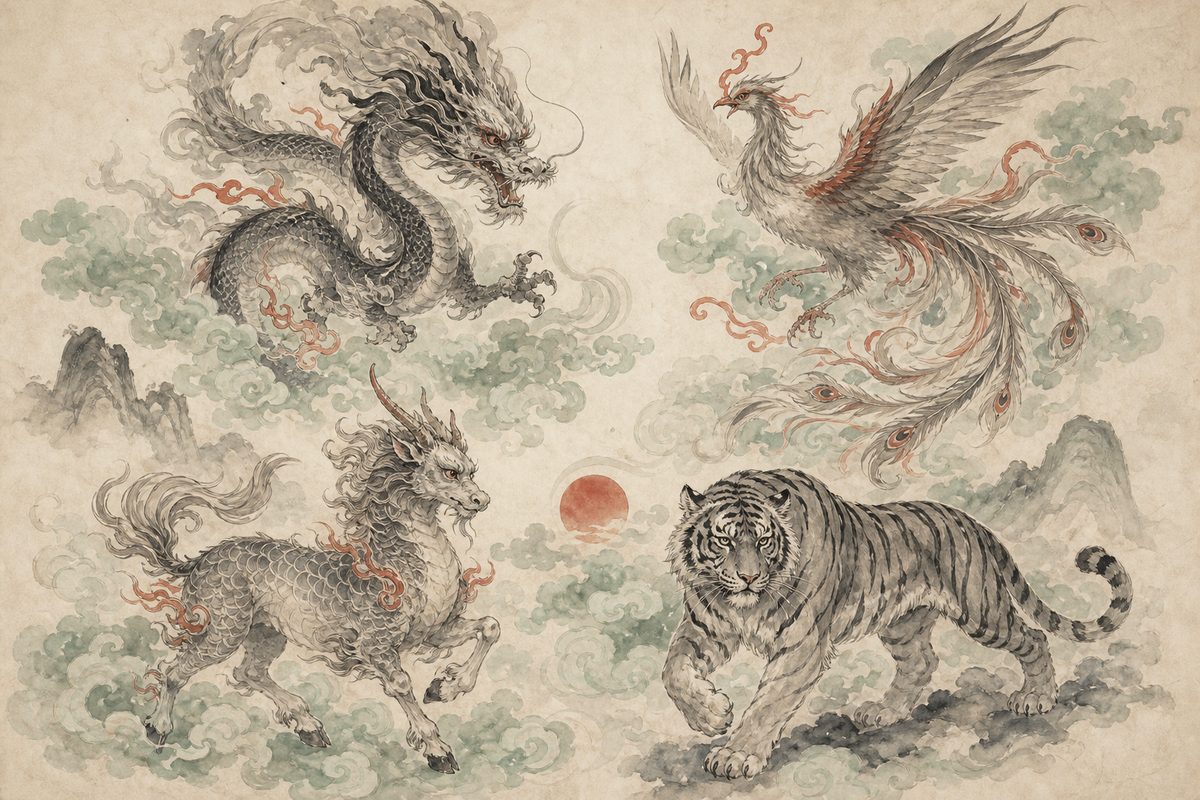
Chinese mythical creatures range from the benevolent to the monstrous, and almost all of them come with a job. The dragon brings the rain; the qilin announces a sage; the phoenix crowns an age of peace; and at the other end of the moral scale, the Four Perils devour the honest and the good. They are not random monsters but a whole ordered menagerie, most of it first written down in a single strange and wonderful book, the Classic of Mountains and Seas. Here is a field guide to the most important of them, sorted the way the tradition itself sorts them, with the classical text each one comes from named alongside.
The famous few have pages of their own: the Chinese dragon, the qilin, and, though he is a hero rather than a beast, the Monkey King who fought his way through this entire bestiary. The gods who command and battle these creatures have a pantheon of their own. More are on the way.
The Four Auspicious Creatures 四灵
The Book of Rites names four creatures as the great auspicious quartet, the sìlíng: dragon, phoenix, qilin, and tortoise. Their appearance was read as a sign that heaven approved of the age.
| Creature | What it is | First attested in |
|---|---|---|
| Dragon 龙 lóng | Bringer of rain and rivers, chief of all scaled creatures, and the emblem of the emperor himself. | Shuowen Jiezi · Classic of Mountains and Seas |
| Phoenix 凤凰 fènghuáng | King of all birds; its appearance was held to signal peace and a wise ruler on the throne. | Classic of Mountains and Seas, Nanshan jing |
| Qilin 麒麟 qílín | A gentle chimera that treads on no living thing and appears to herald a sage or a remarkable birth. | Classic of Poetry · Book of Rites |
| Divine Tortoise 龟 guī | Emblem of longevity and the cosmos, its domed shell read as the vault of heaven; the fourth líng, and the North (see Black Tortoise below). | Book of Rites |
The Four Symbols of the Sky 四象
A second, older quartet maps the four quarters of the night sky, each a constellation-guardian tied to a direction, a season, and one of the five elements. The full set already decorates the 5th-century-BCE tomb of Marquis Yi of Zeng.
| Creature | What it is | First attested in |
|---|---|---|
| Azure Dragon 青龙 qīnglóng | Guardian of the East, of spring, and of the element Wood; the dragon in its directional office. | Book of Rites, Quli |
| White Tiger 白虎 báihǔ | Guardian of the West, of autumn, and of Metal; a ward against evil and a god of war. | Book of Rites, Quli |
| Vermilion Bird 朱雀 zhūquè | Guardian of the South, of summer, and of Fire; a phoenix-like firebird, not to be confused with the fenghuang. | Book of Rites, Quli |
| Black Tortoise 玄武 xuánwǔ | Guardian of the North, of winter, and of Water; a tortoise entwined with a snake. | Book of Rites, Quli |
Guardians and bringers of fortune 瑞兽
Beyond the quartets, a whole menagerie of beasts was kept close for luck, protection, and wisdom, several of which still turn up as charms and temple guardians today.
| Creature | What it is | First attested in |
|---|---|---|
| Pixiu 貔貅 píxiū | A winged lion-beast that swallows wealth and, having no way out, never lets it go; now a favorite money-charm and feng shui guardian. | Records of the Grand Historian, Annals of the Five Emperors |
| Bai Ze 白泽 báizé | The all-knowing beast that met the Yellow Emperor and named every one of the 11,520 spirits under heaven, recorded in the now-lost Bai Ze Tu. | Yunji Qiqian · the Bai Ze Tu (Dunhuang fragment) |
| Dragon-horse 龙马 lóngmǎ | A winged horse with dragon scales that rose from the Yellow River bearing the River Chart, the diagram from which Fuxi drew the eight trigrams. | Book of Changes, Xici |
| Kui 夔 kuí | A one-legged thunder-beast of the eastern sea; the Yellow Emperor is said to have made a war drum from its hide. | Classic of Mountains and Seas, Dahuang dongjing |
The Four Perils 四凶
The dark counterpart to the auspicious beasts. The Zuo Zhuan first names four wicked figures banished by the sage-king Shun; later bestiaries, above all the Shenyi Jing, recast them as monsters. They are the ancestors of every Chinese screen-demon.
| Creature | What it is | First attested in |
|---|---|---|
| Taotie 饕餮 tāotiè | The insatiable glutton, all head and no body; the staring mask cast on Shang and Zhou ritual bronzes bears its name. | Zuo Zhuan · Lüshi Chunqiu · Shenyi Jing |
| Hundun 混沌 hùndùn | Faceless primordial chaos, a wingless yellow sack that could sing and dance but had no eyes, ears, or mouth. | Zhuangzi · Classic of Mountains and Seas · Shenyi Jing |
| Qiongqi 穷奇 qióngqí | A winged tiger that devours the honest and rewards the wicked, a monster with morals turned exactly backward. | Classic of Mountains and Seas · Shenyi Jing |
| Taowu 梼杌 táowù | An immovable, unteachable brute; its name became a byword for obstinate wickedness, and later for a grim historical record. | Zuo Zhuan · Shenyi Jing |
Shapeshifters and spirits 精怪
Not every creature keeps one shape. Chinese folklore teems with animals that cultivate power over centuries and learn to take human form, the fox chief among them.
| Creature | What it is | First attested in |
|---|---|---|
| Nine-tailed Fox 九尾狐 jiǔwěihú | A fox that grows nine tails with age: an auspicious omen of peace in antiquity, then, by the Ming, the shape a demon takes to ruin a king (Daji). | Classic of Mountains and Seas, Nanshan jing · Investiture of the Gods |
Beasts of the Classic of Mountains and Seas 山海经
The Shanhaijing, compiled over the Warring States and Han periods, is the great bestiary of Chinese myth: a geography of impossible mountains, each stocked with a creature and the omen it carries. A handful of its strangest have never left the imagination.
| Creature | What it is | First attested in |
|---|---|---|
| Torch Dragon 烛龙 zhúlóng | A crimson serpent a thousand li long whose eyes, opening and closing, make day and night, and whose breath makes winter and summer. | Classic of Mountains and Seas, Dahuang beijing |
| Responding Dragon 应龙 yìnglóng | The winged dragon who slew the war-god Chi You and the giant Kua Fu for the Yellow Emperor, then could not return to the drought-stricken sky. | Classic of Mountains and Seas, Dahuang dongjing |
| Bifang 毕方 bìfāng | A one-legged crane-like bird, red-marked on white; where it appears, strange and sourceless fire is said to follow. | Classic of Mountains and Seas, Xishan jing |
| Jingwei 精卫 jīngwèi | A drowned girl reborn as a small bird, forever carrying twigs and pebbles to drop into the sea that took her, trying to fill it in. | Classic of Mountains and Seas, Beishan jing |
| Xiangliu 相柳 xiāngliǔ | A nine-headed serpent, minister to the water-god Gonggong; wherever it fed, the ground turned to marsh too foul to farm. | Classic of Mountains and Seas, Haiwai beijing |
From the Zhuangzi, and from the New Year 其他
Two last creatures the whole culture knows: one a philosopher’s parable, one the reason your Lunar New Year is loud and red.
| Creature | What it is | First attested in |
|---|---|---|
| Kunpeng 鲲鹏 kūnpéng | A fish so vast that no one knows its length, which transforms into a bird whose wings darken the sky; Zhuangzi’s image of boundless freedom. | Zhuangzi, Xiaoyaoyou |
| Nian 年兽 nián | The New Year beast that came each winter to devour the village, until people learned it feared red, firelight, and noise, which is why the festival has all three. | Folk tradition |
Questions people ask
What are the most famous Chinese mythical creatures?
The best known are the dragon (a rain-bringing water god, not a Western fire-beast), the phoenix (fenghuang), and the qilin, which together with the tortoise form the Four Auspicious Creatures. Add the nine-tailed fox, the wealth-beast pixiu, and the glutton taotie whose face stares out from ancient bronzes, and you have the creatures that turn up most often in art, temples, and film.
What are the Four Symbols in Chinese mythology?
The Four Symbols (四象) are the guardians of the four quarters of the sky: the Azure Dragon of the East (spring, Wood), the White Tiger of the West (autumn, Metal), the Vermilion Bird of the South (summer, Fire), and the Black Tortoise of the North (winter, Water). They are astronomical as much as mythological, marking the four groups of constellations, and appear together as early as the 5th century BCE.
What is the difference between the Four Auspicious Creatures and the Four Symbols?
They overlap but answer different questions. The Four Auspicious Creatures (四灵) are dragon, phoenix, qilin, and tortoise, prized as omens that heaven favors the age. The Four Symbols (四象) are directional sky-guardians tied to compass points, seasons, and elements. The dragon and the tortoise wear both hats: the dragon is also the Azure Dragon of the East, and the tortoise is the Black Tortoise of the North.
What are the Four Perils in Chinese mythology?
The Four Perils (四凶) are the malevolent counterpart to the auspicious beasts: Taotie the glutton, Hundun the faceless chaos, Qiongqi the winged tiger that eats the good, and Taowu the unteachable brute. The Zuo Zhuan first lists them as wicked men banished by the sage-king Shun; later texts, especially the Shenyi Jing, turn them into monsters.
Which text are Chinese mythical creatures from?
The single richest source is the Classic of Mountains and Seas (山海经), a bestiary and mythic geography compiled over the Warring States and Han periods. Others come from the Book of Rites (the four auspicious creatures and four symbols), the Zuo Zhuan and Shenyi Jing (the Four Perils), the Zhuangzi (Kunpeng), and later fiction such as the Investiture of the Gods (the nine-tailed fox as Daji).
Are Chinese and Japanese mythical creatures the same?
Many were carried to Japan along with Chinese writing and Buddhism, then took on a local life. The qilin became the Japanese kirin, the fenghuang the hō-ō, the nine-tailed fox the kitsune, and the dragon the ryū. They share an origin but are not identical: the fox spirit, for instance, is far more central and elaborated in Japanese folklore than in the Chinese source.
The Chinese zodiac
The dragon and tiger you meet here also run the twelve-year cycle.
Feng shui and the four directions
The Four Symbols are the compass of Chinese space, from the pixiu to the azure dragon.
Sources & further reading
- The Classic of Mountains and Seas (山海经), tr. Anne Birrell (Penguin Classics) — the foundational bestiary of Chinese myth
- Classic of Mountains and Seas (山海經), full Chinese text (Chinese Text Project, ctext.org)
- The Book of Rites (禮記), Liyun and Quli — the Four Auspicious Creatures and the Four Symbols (Chinese Text Project)
- Zuo Zhuan (左傳), Duke Wen year 18 — the Four Perils as banished men (Chinese Text Project)
- Records of the Grand Historian (史記), Annals of the Five Emperors — the pixiu among the Yellow Emperor’s beasts (Chinese Text Project)
- Zhuangzi (莊子), Xiaoyaoyou ("Free and Easy Wandering") — the Kun and the Peng (Chinese Text Project)
- Four Symbols (Chinese constellation) — Wikipedia
- Four Perils — Wikipedia
By Julian 祝君瑜 · every creature traced to the classical text it comes from · updated 2026-07-20