Qilin (麒麟): China's Auspicious Unicorn
The qilin, 麒麟 (qílín), is the gentlest creature in Chinese myth: a benevolent, scaled, hoofed animal with a deer's body, an ox's tail, and a soft horn, so kind it will not tread on a blade of grass. The West calls it the "Chinese unicorn." One of the four great auspicious animals, it appears when a sage is born or a golden age is coming, and it is the reason a real giraffe once caused a sensation at the Ming court.
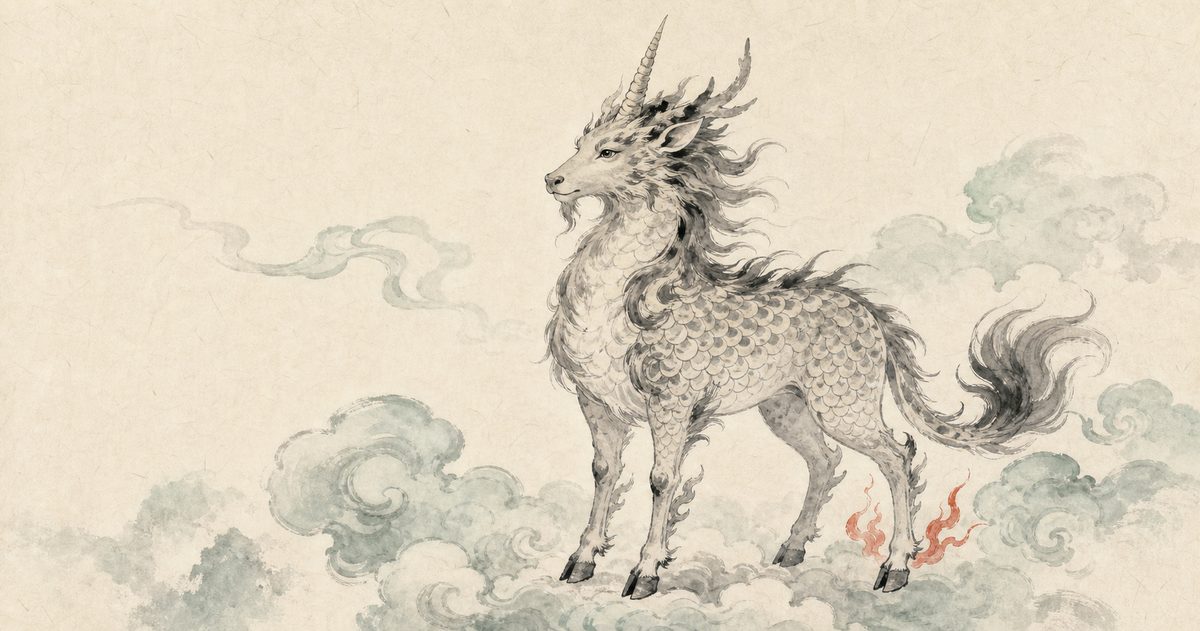
Somewhere between a deer, a dragon, and a wish, you will find the qilin. It is the gentlest monster China ever dreamed up: a benevolent, scaled, hoofed creature with the body of a deer, the tail of an ox, and a single soft horn, so kind that it will not tread on a living blade of grass or step on an insect. Westerners, reaching for the nearest label, call it the "Chinese unicorn," and the one-horn part fits, though almost nothing else does. The qilin is one of the four great auspicious animals of Chinese myth, alongside the dragon, the phoenix, and the tortoise, and its job is the loveliest in the whole bestiary: it appears when a sage is born or a golden age is coming, a walking piece of good news. It is also, as it happens, the reason a giraffe once caused a sensation at the Chinese court.
The giraffe that became a unicorn
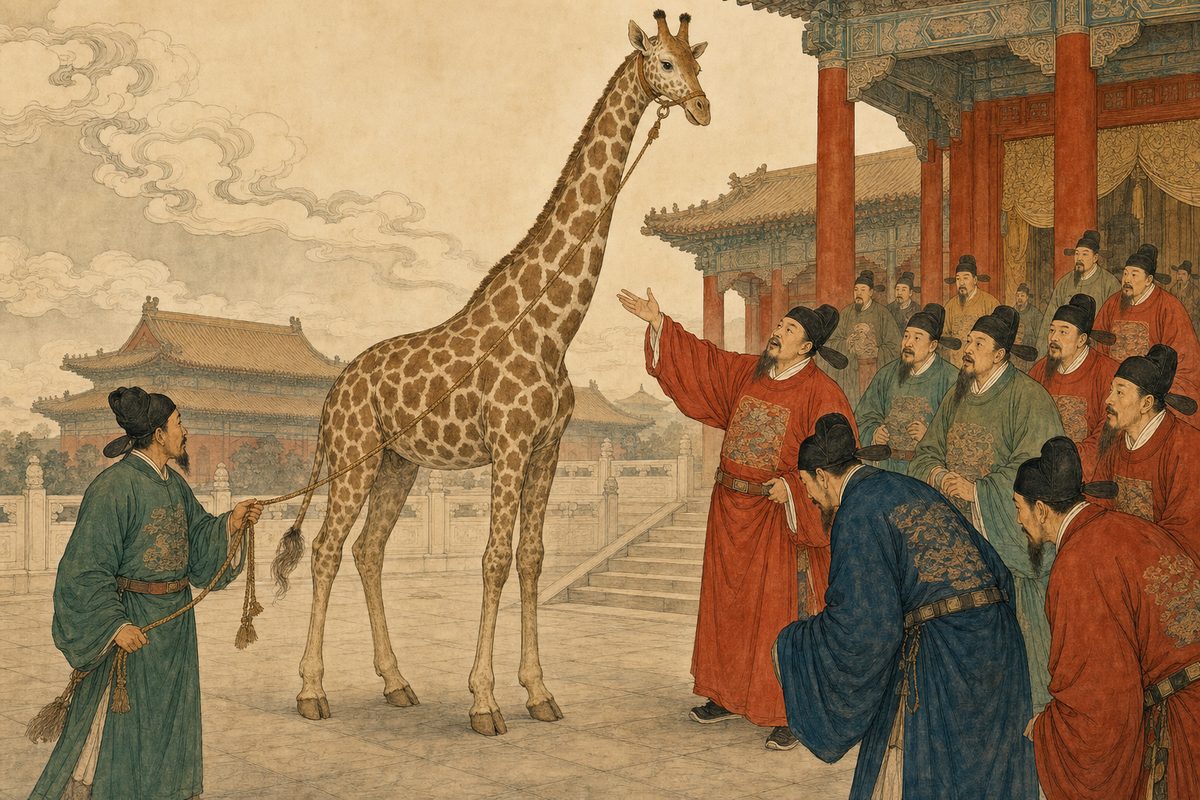
In 1414 a ship in the fleet of the admiral Zheng He came home carrying the most extraordinary passenger the Ming court had ever seen: a giraffe. It had been handed to the Chinese by envoys from Malindi, on the coast of what is now Kenya, passed along a chain of trade that ran through Bengal, and when it arrived, tall and gentle and patterned like nothing in China, the court decided it could only be one thing. It was a qilin. The identification was not as mad as it sounds. A giraffe is peaceable, it has strange soft horns, and it turned up, conveniently, during a reign the emperor wished to think of as a golden age, which is precisely when a qilin is supposed to appear. Officials wrote poems, a court painter recorded it, and the Yongle emperor, to his credit, was privately skeptical but happy to accept the omen. There was politics in the enthusiasm. A qilin was a heaven-sent stamp of approval on a ruler, proof that his reign was virtuous enough to summon one, and the Yongle emperor, who had seized the throne from his own nephew, could use every scrap of divine endorsement he could get. His ministers understood this perfectly, which is part of why an African giraffe was met less with zoological curiosity than with a chorus of congratulation. The episode left a permanent mark on the language too: to this day the word for qilin, read as kirin in Japanese and girin in Korean, is also the ordinary word for a giraffe. Few mistakes have ever been so charming, or so long-lived.
Kirin, the beer and the brand
That double meaning, mythical beast and long-necked mammal, is why a bottle of one of Japan's most famous beers has a unicorn on it. Kirin Beer, first sold in 1888, is named for the qilin, and its label carries a stylized image of the auspicious creature rather than the giraffe the word now also denotes. The qilin has kept up a busy modern career under both its names. It stalks video games as a slender, lightning-wreathed white beast in the Monster Hunter series; it strikes as a thunder technique in Naruto; it guards shop doorways and bank lobbies as a pair of feng shui statues, warding off misfortune the way a stone lion would, only more benignly. In parts of southern China a qilin dance, a close cousin of the lion dance, still winds through village festivals at New Year, two performers hidden under a bright cloth beast that bows and nods for luck. For a creature whose entire personality is gentleness, it has proved remarkably good at branding.
The unicorn that brings sons
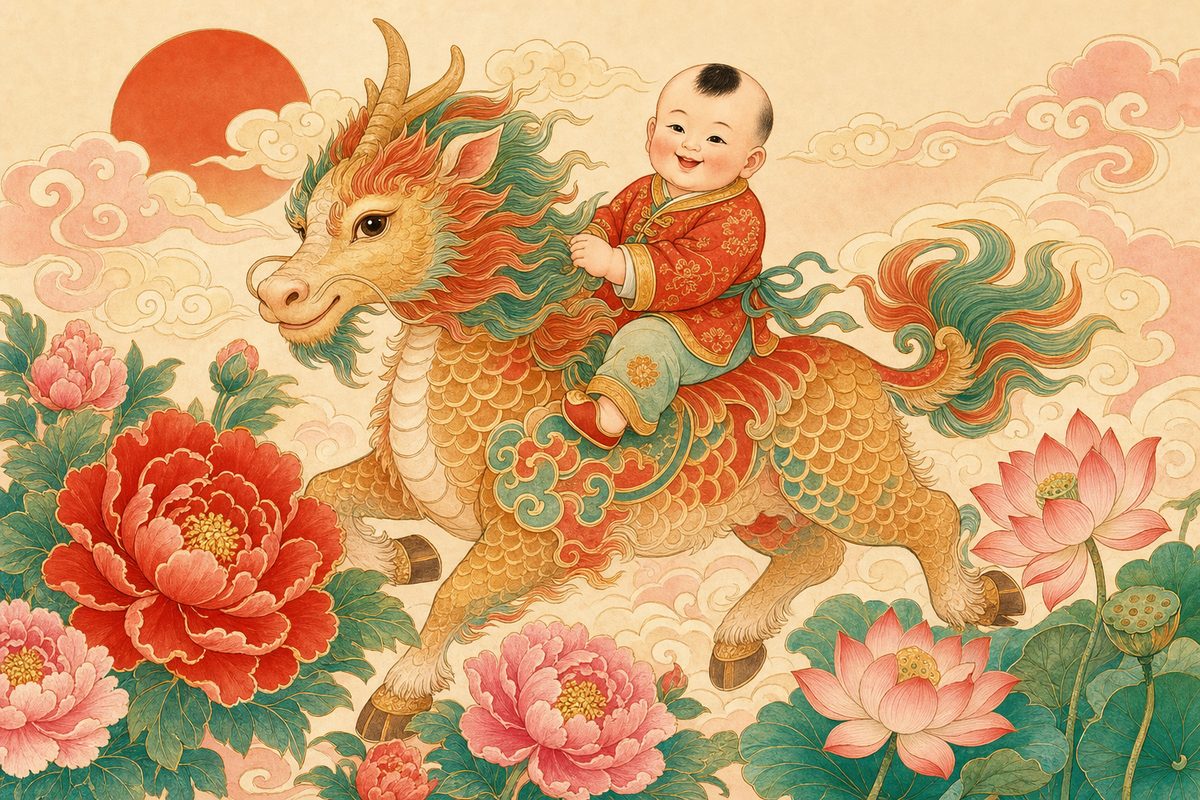
The qilin's warmest job is delivering babies. A much-loved folk motif called qilin songzi, "the qilin brings a son," shows the creature carrying a small child on its back, usually a boy destined for greatness, and it has decorated wedding gifts, papercuts, New Year prints, and cradles for centuries. The logic is old and sweet: the qilin appears where greatness is coming, so what better omen to hang over a nursery? The custom runs straight back to one of the oldest poems in the language, and it is why, even now, to call a bright boy a qilin child is one of the fondest compliments a Chinese parent can receive. If you are hoping for a child of your own, the Chinese also have a long tradition of guessing a baby's sex from the calendar, which our Chinese gender predictor revives, honestly and for fun.
What the qilin actually is
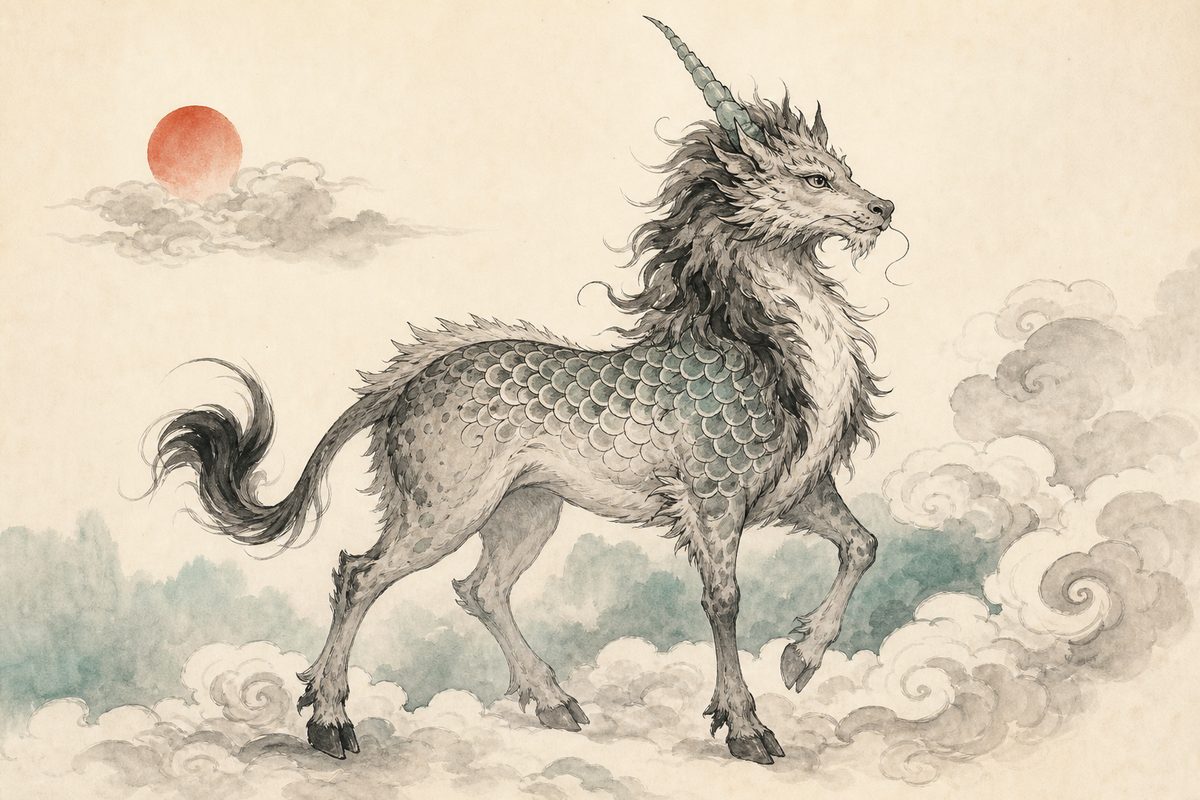
So what is it, exactly? The short answer is a committee animal, like the dragon, assembled from the best parts of several others. The oldest dictionary in China, the Shuowen Jiezi of around the year 100, files the qilin plainly as a "benevolent beast," and describes it with the body of a deer, the tail of an ox, and a single horn. Later artists piled on more: dragon scales, cloven hooves, a wolf's forehead, a coat that could blaze with flame. What never changed was the temperament. The qilin is the lord of all the furred and hoofed animals, just as the dragon rules the scaled, the phoenix the feathered, and the tortoise the shelled, and it is the mildest of the four by a wide margin. It punishes the wicked and spares the good, it walks so carefully that it harms no living thing, and its arrival is always, without exception, good news. You can see it written in brush calligraphy to feel how two dense, antique characters can carry all of that at once.
Not quite a unicorn
The "Chinese unicorn" label, useful as it is, quietly oversells the resemblance. The single horn matches, and so does the aura of purity and good omen, but there the two creatures part ways. The Western unicorn is essentially a white horse with a horn, wild and skittish, a thing medieval legend said could be tamed only by a maiden. The qilin is a chimera, a patchwork of deer and ox and dragon, as often shown with two horns as with one, its body sheathed in scales and wrapped, in the more dramatic pictures, in flame. And it needs no taming, because it was never wild to begin with. If anything the qilin outranks its Western cousin. Carried east to Japan, where it is called the kirin, and to Korea, where it is the girin, the creature climbed higher still: in the Japanese ordering of mythical animals the kirin sits at the very top, above even the dragon. Not bad for a beast whose defining trait is that it would rather not hurt you.
| The qilin (麒麟) | The Western unicorn | |
|---|---|---|
| Build | A chimera: deer's body, ox's tail, scales | Essentially a white horse with a horn |
| Horns | One soft horn, shown just as often with two | One, always |
| Temperament | Never wild; will not tread on living grass | Wild and skittish |
| Taming | Needs none | Medieval legend allows only a maiden |
| What it signals | A sage's birth or a coming golden age | Purity and good omen |
The unicorn and the sage
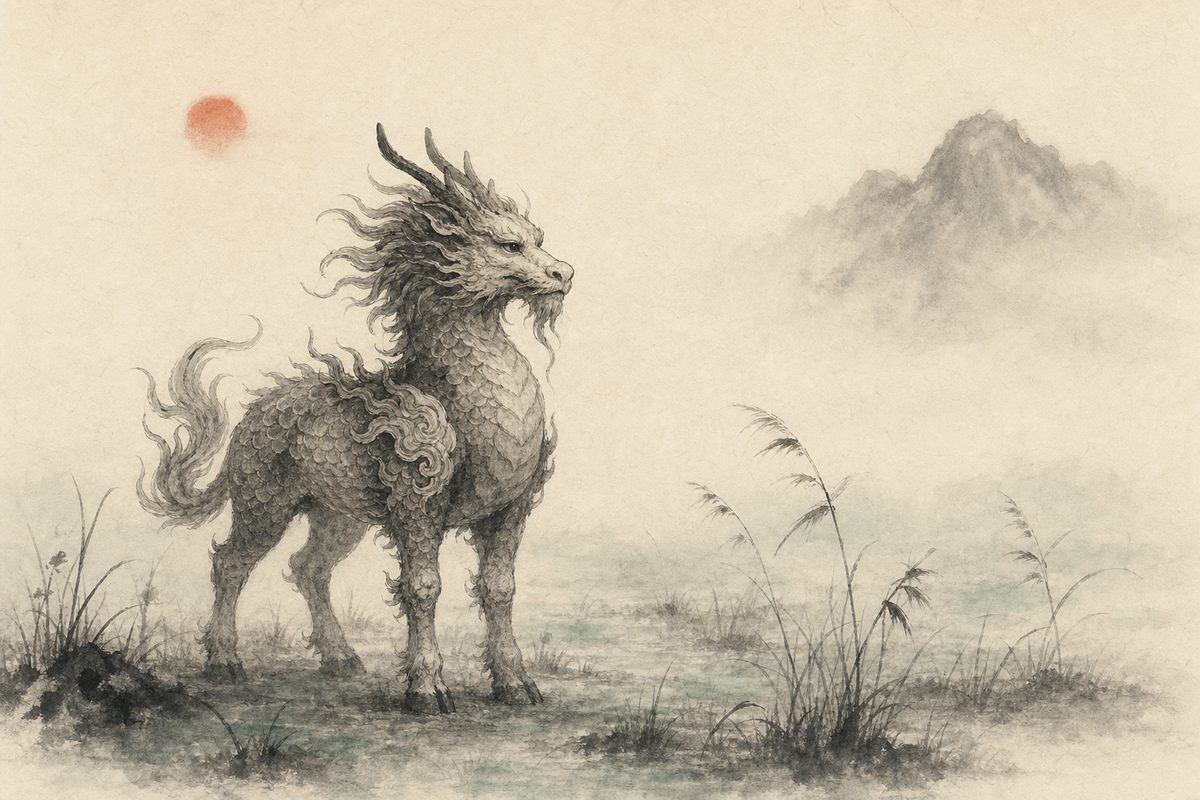
For all its gentleness, the qilin carries a heavy symbolic load, because it does not appear for just anyone. It comes for sages. The most famous qilin in Chinese history belongs to Confucius, and it bookends his life. Legend says that before he was born a qilin appeared to his pregnant mother and left a jade tablet foretelling the birth of a "throneless king," a ruler in wisdom if not in office. At the other end, the creature returns, tragically. In 481 BCE a qilin was caught and killed by hunters in the west, and when Confucius, by then an old man, went to look at the body, he read it as a sign that his time was over. The Spring and Autumn Annals, the terse chronicle traditionally credited to him, break off at that exact moment. In the Gongyang commentary the line is almost unbearable: at the capture of the qilin in the west, Confucius said, my way has come to an end. The gentlest creature in the world, killed out of season by men who did not know what they had, stood for the sage himself, arrived in an age with no use for him.
The qilin's feet
The other great qilin text is far older and far happier. In the Book of Songs, the anthology of early poems that sits at the head of the whole Chinese literary tradition, there is a short, three-versed piece called "The Qilin's Feet." It praises the fine sons of a noble house by comparing them, part by part, to the auspicious beast: the qilin's hooves, the qilin's brow, the qilin's horn, and after each, a sigh of admiration for young men as good as the omen itself. It is the seed from which the whole qilin-brings-sons tradition grew. Three thousand years later the wish it carries has not changed at all: may your children be qilin.
Set the qilin beside the dragon and you see two halves of the same imagination. The dragon is power, weather, the emperor, the storm you pray to. The qilin is the opposite impulse: gentleness rewarded, virtue announced, the quiet conviction that when the world is about to get better, something kind and strange will walk out of the mist to tell you so. It may be the most hopeful animal any culture ever invented. And the fact that a startled giraffe could once stand in for it, and be welcomed home with poems, tells you exactly how badly people wanted it to be real.
In the classics
The original passages behind the story, in the standard published translations.
麟之趾,振振公子,于嗟麟兮。麟之定,振振公姓,于嗟麟兮。麟之角,振振公族,于嗟麟兮。
“The qilin's hooves: the fine, upstanding sons of the duke. Ah, the qilin! The qilin's brow: the fine, upstanding kin of the duke. Ah, the qilin! The qilin's horn: the fine, upstanding clan of the duke. Ah, the qilin! ”
十有四年春,西狩獲麟。……西狩獲麟,孔子曰:吾道窮矣。
“In the fourteenth year, in spring, hunters in the west caught a qilin. … At the capture of the qilin in the west, Confucius said: "My way has come to an end." ”
As seen in
Monster Hunter
game · 2004The Kirin, a slender, lightning-wreathed white beast, is one of the series' most iconic hunts, drawn straight from the qilin — as Kirin.
Naruto: Shippuden
anime · 2007Kirin, a dragon of lightning called down from a storm, is one of the story's most powerful techniques — as Kirin.
Questions people ask
What is a qilin?
The qilin is a benevolent mythical creature of Chinese folklore, often called the "Chinese unicorn." It is a gentle composite beast with a deer's body, an ox's tail, scales, and a soft horn, and it belongs to the four great auspicious animals alongside the dragon, the phoenix, and the tortoise. Its role is to appear when a sage is born or a golden age is dawning, which makes it a walking good omen rather than a monster to fear.
Is the qilin real, or is it a giraffe?
The qilin is mythical, but a real animal is tangled up in its story. In 1414 the fleet of the admiral Zheng He brought a giraffe back to the Ming court, and the emperor's officials hailed it as a living qilin. The identification stuck so firmly that the word for qilin, read as kirin in Japanese and girin in Korean, is still the ordinary word for a giraffe in those languages.
What does the qilin symbolize?
Benevolence and good fortune above all: virtue rewarded, wise rule, prosperity, and the promise of gifted children. The qilin punishes the wicked, spares the good, and steps so carefully it harms no living thing. Because it appears only in the presence of greatness, its image is used to wish someone success, a peaceful reign, or a remarkable child.
What is the difference between a qilin and a dragon?
Both are auspicious, but they stand for opposite impulses. The dragon is power, rain, storms, and the emperor; you pray to it. The qilin is gentleness, virtue, and good omen; you rejoice to see it. In the old scheme each rules a kind of animal, the dragon the scaled and the qilin the furred and hoofed, and the qilin is by far the milder of the two.
Does the qilin bring children?
In folk tradition, yes. A much-loved motif called qilin songzi, "the qilin brings a son," shows the creature carrying a small child, usually a boy destined for greatness, and it has decorated wedding gifts, papercuts, and New Year prints for centuries. The custom traces back to an ancient poem that praised a noble's fine sons by comparing them to the qilin.
Sources & further reading
- The Book of Songs (詩經), 'The Qilin's Feet' (Chinese Wikisource)
- The Spring and Autumn Annals, Gongyang Commentary, Duke Ai (春秋公羊傳/哀公, Chinese Wikisource)
- Qilin (Wikipedia)
- Britannica: qilin
- Qilin (Chinese Unicorn) — World History Encyclopedia
- 'The Peculiar Story of Giraffes in 1400s China' (Smithsonian Magazine)
- Kirin Company — named for the qilin (Wikipedia)
By Julian 祝君瑜 · retold from the classics, with the original passages cited · updated 2026-07-16