Sun Wukong (孙悟空): The Monkey King of Chinese Myth
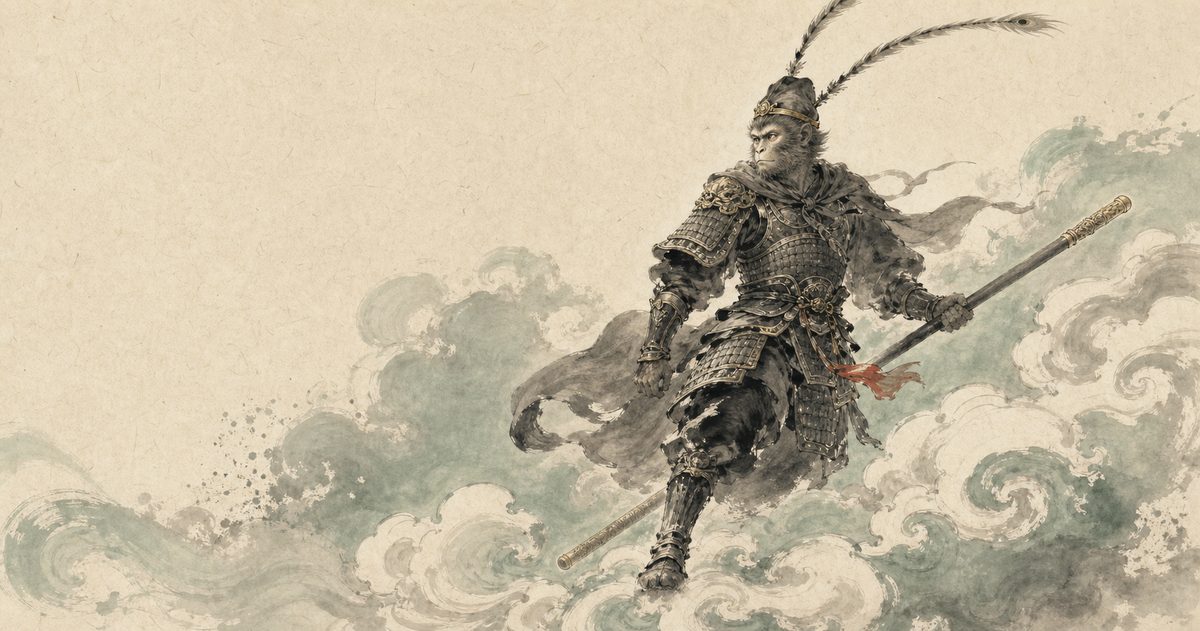
Sun Wukong, 孙悟空 (Sūn Wùkōng), the Monkey King, is the breakout hero of the sixteenth-century novel Journey to the West and the most retold character in Chinese fiction. Born from a stone, armed with a shape-shifting staff taken from the Dragon King, he rebels against Heaven itself, is tamed on a pilgrimage to India, and ends as a Buddha. Rebel, trickster, and unlikely saint, he is now a global game and anime star.
Were you born in a Year of the Monkey?
Enter your birth date to find out your sign and which of the five elements it falls under. We handle the Chinese New Year cutoff, so a birthday in January or early February lands on the right side.
Chinese fortune-telling reads a lot into a birthday. For a playful old birth-chart custom, try our Chinese gender predictor.
Every culture keeps one character it cannot stop retelling, and China's is a monkey. Sun Wukong, the Monkey King, is a stone-born ape with a magic staff, a talent for turning himself into seventy-two different things, and a temper that once got him into a fistfight with the entire staff of Heaven. He is the breakout star of Journey to the West, the sixteenth-century novel that is to Chinese storytelling roughly what the Odyssey and the King James Bible together are to the West: the source everyone quotes without quite realizing it. He has been a rebel, a demon, a bodyguard, a saint, a cartoon, a communist allegory, and, in 2024, the hero of a video game that outsold nearly everything on Earth. Not bad for a monkey who started life as a rock.
The monkey conquers the world (again)
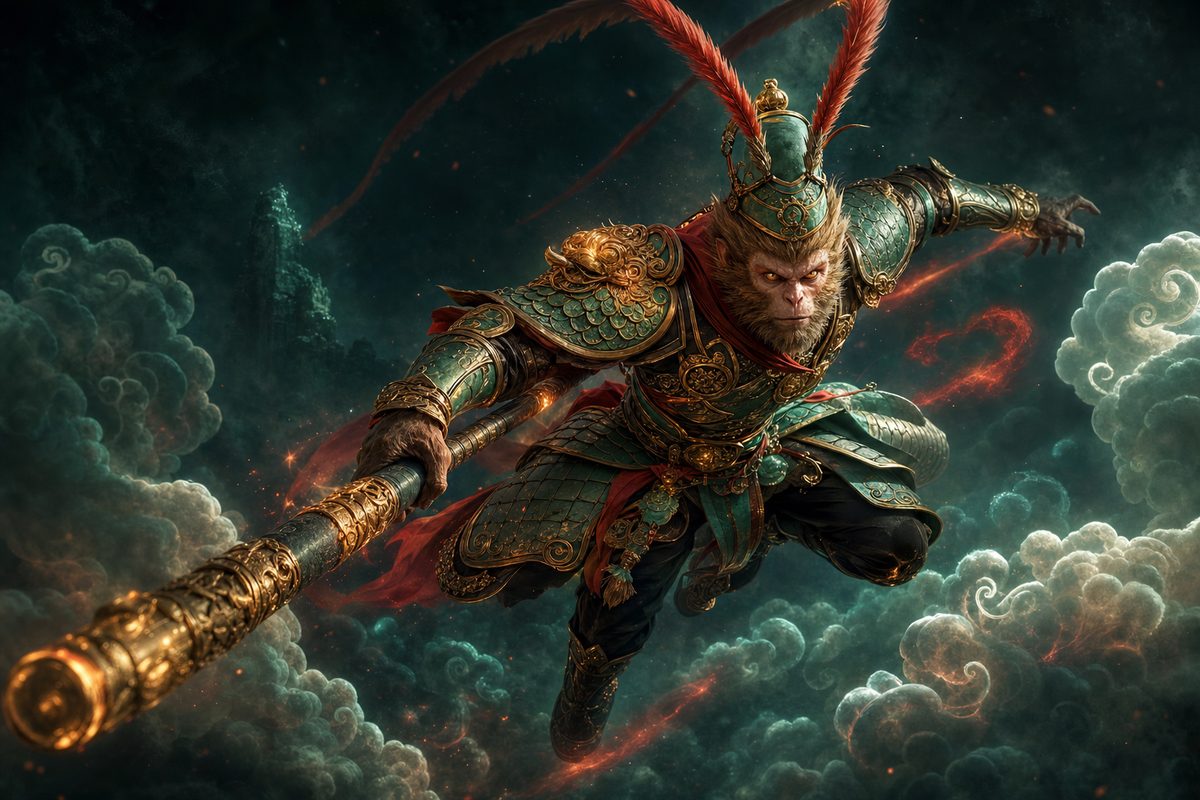
In August 2024 a Chinese studio called Game Science released Black Myth: Wukong, the country's first genuine big-budget blockbuster video game, and the planet lost its mind. It sold twenty million copies in its first month, a pace that puts it among the fastest-selling games ever made, and in December it took Best Action Game at The Game Awards. For a hero drawn straight from a Ming-dynasty novel, this was a spectacular second act. It was also a piece of soft power China noticed: state media treated the game's success as a cultural export, proof that the Monkey King could still carry Chinese myth to an audience that had never opened the book. Which, if you think about it, is exactly the sort of impudent global conquest Wukong would approve of.
The monkey behind Goku
Long before the game, the Monkey King had already colonized global pop culture, usually without a passport. The clearest case is Dragon Ball. Its creator, Akira Toriyama, built his hero Son Goku directly on Sun Wukong: the name is simply the Japanese reading of the same three characters, the boy has a monkey tail, he flies on a cloud, he fights with an extending staff, and in the early series he even turns, on a full moon, into a giant ape. From there the resemblances ripple outward across anime and games until a startling share of the world's action heroes are, at some remove, this one monkey. He shows up as a river of other things too: the beloved 1961 Shanghai animation Havoc in Heaven, a wildly popular 1986 Chinese television series that reruns to this day, Stephen Chow comedies, operas, picture books, and superhero cartoons. Journey to the West is often called the most adapted story in China, and Wukong is the reason.
| Sun Wukong (孙悟空) | Son Goku | |
|---|---|---|
| The name | The original | The Japanese reading of the same three characters |
| The tail | A monkey's | A monkey's |
| The ride | Somersaults across the sky on a cloud | Flies on a cloud |
| The weapon | The extending staff taken from the Dragon King | An extending staff |
| The ape in him | Seventy-two transformations at will | A giant ape, on a full moon, in the early series |
China's favorite rebel
Why does he stick? Partly because he is gloriously, unrepentantly naughty. The Monkey King is a trickster, the folk hero who mouths off to power, cheats death, and punches gods, and every culture runs short of those. But he is also useful, and China has used him. In the twentieth century he was read as a revolutionary, a have-nothing who storms the palaces of the mighty and wins, an image that Mao-era culture found irresistible, as the magazine Sixth Tone has traced in its survey of the many faces of Sun Wukong. He has been the peasant rebel, the free spirit, the loyal servant, and the Buddhist seeker, depending on who was doing the telling. A figure that elastic does not date. It simply gets recast. All of which raises the obvious question: where did this monkey actually come from? To answer it we have to climb down from the games and the cartoons and go back to a rock.
Born from a stone
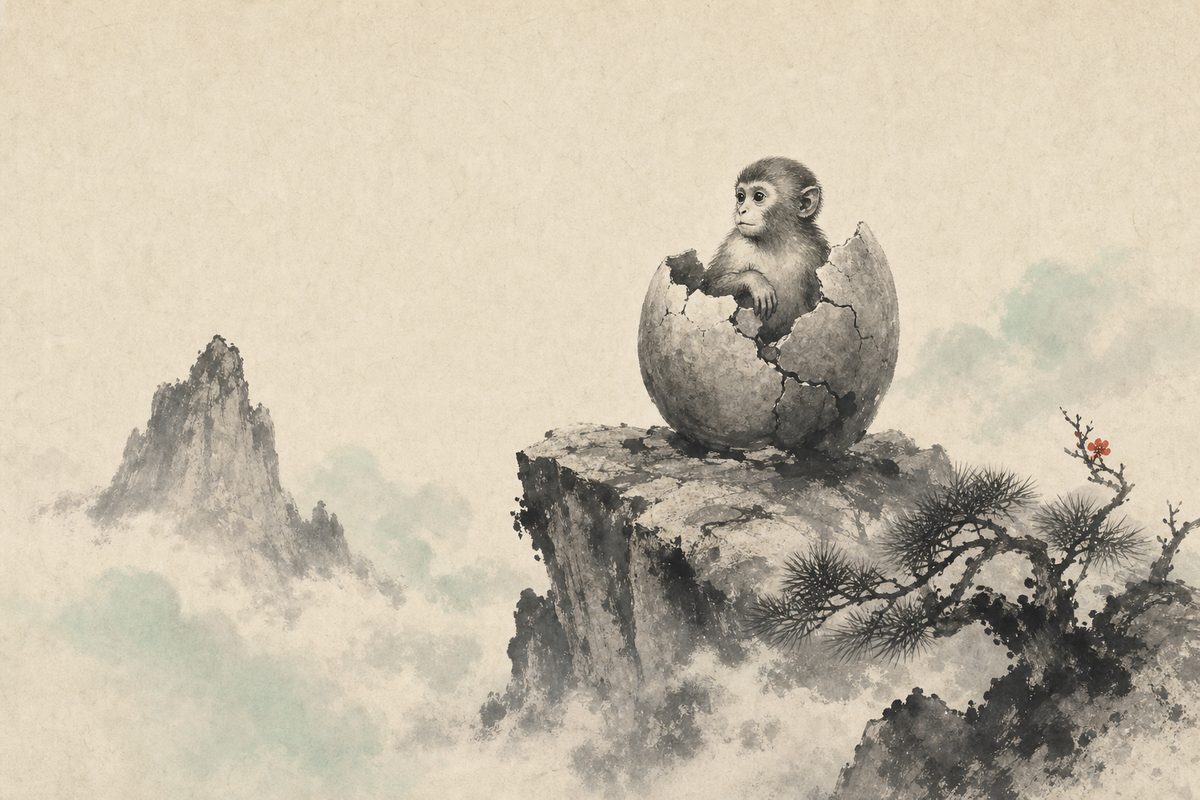
On a peak called Flower-Fruit Mountain, the novel says, there sat an ancient stone that had been soaking up the light of the sun and moon since the beginning of the world, until one day it split and produced a stone egg, and the egg produced a stone monkey. This is our hero: no parents, no lineage, a creature of pure rock and appetite who quickly makes himself king of the local monkeys and then, dissatisfied with mere kingship, sets off to learn how not to die. He finds a Daoist patriarch in the mountains who teaches him the good stuff, immortality, cloud-somersaulting, and the seventy-two transformations, and who gives him his name. The scene is one of the loveliest in the book. The master, punning on the characters for a monkey, settles on the surname Sun, then adds a religious name, Wukong. A closing couplet turns the joke into a creed: in the sense of Anthony C. Yu's standard translation, when primal chaos was first split open there were no surnames, and to break through stubborn emptiness one must awaken to emptiness. That is what the name means. 悟 (wù) is to awaken or comprehend; 空 (kōng) is emptiness, the great Buddhist void. Sun Wukong is, from birth, the monkey awakened to emptiness: a punchline and a spiritual program folded into one. A Chinese name is often a tiny poem like this, sound and sense at once. You can see the name rendered in brush calligraphy, or build a Chinese name of your own the same way, from the sound of your name and a meaning you like.
The staff and the Dragon King
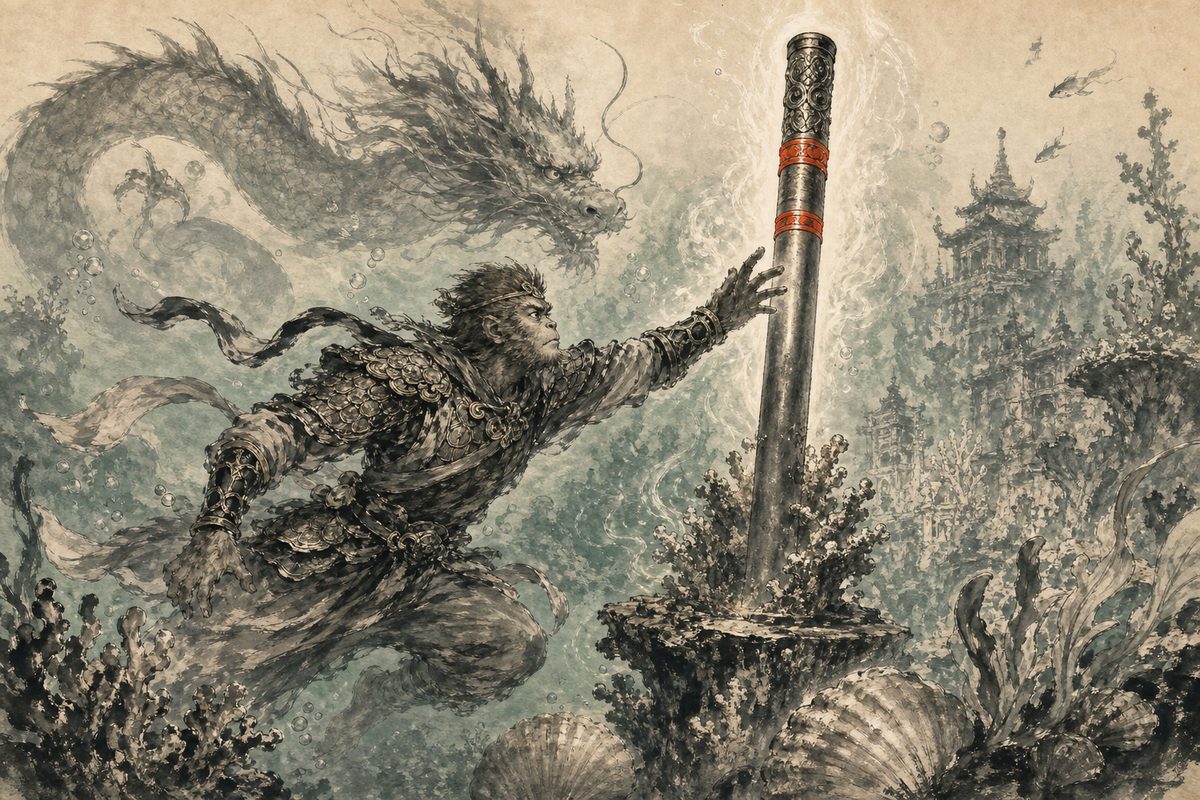
A hero needs a weapon, and Wukong finds his by barging into the sea. He marches down to the undersea palace of the Dragon King of the East Sea, one of the rain-bringing dragon lords who rule the four seas of Chinese myth, and helps himself to the treasury. What he takes is a black iron pillar that had once been used, the story says, to fix the depth of the Milky Way, inscribed with its own name and weight: the As-You-Will Gold-Banded Cudgel, thirteen thousand five hundred catties of it, close to eight tons. Its trick is that it obeys him. It grows to prop up the sky or shrinks, at a word, to the size of a needle he tucks behind his ear. The Dragon King is furious and files a complaint with Heaven, which is how a monkey's shopping trip becomes an interstate incident. (That undersea kingdom and the rain-gods who run it have a page of their own: the Chinese dragon is the other half of this story.)
Havoc in Heaven
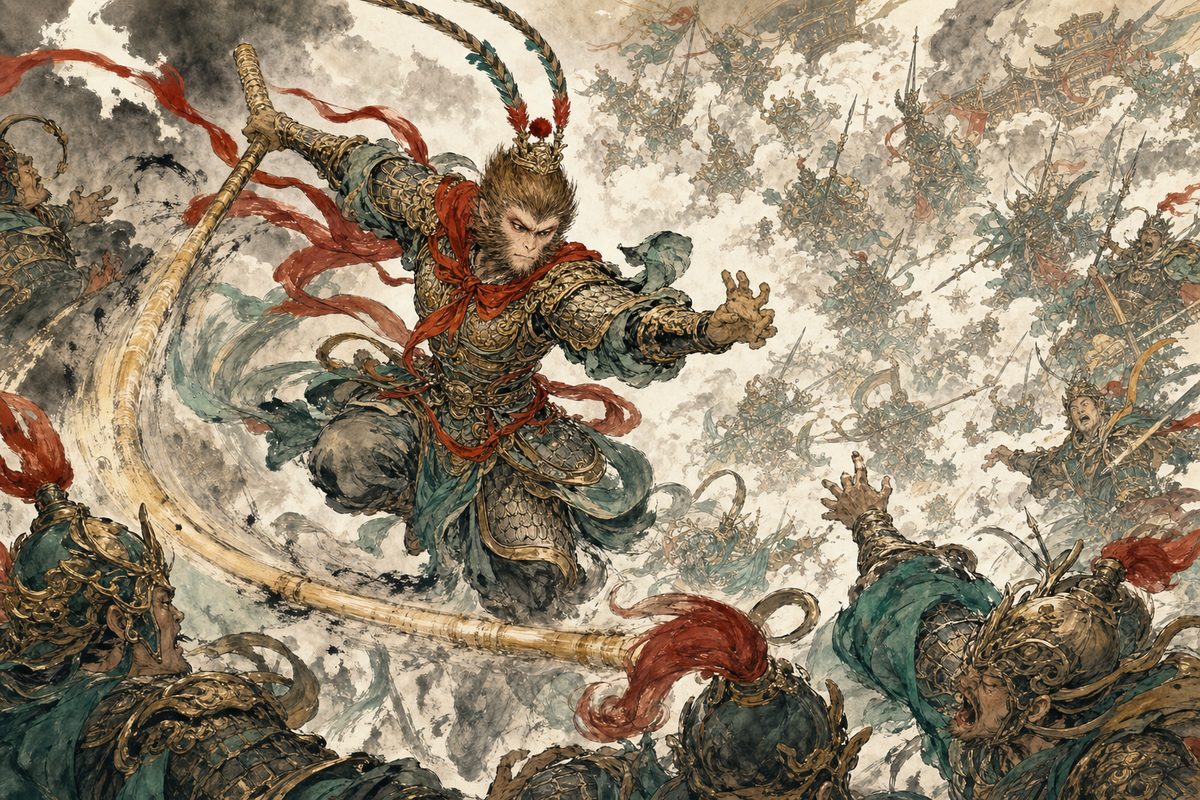
The complaint does not go well for Heaven. Summoned to the celestial court of the Jade Emperor and fobbed off with a menial job minding the imperial stables, Wukong discovers the post is a humiliation, wrecks the place, and declares himself Qitian Dasheng, the Great Sage Equal to Heaven, which is roughly the celestial equivalent of promoting yourself to God on a business card. What follows is the most beloved sequence in the novel, the one the 1961 animators named Havoc in Heaven: Wukong gate-crashes the Queen Mother's banquet, eats her peaches of immortality, drinks the elixir of the highest Daoist god for good measure, and then thrashes the assembled armies of Heaven, all hundred thousand of them, along with the constellations and the heavenly kings. Nobody can hold him. He is, as fans of these things like to point out, quite possibly the strongest troublemaker in the entire Chinese canon.
The palm, the crown, and growing up
It takes the Buddha to stop him, and he does it with a bet. Wukong, certain nothing can contain him, wagers that he can somersault clean out of the Buddha's palm. He leaps a hundred and eight thousand li, reaches what he takes to be the edge of the universe, five great pillars, signs his name on one, and returns to collect his winnings, only to learn that the pillars were the Buddha's fingers and he never left the hand. For his cheek he is pinned under a mountain for five hundred years. And then the story turns from rampage to redemption. The bodhisattva Guanyin springs him on one condition: he must escort a gentle monk, Tripitaka, modeled on the real seventh-century pilgrim Xuanzang, west to India to fetch the Buddhist scriptures. To keep the monkey in line, Tripitaka is given a golden headband that clamps around Wukong's skull and tightens, agonizingly, whenever he misbehaves and the monk recites a spell. With two more converted monsters, the greedy pig Zhu Bajie and the steady Sha Wujing, they cross eighty-one calamities and arrive. For his service Wukong is promoted one last time, to a Buddha in his own right, the Victorious Fighting Buddha. The rock has become a saint.
How far is one somersault?
Wukong's cloud-somersault crosses 108,000 li in a single leap, about 54,000 kilometers. Pick a trip and see how many it would take.
The mind that storms heaven
Read one way, this is a rollicking adventure. Read another, which the novel keeps nudging you toward, it is a map of a mind learning to sit still. Wukong is repeatedly called the "mind-monkey," xīnyuán, an old Buddhist and Daoist image for human attention: restless, brilliant, leaping everywhere, impossible to pin down. The whole journey is that monkey being tamed, the tightening headband standing in for discipline, the eighty-one trials for the long grind of practice. It is a very Chinese idea, that enlightenment is not a lightning bolt but a road trip with difficult colleagues. And it is a large part of why the character survives every retelling. Everyone recognizes the mind-monkey, because everyone owns one.
Where did the Monkey King come from?
One mystery the novel cannot settle is Wukong's own pedigree, and scholars have argued about it for a century. The book is traditionally credited to a sixteenth-century writer named Wu Cheng'en, though even that attribution is shakier than the school textbooks admit. As for the monkey himself, two camps formed in the 1920s and never fully made peace. The writer Lu Xun, in his history of Chinese fiction, argued that Wukong was homegrown, descended from Wuzhiqi, a monstrous water-demon monkey chained beneath a mountain in Tang-dynasty tales. The scholar Hu Shih disagreed. In 1923 he proposed that the monkey was an import, and that behind him stood Hanuman, the divine monkey of the Indian Ramayana. It is a seductive idea with one large problem: as critics have pointed out, the Ramayana was not translated into Chinese until the twentieth century, long after Wukong was already famous, so the route by which Hanuman could have reached a Ming novelist is far from clear. Anthony C. Yu, the novel's great modern translator, notes that Wuzhiqi has served many scholars as Wukong's prototype. The honest answer the evidence supports is closer to a shrug: probably mostly native, possibly touched by Indian tales carried along the Buddhist road, certainly older and stranger than the tidy single origin either camp wanted. We do not entirely know where the Monkey King came from, which, for a creature born from a parentless rock, is oddly fitting.
So the next time the Monkey King turns up, in a game, a cartoon, a New Year opera, or a small tail on a Japanese superhero, know that you are meeting one of the oldest and most durable characters on the planet: a stone that woke up, learned every trick there is, punched Heaven, and then spent eternity learning to be good. He is China's favorite rebel and its unlikeliest saint, and he has been running rings around the gods, and around the rest of us, for four hundred years and counting.
In the classics
The original passages behind the story, in the standard published translations.
鴻濛初闢原無姓,打破頑空須悟空。
“When primal chaos was first split open there were no surnames; to break through stubborn emptiness, one must awaken to emptiness (wùkōng). ”
如意金箍棒,重一萬三千五百斤。
“The As-You-Will Gold-Banded Cudgel, weight thirteen thousand five hundred catties. ”
As seen in
Black Myth: Wukong
game · 2024A blockbuster action retelling in which the player, a successor to Wukong, walks straight into Journey to the West; it carried Chinese myth to a global audience — as The Destined One.
Sold twenty million copies in its first month and won Best Action Game at The Game Awards 2024; China's first AAA blockbuster.
Dragon Ball
anime · 1984Son Goku is built directly on Sun Wukong: a tailed, cloud-flying, staff-wielding boy who, on a full moon, turns into a giant ape — as Son Goku.
Havoc in Heaven (大闹天宫)
donghua · 1961The landmark Shanghai animated film of Wukong's rebellion against the celestial court, a touchstone of Chinese animation.
Questions people ask
Who is Sun Wukong, the Monkey King?
Sun Wukong is the hero of the sixteenth-century Chinese novel Journey to the West: a monkey born from a stone who masters immortality and magic, rebels against Heaven, is tamed by the Buddha, and then escorts a monk to India to fetch Buddhist scriptures, earning enlightenment along the way. He is the most beloved and most retold figure in Chinese fiction.
Is Sun Wukong a god or a Buddha?
Both, in the end, though he starts as neither. He is born a stone monkey and wins his powers through Daoist training, becoming a demon-immortal strong enough to fight the gods. After his long pilgrimage he is formally elevated to a Buddha, the Victorious Fighting Buddha (斗战胜佛). His whole story is a climb from rock to saint.
Is the Monkey King good or evil?
Complex, and that is the point. In the early chapters he is a proud, violent troublemaker who steals, cheats death, and lays waste to Heaven. By the end of the journey he has become loyal, wise, and enlightened. The arc from rebel to saint is exactly what the novel is about, which is why he cannot be filed as simply hero or villain.
What is Sun Wukong's staff?
The Ruyi Jingu Bang (如意金箍棒), the As-You-Will Gold-Banded Cudgel. Wukong takes it from the undersea treasury of the Dragon King of the East Sea; the novel gives its weight as thirteen thousand five hundred catties, close to eight tons. It obeys his will, growing to hold up the sky or shrinking to a needle he keeps behind his ear.
Is Sun Wukong based on Hanuman?
It is debated. In 1923 the scholar Hu Shih argued that Wukong was an Indian import influenced by Hanuman, the monkey god of the Ramayana, while Lu Xun held that he was homegrown, descended from Wuzhiqi, a water-demon monkey of Tang-dynasty tales. A problem for the Hanuman theory is that the Ramayana was not translated into Chinese until the twentieth century. Most likely he is mostly native, perhaps brushed by Indian stories carried along the Buddhist road.
How strong is Sun Wukong, and what are his powers?
Formidably strong. He masters the 72 Transformations, shape-shifting into animals, objects, or people; he rides a cloud-somersault that crosses 108,000 li in a single leap; each of his hairs can become a copy of himself or a weapon; and after being cooked in Laozi's furnace he comes out with fiery golden eyes that see through any disguise. Armed with his shape-changing staff, he single-handedly fights the assembled armies of Heaven, which is why he is often called the strongest troublemaker in the Chinese canon.
Sources & further reading
- Journey to the West (西遊記), full text, Chapter 1 (Chinese Wikisource)
- Journey to the West (西遊記), full text, Chapter 3 (Chinese Wikisource)
- Anthony C. Yu, 'The Journey to the West', Revised Edition Vol. 1 (University of Chicago Press) — the standard scholarly English translation
- Britannica: Sun Wukong
- Sun Wukong (Wikipedia)
- 'The real history behind the legend of Sun Wukong' (National Geographic)
- Journey to the West Research (Jim McClanahan) — a scholarly resource on the novel and the Monkey King
- 'The Many Faces of Sun Wukong' (Sixth Tone)
- Black Myth: Wukong — sales and reception (Wikipedia)
- Akira Toriyama based Dragon Ball on Journey to the West (Collider)
By Julian 祝君瑜 · retold from the classics, with the original passages cited · updated 2026-07-16