Tiger and Rabbit Compatibility: One Forest, Two Natures
No formal bond, and both carry the fixed element Wood — kinship without guarantees.
Tiger and Rabbit sit side by side at seats three and four, and the branch system draws no formal line between them: no trine, no secret friend, no clash, no harm. What they share is quieter and stranger, the same fixed element, because these neighbors are the wheel's only two Wood signs, spring's entire delegation seated together. Tradition reads elemental kinship as sympathy without guarantees and grades the match good, and the honest gloss writes itself: one forest raised two answers to danger, the charge and the diplomacy, and then housed them next door to each other to see which one the household would run on.


How the wheel reads this pair
Chinese zodiac verdicts are positions, not vibes. The Tiger holds position 3 on the twelve-branch wheel (branch yín) and the Rabbit position 4 (branch mǎo); their verdict follows from that geometry alone.
- Verdict
- Good match
- Bond
- No formal bond
- Branches
- yín 寅 + mǎo 卯
- Fixed elements
- Wood + Wood
The Tiger and the Rabbit, side by side
Love and romance
The attraction is asymmetric and real on both sides. The Rabbit, curator of safe rooms, has spent its life arranging security molecule by molecule, and the Tiger is security in bulk, a presence that makes rooms safe by entering them; walking beside a Tiger is the first time many Rabbits experience the forest at peace. The Tiger, whose company mostly either challenges it or manages it, meets in the Rabbit a third thing, a host, someone who neither contests the crown nor flatters it but simply arranges the evening so well that the Tiger's shoulders drop an inch it did not know they carried.
The friction is climate. The Tiger's native register, frontal, loud, gloriously unedited, is the exact weather the Rabbit builds its walls against, and the Rabbit's native register, indirection, atmosphere, the truth adjusted two degrees for the room, brushes the one nerve a Tiger cannot ignore, its contempt for the flank. The unfairness is that neither is doing the thing the other fears. The Tiger's volume is not attack, it is metabolism; the Rabbit's diplomacy is not scheming, it is weatherproofing. The couples that last are the ones that learn to read the accent instead of the dictionary.
Trust
Neither sign lies to the other in any way a court would recognize, but their honesty systems are incompatible out of the box. The Tiger's code is total disclosure at the moment of feeling; the Rabbit's is curation, the destabilizing thing softened, delayed, or absorbed entirely, because its instinct treats raw truth like raw weather, something you shelter people from. So the Tiger, who cannot detect atmospheres, lives beside a partner whose accumulating discontent is invisible until it is structural, and the Rabbit lives beside a partner whose passing storms sound, every single time, like the end of the world. Each files the other's normal as a warning sign.
The treaties are translation clauses. The Tiger's storms get ratings, said out loud, this is weather, this is real, because a Rabbit cannot calibrate a Tiger's volume from the volume alone and will otherwise armor against all of it. And the Rabbit surfaces one true discontent a week, in plain words, unhinted, chosen small on purpose, because the practice matters more than the payload: a Tiger will absorb any honest complaint and cannot forgive discovering, years late, a filed one.
Communication
Spring's two dialects, the shout and the salon, in daily contact.
| The Tiger | The Rabbit | |
|---|---|---|
| Danger | Charged, head-on | Managed around |
| A hard truth | Said to the face | Fed into the atmosphere |
| Anger | Loud, brief, forgotten | Quiet, absorbed, kept |
| Safety | Something you win | Something you arrange |
The anger row is the marriage's fault line. The Tiger's fury empties itself within the hour and leaves no residue, which the Tiger considers hygiene; the Rabbit's flinch outlasts the storm by weeks, filed in a ledger the Tiger does not know exists. Meanwhile the Rabbit's genuine grievances arrive so exquisitely cushioned that the Tiger, a reader of frontal statements only, never receives them at all. The working rules are two. Anything the Rabbit actually needs changed gets the frontal format, flat, plain, once, hard as that is against instinct. And the Tiger grants the softened truth diplomatic status instead of prosecuting it as evasion, because demanding the Rabbit speak only in charges is demanding the diplomat resign.
Marriage and family
Run well, the household is a fortress with an interior worth defending. The Rabbit builds the civilization, the rooms that work, the friendships tended, the family's social weather managed with a skill the Tiger will never see because its whole point is invisibility; the Tiger holds the perimeter, the crisis, the hard call, the courage budget for two. Children raised here get grace from one parent and nerve from the other, and the good houses let each teach without the other translating over them.
The clauses are architectural. The home runs on the Rabbit's climate, calm, arranged, low-decibel, because the Rabbit cannot thrive in weather and the Tiger can thrive anywhere; in exchange the Tiger gets one licensed arena, the project, the sport, the debate table where full volume is welcome and nobody armors. Guests split the same way, the Rabbit's salon evenings and the Tiger's loud ones scheduled apart, each attended by the other as a visitor rather than corrected as a native. It is a treaty between climates, and like all such treaties it works exactly as long as both sides keep paying the tariff.
Work and money
Professionally the pairing covers a firm's two hardest jobs. The Tiger takes the front, the crisis, the negotiation that has stopped being one; the Rabbit runs the alliances, the reading of rooms, the six-month cultivation of the partner nobody else could land. Shared Wood shows in what both protect, growth, the young talent, the long-lived thing over the quick kill, and a Tiger-Rabbit leadership pair, at its best, is a spear with a diplomatic corps.
The frictions are procedural. One blunt Tiger sentence can torch a network the Rabbit spent two quarters weaving, so the diplomatic tables get jurisdiction, rooms the Tiger simply does not enter, by design and without insult. In return, the Rabbit's warnings get the code word, because its native soft-pedaling means its gravest alarms sound like mild preferences, and the firm cannot afford a danger report the commander never registered as one. Credit flows easily here, unusually for the wheel, since the Tiger wants the victory and the Rabbit wants the room, and those are different trophies.
Where it breaks
The failure mode is management. The Rabbit, worn down by weather, stops translating and starts handling, the Tiger steered around rather than spoken to, told what keeps the peace rather than what is true, the marriage curated like a difficult guest. And handling is the one flank a Tiger can smell: it grows louder to reach something real, which deepens the handling, which loudens the reaching, a feedback loop of storm and lacquer in which both parties are behaving reasonably by their own codes and ruinously by the other's.
The endings are true to the natures. The Tiger leaves in one honest scene, stated to the face, finished within the hour like all its storms; the Rabbit has usually been leaving for years, one polite evening at a time, and is merely the last to say so aloud. None of it is fate. The kinship underneath is real, spring's two survivors, the same stake in living things, and the fixes are small and mostly linguistic: storms rated, one plain grievance a week, the frontal format for what matters, and a standing ban, in both directions, on mistaking the other's dialect for its character.
How to fix it
- 1
Rate the storms. The Tiger says out loud which thunder is weather and which is real, every time. A Rabbit cannot read volume from volume and will otherwise build walls against all of it.
- 2
One plain grievance a week. The Rabbit names one true discontent in flat words, chosen small on purpose. The practice keeps the ledger empty, and the ledger is what kills this pairing.
- 3
Give warnings the frontal format. Anything the Rabbit actually needs changed is said once, plainly, to the face. Cushioned alarms never reach a reader of frontal statements.
- 4
Never handle the Tiger. Steering it, curating it, managing it around the truth is the one flank it always smells. Ask it straight; it is the single request a Tiger never refuses.
Share this pairing
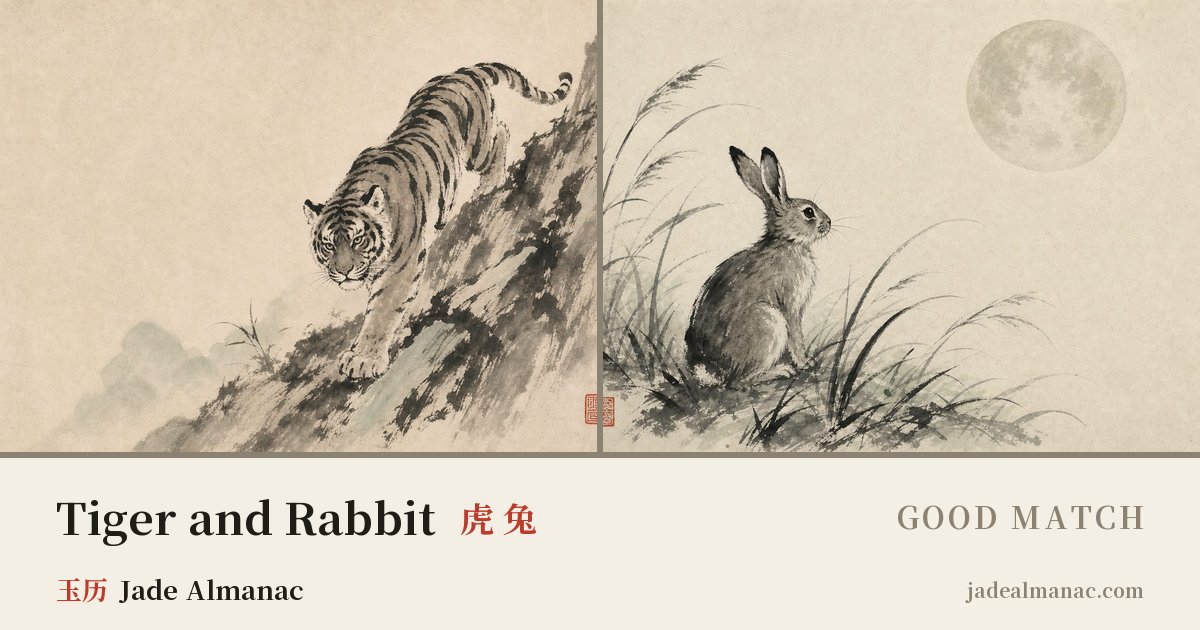
The card carries both portraits and the verdict.
Questions people ask
Are Tiger and Rabbit compatible in the Chinese zodiac?
A good match, honestly graded. The branch system draws no formal line between them, no trine, no secret friend, no clash, and both signs carry the fixed element Wood, the only two on the wheel that do. Tradition reads shared-element pairs as kinship without guarantees, real sympathy that still has to be engineered into a household.
Why is there no formal bond between Tiger and Rabbit?
Position, as always. The Tiger holds seat 3 on the wheel and the Rabbit seat 4. Adjacent seats form neither a trine nor an opposition, and this pair appears in none of the six harmony or six harm listings, so the relationship is read through fixed elements instead, where these neighbors happen to share Wood.
What problems do Tiger and Rabbit couples have?
Climate, mostly. One is loud, frontal, and finished within the hour; the other is quiet, indirect, and keeps what it absorbs, so storms get over-read and cushioned grievances never land. The standard fixes are storms rated out loud, one plain-worded grievance a week, the frontal format for anything that must change, and no handling.
Year of the Tiger 虎
Personality, years, matches, and where the sign comes from.
Year of the Rabbit 兔
Personality, years, matches, and where the sign comes from.
← All 66 zodiac pairings, with verdicts
Signs turn over at Chinese New Year, not January 1 — a January or February birthday can belong to the previous animal. Check a birthday on the lunar calendar →
Sources & further reading
By Julian 祝君瑜 · verdict derived from the twelve-branch system, not assigned by hand · updated 2026-07-17