Tiger and Dragon Compatibility: Two Crowns, One Kingdom
No formal bond, and their fixed elements rub: Wood controls Earth in the five-element cycle.
The language itself pairs these two: wo hu cang long, crouching tiger, hidden dragon, the old idiom for formidable talent kept out of sight. The joke of the actual pairing is that neither sign keeps anything out of sight. Tiger and Dragon sit two seats apart on the wheel, and the branch system draws no formal line between them, no trine, no secret friend, no clash, no harm, so the verdict falls to the five-element layer, where it picks up an edge: the Tiger's fixed element is Wood, the Dragon's is Earth, and Wood controls Earth in the controlling cycle. Tradition reads that as workable with friction, and the domestic translation is exact. Two crowns, one kingdom.
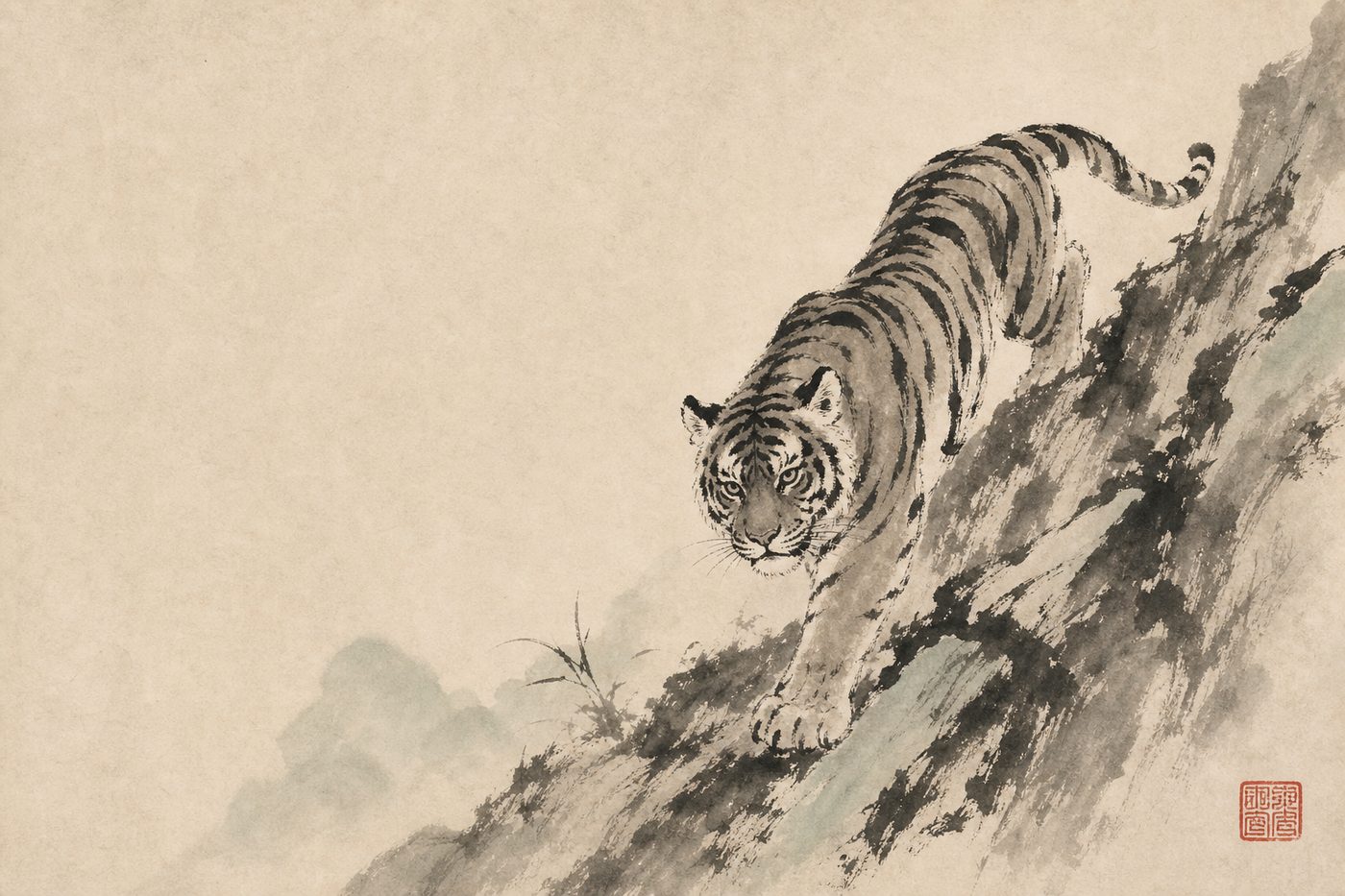
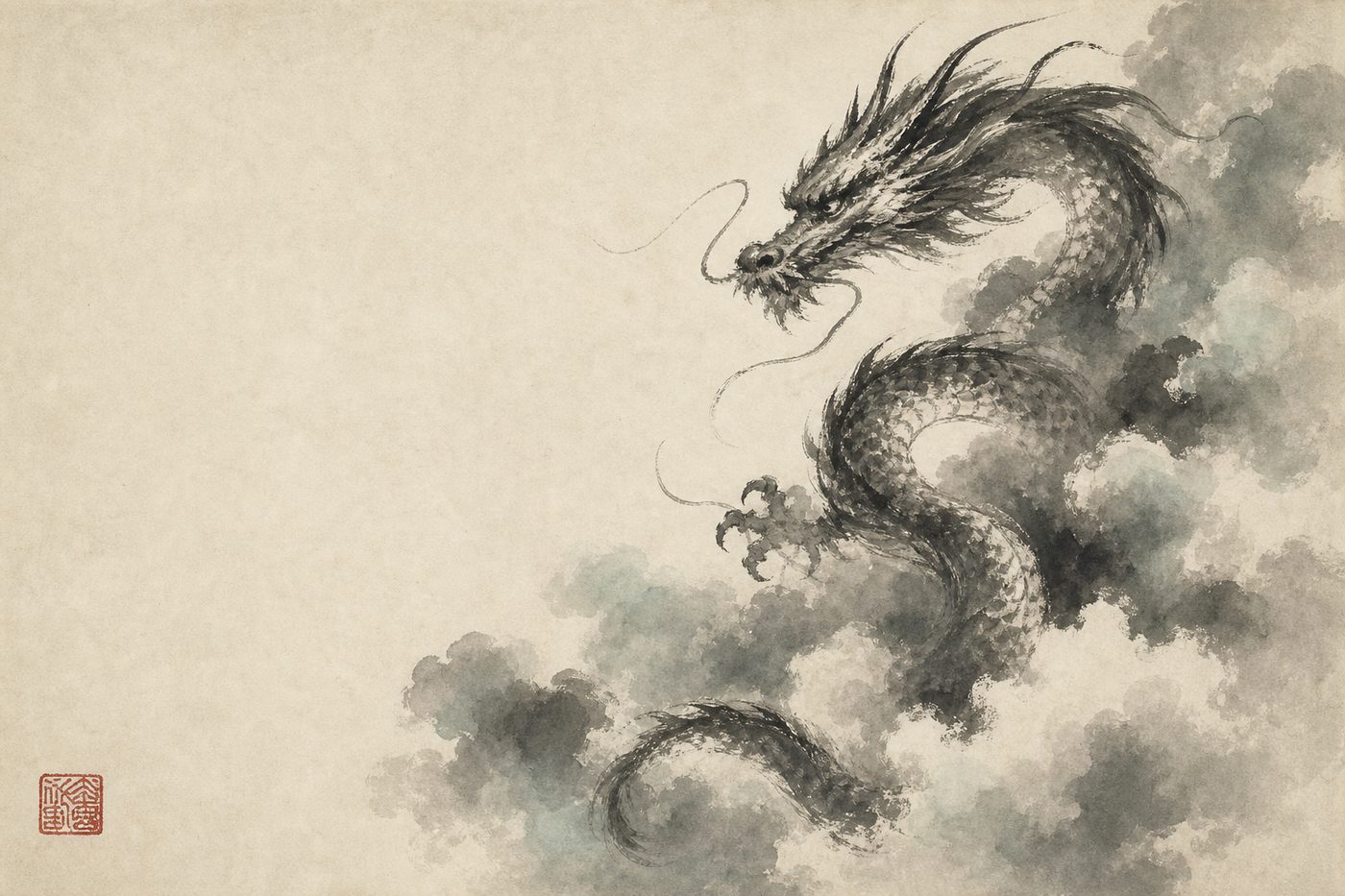
How the wheel reads this pair
Chinese zodiac verdicts are positions, not vibes. The Tiger holds position 3 on the twelve-branch wheel (branch yín) and the Dragon position 5 (branch chén); their verdict follows from that geometry alone.
- Verdict
- Takes work
- Bond
- No formal bond
- Branches
- yín 寅 + chén 辰
- Fixed elements
- Wood + Earth
The Tiger and the Dragon, side by side
Love and romance
The attraction is recognition of magnitude. Each spends its life being the largest presence in the room, and each walks into this one and finds the assumption already taken. The Dragon collects remarkable people the way empires collect provinces, and the Tiger is the one remarkable thing that cannot be collected; the Tiger respects exactly what does not back down, and the Dragon is the one creature that never has. The early season is famous among their friends, two enormous weathers merging, plans at a scale neither bothers to apologize for, and a mutual, half-delighted wariness that everyone else mistakes for chemistry, which it also is.
The friction is precedence. Both signs lead by reflex, neither has ever filed a report, and a household has only so many thrones. Wood controls Earth: the Tiger's push finds the Dragon's ground and digs, the challenge that will not defer meeting the authority that cannot be challenged, and the same force that can till an empire into better yield can also gut it, which is why the old tables grade this workable rather than easy and mean both halves.
Trust
On honesty grounds the pairing is immaculate. Both codes are frontal, both lives are public, nothing here is filed, hinted, or discovered years later in a drawer; suspicion starves for lack of material. The war is jurisdiction and glory. The Tiger's code is personal, the deed done by its own paw and valued precisely because no one commanded it; the Dragon's code is imperial, deeds absorbed into the legend of the whole, credited generously but credited as empire. So the Tiger watches its charge become a chapter in the Dragon's story and experiences theft of the only currency it banks, while the Dragon watches the Tiger act without consulting the throne and experiences secession.
The treaties are two, and they are cheap against the alternative. Credit stays personal: the deed is named with the paw that did it, in company, every time, because a Tiger will forgive a lost battle before a borrowed one. And loyalty is sworn to campaigns, not to the crown: the Dragon stops asking for fealty, which the Tiger constitutionally cannot pay, and gets in exchange the wheel's most formidable ally, enlisted afresh for each thing worth doing.
Communication
Two sovereigns, two theories of command, and no natural listener in the house.
| The Tiger | The Dragon | |
|---|---|---|
| Leads by | Charge, from the front | Decree, from the throne |
| A disagreement | Settled face to face | Argued before an audience |
| Praise | Rare, and meant entirely | Distributed, as patronage |
| Backing down | Never at all | Never in public |
The last two rows are the fire hazard. The Dragon's praise, generous but imperial, lands on the Tiger as patronage, and the Tiger does not accept patronage; the Tiger's bluntness, honest but unceremonial, lands on the Dragon as lese-majesty in front of the court. Both escalate magnificently and neither backs down, so the working couples legislate the venue instead of the volume: real disputes move to a closed room, no witnesses, no court to perform for and no face to lose, where two frontal creatures discover they agree faster than any two other signs on the wheel, because at least nothing here needs decoding.
Marriage and family
Run well, the household is an eventful state. The Dragon governs the visible realm, the ambitions, the guests, the family's public weather; the Tiger governs the frontier, the crisis, the hill that must be taken this week, and both do their governing at full commitment. Children raised here inherit nerve from two directions and a dinner table where courage is the house currency. What the house lacks by temperament is a small-prints department, since neither sovereign maintains, audits, or files, and the fix is hired or automated, never assigned, because assigning it to either is a demotion neither will absorb.
The load-bearing clause is the border. Most wars between these two are border disputes with no border drawn, two rulers discovering mid-argument that each assumed the province was theirs. Draw the kingdoms early, each sovereign absolute somewhere real, joint matters negotiated as between equals, because the wheel supplies no seniority here and every attempt to establish one by force is the failure mode itself, rehearsed. Add the outward campaign, always one project aimed at the world with both names on it, and the dueling energy has somewhere better to go.
Work and money
Professionally, pointed at a rival instead of each other, the pairing is a conquest engine. The Dragon supplies scale, magnetism, and the credibility of the visible empire; the Tiger supplies the strike, the crisis command, the territory actually taken while committees deliberate. Wood controls Earth reads differently at the office: the Tiger's push tills the Dragon's estate, pressure that keeps an empire lean, provided the pressure points outward.
Adjacent desks need the marriage's treaties in office form. Two number ones cannot share one chain of command, so the org chart splits into commands, each reporting to the shared goal rather than to each other. Credit divides explicitly, in writing, at the start, the campaign the Dragon's, the breakthrough the Tiger's, because improvised credit always flows to the throne and the cavalry notices. And disputes stay out of the all-hands: the Tiger challenging the Dragon in front of the team costs the empire its emperor, and the Dragon overruling the Tiger in front of the team costs it the one officer who never needed orders.
Where it breaks
The terminal pattern is the duel of sovereigns. The Tiger provokes because decree offends its code; the Dragon decrees because provocation must be answered from the throne; each round is louder, more public, and more principled than the last, and the court, friends, family, children, gets conscripted into camps, which both signs regard as the other's atrocity. By the end the marriage is a war of succession over a kingdom that only ever existed because both were in it.
The endings are loud and total, the Tiger's a final frontal scene it has usually rehearsed, the Dragon's a public restaging with the narrative already commissioned, and both tell the story at volume for years, each as the wronged king. None of it is fate. The controlling cycle names real pressure, but pressure is also how ground stays fertile, and the couples who last all describe the same constitution: kingdoms drawn, credit named with the paw, disputes settled where no court can watch, and both crowns pointed at the world, which turns out to be large enough for exactly two.
How to fix it
- 1
Draw the kingdoms early. Each sovereign rules somewhere absolutely, joint matters negotiate as between equals, and no one establishes seniority by volume. Most of this pairing's wars are border disputes with no border drawn.
- 2
Name the paw. Credit stays personal and explicit, agreed in advance and said in company. A Tiger forgives a lost battle before a borrowed one, and a Dragon distributes credit generously once it is a clause instead of a concession.
- 3
Duel behind doors. Real disputes move to a closed room with no audience, because the Tiger fights for honor and the Dragon for the court, and removing the witnesses removes half the war.
- 4
Point both crowns outward. Keep one campaign aimed at the world with both names on it. This pairing audits itself only between conquests, so the working couples make sure there is always a next one.
Share this pairing
The card carries both portraits and the verdict.
Questions people ask
Are Tiger and Dragon compatible in the Chinese zodiac?
Workable, honestly graded. The branch system draws no formal line between them, no trine, no secret friend, no clash, so the verdict comes from the five-element layer, where the Tiger's Wood controls the Dragon's Earth. Tradition reads that as real friction between two commanding natures, pressure that can cultivate the partnership or exhaust it.
Why is there no formal bond between Tiger and Dragon?
Position decides it. The Tiger holds seat 3 on the wheel and the Dragon seat 5. Two seats apart is not a trine, not an opposition, and not one of the six harmony or six harm listings, so the pairing is read through fixed elements instead, which is where the controlling-cycle friction comes from.
What problems do Tiger and Dragon couples have?
Precedence. Both lead by reflex, so authority, credit, and the public stage all become contested ground, and disputes escalate because neither code permits backing down. The standard fixes are jurisdictions drawn early, credit agreed in advance and named personally, disputes moved out of company, and a shared outward campaign to absorb the energy.
Year of the Tiger 虎
Personality, years, matches, and where the sign comes from.
Year of the Dragon 龙
Personality, years, matches, and where the sign comes from.
← All 66 zodiac pairings, with verdicts
Signs turn over at Chinese New Year, not January 1 — a January or February birthday can belong to the previous animal. Check a birthday on the lunar calendar →
Sources & further reading
By Julian 祝君瑜 · verdict derived from the twelve-branch system, not assigned by hand · updated 2026-07-17