Ox and Goat Compatibility: The Plow Opposite the Pillow
Liu chong — one of the six clashes: the two signs sit directly opposite on the wheel.
The old punishment (xing) tables also flag this pair — details under the wheel below.
Ox and Goat sit directly opposite each other on the Chinese zodiac wheel, one of the six clashes the branch system calls liu chong, and the tradition's summary of this one is almost domestic: the plow opposite the pillow. One sign endures discomfort as a matter of principle, the other arranges comfort as a form of art, and each finds the other's priorities genuinely baffling. It is a real caution flag, worth understanding precisely, and considerably more fixable than its reputation.
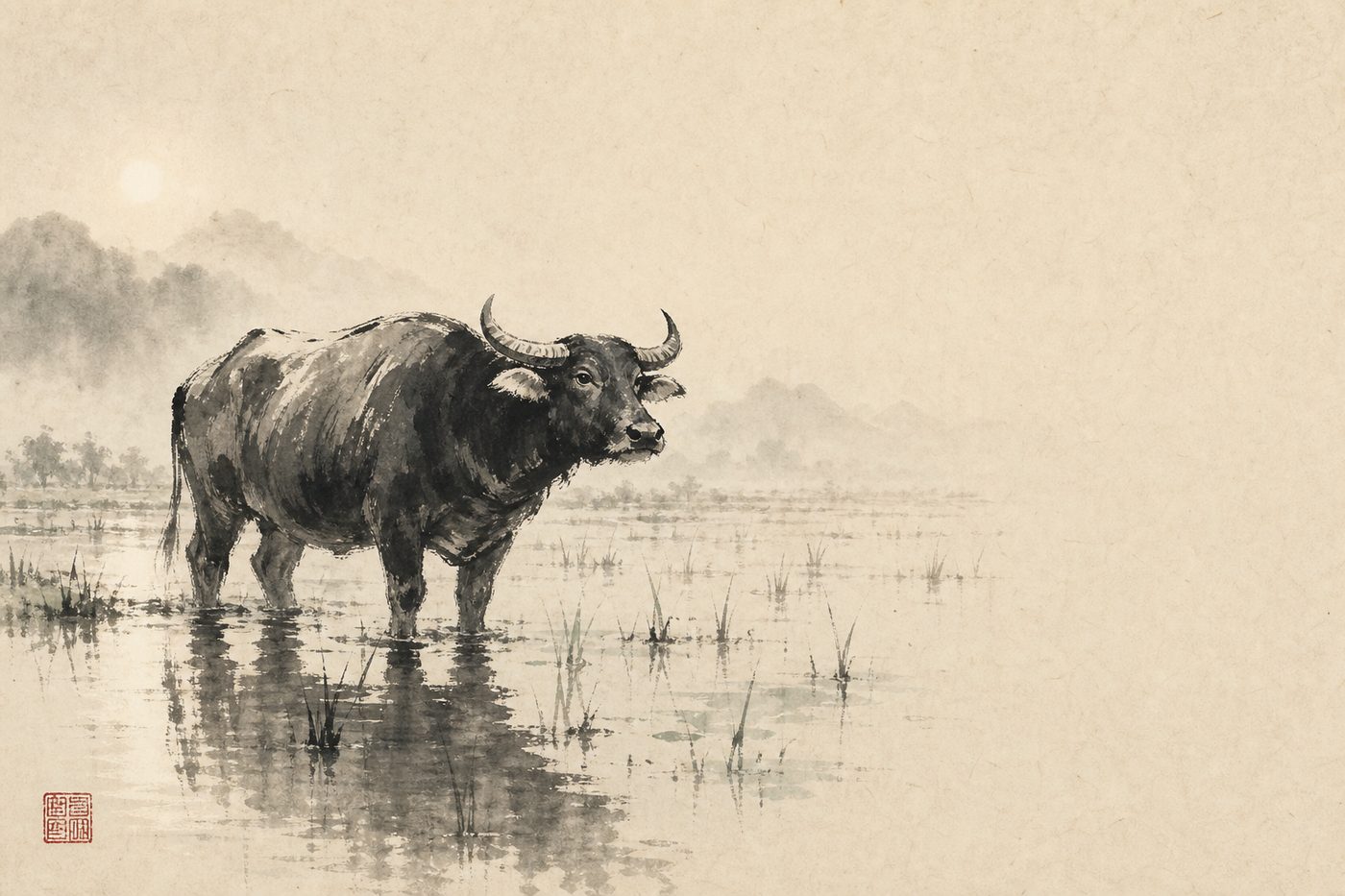
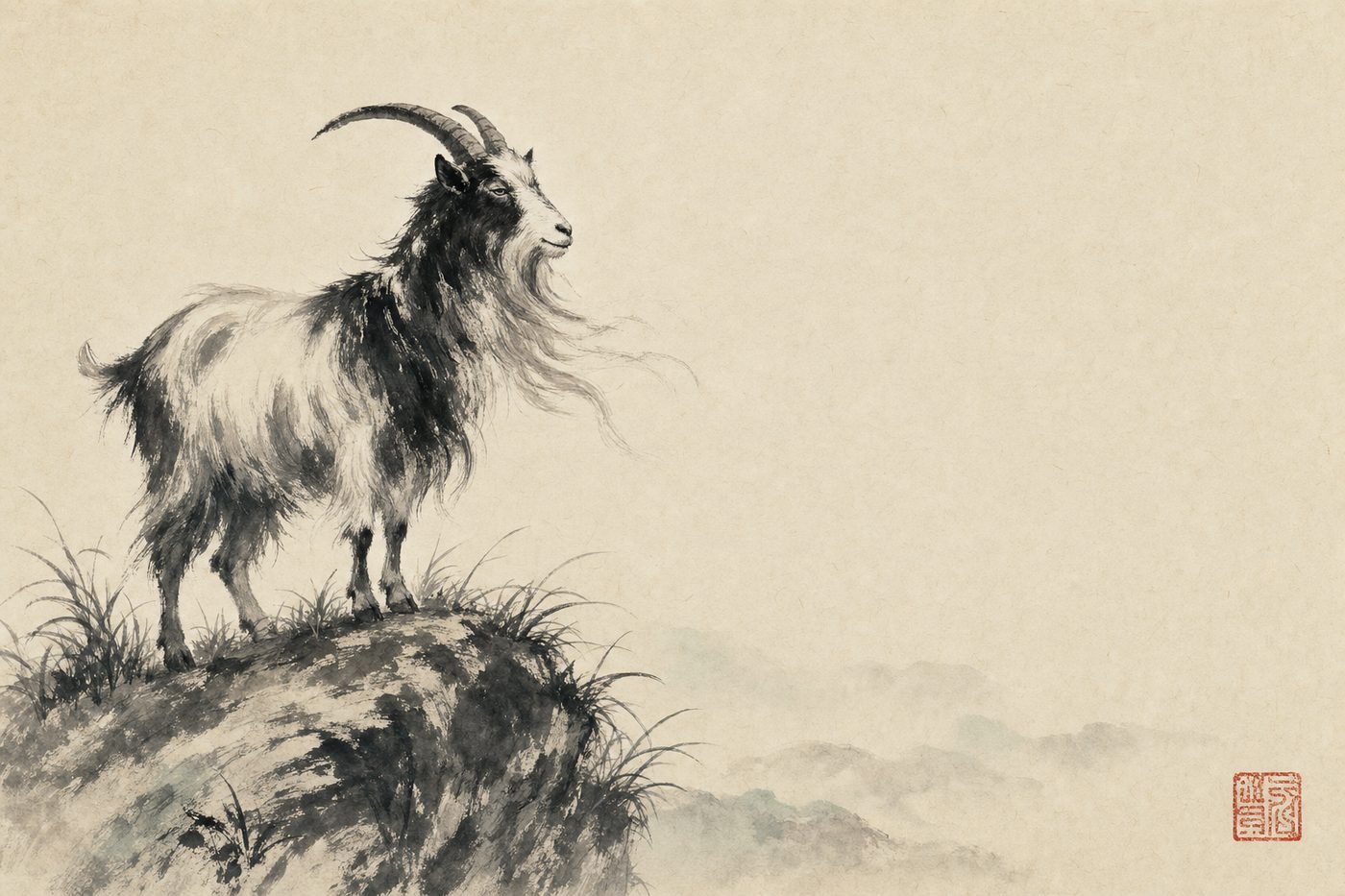
How the wheel reads this pair
Chinese zodiac verdicts are positions, not vibes. The Ox holds position 2 on the twelve-branch wheel (branch chǒu) and the Goat position 8 (branch wèi); their verdict follows from that geometry alone.
- Verdict
- Challenging
- Bond
- Liu chong · the six clashes
- Branches
- chǒu 丑 + wèi 未
- Fixed elements
- Earth + Earth
One honest footnote: the branch tables also list this pair under xing, the punishments, a third and murkier layer of the old system. Sources disagree about how much weight it carries, and most modern readings treat it as a caution rather than a verdict. We flag it because it is in the tables, not because it settles anything.
The Ox and the Goat, side by side
Love and romance
The attraction, when it strikes, is the oldest kind: each meets the life it never gives itself. To an Ox, whose idea of rest is a shorter shift, the Goat's world is a revelation, rooms that are actually comfortable, meals that are occasions, weekends with no agenda surviving contact with Saturday. To a Goat, who runs on security the way the Horse runs on horizons, the Ox is the most solid object on the wheel: a partner whose promises function as load-bearing walls.
The early months are usually lovely, because each is enchanted by the other's foreign country. The friction starts when the visitor is asked to immigrate. The Ox begins to read the Goat's comfort as softness, expenditure without output; the Goat begins to read the Ox's endurance as joylessness, a life audited down to its studs. The old matchmakers called this a mismatch of temperaments rather than a war, and that is accurate: nothing explodes here. Two people simply keep politely declining to want what the other one is offering.
Trust
Neither sign lies, so trust survives; what erodes is confidence in being understood. The Ox keeps its word with a completeness that borders on geology, and the Goat, to its credit, never doubts it. The Goat is loyal, warm, and constant in its affections, and the Ox, to its credit, knows that too. On the great questions of fidelity and permanence, this clash is oddly secure.
The corrosion is smaller and daily. The Goat needs reassurance delivered warmly and often, and the Ox considers its continued presence to be the reassurance; asking for it in words strikes the Ox as asking the bridge to announce, hourly, that it is holding. Meanwhile the Ox needs its effort acknowledged as the love language it is, and the Goat, fluent in comfort rather than labor, keeps thanking the Ox for everything except the thing. Two faithful people, each depositing devotion in an account the other never checks.
Communication
The Ox communicates in conclusions, delivered rarely and meant permanently. The Goat communicates in atmospheres, hints, aesthetics, the emotional temperature of a room, and expects a partner to read the weather. This is close to the worst possible pairing of dialects: the Goat broadcasts on a frequency the Ox does not own a receiver for, and the Ox's plain statements land on the Goat's ear as coldness even when their content is kind.
Conflict style compounds it. The Goat avoids confrontation past the point of usefulness, managing tension by rearranging everything around it; the Ox does not avoid confrontation so much as schedule it geologically, filing grievances in the famous permanent ledger until the pressure finds the fault line. The result is a household where nothing is ever said and everything is eventually meant. The single most useful habit this pair can buy is a standing, low-stakes talk, fifteen minutes, weekly, before anything is wrong, because neither sign will ever convene one during the storm.
Marriage and family
Run properly, the household is a genuinely good trade. The Ox builds and maintains: the income steady, the repairs done, the future funded. The Goat makes the built thing worth inhabiting: the home beautiful, the table generous, the children's world soft in the places childhood should be soft. Friends notice such houses feel both safe and warm, which is rarer than either quality alone, and is exactly the two signs' work product laid side by side.
The battles are budgetary and calendrical. To the Ox, the Goat's spending on comfort and beauty is decoration; to the Goat, it is infrastructure, as non-negotiable as the Ox's insurance premiums. Neither is wrong, and the marriage stabilizes the day both categories appear in the budget by name. The calendar fight is the mirror image: the Ox schedules work, the Goat schedules rest, and each treats the other's category as slack. One protected day of each, weekly, honored like a religious observance, settles more than any number of arguments about laziness or grimness.
Work and money
Professionally, distance improves them. In separate departments the trade works: the Ox is the cycle's builder, best at long, unglamorous execution, and the Goat is its designer, best at taste, care, and the human texture of a workplace. An operation with Ox structure and Goat finish ships things that are both sound and likable, and each partner genuinely respects the half they cannot do.
Adjacent desks are harder. The Ox reads the Goat's flexible hours and mood-driven process as unseriousness; the Goat reads the Ox's regime as a factory whistle. And one asymmetry needs naming: the Goat's classic weakness is outsourcing hard decisions to whoever is nearest and sturdiest, and an Ox will silently absorb that load, and silently invoice it, for years, in the ledger where Ox resentments compound. The fix is structural: the Goat keeps ownership of named decisions, and the Ox's help is requested, not ambient.
Where it breaks
The break, when it comes, is quiet and years in the making. The Ox's ledger fills: every absorbed decision, every comfort purchased from its overtime, every unthanked repair, logged in the permanent record with no late fees announced. The Goat's warmth, which needs acknowledgment to photosynthesize, slowly starves in the shade of a partner who shows love exclusively through labor and considers saying so to be redundant. Neither complains, for opposite reasons: the Ox because complaining is not endurance, the Goat because complaining is conflict.
One footnote belongs on this page rather than in fine print: the branch tables also list Ox and Goat in one of the old punishment (xing) groups, alongside the Dog, a second, murkier caution layered on the clash. Sources disagree about its weight, and most modern readings treat it as emphasis rather than a separate sentence: this pairing, more than most, cannot run on silence. Take that as the operational summary, because it is the one thing both the clash and the punishment tables agree on.
How to fix it
- 1
Fund both infrastructures. Comfort is a budget line, not a leak; so is the reserve. When the Goat's category and the Ox's category both have names and numbers, the spending fight loses its moral edge.
- 2
Translate the love once a week. The Ox says one warm thing out loud; the Goat thanks one specific piece of labor by name. Each is depositing in the other's actual account for a change.
- 3
Convene in fair weather. Fifteen minutes weekly, before anything is wrong. The Goat will never raise a live grievance and the Ox will never raise one early, so the meeting has to exist before the grievance does.
- 4
Return the decisions. The Goat owns its named choices, wobbles and all; the Ox helps when asked and not before. An Ox that absorbs everything invoices everything, eventually, at the worst possible moment.
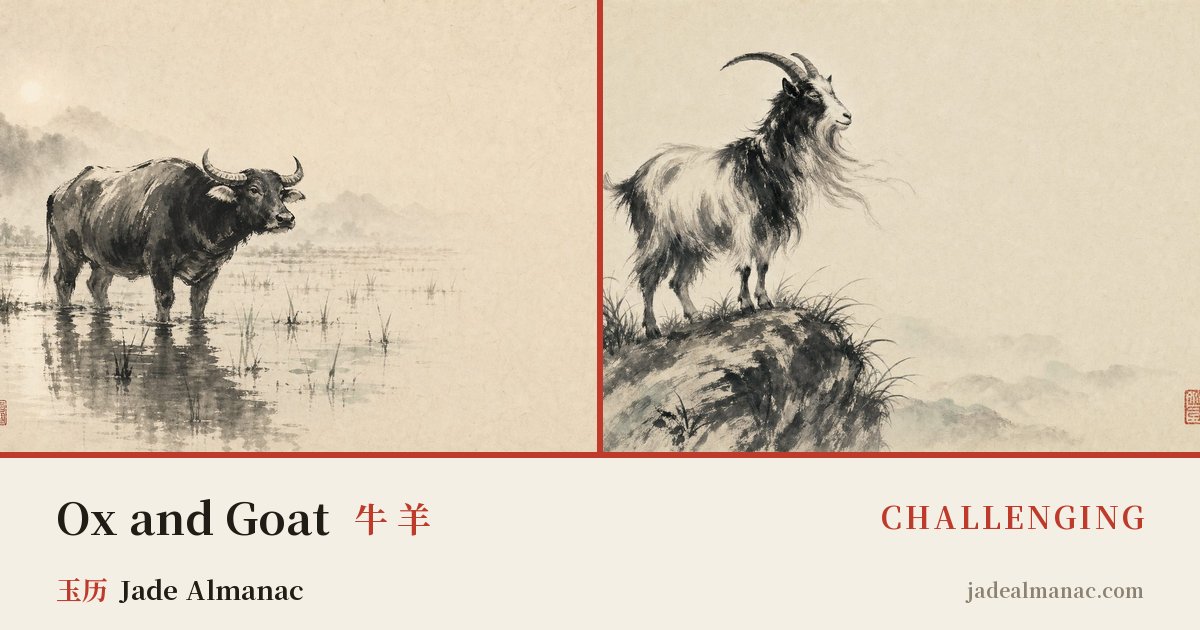
Share this pairing
The card carries both portraits and the verdict.
Questions people ask
Are Ox and Goat compatible in the Chinese zodiac?
This is one of the six clashes (liu chong). Ox and Goat sit directly opposite on the wheel, and tradition reads the opposition as endurance versus comfort, the plow opposite the pillow. It is a caution about mismatched priorities, not a prohibition, and it responds well to structure.
Why do Ox and Goat clash in the zodiac?
Position, not personality. The Ox holds position 2 on the twelve-branch wheel and the Goat position 8, exactly opposite, and all six opposite pairs are clashes. This pair also appears in one of the old punishment (xing) groups, alongside the Dog, whose two other pairings are covered at Ox and Dog and Goat and Dog, a second traditional caution most modern readings treat as emphasis rather than a separate verdict.
Can an Ox and Goat marriage work?
Yes, and the working ones are quietly enviable, safe and warm at once, the Ox building and the Goat making it worth inhabiting. The reliable requirements are a budget that names comfort as infrastructure, love translated out loud in both directions, and grievances aired weekly instead of archived.
Year of the Ox 牛
Personality, years, matches, and where the sign comes from.
Year of the Goat 羊
Personality, years, matches, and where the sign comes from.
← All 66 zodiac pairings, with verdicts
Signs turn over at Chinese New Year, not January 1 — a January or February birthday can belong to the previous animal. Check a birthday on the lunar calendar →
Sources & further reading
By Julian 祝君瑜 · verdict derived from the twelve-branch system, not assigned by hand · updated 2026-07-12