A question, answered the Chinese way

When will I get married?

The Chinese tradition has been asked this question for about a thousand years and has never once answered it with a date. What it answers with is a list. A bazi reader takes your birthday, finds the two places in the chart where marriage lives, and circles the years whose characters touch them. The first place is the spouse palace, which is the animal of your day pillar: the Ming compendium that every later manual leans on, the Sanming Tonghui, quotes the old rule that "the year is the ancestors, the month the parents and siblings, the day the spouse and the self, the hour the children." The second is the spouse star, which is an element: for a man, the element his day master overcomes ("what I overcome is Wealth, and the wife"); for a woman, the element that overcomes hers ("what overcomes me is the husband").

So "when" means: which years does the calendar bring that element, or a branch that combines with or clashes with your spouse palace, or the peach blossom star, which is a third thing and not as friendly as it sounds. Those are the marked years. A practitioner reads a year with two marks as a year the question is live, reads the decade around it for whether the chart is running with you or against you, and stops there. The finder below prints your marks for the next twelve years from the same tables our calculator uses; what they mean, and what they cannot mean, is the rest of the page.
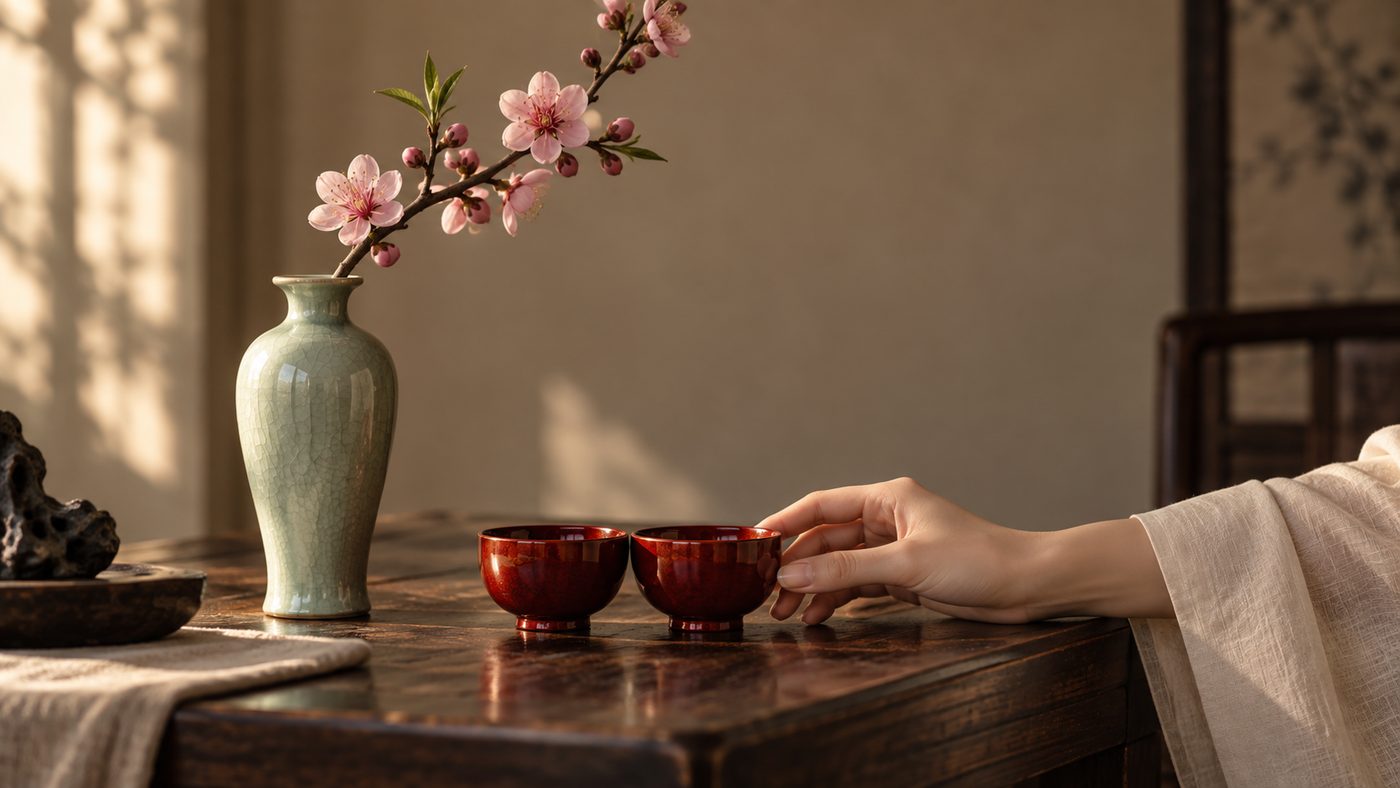
A branch of pink peach blossom in a celadon vase on a dark wooden table, two small red lacquer cups set side by side in front of it, and a hand resting at the table edge in soft window light.
Peach blossom, the star the internet calls the romance year, and the two cups of the wedding rite. Illustration.

Your marked years, from your birthday

The day pillar, the spouse star and the peach blossom branch come from the same tables as the calculator; the years are read by the Lichun rule a chart uses. Nothing you enter is stored.

Read as

Where the tradition looks: a palace and a star

Open the Sanming Tonghui, the sixteenth-century compilation that gathered up eight hundred years of chart-reading into one set of rules, and the first thing it does with your marriage is file it under real estate. Its chapter on the six relations, which means parents, siblings, spouse and children, assigns each of them an address in the four pillars: "the year is the ancestors' estate, the month the gate of parents and brothers, the day the wife and oneself, the hour the children." The day pillar is two characters. The stem on top is you, the day master. The branch underneath, the animal, is the spouse palace, and everything that happens to that branch in a given year is read as happening to the marriage.

The star is the other half, and it is an element rather than a place. The same chapter sets it out with a bureaucrat's tidiness: "what I overcome is Wealth, and the wife"; "for a woman the use is different: what I produce is the child, what overcomes me is the husband." So a man born under a Wood day master has an Earth spouse star, because Wood overcomes Earth; a woman born under Wood has a Metal one, because Metal overcomes Wood. (The chapter goes on to split the Wealth star into a proper wife and a concubine by polarity, which tells you what century it was compiled in and is not something the finder reproduces.) Any year whose stem, or whose branch's main element, is your spouse element is a spouse-star year: the thing the chart calls a partner has arrived in the calendar.

The peach blossom year, and what the book actually says about it

The third mark is the one everyone has heard of. A peach blossom year, taohua nian, is the year the internet promises you romance, and the promise has a real rule behind it. The Sanming Tonghui opens its chapter on the star with a line from the Han Huainanzi, "the sun rises from Fusang and sets in Xianchi," and explains that Xianchi, the pool the sun bathes in, is the star's proper name: it is the bathing station of the five elements, the second stop after birth in the twelve-stage life cycle, "the hour when all things are dim." The placement follows from that and is purely mechanical, which is why our calculator can print it without an opinion. Your day branch belongs to one of four groups of three animals, and each group has one peach blossom branch: Tiger, Horse and Dog get the Rabbit; Snake, Rooster and Ox get the Horse; Monkey, Rat and Dragon get the Rooster; Pig, Rabbit and Goat get the Rat. The branch relations page shows the derivation; the finder above just applies it.

Now the part the romance blogs leave out. The same chapter gives the star two other names, "the ruined god" and "the peach blossom curse," and it does not mean them kindly. In a strong chart, it says, the star makes for good looks, a taste for wine and company, money spent freely and a household scattered; in a weak one, worse. It closes with a sentence as flat as a court verdict: "Xianchi is not an auspicious star," and adds that women in particular should fear it. The tradition, in other words, read peach blossom as attention, and attention as a hazard. The modern reading, which is that a peach blossom year is a year people notice you, is fair as far as it goes. The book's reading is that being noticed is not the same as being married, and it had a point.

The three kinds of marked year

These are the marks the finder prints. Each is a lookup against your day pillar, and each comes from a named chapter; none of them moves a score, which is the same standing the calculator gives every year label.

Mark The rule Where it comes from What a reader takes from it
Spouse-palace year The year's branch combines with your day branch (the six combinations), or clashes with it (the six clashes), or is your day branch itself. Sanming Tonghui, On the Six Relations: the day is the spouse and the self. Something happens to the marriage. A combination is read as a joining, a clash as a disturbance, which can be a wedding as easily as a parting.
Spouse-star year The year's stem, or the main element hidden in its branch, is your spouse element: Wealth for a man, Influence for a woman. Sanming Tonghui, On the Six Relations: what I overcome is the wife; what overcomes me is the husband. The partner the chart describes is present in the year. Two spouse-star years in a row are read as a stretch, not an event.
Peach blossom year The year's branch is your peach blossom branch, fixed by your day branch's group of three. Sanming Tonghui, On Xianchi: the bathing station, "not an auspicious star." Attention. People notice you; the book warns that this is a hazard, the blogs promise it is a romance. Both are describing the same thing.

What the tradition can say, and what it cannot

It can say which years are marked, and it can say it for anyone with a birthday, which is more than the quizzes can. It can also rank them: a year that is both a spouse-star year and a spouse-palace year is the one a practitioner circles twice, and a marked year that falls inside a decade the chart rates as running with you is stronger than the same mark in a decade running against. That second half needs your month pillar and the solar terms, which is the calculator's job, and it is why the finder ends with a door to the full chart rather than a verdict.

What it cannot do is name the year. No honest reader of the eight characters will, because the marks describe a person's exposure to the question, not the answer. A spouse-palace year for someone happily married is read as a year the marriage is tested; for someone single it is a year the question comes up; for a twelve-year-old it is nothing. The same mark, three different lives. The system is old enough to know this about itself, which is why its own manual spends more words on what the peach blossom does to your character than on whom it brings to your door. If you want the other half of the question, the who, that is a different chapter, and in our written reading it is the third one, called "Who suits you": the spouse star's element and polarity and what sits in the palace, read as a description of a person rather than a date on a calendar.

Questions people ask

Can Chinese astrology predict when I will get married?

It can mark years; it cannot name one. A bazi reading looks at two places in your chart, the day pillar (the spouse palace, in the words of the Sanming Tonghui) and the spouse star (the Wealth element for a man, the Influence element for a woman), and it circles the years whose stem or branch touches either of them, plus the peach blossom year, which is a separate star. A practitioner will tell you that a year with two of those marks is a year the question is live, and that is the whole of the prediction. Nobody reading the eight characters honestly will give you a month.

What is the marriage palace in bazi?

The branch of your day pillar, the animal under the character that is you. The Sanming Tonghui, the Ming compendium every later manual leans on, quotes the older rule: the year is your ancestors, the month your parents and siblings, the day your spouse and yourself, the hour your children. So the day branch is read as the spouse's seat, and a year whose branch combines with it, clashes with it, or sits on it is a year that touches the marriage. Our finder prints your day branch and marks those years; the full chart is on the calculator.

What is a peach blossom year?

A year whose branch lands on your peach blossom star, and the star is placed mechanically: your day branch belongs to one of four groups (Monkey-Rat-Dragon, Tiger-Horse-Dog, Snake-Rooster-Ox, Pig-Rabbit-Goat) and each group has one peach blossom branch (Rooster, Rabbit, Horse and Rat respectively). The internet calls it the romance year. The Sanming Tonghui, which gives the rule, calls the star by two other names, the ruined god and the peach blossom curse, and closes its chapter with the line that it is not an auspicious star. Read it as attention, not as a wedding.

Will I get married this year?

Run the finder with your birthday and look at the first row. If the year carries no mark, the tradition has nothing to say about it either way. If it carries the peach blossom or touches the spouse palace or the spouse star, the tradition says the question is live this year, which is not the same as a yes. The decade you are in (the luck pillar) matters as much as the year, and that needs your month pillar, so the calculator does that part.

Can it tell me whom I will marry?

Not a name, but a type, and that is a different question from this page's. The spouse star's element and its polarity, and what sits in the spouse palace, are what a reader uses to describe the person the chart is disposed toward, which is the third chapter of our written reading, "Who suits you." This page only does the calendar.

Keep going

  • The bazi calculator casts the full chart: the decade luck the marks are read against, the spouse star named, the eighty-year life chart.
  • Branch relations is where the combinations, clashes and the peach blossom star are derived, with the tables printed in full.
  • Chinese zodiac compatibility answers the two-person question, the one the matchmakers asked: do these two signs get along.
  • Yue Lao is the god people actually ask this question of, with a red thread and a ledger he refuses to open.

Sources

The finder's tables are the calculator's own, exported at build: the sixty pairs with their elements, the peach blossom map, the combinations and clashes, and the spouse-star map, which the build checks against the ten-god function. The rules are from the chapters below.

Stay in the loop.

Chinese mythology, the zodiac, and the meaning behind names and symbols, rooted in the classics and read back to you. No spam. Unsubscribe anytime.