Feng Shui Bedroom: Your Best Bed Direction and the Rules That Matter
Which way should your bed face? Feng shui's answer is personal: point the head of your bed toward one of your four lucky directions, which come from your birth year, not from a one-size-fits-all rule. Before any compass work, though, three practical rules do most of the good: a solid wall behind your headboard, the door in view but not in line with you, and nothing heavy hanging overhead. Below, the full chart, and an honest sorting of which rules are actually old.
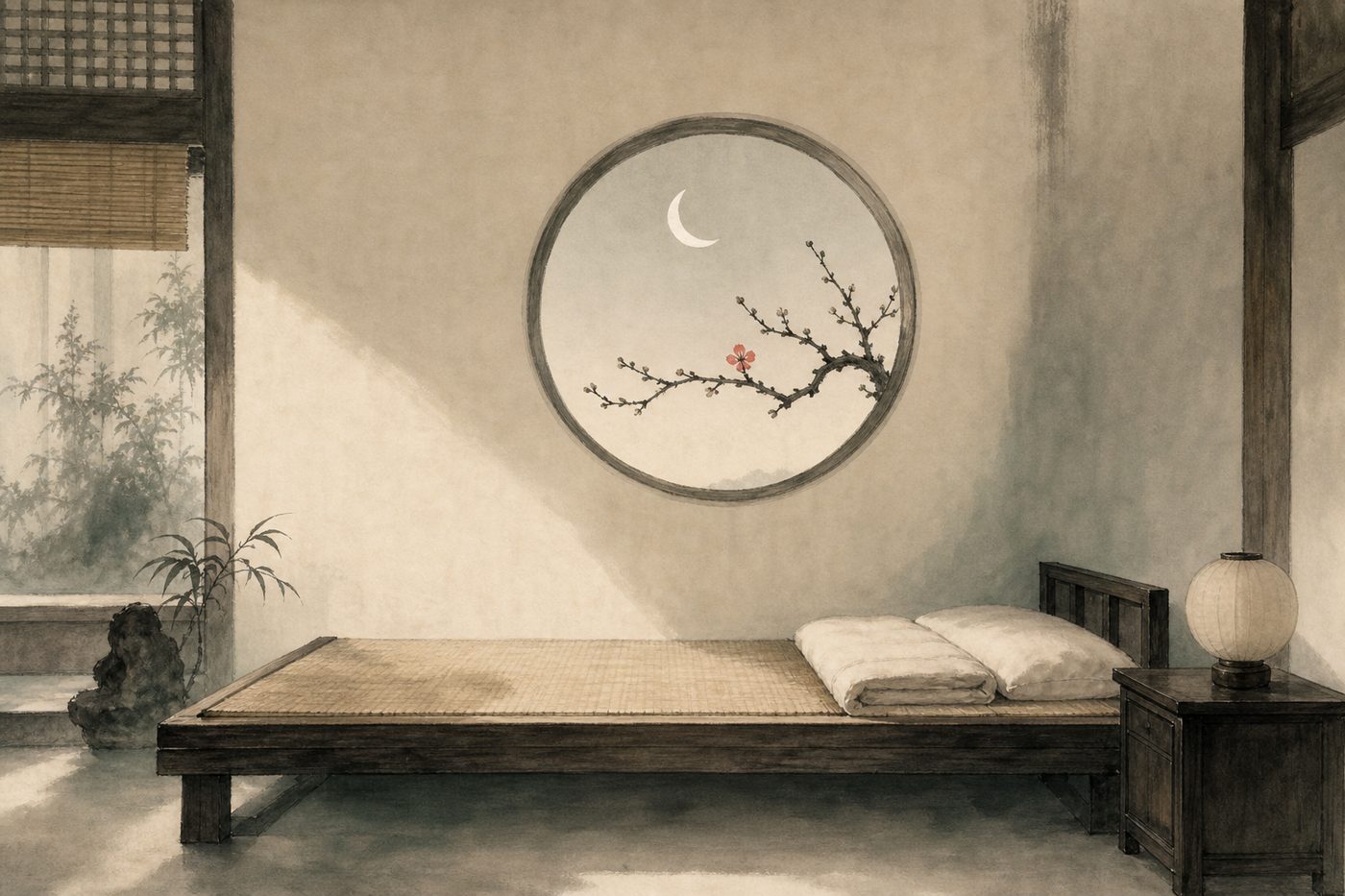
The three bed placement rules that matter most
Feng shui has a reputation for complication, and parts of it deserve one. The bedroom, happily, is not one of those parts. Across schools, teachers, and centuries of accumulated opinion, three rules do most of the work, and none of them requires a compass.
Put a solid wall behind your headboard. Not a window, not a flimsy partition, and ideally not the wall the door swings from: a proper wall. The traditional image is a mountain at your back, the same instinct that makes generals camp against hillsides and makes the rest of us pick the restaurant seat facing the room. You are going to be unconscious in this spot for a third of your life. The tradition asks that something dependable be behind you while you are.
Keep the door in view, but not in line with your body. From the pillow you should be able to see who is coming in without craning, yet the bed should not sit in the direct path between door and wall like a boat moored in a shipping lane. The explanation usually offered for the second half is blunt: the dead were traditionally carried out feet-first through the door, and nobody wanted the preview. Modern American manuals call the correct arrangement the commanding position, which sounds better in a furniture catalog.
Nothing heavy overhead. No exposed beam crossing the bed, no massive shelf, no chandelier hanging over your chest like an inverted exclamation mark. The old worry was pressure on the sleeper's qi (气), the breath or life-current of a place; the newer worry is that sleeping under a beam feels faintly oppressive even to people who would never use the word qi. Both parties end up moving the bed.
Notice what these three have in common: every one of them is also just sound sense about feeling secure in a room. That overlap is not an accident, and it is worth keeping in mind when the compass work below starts assigning you directions. The practical layer comes first. The personal layer is where it gets interesting.
Find your best bed direction
Your kua number comes from your birth year and sex, with a calendar wrinkle in early February. The fastest way to get it right is our calculator; then find your row below.
| Kua | Trigram | Group | Best (Sheng Qi) | Health (Tian Yi) | Harmony (Yan Nian) | Steady (Fu Wei) | Avoid (Jue Ming) |
|---|---|---|---|---|---|---|---|
| 1 | Kan ☵ | East | Southeast | East | South | North | Southwest |
| 2 | Kun ☷ | West | Northeast | West | Northwest | Southwest | North |
| 3 | Zhen ☳ | East | South | North | Southeast | East | West |
| 4 | Xun ☴ | East | North | South | East | Southeast | Northeast |
| 6 | Qian ☰ | West | West | Northeast | Southwest | Northwest | South |
| 7 | Dui ☱ | West | Northwest | Southwest | Northeast | West | East |
| 8 | Gen ☶ | West | Southwest | Northwest | West | Northeast | Southeast |
| 9 | Li ☲ | East | East | Southeast | North | South | Northwest |
Point the head of the bed (where your head rests) toward a favorable direction. Kua 5 does not appear: the traditional formula reassigns it, 2 for men and 8 for women, which the calculator handles.
Where your lucky directions come from
The system behind the chart above is called Eight Mansions, and it runs on a piece of arithmetic you can do from a birthday. Your birth year reduces to a single digit called your kua number (from gua 卦, a trigram, one of the eight three-line figures of the Book of Changes). Each kua corresponds to one trigram, and the trigrams were dealt out around the compass long ago: the arrangement feng shui uses is recorded in the Shuo Gua, the Book of Changes commentary that seats each trigram in its direction.
From your own trigram, the system generates eight verdicts, one per compass point: four kind, four unkind. The kind ones are Sheng Qi (vitality, the best), Tian Yi (the Heavenly Doctor, guardian of health), Yan Nian (longevity, and by extension harmonious relationships), and Fu Wei (stability, a gentle home base). The unkind ones escalate from Huo Hai (mishaps, the minor-annoyances direction) through Liu Sha (Six Killings) and Wu Gui (Five Ghosts) to Jue Ming, Total Loss. Chinese metaphysics never went in for euphemism. You are meant to know exactly where you stand, or rather where you should avoid standing.
The eight kua numbers sort into two families: the East group (kua 1, 3, 4, and 9) and the West group (kua 2, 6, 7, and 8). Everyone in a group shares the same four lucky directions, which is why the chart has the tidy, half-and-half look of a well-organized dinner party. For the bed, tradition says to point the crown of your head toward a favorable direction while you sleep. Practitioners usually give the bed to Yan Nian, whose portfolio covers rest and relationships, and save Sheng Qi, the strongest, for the desk and the front door; Tian Yi is the sensible pick when health is on your mind.
Two honest wrinkles, briefly. The formula differs for men and women, so siblings born the same year can land in different groups. And the traditional year turns at the spring boundary in early February, not on January 1, so a late-January birthday belongs to the previous year's count. If you'd rather not do calendar arithmetic before bed, our kua number calculator handles both wrinkles from a birthday and shows your full compass on the spot. It is the same birth-year arithmetic, incidentally, that decides your Chinese zodiac sign; the traditional calendar files everything about you under the year you were born.
Which rules are actually old (an honest sorting)
Here is something the average feng shui article will not tell you, mostly because the average feng shui article has not read the classics it invokes.
The key classical text of the Eight Mansions school is the Ba Zhai Ming Jing, the "Bright Mirror of the Eight Mansions," a Qing-dynasty manual whose surviving edition carries a preface dated 1790 and a loose attribution to a Daoist known as Ruo Guan. Read it, and a surprise emerges: the book talks about doors and gates, page after page, and has remarkably little to say about what happens inside a room. Its concern is which way your dwelling sits and where its mouth opens. Aiming your bed at a personal lucky direction is a modern extension of the method, popularized by twentieth-century practitioners who carried the old door-compass indoors. The formula is genuinely old; the bedroom application is younger than the paperback.
The tradition's origin stories are cheerfully tangled too. One tale holds that the method descends from Yi Xing, a brilliant Tang-dynasty astronomer-monk supposedly ordered by the throne to write a false feng shui manual, to be leaked to the empire's rivals so their fortunes would quietly sour. The book, if it existed, is lost, so nobody can check whether it described this system or some other one, and the dates sit centuries apart in any case. Scholars mostly shrug. It remains one of history's better excuses for a discipline: even its detractors granted it was worth counterfeiting.
The West met all this in 1873, when Ernest Eitel, a German missionary in Hong Kong, published the first systematic English account, with solemn chapter titles like "The Breath of Nature." Eitel found the whole apparatus exasperating and said so at length, then grudgingly allowed that a grain of truth might be hiding in it somewhere. His Victorian readers took the dismissal and skipped the grain.
Hong Kong, for its part, never asked the West's opinion. The city's skyline is punctured by enormous rectangular holes called dragon gates, kept open so the dragons of the hills can pass to the water; when I.M. Pei's sharp-angled Bank of China Tower went up without a geomancer's blessing, neighboring firms installed countermeasures, and the tower's edges were blamed for years of local misfortune, a saga the design journal 99% Invisible has chronicled with a straight face. By one estimate the territory supports as many professional feng shui practitioners as accountants. The rules may be a layered inheritance of old compass work, newer conventions, and outright improvisation, but nobody there is treating them as quaint.
So when you meet a bedroom rule, it helps to ask which layer it comes from. Trigram directions: ancient, from the Book of Changes commentaries. The kua formula and its door-compass: classical, codified by the Qing. Bed direction: modern, an indoor extension of the door system. Mirrors, beams, and the door sight-line: practitioner convention, the accumulated house-lore of centuries of consultants and grandmothers, never canonized but never ignored. None of these layers is a fraud. They are simply different ages, and a guide that pretends otherwise is selling you a flatter story than the real one.
When your bedroom won't cooperate
Now for the part most guides skip: what to do when your actual bedroom, with its radiator, its one sensible wall, and its landlord, declines to participate.
Take heart from the tradition itself. Feng shui was never the art of building the perfect room from scratch; it was the art of reading the site you were stuck with and coaxing the best from it. A farmhouse could not be rotated. A city apartment cannot either. The discipline's entire history is workarounds.
So work in priority order. The solid wall behind the headboard comes first; if the room permits only one virtue, take that one. The door sight-line comes second, and it can often be fixed by shifting the bed a foot or angling a wardrobe rather than rebuilding your life. Overhead weight comes third; failing all else, practitioners drape fabric below a beam and declare the pressure softened, which tells you something about how negotiable these rules have always been. The compass direction comes last. If your four lucky directions are all architecturally impossible, choose the least of the unlucky ones (the chart above ranks them) and move on with your week.
Couples who straddle the East and West groups face the classic negotiation; the FAQ below covers the traditional settlements. Renters can do nearly everything that matters, since walls, sight-lines, and beams are about placement, not renovation.
And if you can honor none of it? Then you are merely back where every reader of Eitel's generation started, sleeping in an unaudited room, as billions do nightly with no reported surge in Total Loss. The tradition's quiet gift is attention. It asks you to look, really look, at the room where you spend a third of your existence: at what stands behind your head, what hangs above it, what you would see if the door opened at midnight. Look that carefully at any room and you will improve it. Your grandmother, whichever tradition she kept, would recognize the exercise.
Find your own compass in a few seconds with the kua number calculator, then come back and argue with the chart.
Questions people ask
What is the best feng shui direction for a bed?
There is no single best direction; it depends on you. In the Eight Mansions school, your birth year gives you a kua number, and that number gives you four favorable directions and four unfavorable ones. Someone born in 1990 and someone born in 1991 can have opposite answers. Point the head of the bed (where your head rests) toward one of your four favorable directions. Practitioners traditionally give the bed to Yan Nian, the longevity-and-relationships direction, with Tian Yi (health) and Fu Wei (calm) as backups. Our kua calculator works it out from your birthday in a few seconds.
What if I can't move my bed to face my lucky direction?
Then don't lose sleep over it, which would rather defeat the purpose. Practitioners themselves rank the rules, and the compass comes last. A solid wall behind the headboard, a clear view of the door without lying in its direct path, and no beam or heavy shelf overhead all matter more in practice. If the room only allows one improvement, take the wall. Feng shui grew up as the art of making the best of the site you have, not the site you wish you had.
Is it bad feng shui to have a mirror facing the bed?
The mirror rule is a practitioner convention rather than something from the classical texts, which concerned themselves with doors and orientation. The traditional explanations vary: a mirror is said to bounce your own qi back at you, or to startle the soul returning from dreams. The unglamorous version is that catching movement in a dark mirror at 3 a.m. genuinely does startle people. If your mirror faces the bed and you sleep soundly, no classical author condemns you; if you sleep badly, turning it is free.
What if my partner and I have different kua numbers?
This is one of the most common situations in the system, since the formula differs for men and women and half of all pairings mix an East-group person with a West-group one. Practitioners usually suggest favoring the direction of whoever earns the household's keep, or whoever is in poorer health, which is as much marriage counseling as metaphysics. A gentler reading: pick the direction that suits one of you, give the other the solid wall and the view of the door, and share the blessings unevenly but amicably.
Does bed direction really matter in feng shui?
Honestly told: the oldest layer of the tradition cared about doors, gates, and where a house sits, and the classical Eight Mansions manual barely mentions the inside of rooms. Aiming beds at personal lucky directions is a modern extension of that older compass system. That does not make it meaningless; it makes it recent. What the whole tradition consistently rewards is attention: a bed you feel secure in, a room with nothing looming over you, a door you can see. Those habits are old, sensible, and free.
Sources
- • Shuo Gua (Book of Changes commentary; assigns the trigrams their directions)
- • Ernest J. Eitel, Feng-shui: or, The Rudiments of Natural Science in China (1873), full text
- • 99% Invisible, Here Be Dragons: How Feng Shui Shapes the Skyline of Hong Kong
- • Feng Shui Today (Classical Corner), on the Ba Zhai Ming Jing and the Eight Mansions method
Get your kua number and full direction chart
Enter your birthday and we work out your kua, your group, and all eight directions, with the February boundary handled for you. Open the calculator →