Ox and Horse Compatibility: The Furrow and the Gallop
Liu hai — one of the six harms, the tradition’s slow-friction pairing.
Ox and Horse is one of the six pairings the branch system calls the harms, liu hai, the tradition's quieter caution, and it is the one the old matchmakers' rhyme opens with: from of old, the white horse fears the black ox. The mechanism deserves spelling out, because these two are not opposites. Each is the sworn ally of the other's opposite: the Horse is the secret friend of the Goat, the Ox's clash, and the Ox is the secret friend of the Rat, the Horse's. What the tables flag is not a war but a friction of clocks, the wheel's most patient worker sharing a harness with its fastest, and the rhyme's word is exact. The Horse does not hate the Ox. It fears it, the way open ground fears the fence.
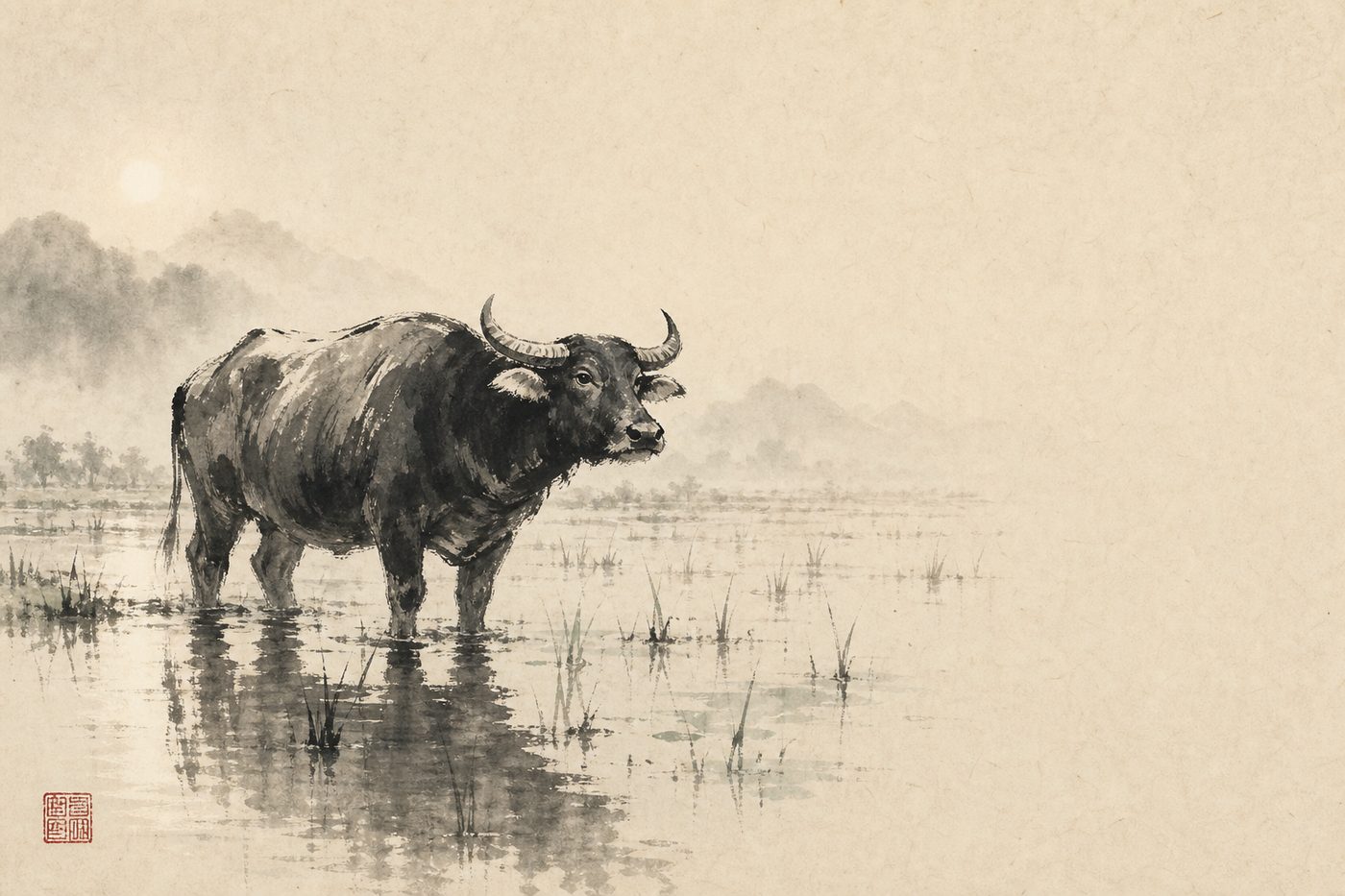
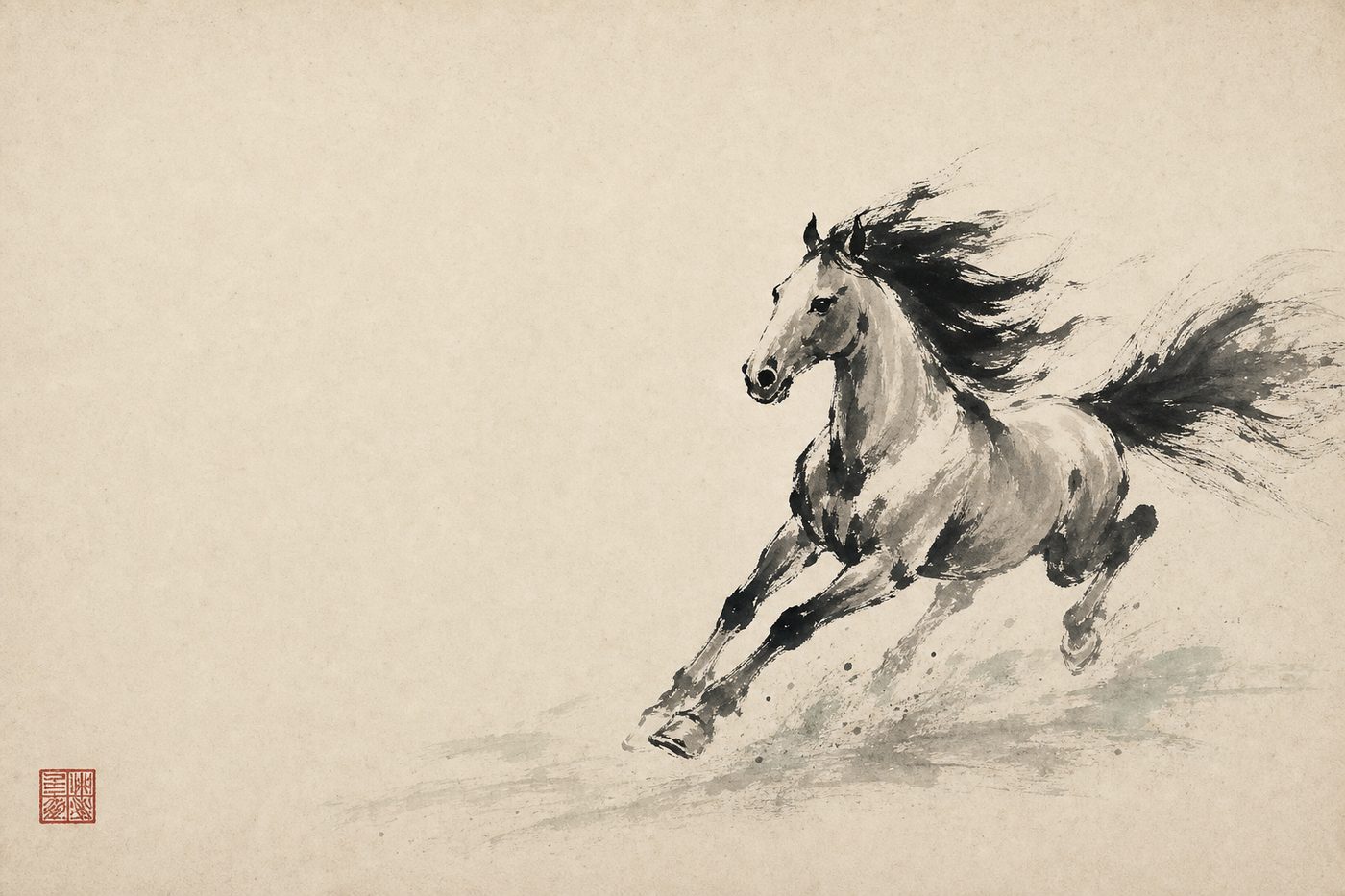
How the wheel reads this pair
Chinese zodiac verdicts are positions, not vibes. The Ox holds position 2 on the twelve-branch wheel (branch chǒu) and the Horse position 7 (branch wǔ); their verdict follows from that geometry alone.
- Verdict
- Challenging
- Bond
- Liu hai · the six harms
- Branches
- chǒu 丑 + wǔ 午
- Fixed elements
- Earth + Fire
The Ox and the Horse, side by side
Love and romance
The attraction is two engines admiring each other across an impossible gearbox. The Horse, midway through a life of running, meets in the Ox the thing it has never had and secretly suspects it needs: a base that does not move, promises that function as load-bearing walls, a devotion that will be in the same place in thirty years. The Ox, whose days are long straight furrows, meets in the Horse everything the furrow excludes, speed, weather, noise, the sudden Tuesday adventure, a creature so alive it makes the Ox's own strength feel like sleep. Each falls for the other's engine, honestly and completely.
The friction begins when the engines are asked to share a road. Both of these signs are workers, which outsiders assume should bond them, but they work in irreconcilable rhythms: the Ox in decades, straight, unhurried, never once stopping, and the Horse in sprints, brilliant, total, and finished, followed by the next horizon. To the Ox, the Horse's bursts read as unseriousness, magnificent starts abandoned at the first far hill; to the Horse, the Ox's pace reads as the slow construction of a corral, one immovable habit at a time. Neither is wrong about the other's clock. They are wrong to keep reading it as a character flaw.
Trust
Both signs are honest to the bone, and the trust problem still arrives, because it is not about lying; it is about drafts. A Horse thinks aloud, at announcement volume, and half of what it declares on Tuesday was never a plan, only momentum passing through language; by Thursday the Horse has genuinely forgotten the scheme it proposed. The Ox forgets nothing and files everything, and every abandoned draft goes into the permanent ledger as a broken commitment. Within a few years the Ox's private file reads like a fraud case, assembled entirely from sentences the Horse never meant as promises, and the Ox begins to treat its partner's word, the thing a Horse keeps cleanest, as unreliable, which the Horse can feel from across the room.
The reverse current is just as corrosive. The Ox speaks rarely and in conclusions, positions announced only after the concrete has set, and to the Horse each pronouncement lands as an ambush, a decision it never got to gallop around before the fences went up. The Horse starts hearing the Ox's stillness as siege architecture; the Ox starts hearing the Horse's speed as flight from accountability. The repairs are two labels, applied out loud. The Horse marks its drafts as drafts, this is thinking, not promising, and marks its true commitments explicitly, so the ledger has something real to hold. The Ox announces its positions while they are still wet, so the Horse meets a proposal rather than a wall.
Communication
The formats could hardly be less compatible. The Horse processes by talking and moving, decisions made mid-stride and revised mid-sentence; the Ox processes in silence and delivers verdicts, rarely, permanently. A conversation between them is a cavalry charge meeting a stone gatepost: one party circles at speed, generating options aloud, while the other stands entirely still and says one sentence that ends the discussion, or would, if the Horse recognized endings. Each finds the other's method almost physically stressful, the Ox exhausted by the churn, the Horse suffocated by the stillness.
The one advantage is that neither hints. Both signs say what they mean, and the household is spared the archaeology that indirect pairings require; the work here is tempo, not translation. The arrangement that functions gives each format its jurisdiction: big decisions get the Ox's clock, a stated question, days of silence, a real verdict, and the Horse learns that the silence is manufacturing, not stonewalling. Daily logistics get the Horse's clock, decided in the doorway at speed, and the Ox learns that not everything deserves a furrow. What neither gets to do is impose its clock on the other's jurisdiction, because a hurried Ox delivers its worst judgment and a stalled Horse delivers its worst self.
Marriage and family
The household war is the calendar, and it is fought over one word, routine. To an Ox, routine is the love language itself: the same reliable Tuesdays, the maintenance done in season, a life whose very repetition is the proof of devotion. To a Horse, each fixed point is a fence post, and a full calendar of them, however lovingly planted, encloses a pasture. The Horse does not want to leave, that is the tragedy of the rhyme's fear; it wants to know it could, and an Ox, hearing that distinction, files it under flight risk and quietly plants another post.
The treaty that works is the open gate, formalized. The Horse gets named, funded, unquestioned freedoms, the trip, the project, the standing wild Saturday, written into the family calendar with the same seriousness as the mortgage, because for a Horse the visible gate is what makes the pasture home. The Ox gets its own guarantee in exchange: the anchor days, the rituals that do not move, honored by the Horse at full presence, not as parole but as the other half of the same bargain. Money runs the same split, a fixed reserve the Horse never touches and a fixed freedom fund the Ox never audits. Fences with gates hold horses that no fence could.
Work and money
Set at the right distance, the professional pairing is genuinely formidable, because between them they own both halves of time. The Horse is the launch, the campaign, the emergency, everything that must happen fast and first; the Ox is the institution, the decade of execution that turns the Horse's beachhead into territory held. Firms that sequence them, Horse opens, Ox consolidates, get the rarest combination in business, speed that compounds. The Great Race itself is the case study the tradition would cite: the sprinter and the plodder both finished ahead of the field, by opposite methods.
Adjacent desks need the marriage's treaties in office form. The Horse's mid-course pivots read to the Ox as breach; the Ox's fixed process reads to the Horse as a speed limit posted on open ground. The working structure gives the Horse the frontier portfolio, new markets, crises, anything unscripted, and the Ox the core, operations, quality, the long middle, with handoffs at named checkpoints and neither empowered to redesign the other's territory. One clause matters above the rest: the Ox states its objections before the Horse is at full gallop, because a wall discovered at speed injures both parties, and an Ox's warning, delivered early, is the best risk instrument a Horse will ever have.
Where it breaks
The terminal pattern is the fear the rhyme names, fully grown. The Ox, wounded by years of abandoned drafts and absent Tuesdays, does what Oxen do with pain: it builds, more structure, more expectations, more posts, each one reasonable, each one logged, until the marriage is a magnificently maintained enclosure. The Horse, feeling the perimeter close, does what Horses do: it ranges, later hours, further projects, plans shared after the fact, each departure confirming the Ox's case and justifying the next post. Neither is malicious. The Ox is loving in fence; the Horse is surviving in distance; and the two vocabularies have no word in common.
The endings differ by nature. The Horse's is fast and total, the bolt, one morning the pasture is simply empty, and Oxen, who conclude slowly, are the wheel's worst-prepared sign for a sudden ending. The Ox's is slow and total, the conclusion, and a concluded Ox cannot be reopened by anything, including the full charm of a returning Horse. The couples who avoid both endings, and they exist in numbers the rhyme never counted, all describe the same architecture: drafts labeled, verdicts announced wet, the gate written visibly into the calendar, and each partner's clock honored in its own jurisdiction. The white horse stops fearing the black ox on the day the ox builds the gate into the fence, and not one day before.
How to fix it
- 1
Label the drafts. The Horse marks thinking aloud as thinking, and marks true promises explicitly. The Ox's ledger holds only the labeled commitments, and holds them without mercy, which is now fair.
- 2
Announce positions while they are wet. The Ox raises its objection before the concrete sets and before the Horse is at full gallop. A wall discovered at speed injures both parties every time.
- 3
Write the gate into the calendar. Named, funded, unquestioned freedoms for the Horse, and immovable anchor days honored at full presence in return. The visible gate is what makes the pasture a home.
- 4
Give each clock a jurisdiction. Big decisions run on the Ox's tempo, question first, verdict later; daily logistics run on the Horse's. Neither clock gets imposed on the other's territory, ever.
Share this pairing
The card carries both portraits and the verdict.
Questions people ask
Are Ox and Horse compatible in the Chinese zodiac?
This is one of the six harms (liu hai), the tradition's quieter caution, and the one the old matchmakers' rhyme opens with, from of old, the white horse fears the black ox. It flags a friction of tempos rather than a war, the wheel's most patient sign harnessed to its fastest, and structured couples do beat it.
Why are Ox and Horse a harm pairing?
Position, as always. Each harm pair joins two signs that are each the secret friend of the other's clash. The Horse is the sworn ally of the Goat, which sits directly opposite the Ox, and the Ox is the sworn ally of the Rat, which sits directly opposite the Horse. The tradition reads that geometry as built-in slow friction, quieter than a clash but real.
Can an Ox and Horse relationship work?
Yes, with treaties about time. The working couples label the Horse's thinking aloud as drafts rather than promises, have the Ox announce positions before they harden, write the Horse's freedoms visibly into the calendar alongside the Ox's immovable rituals, and let big decisions run slow while daily ones run fast.
Year of the Ox 牛
Personality, years, matches, and where the sign comes from.
Year of the Horse 马
Personality, years, matches, and where the sign comes from.
← All 66 zodiac pairings, with verdicts
Signs turn over at Chinese New Year, not January 1 — a January or February birthday can belong to the previous animal. Check a birthday on the lunar calendar →
Sources & further reading
By Julian 祝君瑜 · verdict derived from the twelve-branch system, not assigned by hand · updated 2026-07-15